Events

First torrential summer rain of 2009

On a clear day on the 21st of June, 2009, the sounds of distant thunder made their way into the valley in which the city of Medias, Romania, lies. I checked the sky but not a dark cloud was in sight. In spite of that, the wind began to quicken, and the ruffling of the leaves gave evidence of the approaching rain. Soon, dark clouds appeared over the horizon, and within a quarter of an hour, filled the sky. Peals of thunder punctuated every passing minute. The wind began to blow the dust from the pavement right into the eyes of passersby. People hurried home, shielding their faces.

In another quarter of an hour, the rain started to come down, suddenly. It rained in buckets, with large, thick, heavy drops that hit with a thud and splashed heavily all around. It only lasted another quarter of an hour or so, and it stopped as quickly as it started, but everything was soaking wet. The thick cover of dark clouds slowly parted, and the evening sun lit up the terracotta roof tiles in a golden-orange hue.

I’ve witnessed many rains of all kinds in my time, in temperate and tropical regions, but this was one of the few that I noticed more than the others. I’m not sure why — perhaps because I’d been outside, cleaning up the yard. In the past, I tended to slide in and out of my car and into air conditioned places (work, home), where I was seldom in contact with nature. Now that I’m spending more time at home, and in the yard, I’ve slowed down to where I can sense things a little more. I feel a little of my boyish wonder coming back, and that’s nice; I thought I’d lost it.

A quick video clip recorded while the rain was falling is up in my SmugMug galleries. You can watch it there, or below, if you happen to be reading this on my site (embedded videos don’t appear in the site feed, sorry, nothing I can do about it yet).

http://blip.tv/file/3046222

See this video on blip.tv or at SmugMug.

Standard
Places

In the garden – video

This morning, I took my trusty Olympus C-770UZ into our garden here in Romania and shot some video footage in super macro mode. I love the bokeh I get that way, and how close I can get to things.

I found an iridescent beetle sunning itself on some parsley leaves, a butterfly resting on some spinach leaves, two beetles getting it on, a bee collecting pollen on a squash flower, ants drinking nectar on a raspberry blossom, and more.

See the video on SmugMug, Vimeo or YouTube.

Standard
Lists

Condensed Knowledge – June 21, 2009

This is a summary of articles I read and found interesting during this past week. The list is shared from among my feed subscriptions:

Standard
Thoughts

Googling from different countries

I was watching this video on the Google Webmaster Central Channel, where Matt Cutts answers a question about the impact of server location on Google’s rankings, and he touched on an important point, which I hadn’t noticed until I spent a few months in Romania. In the video, he says that Google will return different search results based on which Google site you visit. For example, if you go to Google.com and type in “bank”, you’ll get different search results than if you go to Google.com.au and type in “bank”.

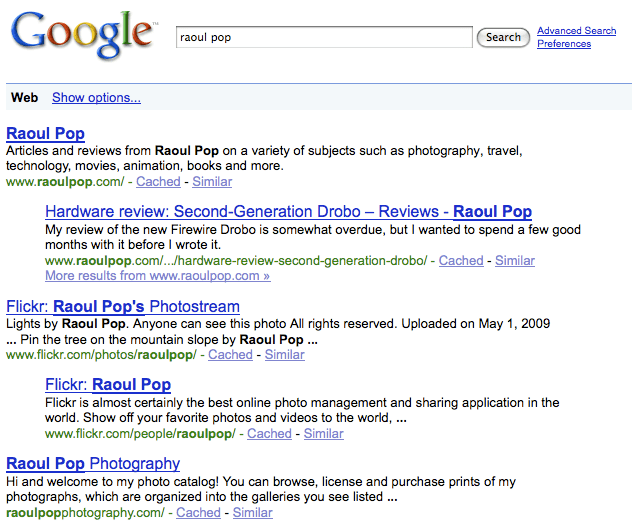
Back in January, when I arrived in Romania, I noticed the same thing. I Googled myself while in Romania, only to find out I was no longer the first search result that came up for my name at Google.ro or at Google.com. I thought that was odd at the time, because doing the same thing while in the US yielded the expected result. It never occurred to me that Google would yield different search results for each country, although that makes perfect sense now.

Here’s the interesting part though. As I spent more time in Romania, writing and publishing to this site, whose server is in the US, from Romania, the order of the search results for my name at Google.ro and Google.com changed. One day, I googled myself and noticed my name came up first, just like it did in the US. So, Google somehow learned — and I’m not sure how they did it — that I was writing from Romania, or that I was in Romania, and figured out that returning my site as the first search result for my name in Romania was the relevant thing to do. If nothing else, it reveals some of the complexity behind Google’s search algorithms and earns my respect.

google-search-raoul-pop

Standard
Reviews

Using Contenture to handle micropayments

Back in April, I wrote about micropayments, and why I thought they were an equitable way to reward web publishers for their time and effort. I shared my thoughts on ad revenues, which, for most people, are minimal and not enough to live on, unless you are one of the relatively few websites that gets massive amounts of traffic.

In that same article, I also talked about how I thought micropayments should work, via a standard, instant way to charge readers a few cents per article, through protocols that were integrated into each browser. Instead of charging fees for each transaction, which would be impractical for such small amounts, micropayment processing centers would charge for bundles of transactions which exceed a set limit.

Fast forward a few months, and ZDNet publishes an interview with Barry Diller, one of the early Internet millionaires, where he talks about the very same thing: the need to go beyond falling ad revenues by charging small amounts for useful information. That article was hotly debated on FriendFeed, which is where I found out about it. Among the comments, I found one pointing me to Contenture, a newly launched micropayment system (it saw the light of day on 5/26).

contenture

Contenture’s method of handling micropayments is different from what I envisioned, in that it involves a monthly subscription. Here’s how they say it works:

“… a fully automated system that requires no user interaction. Users simply pay a set fee to Contenture on a monthly basis, and that money is automatically distributed to the sites they visit. How much each site gets from each user is determined by how often that user visits that web site, relative to all of the other Contenture sites they visit. Users get their seamless experience, and the site actually makes money. Everybody wins.”

So what’s involved on my end? I installed Contenture’s WordPress plugin and pasted in an extra line of code to customize the ad hiding behavior. Others might need to paste a Javascript snippet in their footer, which is basically what the plugin does for you.

On your end (the reader), the code will check to see if you’re a Contenture user, and will automatically distribute your subscription fee to the websites that you visit, based on how often you visit each site. As an immediate benefit, all ads on my site are hidden from you. They’ll load as the page loads, but they blink out of view and the ad space collapses unto itself as soon as the page finishes loading. It’s pretty cool.

Other benefits I might be able to offer you in the future are the ability to view exclusive content, or perhaps to even close off the archives to those who aren’t Contenture users, although I’m not too keen on that, since Google won’t be able to index me properly any more if I do it. At any rate, the ability to offer more benefits is built in, and that’s nice.

Contenture’s model is opt-in (also called freemium) and so it has some limitations, in that I don’t get paid for everyone that accesses my content. My micropayment model, the one I envisioned and the one Barry Diller and others are talking about, is standardized across platforms and browsers and works for everyone, all the time. Eventually, I think we’ll get there, but Contenture has made a good start of it, and they did it now, which is why I signed up with them.

To let site visitors know they can support my site, I placed a small link in the header, as you can see below. I also have a link in the footer, also shown below.


header-screenshot

footer-screenshot

I look forward to seeing Contenture’s user base grow, so I can tell whether I’ve made the right choice. I want to keep writing and publishing online for a long time to come, but the only feasible way for me to do that is if I get rewarded properly for my efforts. I believe micropayments are the way to do it. It’s affordable for the readers, and it scales up nicely for me, the web publisher. Time will tell exactly which micropayment method will work best, and you can be sure I’ll continue to monitor the options available out there.

Standard