Reviews

Three classic movie duds

If you follow along with my classic movie reviews, you may think I have only good things to say about them. Truth is, I don’t usually choose to write up movies I don’t like. But I’ve recently seen three classic movies that were so bad I needed to point them out. I’ll look at each in the order I’ve seen them.

Chicken Every Sunday (1949)

Made after a book which can still be found in print (at least the book was good), this movie is a convoluted, drawn-out, syrupy mush that does not entertain. It only frustrates.
One good thing is that it has Alan Young, one of my favorite actors, but he’s stuck in this horrible, lily-livered role that has him meowing and crying his way through the movie, and it’s just sad.

Individually speaking, the actors are good. They’re talented, they can play good parts when they get them — but this movie’s script doesn’t have a single good part in it. It just plain sucks. Stay away from it. Did I mention it’s long and you’ll be sorry if you’ll watch it?

Platinum Blonde (1931)

This is one of Frank Capra’s earlier movies. Any movie by Frank Capra ought to be good, right? WRONG. This movie is a real stinker. The direction is off. The dialogue is slow. The editing sucks. The script is pathetic. There are long, dead pauses, and the chemistry between the actors is non-existent.

As if that’s not bad enough, the movie’s principal roles were miscast. We have Jean Harlow playing the part of an aristocrat. Excuse me? JH?! A platinum blonde best suited for the more tawdry, tough roles, playing an innocent, educated, mannered, high class lady?! That’s a riot… Every move Harlow makes is a verdict against the part she’s playing. Every sway of her hip convicts her, calls her a liar. She simply wasn’t made for that role. It’s the antithesis of her.

Then we’ve got some dude I’ve never seen before in the principal role. Who he is, I don’t know, and I don’t really want to know. He’s not likable, and he’s not meant for principal roles, end of story.

The movie’s saving grace is Loretta Young, who’s stuck as Gallagher, the office girl men see as one of them, until the dude in the principal part gets things right in the last scene. You’ve got to be kidding me… Loretta Young is NOT a man and you can’t look at her that way. Frank Capra was cuckoo to cast her in that part, sorry — although she made the best of it and was the one shining actor in the whole movie.

How can I put it? This movie stinks. Don’t watch it.

Second Chorus (1941)
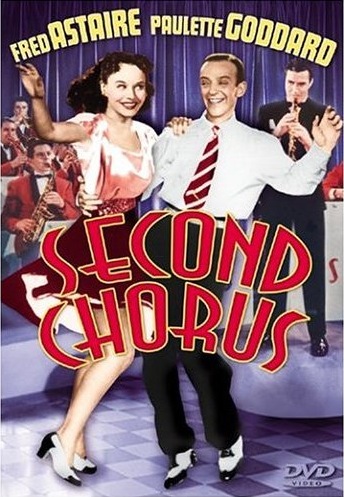
Here we’ve got another example of a movie that should have been good, but it’s most definitely NOT. You’d have to get a really crappy writer and director to mess up a movie with Fred Astaire and Paulette Goddard. Guess what? They found both “geniuses” for this movie.

The plot is just pathetic. Two guys fight for the affections of one girl. Should be good, under the right circumstances, but it’s horribly complicated, and the plot devices are terrible and amateurish, the sort of stuff that made me cringe. The writing, the lines: yuck.

You know who else is in this movie? Rocky’s trainer — Burgess Meredith. He looks pretty much the same in 1941 as he did in 1976 for Rocky, and for the sequels. He was like George Burns. Looked old from his youth. And he’s unlikable in this movie.

There’s one scene that’s good in this movie, and it’s when Fred and Paulette dance together. Why couldn’t they do more of that throughout the movie? Why did they stick Fred Astaire, a dancing man, in a trumpet player role? Why do they have him trying to conduct an orchestra while dancing and playing the trumpet?

The movie is full of hair-pulling questions like these. It made me want to get a bunch of rotten tomatoes and start throwing them at the director and the other people responsible for making this idiotic waste of time.

Standard
A Guide To A Good Life

My favorite pair of casual shoes

–> Updated: these shoes turned out to be terribly put together. The sole came apart from the shoe less than a year after I got them. I asked LL Bean to replace them, which they did. They sent me a new version of the shoes whose soles also came apart from the shoes about a year after I got that pair. So while they were comfortable to wear, their durability was terrible. Caveat emptor. 

I’ve been wearing a new pair of Keen shoes for the past few weeks, and I love them. If they haven’t got the showroom look in my photos, it’s because they haven’t been sitting in the closet.

I spotted them at L.L.Bean and couldn’t resist the design. They looked so comfortable and cool, up there on the shelf, that I had to try them on and get them. Indeed they are comfortable, even for extended walks, and they’re a lot of fun to wear.

One thing I should mention, if you care about that sort of thing: this particular design will make your feet seem smaller. I took a photo of one of my formal shoes next to one of my Keen shoes, just to show you the difference. Believe it or not, the formal shoes are slightly tight on my toes (length-wise, not width-wise). The Keen shoe looks smaller, yet my feet have no problems fitting in there.

While women may love having their feet look smaller, I understand that some men may not go for that sort of thing… Apparently foot size is associated with a certain other size in our vernacular. Personally, I’ve gotten over that, because I like these shoes a lot. Just thought I’d put that out there in case any of the women reading this are thinking about getting them for their significant others.

Standard
Places

Shenandoah Valley panoramas

You are about to see several panoramic photos that have taken me well over 35 hours to create — and I’m not counting travel time, setup time, time it took to take the photos, and the time it took to write this post.

This slideshow requires JavaScript.

A couple of weekends ago, Ligia and I got into our MINI and drove up to Shenandoah National Park, for a single purpose: to take a few panoramic photos of the valley from the tops of the Appalachian Mountains. Fortunately, that simply meant driving on beautiful, scenic Skyline Drive and stopping at various points to set up the tripod and take series of shots that would later be stitched together. Unfortunately, the weather wasn’t exactly collaborating, in spite of the cheery weather report. The day was neither sunny nor cloudy. The light was diffuse and had that washed, in-between quality that doesn’t really make it good for anything. But, I was there, and if that’s what I had to work with, so be it.

As it turned out, driving out there and taking the photos was the easiest part of the whole thing. Like I mentioned in the opening paragraph, putting together the panoramas was by far the longest, most excruciatingly slow stretch of processing work I have ever done. I do not recommend it to anyone, for multiple reasons, which I’ll mention below. If you just want to see the photos, skip ahead.

A few thoughts on the whole thing

I will not do panoramas very often in the future, unless I’m commissioned to do specific ones. If and when I do another panorama for myself (not for a client), it will likely only be a 5 to 10 photo image, simply because it takes an enormous amount of time to stitch and process them on the computer if they’re made up of more images than that.

For one thing, you would need a super fast, quad-core or better computer loaded to the gills with RAM to get any sort of decent speed while processing panoramas. A Mac Pro worth about $7,000 or better should do the trick. Seriously, every single simple operation, like cropping or rotating, took at least 10 minutes or more to execute. Sometimes just assembling a single panorama in Photoshop (through the Photomerge feature) took about 45 minutes. I have the latest MacBook Pro laptop (2.5 GHz Intel Core 2 Duo processor, 512 MB video card, 4 GB RAM), and it still took what seemed like forever to get through each panorama.

The resolution of the photos also matters. My individual photos are 12-megapixels each, at 240 dpi, made by a Canon 5D. Just imagine how much processing power is needed to put together 20 or 30 of these photos into a single image!

People don’t appreciate panoramas. I bet you most people will skim this post, unimpressed, and move on. You can’t really appreciate panoramic photos unless they’re printed out in their full size and spread out on a wall, right in front of you. You can’t appreciate their size on your computer monitor, no matter how large it might be. The largest single monitors nowadays are 30″ and have a maximum resolution of 2560×1600. That’s equivalent to about 6 megapixels at 72 dpi. You can’t possibly appreciate a 12 megapixel photo at 1:1 size on a current-day monitor, much less a panorama made up of 20 of those photos.

As an aside, don’t confuse monitor size with resolution. There are LCD HDTVs on the market that are 42″, 46″ or more in size, but they can only display up to 1920×1080 pixels, which is much less resolution than a 30″ monitor.

I can’t show you the full panoramas on my site, because of photo theft. Not that I think my panoramas (these ones in particular) are spectacular and would fetch amazing prices, but I know for a fact that if I post my panoramas at full resolution, there will be people who will steal them and try to profit from them.

How does the new Lightroom 2 Beta handle panoramas?

After I processed the photos in Photoshop CS3, which worked without crashing for the whole bunch, although it ate an amazing amount of space on my hard drive for its scratch disk, I imported them into the new Lightroom 2 Beta, to see how it would handle them.

Most of the photos were over 1 GB in size, uncompressed. Because I saved most as TIFs, using ZIP compression, their file size on disk was significantly lower. Lightroom did amazingly well to start with. It created small previews very quickly, and also created the 1:1 previews much quicker than Photoshop would have been able to render them. I was able to use the spot heal brush to remove sensor dust spots, and also used the new selective retouching brushes, without any problems. Lightroom 2 was able to do these things without significant delays, and would show the effects instantaneously.

LR2 only started hiccuping when I started to add some meta-data to the photos. As I went through and added meta-data, then opened them at 1:1 size once more, it would hang, literally forever. I had to keep force quitting it, and had to do that regularly, for each and every photo that I wanted to look at. Interestingly enough, when I wanted to export the panoramas to use them here on my site, it did it without any problems, and without crashing. It’s certainly odd behavior, but it is in Beta after all.

On to the photos

While I cannot post the panoramas at full resolution here, I did post them at higher sizes than I would normally post, in order to give you a better idea of what they look like. I also created 1:1 previews of regions of each photo, to help you realize how big they really are.

If you click on each panorama (not its 1:1 detail), it will take you to its photo page, where it will tell you how large it is (in megapixels), and how many photos went into making it. If you click on it again (on that page), it will take you to its larger size. Sorry for the double-clicking, but that’s how things work in WordPress these days.

First, a panoramic of Skyline Drive itself. This road is amazing, and I’m so glad the US government decided to build it back in the 1930s. It literally hugs the tops of the Appalachian mountains and lets average John and Jane drive on top of the world (as high as possible in this area of the world, anyway).

We stopped along Skyline Drive, parked our car, and took a hike through the forest on one of the paths marked out there. In the middle of nowhere (literally), we found this cabin, called Range View.

It was a darling little place built out of stone and off the grid (in spite of the fact that wires ran right above it). The fireplace was outside the cabin, by the front door. While the place was locked up and the windows equipped with thick wire and netting, Ligia and I could spot beds and various pieces of old furniture inside. Don’t know what it’s used for nowadays, but it is used, because there was an open bottle of wine standing in plain sight near one of the windows, and it was of recent vintage.

The rest of the photos, including the 1:1 previews, are found in the gallery below. Click on each to get to the photo page, then click again to see it in a larger size. Enjoy!

Standard
Reviews

Updates to my Drobo review

➡ Updated 1/14/19: I have revised my opinion of Drobo devices. After experiencing multiple, serious data loss events on multiple Drobo models, even recent ones, I no longer consider them safe for my data.

➡ Updated 3/19/08: My review of the new Firewire Drobo is now published. I’m also glad to say that the issues outlined in my original Drobo review (and mentioned below) were resolved through firmware updates, as expected.

I’ve re-organized my Drobo review and also added two brand new updates to it, in the “Transfer speeds” and “How it sounds” sections. They’re marked with today’s date. If you’re interested in the Drobo or you already own one, you’ll want to look into this.

While my updates aren’t exactly flattering, I still think the Drobo is the best archival solution for my videos and photographs. Fortunately, the two things I pointed out can be resolved (to an extent) with firmware updates, and Data Robotics isn’t stingy with those, so relief may be coming in the near future.

Standard
Thoughts

Open source software and its use by for-profit companies

Everyone is happy to use free, open source software these days, and for-profit companies are only too happy to join that bandwagon. After all, they’re supporting the open source movement — or are they?

If you’re not sure, there’s an easy litmus test: see how much they contribute to the open source movement.

  • Look at how much they donate to open source. Many companies will make token donations to open source organizations, but let’s face it, that money isn’t going to the developers themselves, it’s going to public relations and ads and the CEOs of those organizations. (Lest we forget, the CEO of Mozilla made $500K/year while the developers made nothing.)
  • Look at how much of their own code (written in-house) they give back to the open source community. If they don’t do much of either, there’s a pretty good chance they’re in it simply to profit off the backs of the many unpaid open source contributors.

After all, companies are more than happy to use free, open source software, since it means they have to do less development themselves, and they don’t have to pay anything at all for that software. But then they charge an arm and a leg for products developed using open-source software. They win, the original developers get screwed, and the customer pays through the nose for something that was free.

I find that sort of a business practice completely hypocritical. Building your business on the backs of malnourished, borderline-healthy geeks, coding their nights away, unpaid is unethical and exploitative. It harks right back to medieval times, when lords would get filthy rich at the expense of poor, overworked serfs. We were supposed to have evolved beyond that, but as it turns out, those sorts of practices haven’t been phased out, they’ve just been sublimated and adapted.

It gets even worse than that. Some companies aren’t content with just using free, open source software to fatten their pockets. They turn around and try to lock the products they’ve built on the free software, and to make it illegal for users of those products to change them. This is quasi-legal and reproachable, because it goes against the original GPL license of that software. You can’t modify open source software by lines of code here and there, and then call that software yours. It’s intellectual theft. This is why I support GPLv3, in spite of the fact that Stallman gives me the willies.

Some developers would argue that they’re writing free software because they want to, and they don’t care if and when they get credit or if they get paid, or even if some ethically questionable company will use their code to make money. They say they’re only interested in writing free code. I say they’re devaluing their work, and when they’ll find themselves without a job, they’ll wish others placed more value on their code.

I don’t need to name specific companies. You just apply this simple litmus test to the big name (or small name) companies out there, and you’ll find them out soon enough.

In the end, a company’s real commitment to the open-source software philosophy can be measured by how much new, internally written code, it contributes back to the open source community.

Standard