
We dined at Mosaic Cuisine & Cafe in Rockville this past Friday evening. The food was delicious and the service wonderful. Here are some of the dishes we had with our friends:


We dined at Mosaic Cuisine & Cafe in Rockville this past Friday evening. The food was delicious and the service wonderful. Here are some of the dishes we had with our friends:

Ligia and I attended the Baltimore Symphony Orchestra‘s 2007 Annual Donor Thank You Concert last night. It was held at Strathmore Concert Hall. Pete & Nicole, thank you for the tickets! It was simply amazing.
I realized two things during the concert:
Ligia and I both grew up listening to classical music. Ligia studied at music schools since the age of 6, and she finished the conservatory in 2004, after having studied voice and piano. Her appreciation runs much deeper than mine. She actually gets goose bumps while she listens to good music. It’s kind of funny. I can always tell when a piece of music is great by looking at her skin. If she’s got goose bumps, it’s gotta be good. Well, last night she practically broke out in goose bumps…
There was always a huge (and growing) stack of classical music records by our pickup player during my childhood. If I wanted music, I got Mozart, Bach, Beethoven, Liszt, Paganini, Tchaikovsky, Haydn, Handel, Strauss, Brahm, Vivaldi, Verdi, Rossini, Pacabel, Enescu, Porumbescu, Bizet — well, you get the point. I’ve always liked good classical music. But the older I get, the more I relate to it. It speaks to me. It resonates within my body, my soul, and my mind. I appreciate it on more levels. Never did I realize this more poignantly than last night.
We spent the first half on one of the upper levels, and we snuck down to the orchestra seats during the intermission. We felt a little guilty, but after all, it was general seating, and those seats weren’t being used. No point in letting great seats go to waste, right?

The BSO played Tchaikovsky. They started with the Polonaise from Eugene Onegin, then continued with Variations on a Rococo Theme, opus 33, and after the intermission, finished with Symphony No. 5 in E Minor, opus 64.
At Strathmore, photography isn’t allowed during performances. I was good and obeyed the rules. But before the show and during the intermission, I took out my 5D and 24mm prime lens, and took photos of the hall and of the public. Strathmore is quite beautiful. It’s got a modern design, quite different from traditional concert halls, and they’ve had to add floating, adjustable acoustic panels to the ceiling to make sure sound travels properly. They’ve done a good job with that, and the sound quality is pretty consistent between the upper and lower levels. I love the warm colors of the wood floor and panels. That, coupled with the open feel of the place, gives it a really nice atmosphere.

A highly unusual thing happened during the performance. Because of the severe rainstorm outside, the power went out for a few seconds right in the middle of the first movement of Tchaikovsky’s 5th Symphony. The entire concert hall was pitch black, save for the red, glowing Exit signs. Do you know what the BSO did? They kept on playing right through the power outage as if everything was alright! They did not miss a beat! Now that’s professionalism! This also underscores one of the advantages of using acoustic instruments. No power outage can put them out!
You know what they say, right? Start strong, finish strong. Well, the BSO most certainly did that. We were on our feet by the end, giving the orchestra a standing ovation, along with everyone else. During the performance, Ligia and I kept looking at each other and smiling. Normally, my obsessive-compulsive mind keeps its manic wheels turning all the time. Even when I dream, I have parallel dreams, and I find myself half awake in the early hours of the morning, trying to force my brain to skip back to the more interesting dream… When I’m supposedly relaxed, tons of thoughts run through and I can’t keep still. Even when I want to think about nothing, I can’t. I’m telling you all of this because I managed to find clarity during the concert. There were long moments when the music passed right through me, clearing my mind. I could focus on just one thing at a time — on enjoying the music — and that was really something. I tell you, those moments are rare for me! What a concert! What a fantastic performance, especially during the symphony!
Last Saturday morning, Ligia and I met up with Keith McCammon and held our first DC area photowalk, as announced last week. Even though rain was predicted for that day, the weather was fantastic. We got there around 7:30 am and had a wonderful time walking on the docks and through the streets, photographing all things of interest to us.
Ligia carried my tripod for me. What a trooper! 😀






We received an amazing gift during our photowalk. We stumbled onto a really old home on Prince Street, built in the 1700s, called the John Douglass Brown House. As we were taking photos outside, the neighbors happened by, and we started talking. They were really nice and offered to introduce us to the owner of the house, Mr. Charles J. Reeder. He not only came out and started talking with us, but allowed us to come into the gated courtyard. We learned how he purchased the home, restored it, and made some additions to it.
While we snapped away at the amazing collection of fascinating things he had around the home and talked, I guess he saw something in us that engendered some trust, because he invited us inside and gave us a tour of his home. He does not normally do this, and he told us that as he let us in. I cannot even begin to tell you how many amazing old antiques he has in there, and how much he knows about each of them. My mind reels when I try to remember the experience. Thankfully I took plenty of photos. I’m not sure how many of them I’ll make public, because I do not want to invade Mr. Reeder’s privacy. Just because he allowed us into his home doesn’t mean he wants it shown on the internet. I’ll have to choose carefully what I publish online.


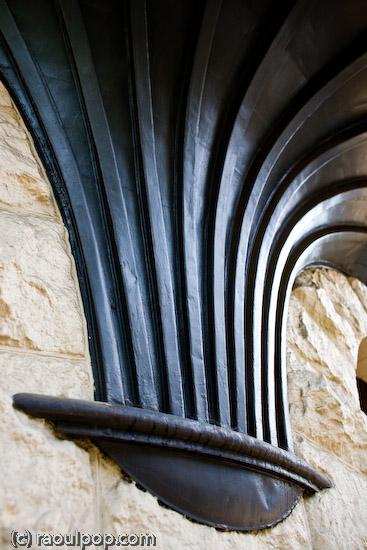

In the end, it worked out better than we could have imagined. If a larger group got together for the photowalk, I doubt we would have been able to visit inside Mr. Reeder’s home. This way, we formed a nice photowalking nucleus, and we’ll try to expand the group with future photowalks in the DC area. What a great start we had!






Here’s what happens when Alka-Seltzer gets added to a water drop in space:
Want to see an aluminum foil ship float on “nothing”? (It’s not quite nothing, but it’s still pretty cool.)
Asimo, the robot made by Honda, ran at the 2007 CES:
The blind learn to see with their tongue:
Boeing conducted a 777 ultimate wing load test:
Here’s another Boeing 777 test, the maximum rejected takeoff:
I’m an airplane sucker. Here’s a Boeing 777 on final approach in high cross winds:
After looking around for a storage solution to house my growing collection of photographs, I found the Western Digital My Book World Edition II. I’ve been storing my photos on single external hard drives so far, but data loss has always been a concern with that approach. All it takes is a hard drive failure, and I’m going to lose a good portion of my hard work. Naturally, I’ve been looking into various RAID or other failsafe solutions, since they’ve gotten to be fairly affordable.
I was immediately drawn to the new WD My Book line because of their beautiful design, 1 TB capacity, and the ability to configure the device in RAID 1 format, which would mean my data would be mirrored across the two hard drives inside it. (This would also halve the amount of space available, but that was okay with me — I wanted data redundancy.)

For those of you not familiar with WD’s external drives, they have done a beautiful job with their enclosure design, and I raved about their Passport line several months ago. It turns out I now own one of them, a sleek black 160 GB 2.5″ drive just like the one pictured in that post. It’s perfect for data portability, and for a while, I even stored some of my photos on it. But it is just a single drive, and as I said, I’m worried about data loss.
Back to the My Book line. There were two models I really liked: the My Book Pro and the My Book World. Because I have a mixed OS environment (both PC and Mac), I thought a NAS solution like the My Book World would work best for me, even though its specs said it would only work for Windows. I had a pretty good hunch that I would also be able to access it with my iMac. It runs on Java, it has Samba shares, and those are readily accessible from any Mac. But, this isn’t advertised, and that’s a pity.
By the way, if you’re thinking about getting the My Book Pro drive, make sure to read my review of that model. The takeaway message is to stay away from it, and I explained why in that article.
The drive itself is beautiful and fairly quiet, except when it boots up. WD has also made firmware upgrades available that make the drives even quieter, so that’s a good thing. I can tell you this right away. If you only plan to use the drive in a Windows environment, it’ll work great. Feel free to buy it, you’ll be happy. But, if you plan to use it in a mixed OS environment, and are looking to access it in more flexible ways, such as with custom drive mappings, and not through the software provided with the drive, you might be very frustrated.
Let me explain. The drive comes with a custom version of something called Mionet. I’ve never heard of it, but it’s software that installs on your machine and makes your files and computer remotely accessible from anywhere. When you run the installer, it’ll prompt you to create an account on the Mionet website, and it’ll register the WD drive, along with your computer, as devices that you can then access remotely. (There’s a monthly fee involved if you want to control your own PC remotely with the software, but you don’t need to pay it to use the WD drive fully.)
Once you install the software, you start up Mionet, and the WD My Book World drive gets mapped automatically to your machine. You also have the option to manage the drive through a browser interface. That’s actually where you configure its volumes (1 TB single volume, or RAID 1, still single volume, but mirrored data and only 500 GB) and other options. Basically, you have to remember that the only proper way to access the drive, whether you’re at home or you’re away, is to start up Mionet and get it mapped to your “My Computer”. If you do that, you’re good to go.
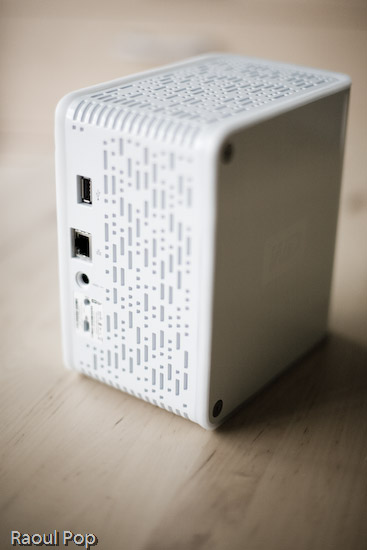
The problem with this approach (and this tends to be a problem only for geeks like me) is that the drive is readily accessible over the network without Mionet. I can simply browse my workgroup and find it, then log in with separate accounts I can set up by using the WD drive manager, which is accessible through my browser. So here’s where the frustrating part comes in. I can browse to my drive over the network, without Mionet, from any PC or Mac in my home, administer its options, add users and shares, etc. Then I can use Tools >> Map Drive on my PC or Command + K on my Mac to connect to the share name, and log in using those user accounts I’ve just set up. But, I can only read from those shares. I can’t write to them. The drive operating system assigns weird UNIX privileges to those shares, and they don’t correspond to the accounts I’ve just set up. It makes no sense to me and you’ll only fully know what I mean if you do this yourself. Suffice it to say that it’s really frustrating, and it’s not what I expected.
It would have been alright if Mionet made a version of their software for the Mac, but they don’t, and they don’t seem to have any plans to make any. It would have still been alright if the drive hadn’t been accessible through any Mac whatsoever. But the fact that they are accessible, and that I can log onto the drive with usernames and passwords that I can set up through the admin interface, yet I can only gain read-only access to those shares even though I’m supposed to have full access really gets me. Sometimes it’s a real pain to be a geek…
So, my verdict is that I really like the design and the RAID 1 capability, but I do not like the implementation. I ended up returning this and getting the My Book Pro Edition, which I will review very soon. But remember, if you don’t have a mixed OS environment, and have no problems with starting up Mionet when you want the drive to appear in “My Computer”, My Book World will work great for you, and the remote access capability is a really nice feature.
❗ Updated 7/19/07: I purchased and reviewed the My Book Pro as well. You can read my review right here.
❗ Updated 8/3/07: Multiple commenters have pointed out (see this, this, this, this, this and this) that you can use the drive just fine with both Macs and PCs, over the network, if you skip the install of the Mionet software altogether. It looks like the clincher is the Mionet install itself. Just forgo it, and you’ll be able to map the drive to both PCs and Macs, and read/write as much as you want. I didn’t realize that I had to uninstall Mionet entirely in order for the read/write to work properly.
But keep in mind, if you don’t use the Mionet software, you won’t be able to access the drive remotely. Well, you might be able to arrange some access, but you’ll need to custom-configure your firewall settings to allow traffic on certain ports, and you’ll need a static external IP or dynamic DNS so you can get at your firewall from the outside. And then you’ll need to worry about data encryption as well, unless you don’t care that your data will travel unencrypted over open networks. If you’re a hardcore geek, feel free to try this last bit out, but if you aren’t, beware, it’s a weekend project, and I can’t help you.
❗ Updated 8/9/07: I’ve had several people comment on how they bought the drive based on this post and the comments made on it by others, believing they could get it working over the network with their Mac. The kicker is that they thought they could connect it directly to their machine and get it working that way. 😐 I don’t know how they got that idea, but let me set the record straight. This is a NETWORK drive. It needs a network in order to work. There’s a chance you might get it working by using a crossed ethernet cable or connecting it directly to your machine, but it probably has to be a crossed ethernet cable.
The best way to get it working is to use a hub or a switch, or best of all, your home router, which can assign IP addresses. The drive ships configured for DHCP. That means it has no IP address to start with, and it’s looking for a place to get them. If you don’t have such a place, you’re going to have a lot of headaches. Get such a place (router) or go buy a USB/Firewire drive. Most people who’ve commented already made it plainly clear that’s what they needed, but they still insisted on using this drive. I don’t know why they enjoy the stress of doing that. I didn’t. As I already said in my post, I returned it and got a WD My Book Pro Edition II.
Last but not least, please do me a big favor. Read through the existing comments before you write one. There are so many already, and there’s a very good chance someone’s already asked your question, and I or someone else has already answered it. Thanks!
❗ Updated 12/11/07: I found out today that Western Digital is going to disallow the sharing of all media files through the Mionet software. In other words, if you’re going to use Mionet to share the files on your drive and make them accessible remotely, you will not be able to see or use any of your media files. I think this is a pretty stupid move on WD’s part, and it’s going to come back to bite them. Until they decide to do away with this boneheaded downgrade, keep it in mind if you’re looking to purchase a My Book World Edition. Do NOT use Mionet. Install the drive without it, and if you’ve got to make the files accessible remotely, find other ways to do it, like through a custom config of your firewall.
❗ Updated 12/18/07: Christian, one of the commenters, has left two very useful comments that are worth mentioning here in the post. The first shows you how to access the drive remotely (when you’re away from home) without using the Mionet software. The second tells you why you don’t need to worry about defragging the drive, and how to troubleshoot its performance if you think it’s not as fast as it should be. Thanks Christian!
❗ Updated 4/5/10: Andrew Bindon has posted an easy-to-follow tutorial on how to remove Mionet completely from your computer and the My Book World Edition drive. If you, like me and many others, think Mionet is an annoyance that would best be removed, then follow his advice.
 Raoul Pop