There are two problems with dogs in Romania, as I see it:
- There are entirely too many stray dogs
- Most dog owners care little about their dogs’ behavior
Let me say first that I’m a dog lover, though my recent experiences here in Romania have cooled my enthusiasm for dogs significantly. Overall, it’s been one negative experience after another, and right now, it’s gotten to the point where I will not hesitate to kick a dog who lunges at me or my wife, as has happened repeatedly.
Stray Dogs
Everywhere you look in Romania, there are stray dogs. It could be the middle of the city, or the middle of the countryside — you are guaranteed to find a stray dog. They usually converge where people are, but you’ll see them crossing open fields or walking alongside roads in the middle of nowhere, looking for scraps of food.
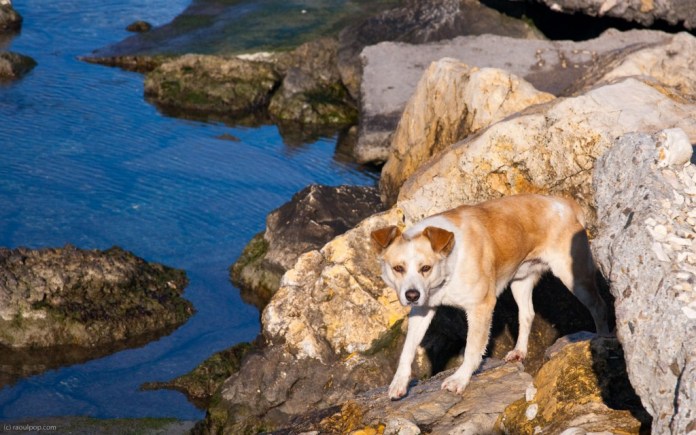
You’d think a breed of animals that depends on people for their food supply, especially dogs, who are supposed to be “man’s best friend”, would be more grateful to people. You’d be dead wrong to assume that, and I don’t exaggerate. Sure, they’re nice when you have food and you want to give them some. They’ll line up and beg, putting on a show. Some packs of these stray dogs specialize in begging, and will stick around car stops and fast food kiosks. They do alright, because they look well-fed. Even I feed them sometimes. After all, I still love dogs, and I don’t mind sharing my food with a hungry and friendly animal.
But may God protect you from meeting a pack of stray dogs at night, or when they’re hungry, because they’ll tear you to pieces. They’re dangerous even during the daytime, sleeping in the sun, curled up next to buildings or on the sidewalk. Those same sleepy dogs can turn vicious and attack at any second.
The dangerous thing about stray dogs is their pack behavior. They’re not disciplined and they are dumb animals. When one begins to bark at you, they’ll all join in. When one of them lunges at you, they’ll all start lunging at you. When of them bites and draws blood, the others become enraged and will all start biting you. As the taste of blood enters their mouths, they’ll soon begin to bite you in order to get pieces of meat. You will no longer be seen as a human being, someone to be feared and respected, but as food — a hunk of meat to be eaten.
I’ve seen stray dogs lunge at street cleaners working nearby. I’ve seen them lunge at elderly people. I’ve heard of them killing adults and children or leaving them scarred for life. A relative of ours from Constanta was jogging on the beach one morning, and was attacked by a pack of dogs who chased him for over a kilometer. He literally ran for his life while they lunged at him one after the other, biting, scratching, digging their teeth deep into his body. He fought them off and barely escaped alive. Now he’s scarred for life on his arms, legs and face, from something that could have been avoided if the city of Constanta did its job in cleaning the city of strays.
I was running one evening in a village in the province of Dobrogea, and a stray dog lunged at me, barking and snarling viciously, ready to bite. I stood my ground, ready to fight, and he retreated. If there had been more of them around, they wouldn’t have retreated, and I might have ended up in the hospital. I have not been able to do any regular running during my stay in Romania. You can’t do it in the city, and you can’t do it in the countryside. When you run, it’s basically an open invitation for stray dogs to attack you. To be able to do any sort of outdoor sport, I’ve had to find remote places away from people, but even there, I have to watch out for sheep dogs, who will attack you on sight if they see you running. It’s insane. This brings me to the second part of this article, where I talk about dog owners and their dogs’ behavior. Before I do that, let me mention one more incident.
I don’t know if folks in the US have had the chance to witness dogs running alongside cars, or behind them lately. The US does a good job of taking strays off the streets. In classic cartoons, this is sometimes depicted as dogs running to latch onto the bumpers of the cars. That’s inaccurate. Dogs will run alongside the cars, barking at them, and some might even try to lunge at the tires, in order to bite them, clearly with sad consequences. When you see stray dogs with bad scars on their faces, you can assume they probably succeeded in latching onto a moving tire.
When you’ve got so many strays, you can get anywhere from only one or up to ten or more running after your car, and accidents will happen. Before I spent any significant time driving in Romania, I couldn’t understand why, and thought the drivers were just being vicious and ran them over on purpose. That’s not the case. I, too, ran over a stray dog recently. It couldn’t be helped. It was raining, so the road was somewhat slippery. This particular dog came out from the side of the road and started running alongside the car in front of me, on the driver’s side, then decided to switch sides and darted right in front of me. I slammed on the brakes and swerved left, but couldn’t avoid him and ran over his hind legs. Needless to say, that was not a good day, and I’d still rather not think of it — but that’s what will happen when the stray population isn’t controlled.
Domesticated dogs
Few dog owners in Romania care enough for their dogs to teach them how to behave properly. Of the majority, there are two classes: those who do little more for their dogs but provide them with a dog house and food, and those who pamper them for the very purpose of showing them off on the street.
This latter class of people is more rare now, but used to be quite common during Romania’s communist regime. They’d have these big, ferocious dogs, such as German shepherds, dobermans, or bulldogs, and they’d walk them in public with a muzzle, smiling secretly (or openly) every time their dog growled at someone and that person shied away.
The other class of dog owners — by and large the overwhelming majority — is quite content to tie up their dogs in the yard, next to a dog house, and to feed and (maybe) clean up after them, but do little else for them, like teach them when to bark and when not to bark. The end result of their treatment (or lack of it) is that you have these frustrated dogs who are tied up behind wooden fences where they can’t see what’s going on outside, but can hear and smell a ton of foreign scents, and who are going nuts, barking at everything, all the time. For all intents and purposes, they’re not really domesticated, because they’re not potty trained, house trained, or taught how to respond to signals and when to be silent. They might as well be strays, because they’re just as dumb as the strays. They cannot communicate. They only bark and snarl, and collectively, they create this cacophony of barks and yelps and snarls that can’t be ignored and drives me crazy.
I’m told I’m supposed to get used to it. I cannot. I can only bear it, and that only for short amounts of time. After that, I get pounding headaches, and the only thing I want to do (and imagine doing) is to squash those idiotic, furry, barking noise boxes. If you’re reading this and you’re shocked, I tell you, you cannot understand it unless you get to spend a few weeks in Romania and are treated to incessant barking at all hours of the day and night, from all directions. You try sleeping when every damn dog in the neighborhood has joined in the barking started by the neighbor’s idiotic mutt. You try concentrating on your work when some moronic, flea-bitten fartbrain a couple of houses away chooses to mark the passing of every 10 seconds with a bark. You try going on about your business, accompanied by that sort of a noise parade, and you let me know how it feels after a couple of weeks (or months) of it.
The other issue I encounter is that of violent behavior in dogs that are supposed to be domesticated. I guess this sort of ties in with what I said a few paragraphs above, but this sort of violence isn’t necessarily encouraged by the dog owners. It results more from a lack of care. I’ve seen it on two occasions.
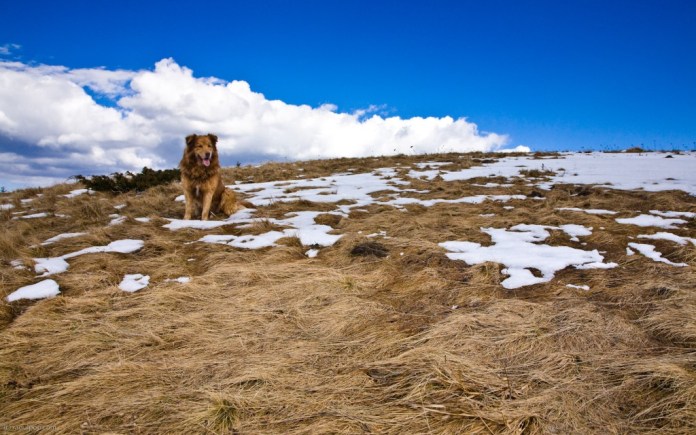
While in Predeal — a popular mountain resort — I hiked to one of the peaks nearby, a place miles away from civilization, called Clabucetul Taurului. The only settlement nearby was a tourist cabin set in the valley between two peaks, about a mile away, called Cabana Garbova. As I stood there on the peak, taking in the beauty of the place, a stray dog wandered up the slope of this peak, and greeted me in a friendly fashion. I warmed up to him quickly. After all, I still love dogs, in spite of my recent experiences. This dog was nice and clean, which isn’t something you see often in stray dogs. It’s likely that he belonged or had recently belonged to a farmer down in the valley, and he liked to wander around all day long. I took several photos of him while up on the peak. Here’s one of them.
When I headed down the mountain to re-join my wife, who was waiting for me near Cabana Garbova, he followed me. As we all approached the cabin, it became evident to us that we had a problem. The dogs at the cabin, a pack of about 8 big monsters accustomed to fighting wolves and bears, sniffed him and started barking wildly. We tried to shoo him away, to make him go back up the mountain, but he didn’t want to leave us. Then the dogs down below started running toward us. We started getting really worried. Here were some seriously large dogs who gave all the signs of intending to do us harm. I started yelling down at the cabin, hoping its owner would come out and call them back. No such thing. Our companion stray got really worried, and stood close to me, behind my legs. He was hoping the other dogs would see he was with me and wouldn’t attack.
I called out to them, telling them to stop, but they kept coming. I could see their teeth, bared, ready to bite. They ran and lunged right at me. I braced for the impact. They brushed right by and latched onto the stray. The poor thing was mauled, right there, in front of me, and I was helpless to stop them. I had nothing but my camera in hand, so I took photos. I may at some point publish them, but right now it’s really hard for me to even look at them, because I got attached to that stray. He did nothing to us, even helped us by hanging around as we walked through wild territory where we could have been attacked by wild animals, and yet these vicious dogs were trying to tear him apart. He was, after all, one of them — not a wolf, not a bear, not a fox — not a danger to anyone.
My wife found a stick and started hitting them, trying to make them let go of the dog. They wouldn’t, but growled at her and started dragging him away, wanting to kill him and likely eat him. I woke up from my shock, grabbed the stick from my wife, and started hitting the ground next to them, yelling loudly. Finally, they let go. By this time, some people down in the valley below came out and started calling them back. They spread apart and left us alone. The poor dog was still alive, but badly hurt. He was bleeding in several places. Thankfully, there were no open wounds. His thick fur protected him. He followed us down to the cabin and laid down by the door. Others nearby kept the dogs away. I was livid with anger. I went inside and asked to speak to the owner, who was in the kitchen, not outside tending to his vicious dogs. I asked him why he hadn’t done something to stop them. Did he think it was okay to let them kill an innocent dog? He called me stupid to my face and told me he couldn’t care less about someone else’s dog. I couldn’t believe it! What if the dogs had attacked us, I asked. He didn’t answer that question. I wanted to punch him right in the face, but chose to walk away.
Just imagine for a second how much more traumatic this whole experience would have been if that had been my dog, not a stray. If it were your dog, and you were standing there helpless, fearing for your life, watching it being mauled to death by a pack of large mountain dogs, how would you have reacted? It’s likely that a smaller dog would have died right away. Thank goodness our stray was hardier and more resistant. Still, only the adrenaline kept him on his feet long enough to walk down to the cabin. When we came out, he was lying by the door, in pain. He didn’t, or couldn’t get up. I bought some meat and bread and put them in front of him. He started eating, slowly, afraid for his life, flinching every time he saw the cabin dogs in the distance.
We had to leave, and he wasn’t going anywhere, so we left him. I only hope the cabin owner had some heart left in him, and didn’t let his dogs finish him off. I think I saw his wife chiding him in the kitchen as we were leaving. Perhaps she knocked some sense into him, because he sure needed it.
The other incident I wanted to mention happened as I was walking through the hills outside a village near Bacau, in the province of Moldova. I was taking photos, and I had my tripod with me. It was a viciously cold day, and a snowstorm was brewing in the air above. The calendar might have said it was March, but no one had told Jack Frost. Billy, a lovable mutt belonging to family of ours, accompanied me.
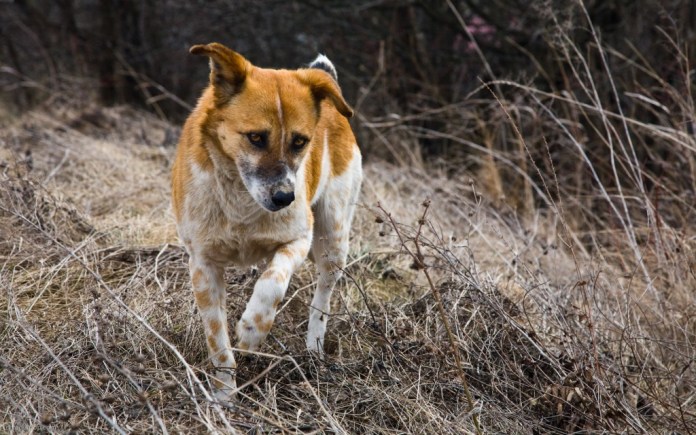
Suddenly, he became wary of his surroundings and started sniffing the air with a worried look. He kept looking at me, then at something in front of us. I could see nothing. I only heard the distant bleating of sheep. Billy hung around for a couple more minutes, signaling that we should return, then, seeing I had no intention of doing so, turned around and headed back home by himself. I laughed and wondered why he did it, but kept walking my way. I soon discovered the source of his fear. It was the vicious sheep dogs who were guarding the flock of sheep in the distance. As soon as they saw me (I was downwind, so they couldn’t sniff me), they charged right at me, three of them. I was ready. I had my tripod, which is nice and thick and just the right size for bashing in the head of a violent dog. I raised it above my head and waited for the first lunge. It didn’t come. They stopped a few feet away and kept snarling and barking. I advanced toward them. They retreated. The shepherd finally came in sight, saw what was going on, and called them off. They obeyed and left me alone.
I walked off, finished the route I wanted to do that day, and started to walk back home. The flock of sheep were still around. I tried to keep a safe distance and avoid another encounter, but this time they sniffed me and came at me again. I raised my tripod again, ready to put out their lights, and again they retreated, leaving about 10-15 feet between me and them. But they were still barking like crazy. I called over the shepherd and had a talk with him. I told him I’d have no qualms about quieting his dogs if he couldn’t control them. He disagreed, and said they wouldn’t attack if I stood still. I didn’t test his theory, because it might have proven painful and hazardous to my health. I went home instead and warmed up by a nice fire.
So you see, Billy wasn’t the coward I thought he was. He knew what he was doing when he hightailed it out of that area. The scar you see on his muzzle in the photo above is apparently the reminder of a fight with sheep dogs — that’s what our relatives told us.
What’s to be done about those dogs?
The way I see it, two things need to happen in Romania when it comes to dogs. For one thing, the stray population needs to be controlled. To this point, city governments, working with NGOs and veterinary offices, conduct neutering campaigns every once in a while, but it’s not working.
Perhaps euthanasia of unwanted strays is a solution. I know it sounds cruel, but stray dogs are a real danger, and they need to be off the streets. They need to be put up in shelters, where if they’re not adopted within a certain time period, they’re euthanised. Why condemn unwanted strays to a life on the streets, in bitter cold or fierce heat, with little or no food, to the risk of accidents that maim them and leave them in pain for life, when they could rest in peace? If we were to judge the situation coolly, we would realize it’s not feasible to take care of all the strays. Perhaps if the money and the interest were there, we could feed them and neuter them all, but neither the money nor the interest is there. We can’t find adoptive families for all of them, either. Why not put them to rest? At least they won’t suffer anymore.
I look forward to the day when I can run on city streets or on a beach in Romania and not have to worry about being mauled by strays. I’m sure a lot of other people look forward to simply being able to walk the streets without being mauled by strays.
The second thing is that dog owners need to start being more responsible about their dogs. At the very least, they need to teach them when to bark and when to keep quiet. That’ll go a long way toward cutting down on unnecessary noise and headaches. As I write this, some mutt a few houses away is barking like a nutcase at something of no consequence. He’s been driving me up the walls for the past few days. I honestly think the dog’s owner ought to be fined for his lack of concern and for the noise pollution. That should be another measure implemented soon by local governments.


 Raoul Pop