Reviews

Meet LaserMonk in Chief

You wouldn’t think a monastery deep in the western woods of Wisconsin would be involved with re-manufactured laser printer cartridges, but there they are, a multimillion dollar business, up to their necks in profits… See, the monastery was in dire financial straits, and Father Bernard McCoy, now the Chief Operating Monk, struggled to keep it afloat. One day it struck him as he searched for a way to save on toner cartridges. Why not tell others about the great deal he got? And why not act as the middle man and purchase these cartridges for them?

The monastery’s initial investment of $2,000 turned into $2.3 million in sales in 2005, and is expected to double this year. The monastery is out of the pits, and can now afford a private plane and a horse stable, among other perks. How do they manage the profits? The monks are all volunteers working for the monastery, and take no salary. LaserMonks is a non-profit. To top it off, Father Bernard has high plans. He wants to take over the toner market. With this sort of a business model, they’re a real threat to their competitors. I have to wonder about the scalability and sustainability of their business, but only time will tell.
Standard
Thoughts

Apple's notebook market share is now 12%

Among other news, like their 48% rise in profits, helped by the iPods, Apple has also proven the dominance of their hardware and software market by achieving a 12% share of the notebook market. That’s double its previous share of 6%, as measured from June of ’05 to January ’06. Over 75% of the new notebooks sold used Intel processors, which showed, beyond a doubt, that Apple’s move to Intel chips was the right one.

If you’re sneering at 12%, and saying that Dell or some other PC company might have more, think about why people buy Dells. Not one person I’ve talked with who owns a Dell says they love it. They buy Dells because they need them for their work. On the other hand, people buy Apple computers because they love the design. It’s a gut decision, not a business one. And as billions of beer bellies show, the gut wins every time. Expect Apple’s share of the market to continue to grow, and Dell’s to decline.

Standard
Reviews

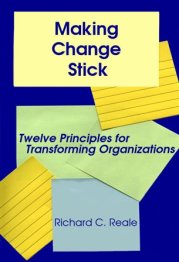
Making Change Stick: Twelve Principles for Transforming Organizations by Richard C. Reale

Making Change Stick: Twelve Principles for Transforming OrganizationsTwo figures stand out when reading this book: twelve and twenty. What do they have in common? The same man, Richard C. Reale. For twenty years, he’s studied why change fails and why it succeeds. Then he boiled down his knowledge base into twelve principles that are absolutely necessary if change is to happen correctly and last in an organization. The amazing thing is that these principles will not only ensure the success of a transformation, but will pay dividends in the long run, by having made an organization more change-capable.

So what’s missing? What’s causing organizations to fail when implementing change? The most common reason is the “failure to consider the human side of change.” It’s easy enough to draw the roadmap. The hardest part is the execution, the fulfillment of that plan. If you don’t believe it, just look at the last time you resolved to do something. What was harder: making the decision and putting some thought into how to best achieve it, or actually doing what you planned?

The twelve principles outlined in this book allow organizational leaders to focus on the people, and to empower them to bring change to fruition. It’s about setting down the right process for change, and following along closely, making sure change is proceeding as planned. It’s about walking the talk, and encouraging people to do the same by praising their efforts to change, and setting them up for success. It’s about monitoring the right metrics, the ones that will tell you how you’re really doing. In theory, it doesn’t sound hard, but in practice, it’s another story. Fortunately, the author explains every one of the twelve principles in detail, and the examples he gives clearly illustrate the point. Inspirational quotes from notable personalities are also provided, to help drive home the point.

This book is a wonderful resource. Twenty years of “on-the-job” experience can’t be wrong. The author’s expertise shows, and will help guide the book’s readers toward that great goal of organizational change, which is a hard goal to achieve indeed. If individual change is hard, organizational change is orders of magnitude harder – but this book will show you how to do it successfully. Get it, and achieve lasting change!

Standard
How To

50 ways to promote your website

Just stumbled onto this. Merle from WebsiteTrafficPlan wrote a nice guide that lists 50 Ways to Promote Your Website. It’s in PDF format and you’re welcome to download it by clicking on its link. Among the methods she recommends:

  • URL plates/stickers for your cars
  • Business cards
  • How to guides that list your URL
  • Classified ads
  • Press Releases
  • Ezines
  • PPC Advertising
  • and more

Although I know from personal experience that some of these methods don’t really deliver the results you’d expect, as a whole, it’s a good idea to diversity your advertising methods, in order to ensure the widest coverage. Besides, if you manage to get your name everywhere, it can’t hurt your business either. Just be aware of the cost of the methods, and track the conversions if at all possible, so you know if the money’s well spent.

Standard
Reviews

Measuring the cost of corruption

The World Bank has put together a very informative collection of papers and websites on corruption at this web page. They define corruption as “theft of public resources for private gain”, and they define and evaluate the various costs associated with corruption.

They name two in the summary: one is redistributive, and is incurred when businesses with political power abuse that privilege to get a contract at the expense of their competitors, and the other is a welfare cost, which is to the overall economy, and thus makes everyone worse off.

The papers and websites are all free to access, and the language is surprisingly clear-cut and demonstrative. This is a really good resource, and I encourage you to take advantage of it. Here is the link to it.

Standard