Thoughts

A way to make Shuffle better in iTunes and on iPhones and iPods

iTunes

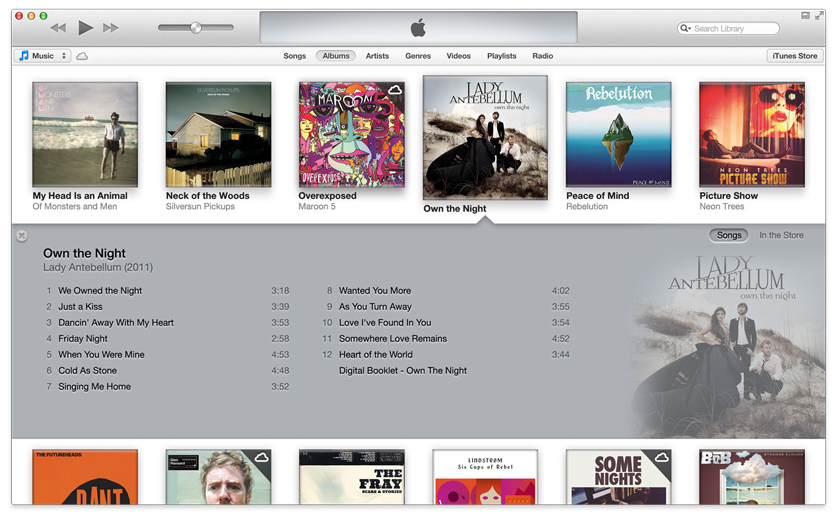
I don’t know about you but I’ve listened to all of the songs in my iTunes library. Repeatedly. Over and over and over. I keep buying new ones but inevitably, the play counts add up. And the ones I didn’t want to listen to, I skipped over. Repeatedly. Over and over and over. And therein lies the answer to making Shuffle better, both in iTunes and on our iPhones, iPods and iPads.

Apple, please tweak the Shuffle algorithm so that if a song is skipped over more than once, it won’t play it during Shuffle mode at all, at least not for a while. The auto-skip period can be tweaked in the settings (in iTunes and on our portable devices). And we should also be able to decide whether we want these songs to sync to our devices at all, sort of like putting them in hibernation. Maybe even create a special section in the Library where a smart list will display these pariah songs when needed.

Some of the songs I bought have started to annoy me so much that I deleted them altogether. I suppose you can’t help that with music. You like it, then you don’t. You need a break from it. But when your iPod or iPhone keeps shoving it in your face, particularly when you’re driving and you don’t want to be bothered with skipping over songs, then that song begins to annoy you enough so that you get home and delete it from your iTunes library, just so you won’t hear it again.

And Apple, please don’t do this only in iTunes. Make sure you do it for iPhones and iPods as well, and for the older models, too. I still have a 1st gen iPod Touch that I use from time to time, and its software hasn’t been updated in years. It’d be nice to get some extra life out of it once the new Shuffle is brought out.

Thanks in advance!

Standard
Thoughts

A couple of suggestions for Waze

Waze

I’ve been using Waze for over a month and I love it. If you haven’t tried it yet, you should. It’s surprisingly accurate, even in a country where you wouldn’t think there’d be a lot of users, like Romania.

The traffic updates can get a little overwhelming in large urban areas like Bucharest and sometimes it doesn’t find an address I need, but overall, it’s a wonderful app and the idea of a user-driven (and updated) map is awesome. Live traffic alerts and automatic calculation of the best route based on current traffic conditions are awesome options (these used to cost a pretty penny with GPS devices and weren’t very good nor up-to-date).

Here’s a way to make Waze better: use the accelerometer in our iPhones to automatically determine if the road is unsafe, based on braking, swerving, stopping and yes, even driving (or falling) through potholes. I love being able to report a road incident but when I’m swerving through potholes and recently dug up roads (like the one between Medias and Sighisoara), I don’t have the time nor the multitasking brain cycles to tap on my phone and report a hole in the road. So doing this automatically and reporting it to the users would be a wonderful new addition to Waze. I’d love to get an alert on my phone as I’m driving through fog or rain, when the visibility isn’t great, telling me there’s a pothole ahead. And by the way, Waze, have you thought about hooking up weather info to the traffic reports?

One thing that always annoyed me with GPS devices is the constant repetition of stuff like “take the 2nd exit” or “turn left”. The new version of Waze seems to be doing the same thing. I’d love an option in the settings where I could specify that I’d like to be reminded about such things a maximum of two times (not 3 or 4 times…)

A big thanks to the Waze team for the awesome work!

Standard
Thoughts

What can you do with corners?

Say you’re stuck inside but you’d love to use your camera and take some creative photos. What can you do? How about a play on lines and colors? You can use your very own walls and corners, and then you can manipulate the photos in editing to make them even more interesting. It’s a wonderful exercise in creativity. Here are some photos I took at home one evening, where I did this very thing.

Standard
Thoughts

A new faucet design

I had an idea recently about a new faucet design. (If you’ve been reading my website for some time, then you may remember I post my ideas here — when I remember to write them down and don’t forget them.)

When you look at a shower, right after it’s been used, you’ll see the splash line is somewhere at chest or shoulder level. Very little water goes above that line, unless you’ve been monkeying around in there.

If you’ve also seen the pipes being put in for a shower, and the faucets also being put in, you’ll know that first the pipes have to be laid in the wall, then the tiles placed over them, making sure to leave two holes with the appropriate hot and cold water connections for the faucets. And these holes happen to be right at waist level, where it’s easy for most people to reach the faucets — and where most water also happens to splash.

What you’re essentially doing is piercing the water barrier (the tile or marble wall) with two big holes right where you throw the most water. If you’re concerned about water seepage into your wall, or if your walls already have water issues, then this isn’t the smartest thing to do. Plus, there’s a lot of mildew that accumulates around those two holes, and no matter how much silicone you put there, you still get mildew and overtime, you still have water seepage into the wall.

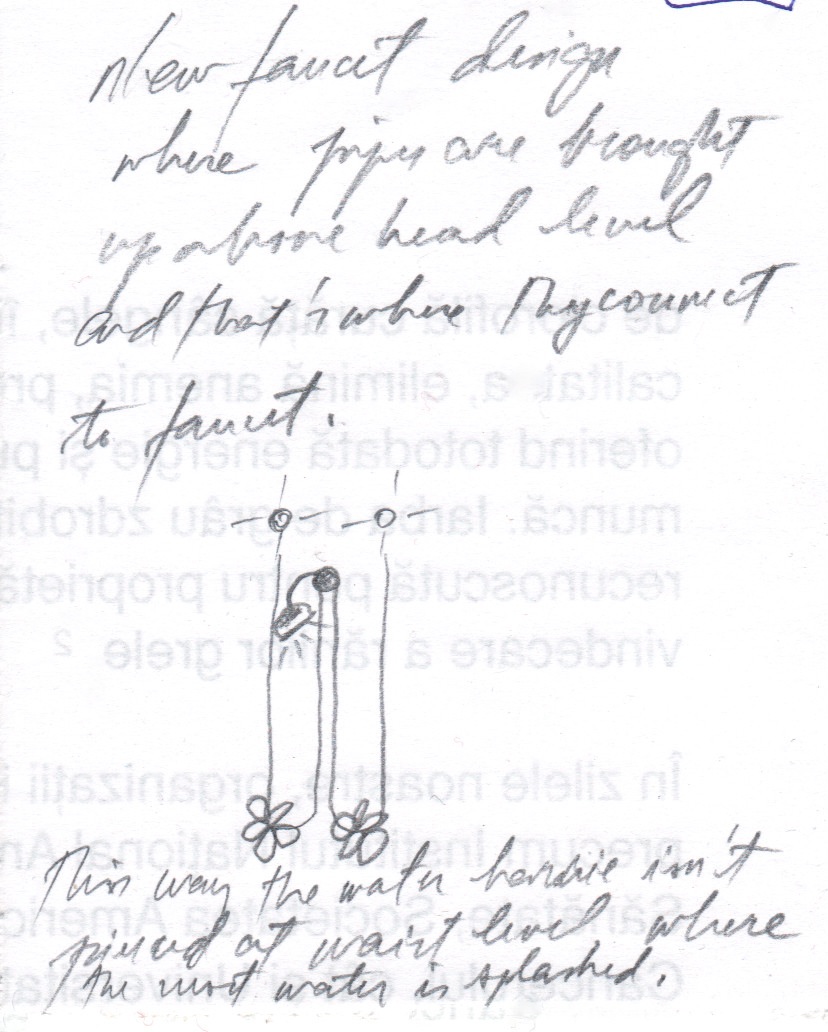
Behold my new faucet design, which does away with this problem. I scribbled it down on a piece of paper when I got the idea.

The point here is that the two faucet holes are brought up above head level, above even the shower head, where water is seldom splashed, if ever. The faucet design consists of its two attachment points at the pipes, with hot and cold water lines coming down, exposed, to waist level, where the faucets are located, then continuing upward to the spigot, where they unite (or they could unite down, in-between the faucets, then come up to the shower head as one pipe). The shower head can be included as part of the package, or you can attach your own shower head to the faucet assembly.

So, there are three points of attachment for this faucet assembly to the wall. Two at the faucet lines and one at the shower head. There are no screws that connect the faucets to the wall at waist level. There the faucet assembly has two contact points with the wall, dressed in rubber, which can be left as is or secured to the wall with a bit of silicone.

What are the implications of this design? Well, it will clearly be bigger than normal faucet designs. It’s also not going to be for everyone. It’s going to be for those discerning consumers who want to reduce the seepage of water between their shower cabinets and the wall, who want to protect the beauty of their shower walls, and who are interested in a new design.

It also means that the builders will have to be clearly instructed where to place the new faucet holes. This faucet will need to purchased ahead of time and its exact location determined before the bathroom walls are laid with tile or marble or precious stones. It also means existing bathrooms cannot be fitted with this new faucet unless significant modifications are undertaken to the shower cabinet.

Like I said, this new design isn’t for everyone. It’s for certain discerning consumers.

Standard
Thoughts

Where’s the Netflix Shelf?

The more movies and shows Ligia and I watch on Netflix, the more convinced we become that Netflix lacks a vital feature. We call it the Shelf. Where is it?

The Netflix Shelf would hold titles we’ve seen and loved. It would contain two collections: a smart collection, which would automatically bring together the titles we’ve rated 4 stars or higher), but more importantly a manual collection, where we could add titles we’d like to watch again in the feature — movies and shows we really love, perennial favorites if you will.

Within the Shelf, we could sort titles by genre, keywords, actor or director (using the metadata added by Netflix staff or metadata we could add ourselves).

There were so many occasions we saw a movie, loved it, wanted to store it somewhere so we could see it again in the future, but didn’t want to leave it in the queue, cluttering up the list of titles we still haven’t seen. There was and is no place for them yet, and that’s regrettable, because it’s a lost opportunity for Netflix to create customer goodwill at a time when they need it.

Standard