Places

A drive through the Carpathian Mountains in early spring

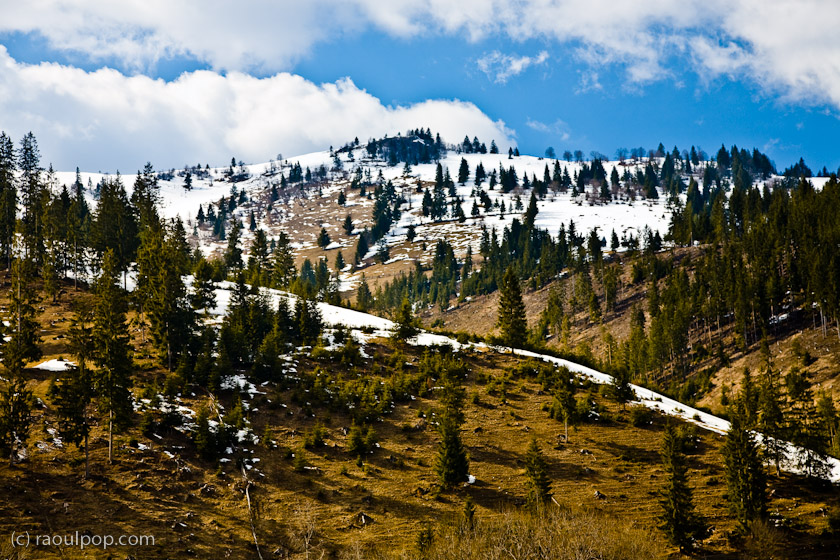
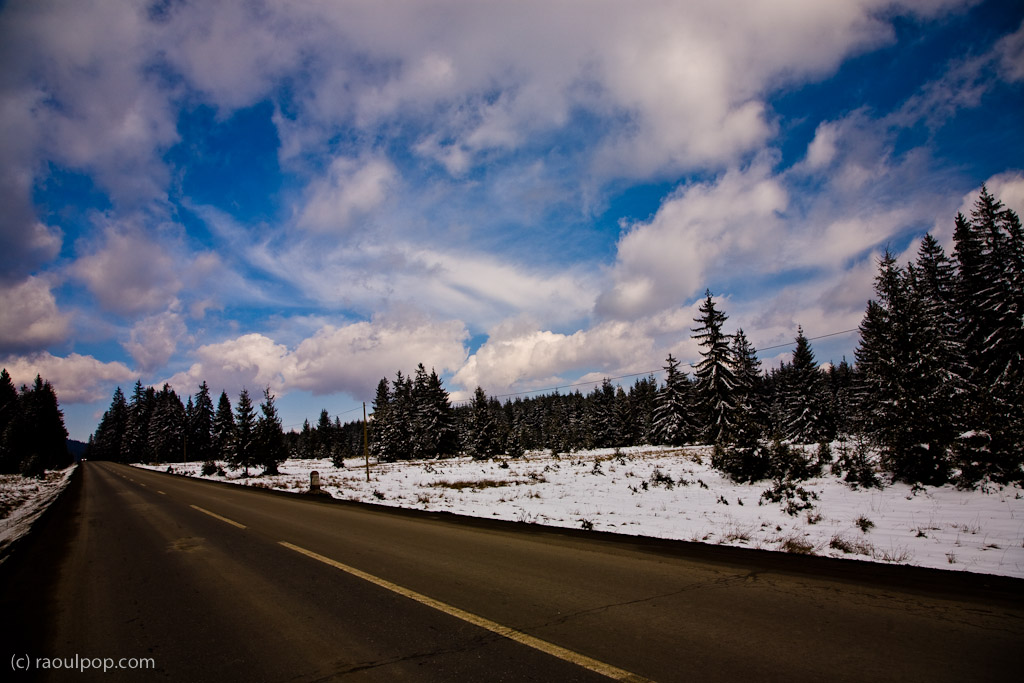
In March, we crossed the Carpathian Mountains in the county of Harghita, Romania, as we drove from the city of Bacau to Medias. The route was scenic and there were lots of beautiful places to stop and admire the view. Snow still covered the mountain peaks, and it covered the ground as well at higher altitudes. The roads got pretty bad at times, as is quite often the case in Romania, but they were fairly decent about half the time, which is something — for Romania. At any rate, the places we saw are among the more beautiful in the country.

I recorded a short video clip as we drove through the high peaks of the Harghita Mountains, and stopped in various places to take photographs. The video clip is embedded below. If you’re reading this on my feed and it doesn’t show up, then you can see it in my Video Log set.

Pin the tree on the mountain slope

The white line you see at the top of the abrupt mountain slope above isn’t a lens aberration. It’s snow. It covers the other side of the mountain. The visible slope is too abrupt and windswept for the snow to keep, so all that’s left is some dry brush and a few trees.

High altitude

Here we begin to approach the tops of the peaks, and snow is more abundant.

Zig zag patterns

The road hugs the mountain side closely as it curves upward. I love the wooden fence alongside the road, it’s so well suited to the place.

Lonely at the top

A small mountain cabin holds onto the top. It leans to the left, either because of the settling of its foundation over the time, or because of the strong winds at that altitude.

This is the road where I recorded the video clip you see below.

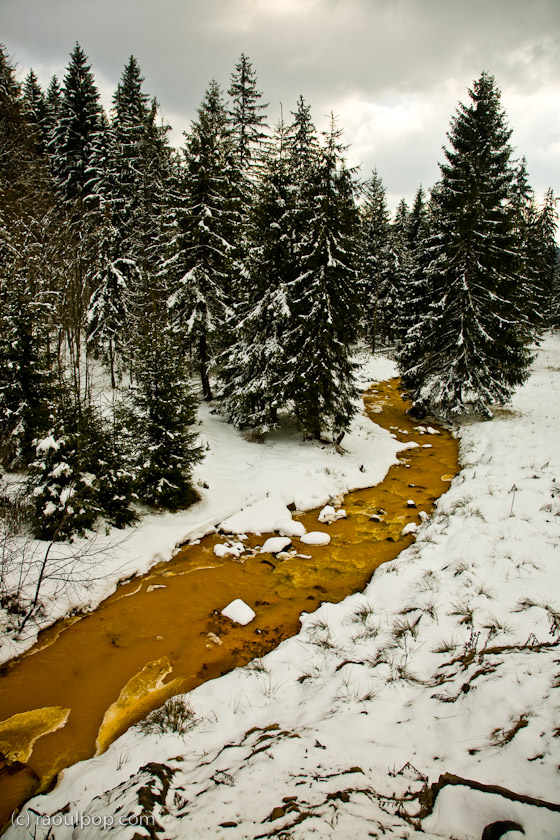
Iron ore

This mountain brook wound its way through a conifer forest. I think its color is either given by the mud in that region, or by iron ore deposits in the brook bed.

Here’s the video clip, recorded from our car, while driving.

See this video at YouTube or SmugMug.

Further reading

Standard
Places

After midnight

A night photograph of the village of Matrei, taken from Hotel Goldried. Various lights in the valley below illuminate the houses and fields, while moonlight casts a white glow behind the mountain in the background.

A night photograph of the village of Matrei, taken from Hotel Goldried. Various lights in the valley below illuminate the houses and fields, while moonlight casts a white glow behind the mountain in the background.

Standard
Thoughts

Just give me a good zoom lens, thanks

Greetings from Osttirol! My wife and I have been vacationing in Austria for the past week. It’s a gorgeous place to visit and, needless to say, I took tons of photos here. I’ve been carrying my Canon 5D and my lenses with me everywhere, and let me tell you, I’ve been sorely in need of a good zoom lens.

The lens inventory in my camera bag is woefully short at the moment. I started out with three primes: EF 24mm f/1.4L, EF 50mm f/1.4, and EF 100mm f/2.8 Macro. I sold the 24mm prime with the intention of buying the EF 24-105mm f/4L Zoom, but other circumstances intervened, and now I’ve only got the 50mm and 100mm lenses.

There are some who say it’s better to have prime lenses. I disagree. I’d like to see them carry five or six prime lenses in a backpack up and down a mountain in order to get the range that one or two good zoom lenses would give, and then tell me if they still feel the same way. And by the way, try changing lenses in swift mountain breezes, with insects buzzing around you and just dying to get inside the sensor chamber and leave smudge marks (which happened to me). Oh, and don’t forget to throw in a few other accessories such as polarizers and UV filters of various sizes for the different diameters of each lens, plus one or two water bottles and a fleece jacket plus an umbrella in case the weather goes bad, and then we’ll talk…

In a way, I was glad to only have to carry two lenses; I’d have really felt the weight of a third one. But I felt so limited in the photos I could take, because I could only use the 50mm or the 100mm lens to frame my photos. In some instances, I could walk back and forth to get a better view or angle, but in others, there was no way to get a better photo without also being able to fly — which incidentally, would be very nice, but I haven’t figured out how to do it yet. And no, I don’t believe in cropping. I only do it when I absolutely have to. I didn’t pay $2,800 for a full-frame sensor that can take 12.8 megapixel photos so I could crop them and get the same resolution I can get from a $500 camera.

To this day, I slap my head when I think that I could have had the 24-105mm zoom lens as a kit lens with my 5D for a little over half its usual price. I was such a fool not to get it! It’s a light and sharp zoom with more range than the EF 24-70mm f/2.8L, and you can easily walk around with it for hours without getting too tired.

So far on this trip (which ends very soon, unfortunately) I took 1904 photos with the 50mm prime, and 471 photos with the 100mm prime. If I had had (don’t you just love the English language) the 24-105mm zoom on my trip, it’d have stayed on my camera 95% of the time, because that’s the range I use the most, particularly on the wider end of that focal spectrum, which was not available to me, each and every day, how stupid could I be, ugh…

Look, I’m not knocking the 50mm prime, which is a great prime, and very cost effective given its low light capabilities and sharpness. And I’m definitely not knocking the 100mm prime, which is versatile and a fantastic macro lens with gorgeous bokeh. But I really didn’t need f/1.4 or macro capabilities for landscape photography, which is what I did on this trip. I needed a zoom lens!

So, if you’re not sure what lenses to get, don’t do what I did, or you’ll be frustrated to no end as well. First get a good, lightweight zoom lens, one that won’t kill your wrist as you carry your camera around taking photos. Later, as you find that you need more specific capabilities, such as being able to take handheld photos at dusk or dawn, or more bokeh, or macro photos, then spring for those primes that have the features you need.

Standard
Places

Shenandoah Valley panoramas

You are about to see several panoramic photos that have taken me well over 35 hours to create — and I’m not counting travel time, setup time, time it took to take the photos, and the time it took to write this post.

This slideshow requires JavaScript.

A couple of weekends ago, Ligia and I got into our MINI and drove up to Shenandoah National Park, for a single purpose: to take a few panoramic photos of the valley from the tops of the Appalachian Mountains. Fortunately, that simply meant driving on beautiful, scenic Skyline Drive and stopping at various points to set up the tripod and take series of shots that would later be stitched together. Unfortunately, the weather wasn’t exactly collaborating, in spite of the cheery weather report. The day was neither sunny nor cloudy. The light was diffuse and had that washed, in-between quality that doesn’t really make it good for anything. But, I was there, and if that’s what I had to work with, so be it.

As it turned out, driving out there and taking the photos was the easiest part of the whole thing. Like I mentioned in the opening paragraph, putting together the panoramas was by far the longest, most excruciatingly slow stretch of processing work I have ever done. I do not recommend it to anyone, for multiple reasons, which I’ll mention below. If you just want to see the photos, skip ahead.

A few thoughts on the whole thing

I will not do panoramas very often in the future, unless I’m commissioned to do specific ones. If and when I do another panorama for myself (not for a client), it will likely only be a 5 to 10 photo image, simply because it takes an enormous amount of time to stitch and process them on the computer if they’re made up of more images than that.

For one thing, you would need a super fast, quad-core or better computer loaded to the gills with RAM to get any sort of decent speed while processing panoramas. A Mac Pro worth about $7,000 or better should do the trick. Seriously, every single simple operation, like cropping or rotating, took at least 10 minutes or more to execute. Sometimes just assembling a single panorama in Photoshop (through the Photomerge feature) took about 45 minutes. I have the latest MacBook Pro laptop (2.5 GHz Intel Core 2 Duo processor, 512 MB video card, 4 GB RAM), and it still took what seemed like forever to get through each panorama.

The resolution of the photos also matters. My individual photos are 12-megapixels each, at 240 dpi, made by a Canon 5D. Just imagine how much processing power is needed to put together 20 or 30 of these photos into a single image!

People don’t appreciate panoramas. I bet you most people will skim this post, unimpressed, and move on. You can’t really appreciate panoramic photos unless they’re printed out in their full size and spread out on a wall, right in front of you. You can’t appreciate their size on your computer monitor, no matter how large it might be. The largest single monitors nowadays are 30″ and have a maximum resolution of 2560×1600. That’s equivalent to about 6 megapixels at 72 dpi. You can’t possibly appreciate a 12 megapixel photo at 1:1 size on a current-day monitor, much less a panorama made up of 20 of those photos.

As an aside, don’t confuse monitor size with resolution. There are LCD HDTVs on the market that are 42″, 46″ or more in size, but they can only display up to 1920×1080 pixels, which is much less resolution than a 30″ monitor.

I can’t show you the full panoramas on my site, because of photo theft. Not that I think my panoramas (these ones in particular) are spectacular and would fetch amazing prices, but I know for a fact that if I post my panoramas at full resolution, there will be people who will steal them and try to profit from them.

How does the new Lightroom 2 Beta handle panoramas?

After I processed the photos in Photoshop CS3, which worked without crashing for the whole bunch, although it ate an amazing amount of space on my hard drive for its scratch disk, I imported them into the new Lightroom 2 Beta, to see how it would handle them.

Most of the photos were over 1 GB in size, uncompressed. Because I saved most as TIFs, using ZIP compression, their file size on disk was significantly lower. Lightroom did amazingly well to start with. It created small previews very quickly, and also created the 1:1 previews much quicker than Photoshop would have been able to render them. I was able to use the spot heal brush to remove sensor dust spots, and also used the new selective retouching brushes, without any problems. Lightroom 2 was able to do these things without significant delays, and would show the effects instantaneously.

LR2 only started hiccuping when I started to add some meta-data to the photos. As I went through and added meta-data, then opened them at 1:1 size once more, it would hang, literally forever. I had to keep force quitting it, and had to do that regularly, for each and every photo that I wanted to look at. Interestingly enough, when I wanted to export the panoramas to use them here on my site, it did it without any problems, and without crashing. It’s certainly odd behavior, but it is in Beta after all.

On to the photos

While I cannot post the panoramas at full resolution here, I did post them at higher sizes than I would normally post, in order to give you a better idea of what they look like. I also created 1:1 previews of regions of each photo, to help you realize how big they really are.

If you click on each panorama (not its 1:1 detail), it will take you to its photo page, where it will tell you how large it is (in megapixels), and how many photos went into making it. If you click on it again (on that page), it will take you to its larger size. Sorry for the double-clicking, but that’s how things work in WordPress these days.

First, a panoramic of Skyline Drive itself. This road is amazing, and I’m so glad the US government decided to build it back in the 1930s. It literally hugs the tops of the Appalachian mountains and lets average John and Jane drive on top of the world (as high as possible in this area of the world, anyway).
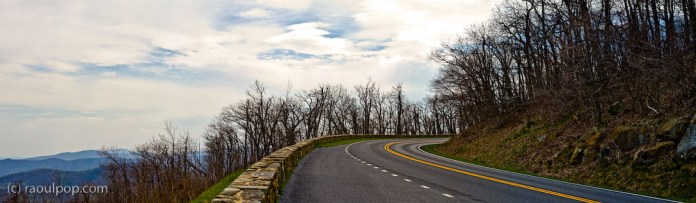
We stopped along Skyline Drive, parked our car, and took a hike through the forest on one of the paths marked out there. In the middle of nowhere (literally), we found this cabin, called Range View.
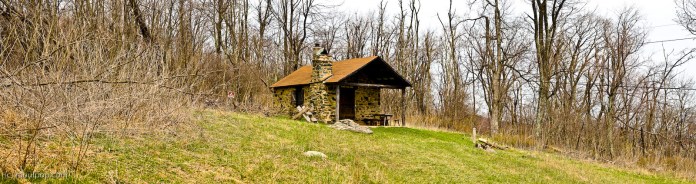
It was a darling little place built out of stone and off the grid (in spite of the fact that wires ran right above it). The fireplace was outside the cabin, by the front door. While the place was locked up and the windows equipped with thick wire and netting, Ligia and I could spot beds and various pieces of old furniture inside. Don’t know what it’s used for nowadays, but it is used, because there was an open bottle of wine standing in plain sight near one of the windows, and it was of recent vintage.

The rest of the photos, including the 1:1 previews, are found in the gallery below. Click on each to get to the photo page, then click again to see it in a larger size. Enjoy!

Standard
Places

Dawn over the Atlantic Ocean

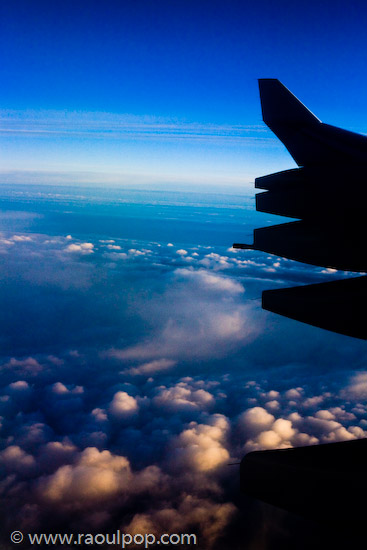
This will be my 1,000th post, so perhaps it’s fitting that it be this: photos of the dawn, breaking high above the clouds, somewhere near the coast of France. It symbolizes a new beginning, a milestone — although I have to confess it came by surprise. I hadn’t monitored the number of posts for a while. By chance, I glanced at it yesterday and saw the fateful sum: 999. That’s when I knew I had to make this 1,000th post a little more special than the rest.

We were on our way to Paris from Washington, DC, on board an overnight Air France flight. We were going to have a short layover at Charles de Gaulle airport, then fly to Bucharest, where a rental car awaited our arrival. From there, we’d drive north, crossing the Carpathian Mountains to reach my grandfather’s house in Transylvania.

I liked Air France. The chairs were fairly comfortable, there was more space between the rows than on Austrian Airlines, and all of the seat gadgets worked, which was very unlike Alitalia (see paragraph 7 of that post for the details). The food was great, they got our menu selections right, the stewards and stewardesses were friendly and polite, and we had a good experience overall. I would fly with them again.

I hadn’t slept much all night. I can’t sleep very well on airplanes — I should probably say I can’t sleep much at all on airplanes. There’s the noise, then, of course, the “wonderful” seats and the lack of humidity, etc. I usually watch movies to pass the time while I gasp for air and pour water down my parched throat.

Outside, pitch black darkness stared back at me, and the faint reflection of a bleary-eyed traveler bearing my resemblance was visible in the window. Had there been no one around, it would have been eerie. But Ligia was next to me. She was sleeping somewhat peacefully, and that comforted me.

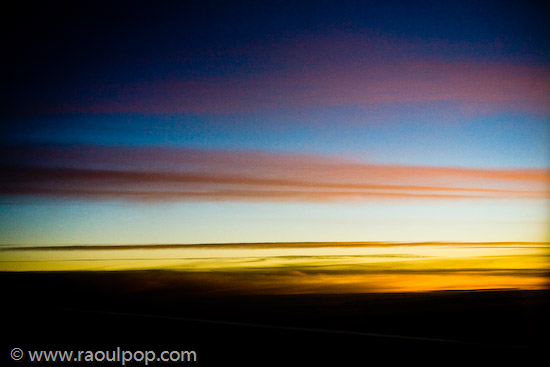
As morning approached and the first rays of light began to break through the darkness, Ligia woke up. I took out my 5D, and stood ready for that fleeting moment when color and light would combine to produce something worth capturing. Here it is.

Dawn breaking

At 33,000 feet, the cloud clover stayed below, and only its remembrance remained, in the shape of wispy lines that traced alongside us.

I kept my camera ready in case other opportunities presented themselves, and I wasn’t disappointed. A supersonic jet passed by us, leaving orange-yellow contrails in its wake.

Jet set

No matter how commoditized flight gets, there are still a great number of people that can never afford to experience it. I suppose that has its pluses and minuses. On the plus side, enough pollution is generated by existing airplanes, so perhaps it’s better that their number is kept somewhat limited. On the other hand, many opportunities open up to you when you can travel so fast. Trips that take days suddenly take only hours. Life, for better or worse, gets faster, and you can do more. I suppose that can be both good and bad, depending on your point of view. I’m on the fence about it myself.

The rarefied life

We found ourselves in our rental car, driving toward Transylvania, that afternoon. We drove through the evening and part of the night. Road repairs made our trip unnecessarily long, but that’s a story for another day. As we were driving through the Carpathian Mountains, night set in, and I stopped to take this photo.

A closing account

As we paused to rest, we thought about the last 24 hours. In that relatively short span of time, we’d traveled over 4,000 miles and still had a few more to go.

Life moves fast these days. If we’re not careful, we can end up old and tired, having spent a lifetime running around from place to place. Sometimes it’s worth more than we know it to STOP, even if it’s only for a few minutes, and look around us. That’s when we realize that those few moments of pause are more precious than whole days of nonstop action.

Standard