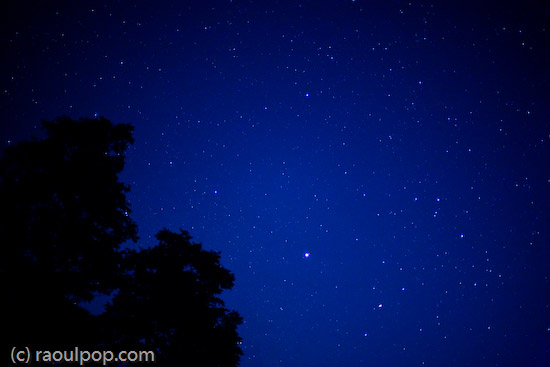
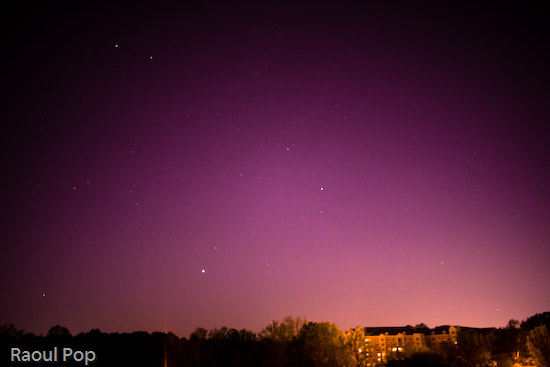
I took this photo during our recent camping trip to the Blue Ridge mountains, somewhere near Natural Bridge, VA. Although the sky was overcast during our first night, it cleared up afterwards, and we couldn’t believe how many stars were visible during our second night. It was so beautiful and peaceful, that I couldn’t help but feel God’s presence there.
Tag Archives: nights
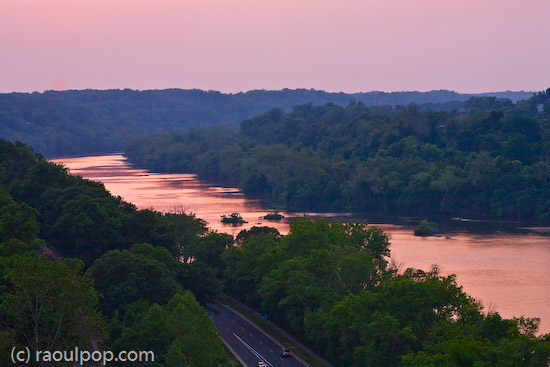
Night falls gently on the old river
This was taken from the roof of the Key Bridge Marriott Hotel in Arlington, VA. I’d just finished a meeting and asked a favor from John, the hospitality manager: could he please let me go up for a few minutes to take photos? He kindly agreed, and he, along with a security guard, escorted me through the labyrinthine corridors of the top floor onto the pebble-lined roof.
What a gorgeous view that hotel has! I quickly took a whole series of photos, and I still need to post-process quite a few of those. I really like this one, as it shows the sun just about to fade over the Virginia hills while the old Potomac River goes on about its business.
Impressions from Walt Disney World – Part 2
Our recent trip to WDW was also an attempt to document the place and our experiences through serious photography, and it was a worthwhile learning experience. Some questions that I asked myself as I set out to do this were:
- Am I prepared, equipment-wise?
- How do I manage to capture worthwhile photos given that I only have two days and there’s so much to photograph?
I thought I was prepared in terms of equipment. I had an anti-glare hood, an external flash, a tripod, an extra camera battery and the charger, extra memory cards and a lens-cleaning kit, not to mention a great camera case. The second question was a bit harder to answer, but things worked out okay because I relied on the following guidelines. I listed them below in no particular order, as they occurred to me:
- Never try to capture too much in a single photo
- Focus on what’s important or representative first
- Proper composition always pays off
- Walk, don’t zoom, when you can help it
- Use mid-range zoom and large aperture for portraits to blur the background
- Innovative angles sometimes add extra flair
- A clean lens means clear photos (for a DSLR, you can add a clean sensor to the list)
- More photos are a good thing
- Extra batteries are a must-have
- External flash beats internal flash any time
- Holding the camera steady equals clear photos
- A tripod is annoying but much needed in low light situations
- Don’t use high ISO unless your camera can handle it well
- Know how and why to adjust shutter speed
- Know how and why to adjust aperture
- Know how and why to adjust strobe strength
- Know your camera’s limitations and know how to work around them
- Avoid boring photos
- Frame subjects off-center unless the situation specifically calls for a symmetric composition
- Know where your camera’s focusing, or adjust the focus manually
- Too much light is a bad thing
- Too little light is a bad thing
- Use burst mode when you’ve got only precious moments to get a good photo
- Use the viewfinder instead of the LCD screen. Resting the camera against the forehead provides an extra point of support and reduces camera shake. It also saves battery life.
- Use the flash in daytime to fill in unwanted shadows
- Get a flash with a pivoting head, so you can vary the strobe angle
- Read the camera’s manual thoroughly. Read it again. And again. And again.
So what did I learn on this trip? Well, I learned that you can never take too many photos, especially with a digital camera, where you can easily delete what you don’t want. It pays to be well stocked with memory cards. And it really pays to have a camera that can take many shots on a single charge. My camera, currently a Panasonic Lumix FZ20K, goes (or it did anyway — more on that later) through a battery charge at 250 shots, give or take a few. Even though I had a spare battery with me, I still found myself running out of juice. It also pays to have a camera that can take photos at 400, 800 and 1,600 ISO without significant noise. There were so many beautiful shots I missed because my camera could only take shots up to 200 ISO without noise, and it could only go up to 400 ISO, period. When the lights turned on at the parks, everything was more beautiful, but my camera couldn’t capture it because I would have needed to set up my tripod for every shot. That’s a bit hard to do with throngs of people around you.I also learned that my external flash and glare hood were worth purchasing. My external flash helped me immensely with people shots at night, and even with large-scale illumination of buildings and walls. The glare hood was definitely useful during the day, especially when the sun came out from behind the clouds. I counted my blessings when I discovered I could tie my camera bag around my waist instead of carrying it around my shoulders. It was immensely helpful to have easy access to my accessories as I held the camera in my hands.
It cost me nothing to throw my lens-cleaning kit in my bag alongside my camera, and it paid off tremendously during my visit. My camera’s lens got pretty dirty during heavy use. I either touched the lens inadvertently as I fiddled with the lens cap, or the camera got splashed by water drops from fountains and various rides as I took photos. I had someone sneeze right as they passed me and my camera… Regardless of what happened, having the lens cleaning solution right there was a huge help. I just sat down on a bench, squirted a drop or two of the solution onto the lens, and wiped it with the special cloth. In about a minute, I was back in business with squeaky-clean lens, ready to take more great photos. When you take event photos, and you’re only there for 1-2 hours or so, you can always go back home or to the hotel to do some maintenance work on the camera (clean the lens, wipe the body a bit, charge the batteries, etc.) When you’re out in the field the whole day, things are a little bit different (and harder). That’s why it pays to be well-prepared.
A little bit about my camera. I used a Panasonic Lumix FZ20K on this trip. I purchased it back in October, as I decided to move up to a bigger camera from my current compact digital, a Kodak EasyShare Dual Lens v610. I’ve always been a fan of small cameras that I can tuck away in my pocket and carry anywhere, but as I got more serious about photography, I found myself always bumping against the various limitations of my cameras and getting frustrated. Still, I couldn’t justify getting a bigger camera, because of two reasons: price, and more importantly, portability. I didn’t want to lug around a camera case all the time.
I got the FZ20 as a stepping stone. I wanted to see if I’d be happier with a bigger camera that wasn’t as limited as my compact, and if I could handle carrying around a case on my trips. Things turned out well. I liked it, and I was happy with the quality of the photos it took as well. I didn’t mind carrying around the camera case, and enjoyed being able to pick from a variety of accessories as needed. I looked forward to using the FZ20 for another 6 months or so, then transitioning to a DSLR. Unfortunately, the FZ20 started malfunctioning during this trip. The zoom stopped working properly, and didn’t respond when I needed to bring it back to wide from tele shots. I’d have to turn the camera off, then back on. It wasn’t fun, and after only a couple of months of use, I was disappointed to see it malfunction. Thankfully, I’d purchased it from Costco, which has an amazing return policy. Other than computers and laptops, you can return merchandise at any time. That’s fantastic! I ended up returning it yesterday, and now I’m back to my Kodak v610, which still works great, but has certain frustrating limitations and no image stabilization. 😦
I’m now saving up for a DSLR. I don’t want to buy an entry-level DSLR, because I know I’m going to be frustrated with its limitations sooner or later. I’d rather get a full-featured model that will cost more but provide me with the features and quality I need. While I was at WDW, I noticed that most of the photographers at Disney (the ones that offered to take portraits) were equipped with Nikon D70s, but those are already more than 2 years old. I’m looking at the Canon EOS 5D and Nikon D200.
I’ll post some of the photos from Walt Disney World this week or next week. There are a lot of them and I need to do some post-processing work to get them ready.
Camping in the Shenandoah National Park
This past weekend, close friends of ours and Ligia and I went camping in the Shenandoah National Park. It was a surreal experience. We left a little later than we’d planned, and caught the rush hour traffic heading west on Route 66. We rued our day as we slowly crawled through miles of clogged up highway, but when we got out of the Manassas area, the traffic improved.
At any rate, we’d been slowed down enough that we arrived on Skyline Drive after dark. Then, it started raining as we approached the park. As if that wasn’t enough, fog set in and we could barely see ahead of us. But after all, we were traveling on mountain tops, and it was the start of fall, so the weather can be pretty unpredictable and wet. After trudging around in the dark, we got to the camp, and found one of the few remaining spots for the night. We were shocked to find out that they were booked solid and there was a waiting list. Our friends, who wanted to stay for two nights, couldn’t.
We bought some firewood and headed to our camp site, dreading the experience that would follow: pitching our tents in the dark, in rain, and in strong wind. Fun isn’t the word to describe it. We turned on our headlights and kept them on as we unpacked the tents and raised them. I’ll spare you the muddy details, but you’d be amazed what four pairs of helping hands, working in unison, can accomplish when under pressure.
We got the tents up, then tried to eat. What to eat? We wanted to heat up the food, but we needed a fire. Have you ever tried to start a fire while it’s raining and windy? No copious amounts of lighter fluid and paper will help. It kept dying down, even though the wood was dry. Finally, I gave up and called in the reserves: our friends. They both tried it, persevered, and finally succeeded. We gave up warming the food and ate some cold sandwiches instead, as we sat and warmed ourselves by the fire.
Fireside chats? Not that night! After we got done eating, we went directly to bed, where another surprise awaited us. Our tents were summer tents, and while they held up very nicely in the wind and rain, they were, shall we say, constructed more for the purpose of aeration than insulation. Luckily, we’d brought plenty of covers, but our friends didn’t. Even though they didn’t admit it, methinks they froze their butts off during the night. And what a night! A gale wind blew the whole time, and waves of rain beat down on our tents. It was noisy and lousy, and cold. It took me a while to fall asleep, but thankfully, I stayed asleep till morning after that. We woke up early, with the wind still blowing outside. The rain had stopped, and I managed to get a fire going without help.
We ate our breakfast and had tea, then had two wonderful surprises. One was the Monarch butterflies, in various stages of development, attached to the exterior walls of the bathrooms. Why they picked the bathrooms I don’t know, but that’s where I found them.
I found the gold lining on their cocoons truly amazing. That’s actually what drew me to them in the first place. If I hadn’t seen the gold spots and crown lining, I’d have passed by them like many of the other people using the bathrooms. It’s no wonder they’re called Monarch butterflies. They sure look regal with those spots of gold, don’t they?
Then Ligia had the second surprise. She found a wild apple tree, and picked a few apples. (They were delicious, by the way.) What do you think she found on one of them? An Eyed Hawk Moth larva, of all things! What was it doing in the Appalachian mountains? It normally lives in Europe. I don’t know, but it was a beautiful thing to behold.
After our breakfast — and this time we could chat around the fire — we took off and went hiking on the Rose River Trail. Our goal: Rose River Falls. The trail was easy and beautiful. Here are a few photos from the hike:
Rose River turned out to be a brook in the forest — quite the optimistic name for a brook, isn’t it? 🙂
After the hike, we had a wonderful late lunch at the Skyland Lounge, then headed out on Skyland Drive, and stopped along the way at overlooks to take photos of the gorgeous vistas. Here are a few of them:
Was it a wonderful trip? You bet your britches it was, and I’d do it again in a heartbeat, even with all the nightmarish traffic and surreal weather.