Thoughts

The Internet is not a truck

You may or may not have heard about the serious gaffe on the part of Senator Ted Stevens (R), who is Chairman of the Senate Committee on Commerce, Science, and Transportation. He voted against the Net Neutrality Act, and gave a speech on the Senate floor to explain his actions. He may have been better off not saying anything.

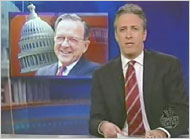
By giving this speech that keeps on truckin’, Senator Stevens has shown that he wasn’t knowledgeable enough about the issue to even speak about it, much less vote on it. It worries me that he’s in charge of a committee charged with deciding on matters as important as science, commerce and transportation, when his understanding of the Internet is that it’s a “it’s not a truck, it’s a series of tubes” that can get “clogged up”. I wonder which telecom lobbyist fed him that analogy. At any rate, the aftermath of the speech is haunting him, and one of the funniest takes comes from The Daily Show’s Jon Stewart.

I am reminded of an Abraham Lincoln quote: “Better to remain silent and be thought a fool than to speak out and remove all doubt.”

Standard
Thoughts

China's growing energy problem, and the US policy quandary

Just read an article written by someone at AP and published on MSNBC, entitled “World feels China’s growing thirst for oil“. I wish they’d publish author names as well! This was a very well-written article, and full of insights into the issue.

If you thought China’s energy demands are small still compared to the US, you’d be right, but what you may not know is that they’re growing at a much larger rate than US demands. What this means is that oil companies in China, a country short of energy reserves of any kind other than coal, have been busy bees for the last decade, striking deals all over the world to meet demands.

China is now competing directly with Japan for energy, and indirectly with the US. All of this leads to tension, especially when China tries to strike up deals that lock the oil reserves only for its use, and when they support abusive regimes in countries like Iran and Sudan, undermining US foreign policy.

If you think this isn’t serious, think again. Here’s a quote from president Bush: “Oil — the dependence upon oil is a national security problem, and an economic security problem.” To back up his words, the US has built a strong naval presence in the Malacca straits, the narrow passage through which most of the traffic from the Middle East and Africa moves on its way to East Asia. This concern isn’t partisan. Democrats – Joe Lieberman being one of them – agree with Bush’s characterization.

I recently read through a World Bank report that I can’t share here, which said that China’s energy demands will only grow. They’re exploring many routes, one of which is hydroenergy, most of their energy still comes from coal, and oil needs will continue to increase.

My take on it is this: the problem is that they’re the biggest manufacturing center in the world. Companies everywhere have shifted their production facilities to China because of its cheap labor costs and lax environmental standards. So it’s a bit hypocritical to expect China to regulate its energy use while they’re making most of the products for the Western world.

The point is, the industrial portion of the global economy has to reside somewhere, and China’s the place right now. I don’t foresee a decrease in that sort of energy consumption as a whole – the world population’s increasing, not decreasing. If China decreases its production, factories will have to be built somewhere else to meet demand.

To see how truly complex this problem is, you have to look at the relationship between China and the US. They’re propping up the US economy by investing heavily in our bonds and economy. We also depend on them for various of our manufacturing needs, whether we like it or not. China could easily hurt our economy by withholding investment. We’ve got a Communist country propping up a capitalist country. Do you see the irony in this? We have to plead with them to regulate their currency price in order to add more value to our dollar, and we threaten them with military force (very subtly, but effectively) in the Malacca Straits and other places, like Taiwan, which is another hot button issue. Isn’t it a messed up world?

While all of this is happening, we aren’t getting our act together when it comes to reducing our energy needs and investing in renewable energy. We complain when the price at the pump goes to $3, when we should think about conserving energy, especially when it comes to automobile use. We are still privileged in the US. We enjoy low prices for energy while the rest of the world pays $5 to $7 per gallon. We, the general public, keep blaming the oil companies and calling them our enemies, when they’re trying to help meet growing demand with dwindling supplies. We expect oil to be there when we fuel up at the pump, yet we don’t realize how volatile oil markets can be, for many reasons, political and environmental ones ranking at the top of the list.

We should wake up and thank God we’re so privileged in the US. Most of us don’t realize it. I’m writing this from Romania, where oil prices are around $6 per gallon, and most people make about $200 per month. Do the math and see if you could live with that! It’s time we woke up and started conserving, and it’s also time automobile manufacturers and other equipment manufacturers started making products that are more energy efficient. It’s also time city planners started building cities that are more pedestrian-friendly, with broad sidewalks and short walks to shops and other public attractions. We should do all this before we get into real trouble because of our thirst for oil. I don’t think any of us want global conflict on this issue.

Standard
Reviews

The Fog of War (2003)

Just saw The Fog of War (2003), a documentary of Robert S. McNamara’s time as US Secretary of Defense, and was blown away by the behind-the-scenes look at what goes on during troublesome times. What strikes me is how lonely, how isolated, these people who hold key positions of responsibility must feel. Sure, there are plenty of people advising you, but in the end, if you’re the one making the decision, it’s an utterly heavy responsibility that is solely yours.

How do you decide to kill 100,000 people, or even less than that? Could you live with yourself afterward? Can you make a decision like that even when there’s a chance the data is faulty and/or its interpretation is wrong? How many politicians currently vying for top spots would be ready to make these decisions? Do they know that’s what they might have to do? Do they know everyone else around them will fade into the background and the decision will hang, like a millstone, around their necks? When do you decide to cut the cord?

I’m also impressed by the need to be more forgiving of the decision-makers of today. I can’t imagine the pressures of power have changed. If anything, they’re even more stressful nowadays. Yet so few people take the time to understand the issues before they start criticizing. I’ve been guilty of it myself. Robert S. McNamara makes a very good point in the documentary. One of his principles is that you should empathize with your enemy, in order to understand him. I’m not saying politicians are our enemies, but I think we should take the time to really understand where they’re coming from and the situations they’re facing before we, too, declare war against them, and yell for a change of office. The fact is, everyone makes good and bad decisions, and when the pressure of office is on, it’s even harder to sort through all of the conflicting information and do what’s right. You’re going to get some things right, and some things wrong, no matter what. We’re human, and we err. We can’t trust our senses and our perception of events is often wrong. It’s a wonder we don’t mess up more often.

What’s also true is that war as we know it is no more. It’s been evolving into some shapeless mass that rears its ugly head here and there, only to disappear before we can bonk it on the head and dispatch it. The frontlines of war are non-existent. We can no longer point out the enemy by their uniform, and Iraq is a perfect example of it. I say this because some people say there are plenty of “lessons learned” that could be applied. Perhaps, in some aspects of war, they prove useful. But when war has changed so much, and we still don’t know our enemies like we should, can we fault our leaders for making the wrong decisions? A lot of criticism out there is mere political posturing. We, as responsible citizens, should do our homework before we pick up the next critical catchphrase and hurl it at whoever’s in power.

I’m left with a feeling of surprise after watching the movie, and it’s because of this: political and world events are so complex, and wars are such ugly beasts, that I’m amazed we haven’t bombed ourselves out of existence yet. I’m thankful that calmer minds have prevailed, and that we’re still alive.

Standard
Thoughts

It pays to do your homework

Most political protest these days has boiled down to blanket accusations, and what’s more unfortunate is that the people that spout them are fairly clueless about the details.

A couple of weeks ago, I read about protesters who marched up to the AT&T headquarters because it collaborates with the NSA by sharing phone call data. They were disheveled, and they weren’t even on the same page. Some were talking about Net Neutrality, and all had some pretty clueless looks on their faces. I wonder, if someone had asked them of the details of both of these issues, if they could have answered cogently. I doubt it. Now I read about the Marc Jacobs store in San Francisco, which has a big sign in their window which says “Worst President Ever”. If I were to walk in and ask one of their clerks why they think that, I bet they’d be clueless, and they’d point me to the manager, who’d point me to the district office, etc. Or, they’d give me an accusatory look, to blame me for not knowing the answer already. Signs like these only serve to alienate instead of proving a point.

I believe people simply can’t get their point across unless they do their homework about what they stand for, and they’re able to express their opinion clearly and convincingly. I don’t care what your stance is on something as long as you can truly stand for it. If there’s something I don’t like, it’s parrots who spout catchphrases but can’t explain them.

Standard
Thoughts

In France, politicians still listen to the voice of reason

The New York Times is running a piece on a French teenager by the name of Aziz Ridouan. He has managed to convince the politicians to listen to him when it comes to digital music. He’s only 18 years old, and he’s already founded the Audionautes, a non-profit organization that provides legal assistance to those accused of illegally downloading music. Aziz says most politicians don’t even know what downloading is. That’s shocking, and when I say this, I doubt that only the French politicians are clueless. I think politicians the world over have no real concept of digital music, and iPods, and streaming music over computer networks, or downloading stuff from the Internet and sharing it with your friends.

Yet – and here comes the shocker – they’re making laws about this stuff! It’s no wonder the stuff they put out here in the States is so inane. They’re getting only one side of the story – from the RIAA and organizations like it, NOT from their constituents. At least in France, the land of political paradoxes, they’re willing to listen to a child, an immigrant, and a poor one at that, all rolled into one. Amazing! Kudos to Aziz for helping them get it!

Standard