
If you’re interested in purchasing a camcorder, this guide will help you decide what to get when you look at the dizzying array of products out there.
At the moment, the industry is “in the 80’s”, caught between 4:3 and 16:9 aspect ratios, and standard and high-definition video. The HDV, 16:9 camcorders are still expensive, while the standard 4:3 camcorders are months to years behind the technology curve. There are some mongrel/hybrid models out there, that offer a mix of standard to high-def recording, on both 4:3 and 16:9 aspects.
To make things more complicated, there are multiple high-def formats: 480p, 780p, 1080p. There are also multiple media: Hi8, DV, miniDV, DVD, miniDVD, and hard drive. Each kind of media has its pros and cons. Finally, there are multiple connections: Firewire, mini-DVI, S-video, RCA, etc. There are caveats with each connection, and the quality of the video output varies with each, even on the same model camcorder.
So, how do you make sense of all this nonsense? Well, my recommendations are:
- 16:9 aspect ratio (the extra width to the picture truly makes a difference, and allows you to compose your shots a lot better)
- HDV (780 or 1080p, preferably the latter)
- Firewire or mini-DVI connector
- MiniDV or hard drive media
I should mention that some people like the convenience of storing directly on DVD – just realize that if you do that, it’s harder to edit the video. You have to import it to the computer from the DVD or the camcorder, then edit it, which is a slower process overall, plus most DVD media isn’t reusable, etc. Also, if your camcorder will record to mini-DVDs, realize that some DVD players won’t be able to play them, in particular the slot-loading ones that you find on Apple computers or some in-car entertainment systems.
You should also look for a good optical zoom, low-light capabilities, and optical image stabilization. Good, intuitive controls should also be present, and it’d be nice to have good battery life as well.
If you’re more than an amateur/home videographer, then you should look at the capability to use different lenses, and the presence of relevant physical controls directly on the camcorder’s exterior. You probably also want to look at the ability to switch between different frame rates.
Before you go out there and try to find a camera with all these features, realize the market’s in disarray, and you’ll be disappointed if you look for a camera that has it all. A camera that has my list of desired features will cost over $1,000 at the moment, and that’s out of reach for many people.
CNET’s put together a camcorder guide which will help you narrow down your choices, and my advice is to look through that as well. On their site, they also have reviews of many camcorders. Just realize that the editors are people, and the reviews are subjective, in particular the video reviews. I remember viewing one where the editor referred to the LCD panel as very small, literally “the same size as the viewfinder”, when it was clearly 4-5 times larger in terms of surface area.
The best thing to do is to come up with your own wishlist of features for your dream camcorder, using this guide and other guides like the CNET guide, then go to the stores, and see which model most closely fits your wishlist. You’ll have to compromise or give up on some features, but you’ll come out with a great buy in the end, because you’ll have done your homework.
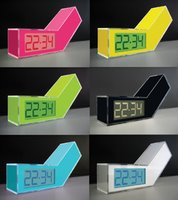 Engadget has a post about this, and I couldn’t help writing one either. This looks like a pretty cool alarm clock, and the price is very reasonable given that it’s made by a designer. The clock is angle shaped, and it has two positions. One side is for alarm-on, and the other for alarm-off. I have to ask the same question Engadget did. Is there a Snooze functionality?
 Raoul Pop