We have a wood-burning stove in the room where I do my work, and on cold or rainy days, I’ll light a fire and turn around to watch it from time to time. It’s calming, and those of us who sit in front of the computer all day long need to take some time every now and then and focus on other things.
I thought it’d be fun to show it to you, so I made a video of burning embers (the glowing, red remains of the burnt wood) as they slowly disintegrate.
Tell me, after watching it, don’t you feel more relaxed?
I’ve been using the duraSync charge and sync cable for the past few months, and I love it. It’s a durable, solidly-made, premium cable that replaces the stock sync cable which ships with your iPad, iPod or iPhone, and it’s made by CableJive, the same company that makes the SoundDock and iStubz cables.
The cable is really sturdy, and it’s made to last. It comes with a Lifetime Warranty, so if anything should ever go wrong with it, you can send it back to CableJive for a replacement.
It has a stiff rubber outer shell and an impact-resistant plastic core. The dock connectors will withstand crushing, banging, dropping and being stepped on, even driven over with a car. The cable itself is made of durable wire, with heavy-duty shielding and a clear coating. It will withstand pulling, jerking and being run over.
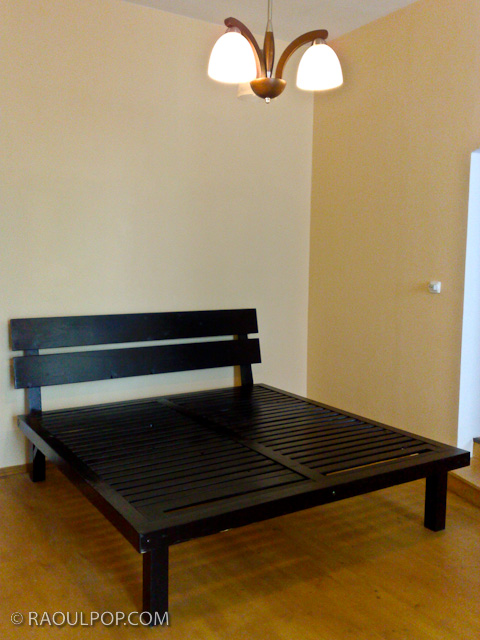
Last summer, I made a custom king size bed frame for our bedroom, out of solid wood. I held off on writing about it until now, nine months later, because I wanted to make sure the end result was solid and worth writing about. We’ve been sleeping on it ever since, and there’s nothing wrong with it, so yes, I can heartily recommend it.
I was fed up with the laminates and particle board garbage they call furniture these days, and I wanted to build something that would last, out of a quality, sustainable material like wood. I chose pine, because it was softer and easier for me to work with. Although I’ve also built a custom cat house for our three cats, I’m no expert carpenter. I just like to work with wood. It’s a wonderful material.
In December of 2005, I wrote an article on wet shaving. Back then, there wasn’t a lot of shaving advice on the internet — at least none I could find. So I wrote the article with the sincere desire to help others like me, who were having a tough time with disposable razors and electric razors, and with constantly irritated faces and necks. For me, it got so bad at times that my whole face and neck would just bleed from every pore, every time I took a razor to my face. It was crazy.
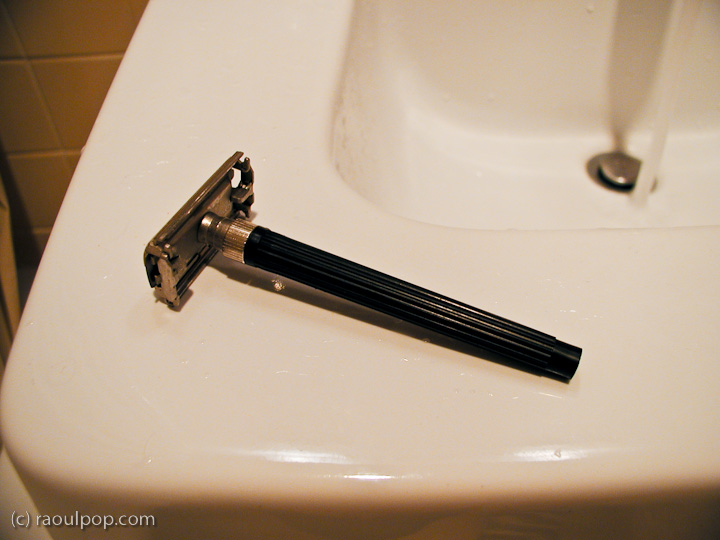
What worked for me then was using a Gillette Mach 3 Razor, because I didn’t know better. I would use a safety razor from time to time, just to troubleshoot where my shaving techniques needed improving. Since then, I graduated to using the safety razor all the time. What helped me improve my shaving technique was watching mantic59‘s videos on YouTube about three years ago. I was really glad to find him again today so I could link to his videos. I haven’t seen them since, and I wasn’t sure if he was still around.
Now that it’s been more than a few years since I wrote the original article, I thought I’d update it with a how-to video on wet shaving with a safety razor, where I show how a typical shave goes for me. I shot the video in 720p HD, with the wonderful Olympus PEN E-P2. My wife acted as my trusty camera-woman.
Shaving is an art, and it has to be learned. It doesn’t come naturally to us. One’s shaving form must by necessity differ, depending on the type of shaving utensil used: straight blade, safety razor, disposable razor, electric razor, etc. For me, a safety razor is the perfect balance between sustainability and shave quality, and that’s what I’m going to talk about here and in the video.
A straight blade is too scary for me. There’s that potential of slitting one’s throat. A safety razor still gives you the benefit of shaving with a sharp blade, but this time it’s contained within an apparatus that won’t let it cut your throat. A disposable razor, whether it has one, two, three, four or five (who cares!) blades, doesn’t offer as good a shave, because it’s less maneuverable, it’s made to be even safer — or in this case, useless — and creates non-recyclable waste, thus polluting the environment.
Just think how many blades and handles you use every year — all of those end up in a landfill. They can’t be recycled, because the plastic can’t be separated from the steel. It’s waste that can be easily avoided. On the other hand, all you throw away from a safety razor is a thin steel blade, which is perfectly recyclable. The razor itself lasts practically forever, which is why the companies that make shaving products would rather you get the disposable stuff. I say consequences have to trump profits sometimes, even in a capitalist society.
And, as Cary Grant says in “Mr. Blandings Builds His Dream House”, I like a safety razor because “I prefer the clean sweep of tempered steel as it glides across my face.” Yes indeed, Cary, yes indeed.
I hope you enjoy the video and come away from it with a better appreciation for the art of shaving, and with a few tips that will help you get a better shave!
In this video, you can see the beauty of Romania in 1964, through the excited eyes of visitors from the British Pathe agency. I found it on YouTube as well.
In it, Romania certainly looks like a beautiful, happy country, but the truth lay somewhat to the right of that picture. Romania was under the complete control of a totalitarian Communist regime, which took over at the end of WWII, under the tutelage of the USSR. Its leaders changed over the years, as they tried to slowly dig themselves out from under the heavy boot of the Soviets, and they succeeded to a certain extent to maintain a somewhat independent stance. It all came tumbling down in 1989, while under the rule of Nicolae Ceausescu, Romania’s last dictator, in what is now known to have been a coup d’état.
What the viewers likely did not know, and may not have known even if they visited Romania, was that the camera crew was closely monitored. Everyone who was allowed to be on camera was warned ahead of time to smile and say nothing bad about the regime… or else they’d be persecuted or put in prison.
Among the many persecuted by the Communist regime were Corneliu Coposu, Ticu Dumitrescu, and Traian Dorz (a friend of my father’s). In my family, my grandfather (my father’s father) was imprisoned because he owned too much land, according to the Communists. They called him a “bourgeois” (he was an honest, hard-working farmer), took away all his land, and put him in prison for a year. My father was expelled from school for the entire 5th grade when that happened, because his father was a “bourgeois”.
Romania wanted to appear friendly to foreign eyes. It flirted with foreigners because it wanted their currency. It also wanted to fend off international critique, because it was playing a double game. On one hand, it was trying to distance itself from Russia, to whom it was paying heavy tribute by the trainloads, every week, so it had to court Westerners, but it had to do it slowly, so as not to anger the Russians, or they might risk retaliation and a leadership change. Meanwhile, they were keeping a very close eye on everything going on in Romania. Any dissension was quashed with an iron fist.
This video will give you a better idea of what was really going on at the time.
Also, here’s a this typical propaganda video for the country’s “beloved leader”, Nicolae Ceausescu. Romanians had to watch staged bull like this daily, because all media was controlled by the state. All foreign content was heavily censored, and Romanian movies would go through multiple approval processes in order to get made, shown in cinemas and on TV. The only things I could look forward to on TV as I grew up in Romania were a half hour documentary on Saturday evening, then a movie later that night, and on Sunday morning, 10 minutes of cartoons. Sometimes they’d play Tom and Jerry cartoons, which were my favorite. Most of the time, it was Romanian or Russian cartoons.
Here’s another video from British Pathe, this one from 1961, detailing a fishing trip to the mountains and to the Black Sea. It also shows the idyllic countryside and the beauty of the Romanian wilderness, which can still be seen today. There’s historic value in these British Pathe videos. They show that Romania was a beautiful country indeed. It’s still beautiful today, and that’s why I love to travel and stay in it.


 Raoul Pop