Thoughts

Good vs. bad globalization

As I traveled around Europe, I saw globalization in action, and made the following observations.

Being able to drive through various countries without needing to go through customs checks at the borders was wonderful. Unencumbered travel is a great experience.

The preservation of local or national cultures is of the utmost importance as people from various countries mingle more freely. Dominant cultures end up dominating, and that’s not a good thing. If I switched through various radio stations in Austria or Romania, I seldom heard German music, and even less often did I hear local music, like traditional Tirolean songs. Instead, I heard the latest hits from the US and the UK. I really don’t care to hear the same music I hear at home when I travel. I’d rather be immersed in the culture of the country I’m visiting, but that’s become quite rare nowadays.

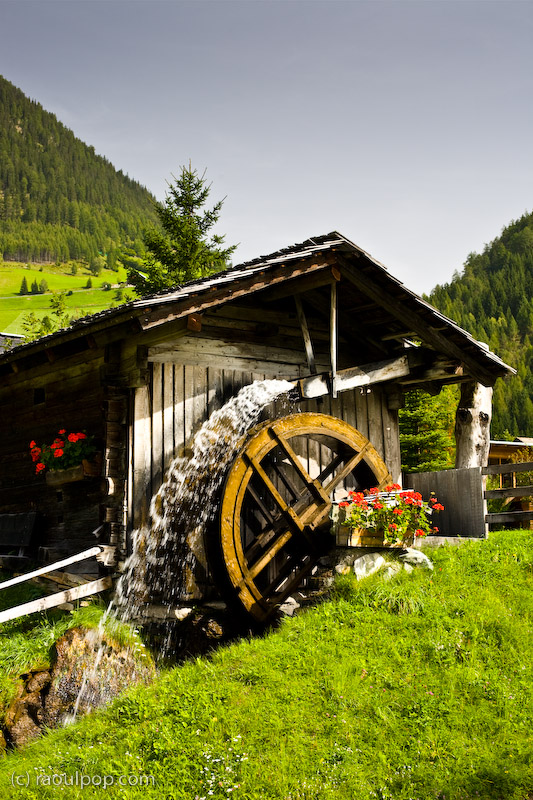
Related to the point made above, the people who win from globalization preserve their local culture, because it not only enriches them, but it’s also a bankable practice when it comes to tourism. Clean, beautiful cities, where the old building were preserved and renovated, not torn down, and friendly local people are what tourists want to see.
The ability to export and import goods freely is great. It’s good for the local economies to have the potential of greater distribution. By the same token, it’s horribly bad when companies and factories move to areas where it’s cheaper to operate. Local economies, cities and people suffer so much when that happens. Just look at what’s going on in the US. I can see the same thing happening in certain cities in Romania. Just a decade or so ago, people used to have jobs and work in local factories or shops, and now they’ve all been sold or moved, and those same people, tied to those cities through their families and houses, are now scraping the ground to get by. I don’t know how they do it. It must be incredibly tough and frustrating.

Related to the point made above about not companies staying put and not moving, why do you think the US economy is hurting so badly now? It’s because it has become based on services and virtual goods like complicated and unnecessary financial speculation, not hard goods. Other than farming products, we make very little in the US these days. Most of the US products (and most of the world’s products for that matter) get made in China. Is it any surprise to see that China’s economy is booming?

Remember that countries have two ways to exert their influence in the world: (1) soft power, which refers to economic and cultural power, and (2) hard power, which refers to military force. US’ soft power has been waning in recent years, through its own faulty policies, and so the only way left for it to retain its dominance is to increase its hard power. The problem is that exerting hard power makes the soft power diminish even more and it also breeds enemies, which makes it even harder to retain dominance in the long run. Soft power preservation is the best long-term foreign policy a country could have, and the US has failed at it.

EU taxes are a heavy burden to bear. The VAT (Value Added Tax) is around 20%. That’s crazy. Not only does that make everything more expensive, but the markups are also higher. This means you’ll sometimes find that the same product, like a laptop or a camera, is up to 50% more expensive in Europe. That doesn’t make sense to me, particularly when salaries in so many Eastern European countries are unbelievably lower than in Western European countries, yet the prices are just as high.

In globalized economies, there’s greater potential to encourage correct or responsible behavior by standardizing business or agricultural practices. Vice versa, there’s greater potential to mess it all up as well, but let’s try to stay positive here. I liked what I saw in Europe when it came to land care and the preservation of forests. I also liked seeing entire fields filled with wind turbines, which generate electricity with zero pollution. I also liked seeing solar panels on the roofs of many, many houses in the countryside. I like the EU’s anti-corruption efforts, and I like the way they encourage good infrastructure through grants and loans to member countries.

When standards are put in place, there’s the potential to go overboard with rules and regulations. While the intentions are good, if you make it too onerous for an individual or a small business to compete or participate in the marketplace, you are effectively favoring large corporations and driving out the small guys. I see this happening with farming regulations in Europe. People that used to own herds of sheep and cows have now been forced to sell them or become part of large farming cooperatives, because they couldn’t afford to keep up with all the rules. Farmers operate on thin margins and big risks, and when you introduce extra costs, you are in effect killing them.

It would be a horrible shame to drive out all the small guys and let large corporations handle all of the marketplace. For one thing, you are killing the spirit of passionate people that love what they’re doing, and for another, you’re destroying a way of life that has served us well for thousands of years.

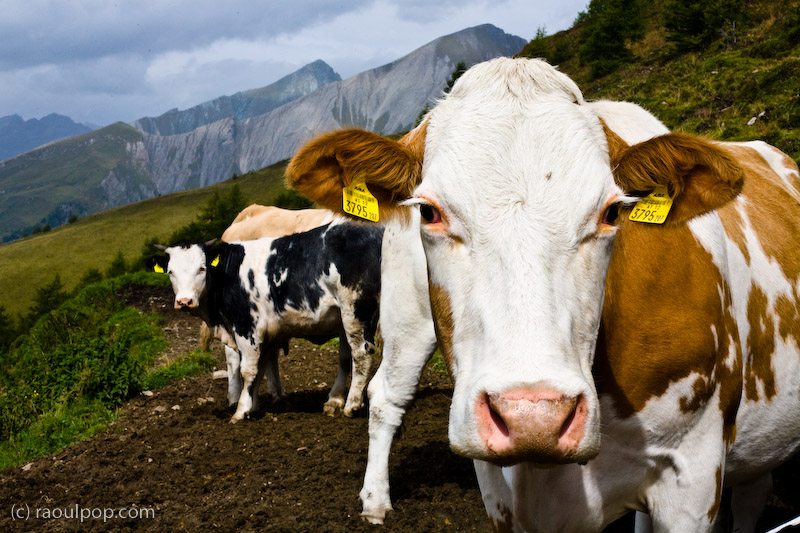
I do hope the EU and the US do their part to keep small farmers alive and well, while encouraging the production of food through responsible, renewable and healthy practices, free of genetic manipulation and unnecessary hormonal, pesticide and antibiotic treatments.
Standard
Places

Photos from downtown Baltimore

We made a day trip into downtown Baltimore last week. I had our point-and-shoot with us, and took photos of the architecture. I need to specify that it was our point-and-shoot because you’ll see purple fringing on a few of the photos. That can’t be helped much when you have a zoom on a digital camera. It’s the price one pays for versatility.

I do love that long zoom though (equivalent of 38mm-380mm on my Olympus C770-UZ). I can get photos like these without having to haul a big, heavy glass with me. (Let me be the first to admit that this is really more of a case of the fox crying sour grapes. I’d love to be able to afford some nice, big, heavy glass, but it costs several thousand dollars…)

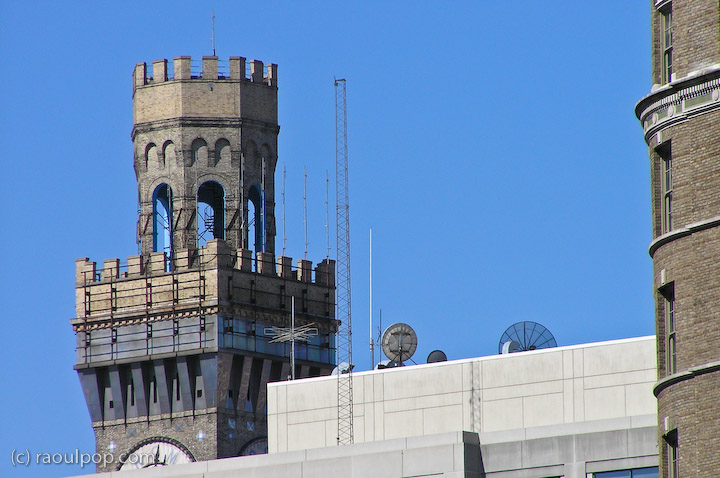
This tower was but a small spot on the downtown skyline with the naked eye. I get my kicks from zooming into distant objects. While I like wide lenses a lot, there’s something really nice about the flatter perspective of telephoto lenses.

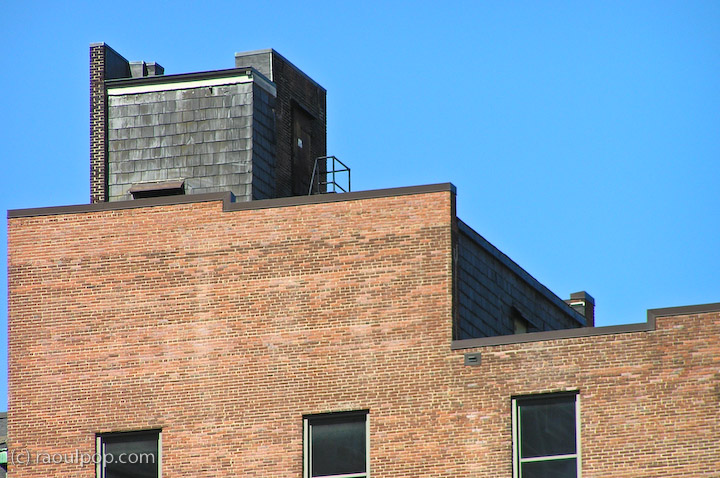
The shoddy appearance of this roof was a surprise. The standing balustrade, seemingly leading nowhere, was another. This is one of the photos where the purple fringing is readily apparent.

A shingle roof on a fairly tall downtown building? Interesting!

I loved the details on this gleaming golden roof. It lit up like fire when the sun shone on it.

Here’s a close-up. I wonder if the top floor is a penthouse. Can you imagine the views?

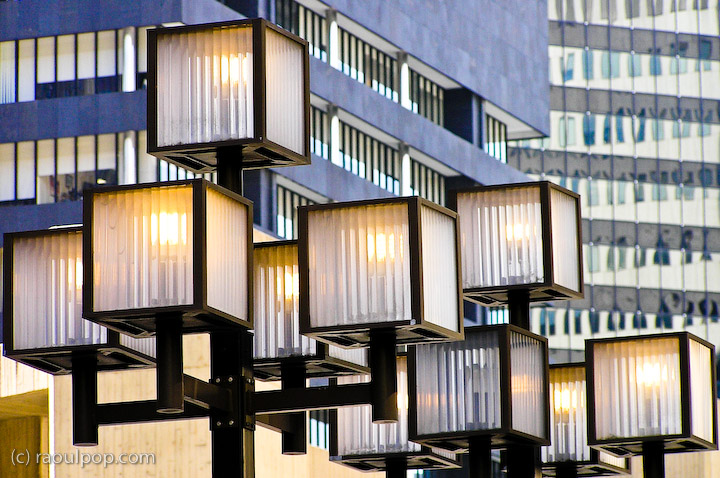
There were so many interesting shapes and colors to be found among the architecture!

Here’s a view of this same building from a different angle.

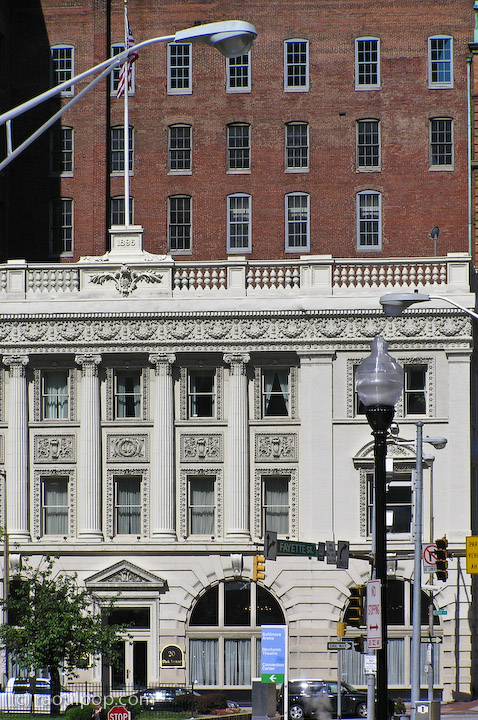
These two reliefs lined the side of a downtown building (a hotel I believe).

A few street-level photos.

This sign was posted to the side of a building. It names it as the original site of the Baltimore College of Dental Surgery, founded in the year 1840. It was, apparently, the first dental college in the world.

Here are a few views of the Radisson Hotel. I mention it by name because we’re thankful for its inviting lobby with free wifi. We needed to spend a few hours waiting around, and it was such a relief to be able to sit down on a couch and get on the Internet instead of having to deal with the street noise. They also had a Starbucks at street level. Nice.

Here’s a closeup of one of the hotel’s towers. I wonder if there is a room at the top of the tower, and if it’s available. Or is it reserved as the penthouse for the hotel’s owners? The views must be spectacular.

Here’s a view of the entrance to the Mariner Arena.

A few of the rooftop inhabitants showed some interest in our presence.

Standard
Thoughts

Scary stuff is happening in China

As I look at these truly scary images of pollution in China, I realize how big a problem pollution really is over there. For most of us, China’s this big country over there in Asia, sort of communist but not really, with plenty of human rights abuses under its belt, but still more decent than other communist countries like North Korea. We also know it as the place our products (toys, computers, clothes, etc.) come from. Well, it’s high time we got to know as the place where incredible pollution exists, and it’s as much our fault as it is theirs.

As consumers, we’ve happily accepted the lower-priced products made over there, because we can buy more of them, more often. As companies, we’ve happily moved our factories over there, because the labor was cheaper and the environmental laws were almost non-existent. China itself was only too happy to receive our business. They got an incredibly influx of money, expanded their economies and gross national product through the roof, got a middle class and a very wealthy upper class, and started walking out of the darker stages of communism toward something that might be called “capitalism light”.

Along the way, people all around easily closed their eyes or winked at the horrible pollution that was accumulating around them, poisoning China’s air and water and earth and cities. They reasoned that it was the price to pay for progress. They chalked it up to growing pains.

Well, it’s hard to close our eyes any more. Not after you see those photos. Don’t worry, they’re not the only photos available. There is plenty of proof of the damage that’s occurred there. And it’s scary. Very scary.

China is a very sick country. It’s very polluted. It’s incredibly polluted. I don’t know if it’ll ever fully recover. The damage has been done, irreversibly. Yet we all keep on going ahead, full steam, in a mindless race toward certain disaster, motivated by corporate greed and consumer lust for more shiny toys.

It has to stop. This will come back to bite us, right here in the US. It’s guaranteed.

Part of the solution is willing to live with “upgradeable” products. Instead of buying a new computer, send the old one in to get new, faster parts put in the old enclosure. Instead of throwing away a toy, donate it if it can still be used. Same with clothes. Don’t throw them away, give them away. Furthermore, Truly gigantic recycling efforts must be put forth, like the Japanese are doing. Every kind of plastic must be recycled. All metals must be reclaimed and reused. Poisonous chemicals must be contained. This is serious stuff.

Recycling efforts in the US are half-assed at best. Let’s face it, if the best stuff we can come up with from recycled plastic is park benches, then we’re screwed. If our answer to reducing environmental pollution is sending our used computer equipment to China, where it piles up by the mountains, we’re screwed. If companies’ answer to societal needs is to create crappy designs that age in months and practically scream “throw me away”, then we’re screwed. If we do nothing, we’re all screwed.

Standard
Thoughts

Living in a mad world

There are two things I want to talk about today. The first took place right here in the US, and the second happened in Italy. Both happened recently.

We’ve got a conductor who has forgotten the US still means freedom. Apparently, a tourist, possibly from Japan, who knew very little English, was taking photos of the scenery (mostly nature) on an Amtrak train between New York City and Boston. The conductor saw him, and asked him to stop in the “interest of national security”. Huh?! For taking photos from a train? For trying to preserve the memories of a trip?

But that wasn’t enough. She screamed at him even though he didn’t understand what she was saying, then called the police in and had him arrested and removed from the train. Yeah, you read that right.

How wrong is that? It’s the sort of thing that makes one’s blood boil. At the very least, that conductor, and the policemen that went along with that sick gag should be censured or suspended, so they can all remember we don’t arrest people willy-nilly in the US, not for taking photos from a moving train open to the public.

The Economist reports that Italy has passed a decree authorizing the expulsion of any Romanian immigrant who is deemed a danger to public safety. This bothers me a lot, since I’m Romanian by birth and upbringing, and I want to clarify the situation.

There was an incident where an Italian woman was killed and possible raped by a Romanian immigrant. There’s a catch to the story though. That was NOT a Romanian immigrant, it was a gypsy from Romania. There’s a BIG difference, so let me explain.

It’s hard for Americans to understand this sort of thing, but ethnicity is a very touch issue in Europe, particularly in Eastern Europe. Just think of the wars in Bosnia and Herzegovina, or go back through the last few hundred years and look at the geography of Europe. All of those governmental and boundary changes created and continue to create ethnic conflicts which may smolder for years, or break out into open war, which is what happened in Bosnia. I’m not saying this to set up my arguments, just to give you some background info. There is no animosity between Romanians and gypsies, just deep-seated and justified frustration with these nomadic people that have chosen to settle in Romania over time.

I was born and grew up in Romania, so I’m a bit more aware of these things than outsiders who decry the situation in the country without really knowing what’s going on. You see, we’ve got a lot of gypsies in Romania. They’re nomadic people, but they’ve chosen to settle there in the last few hundred years. Other countries have them as well, but we seem to have been “blessed” with unusually large numbers of them. There are a few classes of gypsies, and they can be differentiated based on how well they integrated into society, and how clean they are.

First you have the Gabors, which are the most civilized. They’re clean, hard working, responsible people and integrate well into society. I have no issues with them and would be happy to have them as my neighbors. There’s another group whose name escapes me — I don’t know much about them except that while they’re more aloof, they’re also fairly decent in terms of how they interact with other people.

Unfortunately, you then have the gypsies per se, a very mixed class of individuals and families that share these common characteristics: they do not integrate into society, they live mostly in shanty towns, they have little or no hygiene or cleanliness, and they have a very high rate of crime. They call themselves the Roma, which is a title I must protest. It’s much too close to the word Romanian or Roman, and they hail neither from Romania, nor from Rome.

You do not talk about normal living when you talk about these gypsies, the so-called “Roma”. You find them begging on the streets or dealing in God knows what, but mostly, you find quite a large number of them stealing, raping and murdering. This isn’t an exaggeration and has been their historical record. Since they do so poorly in Romanian society and certainly have no interest in obeying the laws of the country, they do not deserve to be called Romanians, and indeed, I would not call them citizens of Romania or bestow on them the rights that go along with that citizenship.

When Romania got accepted into EU, several programs got started whose aim was to integrate these gypsies into society. So far, they have failed. Why? They’re too different and have no interest in life as civilized people know it. Really, they don’t, and if you don’t believe me, you’re welcome to go there and try to integrate them yourself. You will fail miserably.

At any rate, it’s these gypsies that immigrated to other European countries in droves when the borders were opened, along with a number of actual Romanians. When the gypsies arrived in these Western European countries, they started engaging in their usual behavior: living in shanty towns, polluting society in general, participating enthusiastically in crime and other misdemeanors, etc. When they’d get caught by the police, they’d say they were Romanian citizens, which, as I’ve just explained, is not quite true. Ethnically speaking, they most certainly aren’t Romanians, and behaviorally speaking, they’re an entirely different breed.

A few years ago, there was a case where gypsies caught and ate swans from a German lake. There was an uproar, and Romania got the blame for it. As if normal, law-abiding Romanians had something to do with that… Don’t get me wrong, I’m not saying genuine Romanians don’t engage in crime, because every orchard has its rotten apples, but at least the crime rates are very different among Romanians and gypsies.

In the recent case in Italy, we’ve got a gypsy who lived in one of their shanty towns, who accosted, beat up and possibly raped an Italian woman. Who got the blame again? Romania. Why? Because that gypsy was from Romania. Was he a Romanian? Not really. So now we’ve got Italians horribly worked up against Romanians in general, when most of the Romanians that went to Italy did so to find honest work that they couldn’t get in Romania, who’s still having problems with its economy.

It’s just not fair that Romania keeps getting blamed for the actions of gypsies, which, as a group, cannot be controlled or integrated into any society or country where they happen to live. I wanted to set the record straight when it came to this, and do hope that I’ve managed to make my point.

Updated 11/29/07: Came across a great photo-documentary of gypsy life in several countries. Have a look at it. It has photos of gypsies from Romania as well. Try not to romanticize things as you look at the photos. There’s nothing romantic about an utter lack of hygiene or living in a hovel.

Standard
Places

Meeting Mr. Beaver

So I’m driving back home from work this past July. The highway’s ridiculously busy, as usual, and the sweltering heat isn’t making things any easier. I’m in the high-speed lane on I-495, somewhere between the 267 and Georgetown Pike exits. I happen to glance over to the side of the road, and what do you think I spot in the median? Why, it’s Mr. Beaver! (At least I think it’s Mr. Beaver — given my lack of knowledge about beaver anatomy, and the inability to have a closer look… Well, let’s just assume it was a male specimen, right?)

I pull my car off to the side, turn on my emergency lights, roll down my window and get my trusty 5D out of the bag. He stops to check me out. Get a look at that cheeky glance:

A cheeky glance

Mind you, this is the Washington, DC beltway, one of the busiest roads in the US, but does Mr. Beaver care about that? No, he doesn’t. He’s out looking for a snack while thousands of cars zip (or in our case, crawl) past him.

Back to business

He stretches up the branches of a bush, looking for something tasty. Not sure what he’s looking for, since there isn’t much of anything on those branches.

Pickings are slim

So what do you think he does next? He climbs up into the bush, of course!

Beaver in a tree

When I saw him carry on with this affairs so nonchalantly, I thought he wouldn’t mind it if I got out of the car to get a closer look at him. But I was wrong. As soon as I started to open the door, he jumped down and scampered off into some underground tunnel. In less than a second, he was out of sight and out of reach.

Smiling, I got back into my car and drove off, while the other drivers looked at me quizzically. I’m not sure they even saw the beaver at all. Sometimes it’s so easy to get caught up in our own little worlds and drive right by the more interesting sights in life. I for one am glad I had the presence of mind to stop my routine and my car, if only for the photos and the little story I’ve just told you.

Standard