Places

Biking on the Via Appia (part 2)

This is a two-part article. Here’s Part 1.

While in Rome, my brother kept dangling this promise of taking our bicycles out to Via Appia and making a day trip out of it. I wanted to see it because the Via Appia was the most important Roman road of its time. Roman bases, villas and famous tombs adorned its sides in its heyday, and their ruins can be seen even today. The road itself was a marvel of Roman engineering. It was so well-made that portions of it are still preserved, thousands of years later.

Well, I kept feeling like the horse that can’t reach the carrot, since my brother still buried his nose in books every day. But, I kept nagging him, and in my last week there, we managed to make a half-day trip out of it. It was a wonderful time!

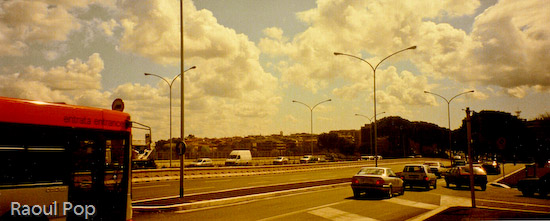
We took our bikes and rode through the city till we reached the highway shown below (don’t ask me for the name, I forgot it), rode alongside it for a bit, then took a side street down a little hill that took us to the start of the Via Appia. From then on, it was an easy (and beautiful) ride out into the countryside.

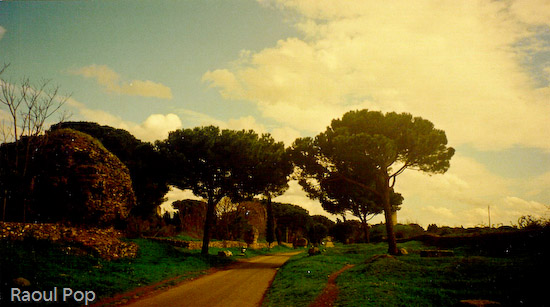
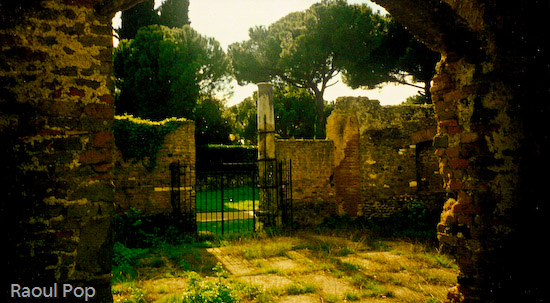
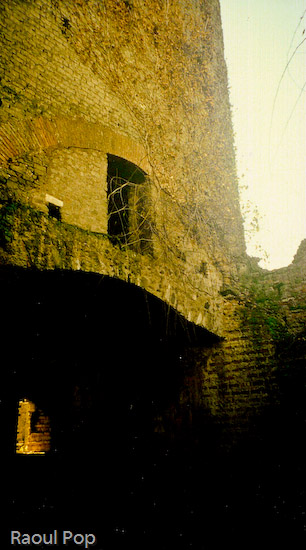
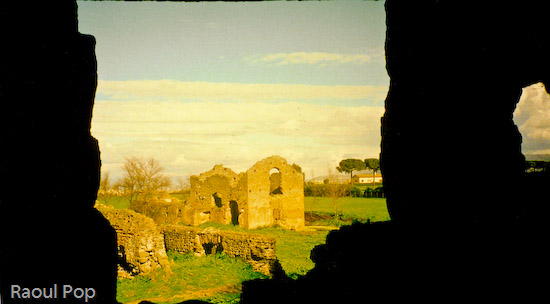
Along the way, we stopped so I could take photos (of course), and also snuck into some pretty unsafe ruins, as you’ll see below. I’m still amazed the floors didn’t crumble under us as we climbed onto the second floor of a villa. I can only attribute it to good, old, solid Roman construction.

Toward the Via Appia

Roman highway

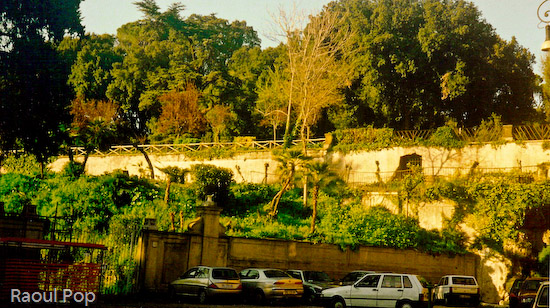
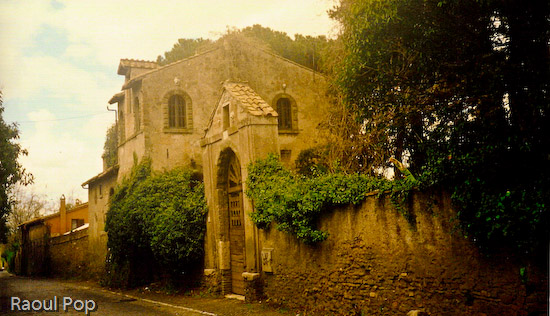
Time takes its toll

The way we came

Keeping up appearances

Greeting the visitors

Light at the end of the tunnel

Looking right through

You can also read more about the Via Appia over at Wikipedia. Stay tuned for my post on Florence.

Standard
Places

Photos from Rome

In March of 1999 I visited Rome. It was my first trip to Italy and I had a wonderful time. I stayed with my brother, who at the time was on a 3-year fellowship there to do research. He studies myths and religions and does comparisons between deities in various cultures. He also collects folklore: dying traditions and customs. Takes lots of photographs and films them as well. The latter part of his work is exciting. The former puts me to bed. Mille scusi, fratello!

Il mio fratello

Anyway, I had the most wonderful time. Bogdan (my step-brother — he’s pictured above) had his nose buried in dusty books at various libraries in Rome, while I literally walked through the entire Rome on foot, taking photos with my trusty little Canon Elph and consulting the map here and there. The Canon has since become unusable, because APS film is no longer available, but it did help me preserve the wonderful things I saw. Over the years, the photos gathered some dust themselves in my closet, till I finally decided to scan and share them online. Since I don’t have a scanner that will work with APS film, I scanned the photos themselves. I realize that’s a real step down in quality, and given the age of the prints, it really shows, but the digitized photos still serve to convey the beauty and history of the place. Plus, the aged paper gave a nice Sepia effect to the photos that I’d be hard pressed to reproduce in Photoshop.

While I really enjoyed Rome, my experiences with Romans were mixed at best. And I had breathing problems there as well, due to the pollution. But none of that could eclipse the sense of wonder and discovery I had every day as I planned out where I’d go, then get there and take photos. Maybe I’m biased, but I find today’s architecture pathetic. It’s disposable, ugly, flimsy and imitative. Few and far between are the buildings that make a statement. Well, in Rome, as in most European cities, you’ll have no shortage of good architecture. I think that’s what makes them so beautiful.

Here are several of the photos I took during my trip.

Bask in the sun

Walk at night

Classically overdone

Farnese

All mixed up

Expansive

Strike a pose

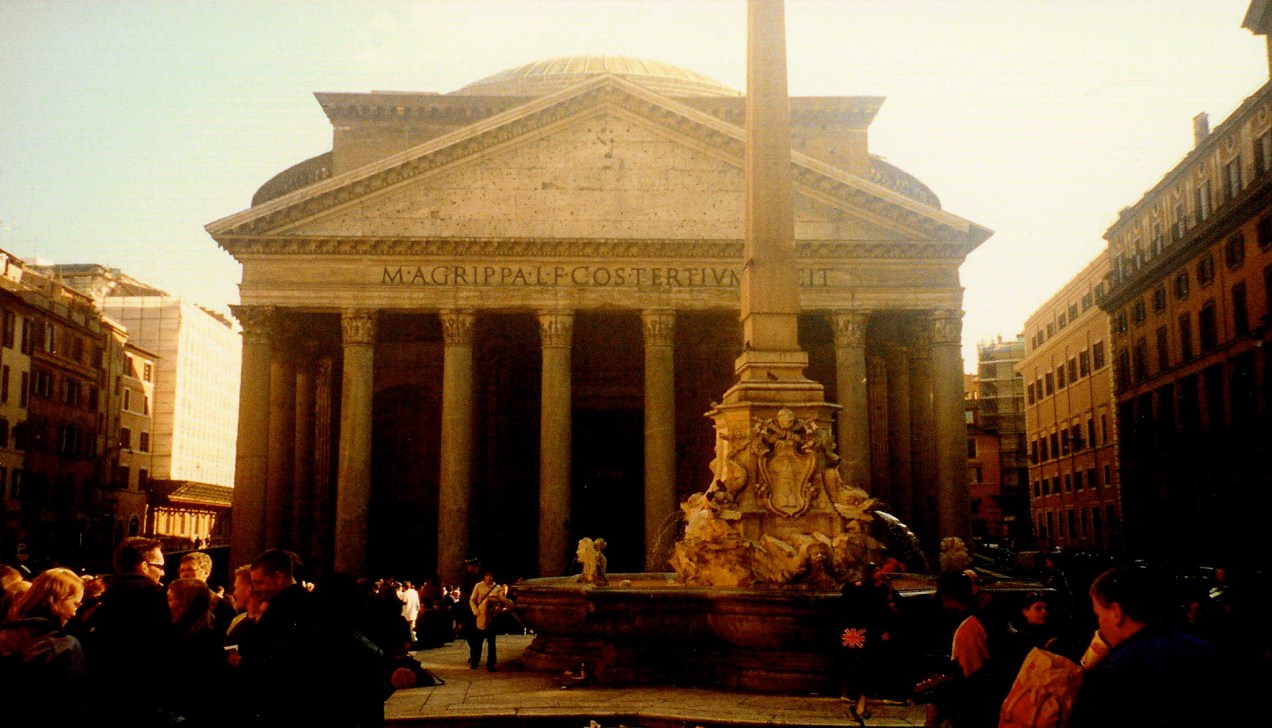
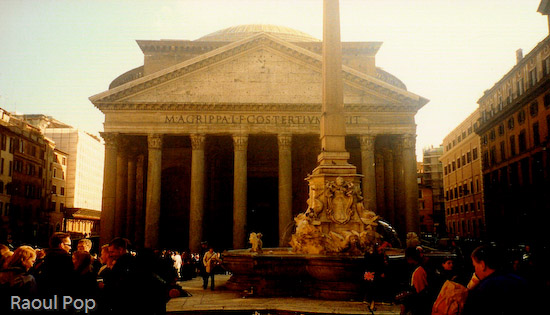
Pantheon

Center of attention

Piazza Venezia

Congregate

The plight of humanity


Standard
Places

No two ways about it

Seen in Florence, Italy.

No two ways about it

Standard
Events

DC FAN Meetup last night

Ligia and I attended the DC FAN (FeedBurner Ad Network) meetup last night. It took place in downtown DC, at Capitol City Brewery. It started around 6:00 pm and lasted well after 8:30 pm. It was lots of fun and we really enjoyed it. Got to meet the cool folks from FeedBurner, without which my site wouldn’t be where it is today.

I use all of their services, and love them. I burn my feeds through them, I offer email subscriptions to my various content, I repackage my feed content and display it on various web pages like this one or this one for example. I use their ads, of course, which is how I monetize my site and feed content, along with Google’s AdSense. I use and love their feed stats, and I’m really excited they recently introduced site stats as well. I also use something they call feed flares, which are the little snippets you see at the end of every one of my posts. They let you do things like subscribe to my feed, email me, add a post to del.icio.us or submit it to Digg, etc. It’s really, really cool stuff.

I covered FeedBurner on my blog in the past as well. If you’re interested, you can read more here, here, and here. And of course, let’s not forget the time when Rick Klau, VP of Biz Dev at FeedBurner, stepped in and stopped me from making a feed gaffe early last year. Rick was at last night’s meetup, so I was really glad to meet him.

Rick Klau

So, who attended? The folks at FeedBurner were well represented. There was Rick of course, and Eric Olson and Jake Parillo.

Eric Olson

Jake Parillo

Eric coordinated the event and invited me, so a big thank you goes out to him. Various folks showed up throughout the evening. Sphere CEO Tony Conrad and VP of Biz Dev Jeff Yolen were there.

Rick Klau, Tony Conrad and Jeff Yolen

A few people from AOL’s content division showed up. George from Fat Pitch Financials was there as well. As we left, more people showed up.

Sitting at the table

George (Fat Pitch Financials)

I really liked being able to interact directly with the FeedBurner folks. I got to hear about some cool upcoming features like blog networks, got the scoop on how Site Stats hit the ground running, had a chance to give some direct feedback about the Ad Network, and of course, the highlight was that Rick Klau loves photography. We had fun chatting about that!

Shutterbug meta

There was an interesting mural on the wall above our table.

More beer

Beer

There was plenty of food, and of course there were pretzels as well. 🙂

FeedBurner pretzels

Standard
How To

Hacking the GN calculations when using manual flash

Here’s how to hack it when you’re stumped as to what guide number to use with a manual flash. This is useful when you’re using an analog SLR that won’t sync the flash power automatically, or you’ve got a DSLR and want to fine-tune the amount of light the flash puts out. I can’t stand having to calculate this with formulas. We all may have seen this :

Aperture (f-stop) = GN X ISO/distance (in meters)

But do any of us know it by heart, or better yet, want to know it? And are we really going to take out a tape and measure the distance to the subject? I know I don’t feel like it. So how can we hack this? Well, we use what knowledge we have to ascertain the flash power we want, and then we adjust the GN (Guide Number) up or down. It works like this:

  • Higher GN means more power for the flash and consequently, more light
  • Higher f-stop means smaller aperture, and that translates to less light coming into the camera
  • Higher ISO means better sensitivity to the light that the aperture lets in
  • Higher distance means less light (remember, we’re using a flash, and the effective distance is limited)

So, what does this mean for us? Simple: we can adjust any of the four factors listed above to get the photo we want. Need more light? Boost the GN and/or the aperture. Can’t get more light, but want a better photo? Boost the ISO, but recognize the photo may be grainy. Can’t boost ISO? Decrease the distance between you and the subject.

Of course, keep in mind that when you boost aperture (choose a lower f-stop), you’ll decrease the depth of field. Think of the focus field as a loaf of bread. When you use a small aperture (large f-stop, 16 for example), you get the whole loaf in the shot. When you use a large aperture (small f-stop, 1.4 for example), you get only a slice in focus. You can effectively think of f-stops as slices of that loaf of bread. Larger f-stops means more slices. So if you’ve got objects in this photo of yours that reside at various points of focus (more slices), to keep them all in focus, you’ll need to keep the aperture fairly small (large f-stop). If you’re only interested in a particular object, by all means, increase the aperture (small f-stop), get more light that way, and use a lower GN. You’ll get more natural colors. Flash light can be harsh and wash out the nuances if overused, so the less you can use, the better off you are.

Don’t think I’ve forgotten to talk about shutter speed. Just realize that you won’t have too much flexibility there, in particular if you’re shooting handheld. Even with a tripod and manual flash, you can’t adjust the speed that much. Too slow, and any people in the photo will be blurry. Plus, the flash will be ineffective. It can’t stay lit for several seconds or more unless you use a bulb. Too fast, and you won’t get any light. Plus, if you’re syncing the flash with the camera, you’re limited by the top sync speed, which varies by camera and usually runs from 1/180 to 1/250 seconds. You’re better off playing with the other variables in the equation.

Remember, you don’t need to go to the trouble of using manual flash unless you have to. If you need to adjust flash intensity and your camera allows it, you can easily boost or decrease it through simple menu functions. Just look this up in your camera’s manual. You can usually use the +/- button, if your camera has one.

Hope this helps!

Standard