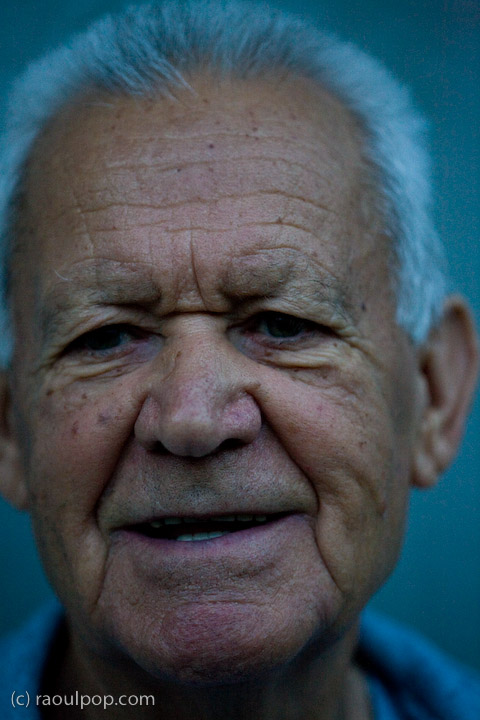
It’s my grandfather’s birthday today. He died just a couple of weeks ago after a painful struggle with mesothelioma, a form of cancer caused by asbestos exposure.
He’d been coughing for a few years. It was a persistent cough, but it wasn’t a severe cough. He coughed here and there, and especially after he came into a cooler room after working outside, in his beloved garden. Then things got worse. He kept getting cold-like symptoms and coughing more. When doctors in Romania examined him, they discovered water in one of his lungs. They started drawing it out with syringes regularly, liters at a time. A lesion of sorts developed at the site where they kept inserting the needle. A biopsy of the lesion revealed nothing. Things didn’t improve.
My parents hoped that the Florida weather would do him good, so they brought him to the States. He loved the weather, but didn’t get better. They thought US medical care would be better than Romanian medical care, so they put him in a hospital here. Doctors literally paraded by his bedside by the tens, specialist after specialist, all of them clueless. Oh, let’s try this, let’s try that, blah, blah, blah — that’s how the story usually goes. X-rays and CT scans and urine and lab tests every day, and still they couldn’t figure things out.
Finally they decided to open him up and see what was going on. That’s when they discovered he had mesothelioma, with a few “localized” tumors in his right lung. But they still couldn’t figure out what to do about the water accumulation, so they proposed to insert talcum powder between the lung walls, in the hope of sealing that chamber and stopping the leaks (that’s apparently a standard procedure for this sort of thing).
So they opened him up again and inserted the powder. Water still accumulated, this time more slowly, but it still happened. Then he developed difficulty swallowing. They stuck tubes with cameras down his throat. More CT scans, more X-rays, and still no idea why. Well, let’s enlarge his esophagus and cardiac sphincter (the opening from the esophagus to the stomach.) That might help… Well, it didn’t. He still had trouble swallowing.
They didn’t know what else to do for him, so they released him from the hospital. The bill came to well over $100,000, and my grandfather was no better than before. He was worse, and now he had to contend with pain from the surgery and the other procedures done on him while in the hospital.
My mother had to blend everything into a soupy puree before feeding him, and still he had trouble swallowing. He withered and dried out and lost tens of pounds. He was hardly recognizable, but his spirit was still well, and he hoped he’d get better. That was the hardest part, to see him trying to eat and unable to swallow, then leave the table with a horribly sad look on his face.
We knew he wouldn’t last long like that, so we convinced him to return to Romania, where at least he could die in his own home, if it were to come to that. Once he got there, my aunt, who took care of him, put him on IV fluids. He got a little better. We decided to try seeing some specialists there in Romania, so she took him to the hospitals in Sibiu and Timisoara.
If you don’t know how the healthcare system works in Romania, I’ll tell you. It’s based on heavy bribes. If you don’t bribe the doctors and nurses, no one cares about you. No one even looks at you, and you’re treated like scum. If you have the money to give them, you actually get somewhat decent service, depending on how much you give. You can’t lay the blame entirely on the medical personnel for this practice though. Doctors’ salaries are horribly tiny, smaller than the salaries of some janitors at well-to-do companies. So they need cash infusions from the patients in order to be able to live properly. But the way they go about it is disgusting to me. And there’s no telling when they’ll make up stuff about your condition just so they can get more money out of you. They’ll even do extra procedures (if they’re unethical people) so you’ll pay them more.
Once in the hospital, they slipped a feeding tube through his nose and into his stomach. In Sibiu, they opened him up again and discovered some lesions on his esophagus, and some on his stomach. They said he needed his esophagus replaced, but that they couldn’t do the procedure, and that he needed to be sent to Timisoara. We believe the doctor who operated on him at Sibiu twisted his stomach or intestines around and caused a severe blockage in his GI tract, because his digestion and regularity were never the same after that.
In Timisoara, the specialist who was to replace his esophagus with a silicone stent bragged to high heaven that he was the only one doing the procedure in Romania and in the entire Western Europe. If that sounds phony to you, don’t worry, you’re right. He just wanted to make sure he got enough money for the job. He ended up operating on my grandfather, but replaced less of the esophagus that he’d originally said. We’re not sure why. Things went completely downhill from there.
My grandfather never recovered from that operation. His situation got worse and worse every day. Now he couldn’t digest his food at all, even the soups he was fed through his tube. He coughed up blood and fluids of various colors. He got thinner and more dehydrated every day. My aunt put him back on IV fluids, but they didn’t help. He was in horrible pain, throughout the day and night. He moaned in agony. He couldn’t sleep. When he did manage to sleep, he would writhe and cry out in anguish. He was dying.
Four days before he died, he asked my aunt to make the preparations for his burial. He knew it and he was ready. He asked her to let him go, to stop trying to keep him alive. She couldn’t stop caring for him, but she knew it was going to end anyway. He looked forward to joining my grandmother in the grave next to hers.
And then he died in the evening. I got the call from my mother. She was crying. I couldn’t cry. I knew what he’d been through, and wanted him to get the rest and peace he so badly needed. I was angry with everything that had happened to him, and still am. Why did he have to die in such pain? Why did he have to encounter the utmost morons in his quest for decent medical care? Why did he have to suffer so much?
We don’t know when he got exposed to asbestos. It wasn’t uncommon in communist Romania to get exposed to dangerous conditions or materials. He worked at the same factory all his life, and got promoted to chief technical engineer from a humble line worker. He came up with various inventions and improvements during his career, and was even decorated by Romania’s dictator, Nicolae Ceausescu, for his contributions. I’m not saying this because I care about Ceausescu, who was a horrible man, but I care about my grandfather and about his life’s work, and was glad to see him get recognized.
For me, my grandfather’s suffering serves to underline how little medical science really knows about the human body, and how horribly few things they can do to cure people. In spite of all our technology and advances and drugs, when it comes to treating disease, our options are very limited, and very primitive. We can:
- Mask the symptoms by treating them with drugs
- Cut into people and butcher them with plain knives or sear them with electric knives, then sew them up with string
- Poison them with radiation therapy and chemotherapy
I remember my frustration with this while in medical school, and perhaps it had something to do, subconsciously, with my leaving it to return to IT work. At least in IT you can find out what’s really wrong and can fix it either through code or hardware replacements.
What my grandfather’s death also showed (amply) is how many idiots there are in the healthcare system. My God, we have so many doctors out there that can’t diagnose their way out of a paper bag, and they run test after test and try this and that and still can’t figure out what’s wrong. I’m fortunate enough to know there are good doctors (although they’re few and far between) who know how to diagnose with much less information at their fingertips, because I’ve met some of them.
If all these retards can graduate medical school and can pass the boards, then clearly medical education isn’t doing its part in weeding them out. I had plenty of them in my class in med school, too. They were the ones who got by very nicely by rote memorization. Worked great, until you asked them to analyze something — then they looked at you like a hen looks at a newspaper.
Another one of my beliefs was reinforced: that the overwhelming majority of nurses are lazy asses that don’t care at all about their patients. I’m sorry if that offends you, but that’s the truth. I know this because I saw they way they treated my grandfather, and I saw the way they treated other patients over the years.
All nurses seem to want is more money and more benefits for as little work as humanly possible. Oh sure, they put in a lot of “hours”, but most of those hours are spent socializing at the nursing station, not by the patient’s bedside. What’s unfortunate is that the market is tilted so much in their favor right now (and will continue to be for the next several years) that nothing significant can be done about it. There’s a nursing shortage, and that means we’re going to have mediocre, good-for-nothing nurses in all of our hospitals until supply meets demand, and hospitals can start to weed out the non-performers.
I tell you, the nursing profession will not emerge unscathed from this. The stink caused by these bad nurses will taint the good ones, too. The good ones are out there, I’ve met some of them, and when I say they’re good, I honestly mean it. They’re great, and they care, and they know a lot, but they’re few and far between, and they’re mostly in academia.
Coming back to my grandfather, I think of my grandmother’s death two years ago, also in June. A week or so after her burial, it was my grandfather’s birthday, and I remember him celebrating it with us, his family, but without his beloved wife. The sorrow was evident on his face, even through his smiles, and there was nothing any of us could do for him but to try and cheer him up.
Now, he’s resting in the grave, and it’s his own birthday. There’s no birthday celebration now. Just pain and a feeling of irreplaceable loss.
Rest in peace, tataie. You taught me how to build and fix things and work in the garden, and how to use tools and paint and be the man I am today. You were the first man I looked up to, the first one that made me want to learn how to shave. I saw you do your best, every day, to care for and protect your family. You never spoke much, but you did much. You were loved, and are loved. Rest in peace.
26.011201
-80.149490