Thoughts

Thank you Congressman Van Hollen!

This is Congressman Chris Van Hollen, the man that represents our district on the Hill. He’s got our heartfelt thanks and gratitude.

Do you want to know why? My wife and her students had to suffer for seven months at her piano studio — without heat in the winter and without air conditioning in the summer — because of Pepco’s unbelievable (one could call it criminal) inability to fix a panel on the outside of the building where she works and had caught fire. (Pepco is our local electricity company.)

The store owner and store manager called Pepco on numerous (countless) occasions to ask about the status of the repairs. They’d get one excuse after another. Usually, Pepco tried to blame the county, who they said was moving too slow in their approval of the repairs permit. Most often, they simply didn’t pick up the phone. Too busy, I gather. Hah.

The store owner even tried to contact the Washington Post, to see if they’d be interested. They weren’t. Shame on them. I guess the story was too small to bother with, right?

This went on for SEVEN MONTHS. I’d love to know how an electricity company that can respond within hours in case a tree downs a power line can’t get their act together and fix an electrical panel in SEVEN MONTHS.

I wrote about it here on my site back in April. Nothing came of that, either. I guess Pepco doesn’t care about bad PR unless it airs on big media, like the Washington Post — who didn’t seem to care.

Long story short, do you know who cared? Congressman Van Hollen, that’s who! We wrote to him on 5/27/2008, and a day later, on 5/28, he wrote a letter back to us and promised he would look into it. He put us in touch with one of his staffers, Miti Figueredo, who even called us to confirm that the congressman was interested in helping us.

Fast forward to 6/09/2008 (yesterday). It was horribly hot — temperatures approached 100 degrees. Pepco showed up in force, with a large team, and got the panel fixed within hours. The store and the studio now have air conditioning once more!

Thank you, Congressman Van Hollen! Thank you for caring when no one else seemed to care! You have our many thanks and gratitude! Thank you for truly representing your district and for caring about your constituents!

Standard
Thoughts

Barack Obama's smart politics

I’m watching Hillary Clinton’s concession speech right now, and I just realized something. Obama was accused of playing dirty politics a few years ago in Chicago, when he eliminated his competition. He checked their candidacy applications to make sure they obeyed all the rules when collecting the required signatures. None of them fully qualified, so they were eliminated before the fight even began. I say those people who think that’s dirty politics are wrong. That’s smart politics.

People are saying the campaign he’s running now tries to project a different image. They say he’s trying to seem nicer. Again, I say they’re wrong. He’s the same. He’s been playing smart politics all along, and that’s exactly why we need him in the White House.

When he entered the race for president, he knew he’d spent too little time in the Senate and in politics to build enough of a public name, the sort of name that draws the popular vote. He also knew there was still plenty of prejudice in America toward blacks — as evidenced aplenty in WV and other states.

What Obama did was genial. He looked around at the situation and made the best move he could make. Instead of trying to attract the popular vote, which he knew would come around eventually but not during the primaries, he went after the superdelegates, and won them one by one until he clinched the democratic nomination.

He knew exactly what to go after to get where he needs to go. That’s why his smart politics are exactly what we need right now, both inside and outside the US, and that’s why I support him. We don’t need Bush’s sawed-off shotgun approach. We need someone who will examine the situation and take a clear, calculated move to get the win in a difficult situation. We need Barack Obama.

Standard
Thoughts

I bought gas for $4.45 a gallon tonight

That’s the going price for premium gasoline (93 octane) in these parts (Bethesda, MD). Back when I advocated the use of a heavy gasoline tax three years ago, I had $4-5 per gallon in mind, but I envisioned about $2 of that to be the actual tax itself.

What we’ve got now is a puny 14 cent tax on $4.45 per gallon. I suppose we’ve got our current administration to thank for this fine pickle. Weren’t we supposed to get cheaper oil from Iraq once we invaded liberated them? At least that’s what was sold to us as part of the rationale…

Thank goodness my commute is fairly short. And even though the price for gas is high and will likely get higher over this summer, at least it will encourage certain productive behaviors on the part of some people, not to mention that it will also spur more research into alternative fuels or transportation methods.

If you’ve got another couple of minutes, this guide to efficient energy use I put together back in 2004 is relevant to our situation.

Standard
Thoughts

Open source software and its use by for-profit companies

Everyone is happy to use free, open source software these days, and for-profit companies are only too happy to join that bandwagon. After all, they’re supporting the open source movement — or are they?

If you’re not sure, there’s an easy litmus test: see how much they contribute to the open source movement.

  • Look at how much they donate to open source. Many companies will make token donations to open source organizations, but let’s face it, that money isn’t going to the developers themselves, it’s going to public relations and ads and the CEOs of those organizations. (Lest we forget, the CEO of Mozilla made $500K/year while the developers made nothing.)
  • Look at how much of their own code (written in-house) they give back to the open source community. If they don’t do much of either, there’s a pretty good chance they’re in it simply to profit off the backs of the many unpaid open source contributors.

After all, companies are more than happy to use free, open source software, since it means they have to do less development themselves, and they don’t have to pay anything at all for that software. But then they charge an arm and a leg for products developed using open-source software. They win, the original developers get screwed, and the customer pays through the nose for something that was free.

I find that sort of a business practice completely hypocritical. Building your business on the backs of malnourished, borderline-healthy geeks, coding their nights away, unpaid is unethical and exploitative. It harks right back to medieval times, when lords would get filthy rich at the expense of poor, overworked serfs. We were supposed to have evolved beyond that, but as it turns out, those sorts of practices haven’t been phased out, they’ve just been sublimated and adapted.

It gets even worse than that. Some companies aren’t content with just using free, open source software to fatten their pockets. They turn around and try to lock the products they’ve built on the free software, and to make it illegal for users of those products to change them. This is quasi-legal and reproachable, because it goes against the original GPL license of that software. You can’t modify open source software by lines of code here and there, and then call that software yours. It’s intellectual theft. This is why I support GPLv3, in spite of the fact that Stallman gives me the willies.

Some developers would argue that they’re writing free software because they want to, and they don’t care if and when they get credit or if they get paid, or even if some ethically questionable company will use their code to make money. They say they’re only interested in writing free code. I say they’re devaluing their work, and when they’ll find themselves without a job, they’ll wish others placed more value on their code.

I don’t need to name specific companies. You just apply this simple litmus test to the big name (or small name) companies out there, and you’ll find them out soon enough.

In the end, a company’s real commitment to the open-source software philosophy can be measured by how much new, internally written code, it contributes back to the open source community.

Standard
Thoughts

Migratory state of being

Every single day, I go around with a little pain in my heart. It’s the sort of pain that only certain people can understand. These people are called immigrants.

Sometime this month, a familiar date will pass, and I’ll know that I’ve been in the States for 17 years. I’ve been a naturalized citizen for a number of those years. Born and raised in Romania, I came here when I was almost 15. I’ve lived the better part of my life in this country, and yet I still do not feel entirely at home. The States feels familiar, but not familial; it feels like I belong, but I don’t entirely fit in; it feels like home, but I don’t feel at home.

I envy Americans born here, I really do. In some ways, they’re better off than me. They feel something, every day, which I cannot feel; they may not realize it, and they may not even appreciate it, but they feel at home. It’s a priceless sort of feeling, and you don’t understand its true value unless you’re away from home.

It’s a painful way to live. I look around me, at those fortunate enough to have been born here, and they haven’t got my problem. They are at home no matter what part of this great big country they happen to live in — especially those that have been born, raised, and now work in the same cities or regions. They benefit from familiarity with customs, habits, lifestyles, places, people, language, traditions — all those things that make home feel like home. If they’ve moved to another part of the country, no matter how different they think it is, it’s still the USA, and it’s still the same country. Some things still apply, and the overall feeling of home is there.

Although I live in the DC area now, and have done so for the last 4 years, I spent most of my years here in the States in Florida. Still, it doesn’t feel like home. Sure, I know the streets and the neighborhoods. I know the cities and the beaches. When I walk or drive down a certain street, memories from my life there evoke certain emotions that make it familiar. The best word to describe that kind of a feeling is comfortable. When I step into my parents’ home down there, I get the closest feeling of home I can get here in the States. It’s relaxing and peaceful, that’s true. But it’s still not home. And I think my parents understand what I mean, since all three of us came to the States as a family back in 1991.

It would be logical to assume that Romania would feel more like home, since it’s where I was born and raised. You’d only be partly correct. Yes, when I go back there, I feel more at home than here. The strings of my heart vibrate at the same frequency as my birthplace. When I’m there, the air is sweeter, the food tastes better, interactions with people are more meaningful, every sensation is accentuated by the vibrancy of my home land. Sleep is more restful, and life takes on a new, familial rhythm. I feel a peace that I cannot feel here. Yet I do not feel at peace.
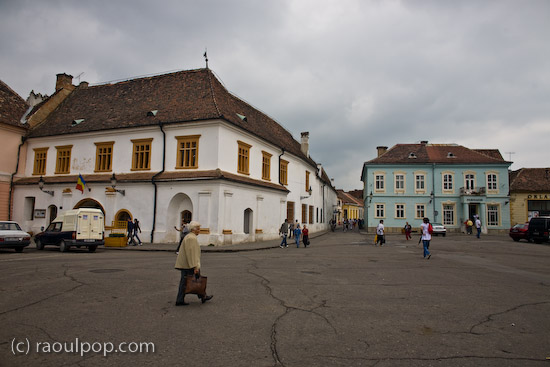
There’s the awful rub. In the words of Charles Laughton from the movie “It Started With Eve” (1941), “I’ve been tampered with!” I’ve spent so much time in the States that I’ve grown accustomed to the way of living over here. Not the comfort and abundance of products, though that’s part of it, but the way of life, of doing business, of approaching situations. I no longer fit in, in Romania, and I still do not completely fit in over here, after 17 whole years.

I can function just about anywhere, but am at home nowhere. I’ve got a mongrel heart, a split state of being, and it’s a sad, painful way to go through life, at least for me. A piece of me exists in each country, and I’m forever torn between the two.

It must be even worse for Ligia. She’s only been here for 4 years. She spent her entire life in the same region of the country, in a very close-knit family, among friends and relatives, and the only reason she left all of that was to be with me. It’s probably safe to describe the way she feels every day as home sick. At least she’s lived enough in one country to know which one feels more like home. Although the more time she spends here, the more she’ll bond with this country, till she’ll be just like me, a mongrel spirit.

I think of the pilgrims that came to the new continent from Europe, hundreds of years ago. I wonder how they must have felt, knowing that the likelihood of ever going back to their home lands was next to nothing, and having to face the rough conditions that awaited them in untamed territories. Perhaps the tough lives they led, and the blood, sweat and tears they put into eking out an existence bonded them more to their new homes. Or maybe they sat down on quiet evenings and silently bore pangs of sorrow over the distance that separated them from their birthplaces and ancestral homes.

Then I envy their children, who didn’t (and don’t) have to worry about any of those things. And I yearn for the normalcy and peace which I don’t think I’ll ever reach.


Standard