Taser X12 Stun Gun
– Without pain my foot! Have a look at the projectile. Those sharp prongs will penetrate your skin and underlying tissue, all four of them! And if that thing lands on your face, it will also scar you for life.
can’t center embedded video – Veoh Forum
– Now I can finally center my embedded videos. I modified the WP plugin I’m using to include the tags, according to this post in the Veoh forums.
Yesterday morning, I added a new feed to my subscriptions in Google Reader, and noticed what I thought was a new feature: the ability to translate posts automatically, within GR. The feature was actually launched in November of last year, and it works through the normal drop-down menu. A new option was added there, and it looks like this:
Isn’t that cool? The translation technology used is the same one found in Google Translate. What’s also cool is how the languages are detected. I assume the translate option with GR uses the language setting saved in the GR settings or in the Google Account settings, and then it either uses the auto-detect capabilities built into Google Translate to figure out the language, or it looks at the language setting encoded within the feed itself.
It’s an incredibly useful feature, because it allows people to read blogs in other languages without worrying about copying and pasting the text into a separate translation tool. Just think, if I write a post in Romanian and publish it on my site, the auto-translation tool within GR will allow you to read it as if I’d written it in English! Granted, the translation is machine-generated so it won’t read fluently and might even miss a few meanings here and there, but it’s certainly better than nothing, which is what we had before.
I’d also like point out that if you’re reading articles on my site instead of the feed, I’ve recently added auto-translation capabilities to each post via the same Google Translate technology. You’ll have the option to translate any of my articles into several languages, by clicking on a particular language, right under any post title, as shown below. I hope this will prove useful to my readers from other countries.
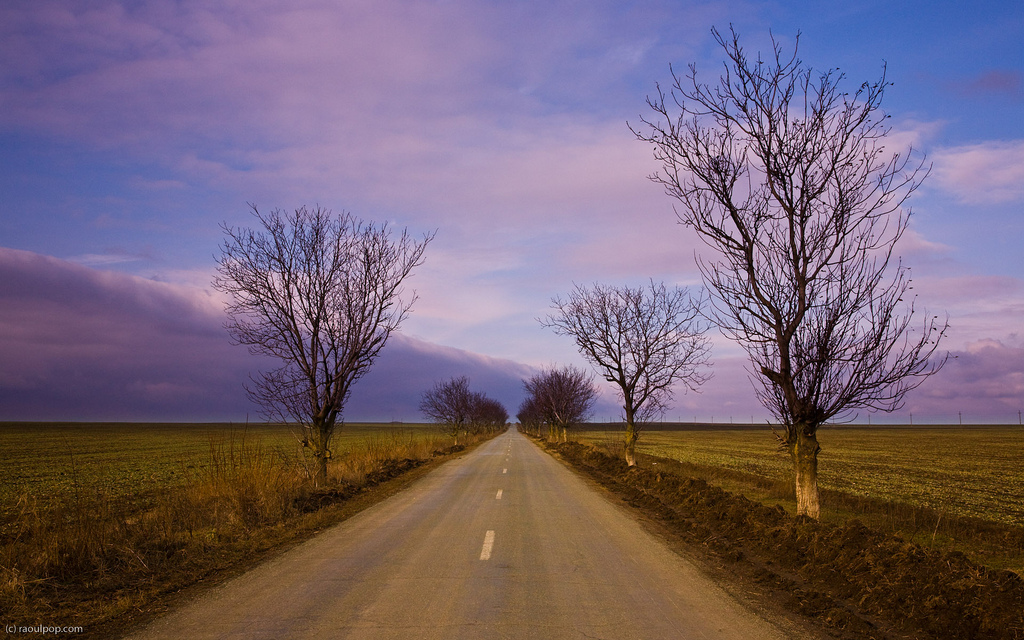
In Romania, many roadways are lined with trees. It could be walnut trees, or poplar trees, or fruit trees of some sort — the point is, they decorate each side of the road, standing guard, so to speak. I happen to think they enhance the beauty of the road, but I’ve heard talk of people who want to do away with them. They say they’re dangerous since drivers might run into them, as it happens every once in a while.
I recorded my own thoughts on the matter one day, while driving on a road in the province of Dobrogea. You can watch the video clip, or you can read on. My words and my voice both carry the same message.
I disagree. I don’t think the trees are dangerous. It’s the drivers who are dangerous. In the overwhelming majority of the cases where cars meet with trees, the drivers engaged in reckless maneuvers and were the very cause for the accident. Any trees that happened to be there simply drove that point home much more poignantly than some shrubs or an empty field ever could.
Thing is, Romanian roads, with very few exceptions, were built for low speeds. They were laid down during Communist times, when the car of choice (the only car, actually) was a Dacia — a relic of early 60s pseudo-design. It was underpowered, creaky — even when new — handled like a tractor hooked up to a blender engine, and stalled frequently in cold weather. If you managed to hit 100 km/h in those cars, it was definitely something. My grandparents had a Dacia 1310 model, and when that thing would get close to 100 km/h, it shook so badly I thought it’d fall apart.
Those were the cars that the road builders had in mind when they laid the roads and highways of Romania. The speed limit in the cities was and still is 40-50 km/h, and the speed limit outside the cities was 80-90 km/h. The latter has now been increased to 100 km/h. Problem is, people drive on these roads at 130-160 km/h or more. They just weren’t built for these speeds. The turns are steep, ungraded, sometimes unmarked, there are potholes most everywhere, and one often finds pebbles and mud on the roads from tractors that cross them to get to the fields, which makes braking on certain portions of the roads hazardous at best.
And yet, people just don’t get it. They think they’re somehow immune to accidents, until they lose control and run into a tree, often with disastrous consequences. Are the trees guilty? No. They simply point out the obvious — that the drivers themselves are to blame. If the trees weren’t there, I bet those same drivers would go even faster, knowing that if they ran off the road, they’d stop in some bales of hay or a wheat field. It would encourage even more irresponsible behavior.
Let me show you a simpler, less expensive, more sustainable way to dispense water at home or even at a business. I didn’t see this in the US, where the water cooler is practically ubiquitous. I saw this in Romania. You see, here it matters if a machine is plugged in and consumes electricity all the time. You feel it more in your wallet than you do in the US. Generally speaking, things are made smaller in Romania, and if possible, made to be operated manually instead of automatically. In many ways, that’s a better way to do things — better for the people, who burn more calories, and better for the environment, because the carbon footprint is smaller.
You have here a water pump, hand operated, which works on the principle of building a small vacuum inside it to draw water from a large jug. It screws on top of these plastic jugs that you can buy at the store, and it’s operated by pressing down on the large button on top. As you press repeatedly on it, negative pressure builds up inside, pulling the water upwards and releasing it through the spout. It’s an old principle which has been in use for many years, but here it’s been packaged in a small, inexpensive little pump.
Isn’t this a better way to dispense water? Wouldn’t you rather use this than a large water cooler which will take up more space, make noise as it cools the water, and require you to lift those huge jugs and set them on top of it?
You can get a water pump like the one from the video at Amazon.




 Raoul Pop