

A ram gives the photographer an inquisitive look as he is photographed inside one of the sheep sheds at Mount Vernon.
A ram gives the photographer an inquisitive look as he is photographed inside one of the sheep sheds at Mount Vernon.

As I traveled around Europe, I saw globalization in action, and made the following observations.
Being able to drive through various countries without needing to go through customs checks at the borders was wonderful. Unencumbered travel is a great experience.
The preservation of local or national cultures is of the utmost importance as people from various countries mingle more freely. Dominant cultures end up dominating, and that’s not a good thing. If I switched through various radio stations in Austria or Romania, I seldom heard German music, and even less often did I hear local music, like traditional Tirolean songs. Instead, I heard the latest hits from the US and the UK. I really don’t care to hear the same music I hear at home when I travel. I’d rather be immersed in the culture of the country I’m visiting, but that’s become quite rare nowadays.
Related to the point made above, the people who win from globalization preserve their local culture, because it not only enriches them, but it’s also a bankable practice when it comes to tourism. Clean, beautiful cities, where the old building were preserved and renovated, not torn down, and friendly local people are what tourists want to see.
The ability to export and import goods freely is great. It’s good for the local economies to have the potential of greater distribution. By the same token, it’s horribly bad when companies and factories move to areas where it’s cheaper to operate. Local economies, cities and people suffer so much when that happens. Just look at what’s going on in the US. I can see the same thing happening in certain cities in Romania. Just a decade or so ago, people used to have jobs and work in local factories or shops, and now they’ve all been sold or moved, and those same people, tied to those cities through their families and houses, are now scraping the ground to get by. I don’t know how they do it. It must be incredibly tough and frustrating.
Related to the point made above about not companies staying put and not moving, why do you think the US economy is hurting so badly now? It’s because it has become based on services and virtual goods like complicated and unnecessary financial speculation, not hard goods. Other than farming products, we make very little in the US these days. Most of the US products (and most of the world’s products for that matter) get made in China. Is it any surprise to see that China’s economy is booming?
Remember that countries have two ways to exert their influence in the world: (1) soft power, which refers to economic and cultural power, and (2) hard power, which refers to military force. US’ soft power has been waning in recent years, through its own faulty policies, and so the only way left for it to retain its dominance is to increase its hard power. The problem is that exerting hard power makes the soft power diminish even more and it also breeds enemies, which makes it even harder to retain dominance in the long run. Soft power preservation is the best long-term foreign policy a country could have, and the US has failed at it.
EU taxes are a heavy burden to bear. The VAT (Value Added Tax) is around 20%. That’s crazy. Not only does that make everything more expensive, but the markups are also higher. This means you’ll sometimes find that the same product, like a laptop or a camera, is up to 50% more expensive in Europe. That doesn’t make sense to me, particularly when salaries in so many Eastern European countries are unbelievably lower than in Western European countries, yet the prices are just as high.
In globalized economies, there’s greater potential to encourage correct or responsible behavior by standardizing business or agricultural practices. Vice versa, there’s greater potential to mess it all up as well, but let’s try to stay positive here. I liked what I saw in Europe when it came to land care and the preservation of forests. I also liked seeing entire fields filled with wind turbines, which generate electricity with zero pollution. I also liked seeing solar panels on the roofs of many, many houses in the countryside. I like the EU’s anti-corruption efforts, and I like the way they encourage good infrastructure through grants and loans to member countries.
When standards are put in place, there’s the potential to go overboard with rules and regulations. While the intentions are good, if you make it too onerous for an individual or a small business to compete or participate in the marketplace, you are effectively favoring large corporations and driving out the small guys. I see this happening with farming regulations in Europe. People that used to own herds of sheep and cows have now been forced to sell them or become part of large farming cooperatives, because they couldn’t afford to keep up with all the rules. Farmers operate on thin margins and big risks, and when you introduce extra costs, you are in effect killing them.

It would be a horrible shame to drive out all the small guys and let large corporations handle all of the marketplace. For one thing, you are killing the spirit of passionate people that love what they’re doing, and for another, you’re destroying a way of life that has served us well for thousands of years.
I do hope the EU and the US do their part to keep small farmers alive and well, while encouraging the production of food through responsible, renewable and healthy practices, free of genetic manipulation and unnecessary hormonal, pesticide and antibiotic treatments.
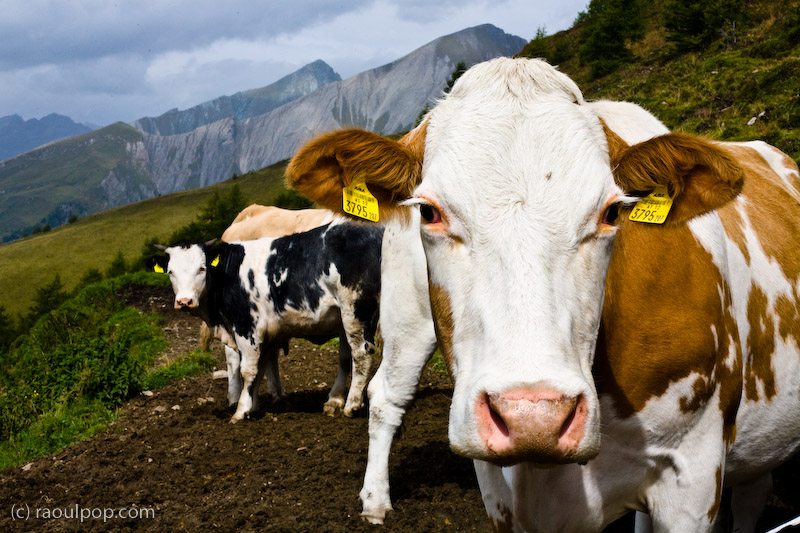
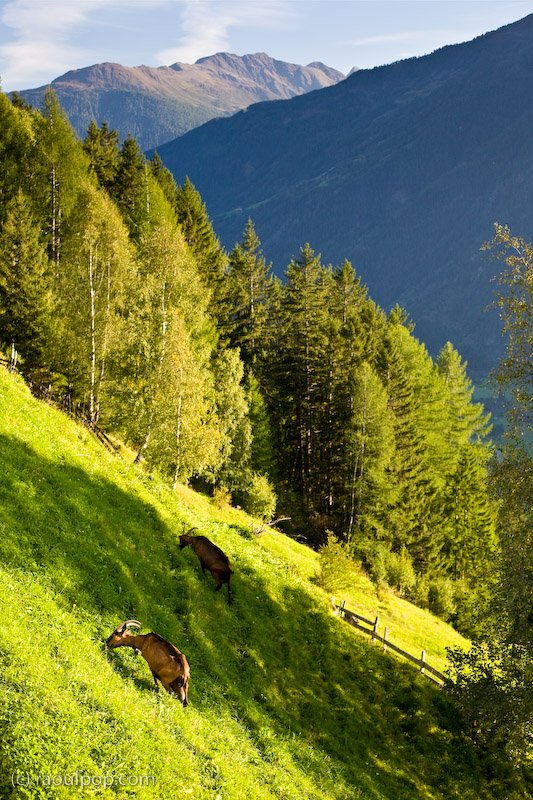
Greetings from Osttirol! My wife and I have been vacationing in Austria for the past week. It’s a gorgeous place to visit and, needless to say, I took tons of photos here. I’ve been carrying my Canon 5D and my lenses with me everywhere, and let me tell you, I’ve been sorely in need of a good zoom lens.
The lens inventory in my camera bag is woefully short at the moment. I started out with three primes: EF 24mm f/1.4L, EF 50mm f/1.4, and EF 100mm f/2.8 Macro. I sold the 24mm prime with the intention of buying the EF 24-105mm f/4L Zoom, but other circumstances intervened, and now I’ve only got the 50mm and 100mm lenses.
There are some who say it’s better to have prime lenses. I disagree. I’d like to see them carry five or six prime lenses in a backpack up and down a mountain in order to get the range that one or two good zoom lenses would give, and then tell me if they still feel the same way. And by the way, try changing lenses in swift mountain breezes, with insects buzzing around you and just dying to get inside the sensor chamber and leave smudge marks (which happened to me). Oh, and don’t forget to throw in a few other accessories such as polarizers and UV filters of various sizes for the different diameters of each lens, plus one or two water bottles and a fleece jacket plus an umbrella in case the weather goes bad, and then we’ll talk…
In a way, I was glad to only have to carry two lenses; I’d have really felt the weight of a third one. But I felt so limited in the photos I could take, because I could only use the 50mm or the 100mm lens to frame my photos. In some instances, I could walk back and forth to get a better view or angle, but in others, there was no way to get a better photo without also being able to fly — which incidentally, would be very nice, but I haven’t figured out how to do it yet. And no, I don’t believe in cropping. I only do it when I absolutely have to. I didn’t pay $2,800 for a full-frame sensor that can take 12.8 megapixel photos so I could crop them and get the same resolution I can get from a $500 camera.
To this day, I slap my head when I think that I could have had the 24-105mm zoom lens as a kit lens with my 5D for a little over half its usual price. I was such a fool not to get it! It’s a light and sharp zoom with more range than the EF 24-70mm f/2.8L, and you can easily walk around with it for hours without getting too tired.
So far on this trip (which ends very soon, unfortunately) I took 1904 photos with the 50mm prime, and 471 photos with the 100mm prime. If I had had (don’t you just love the English language) the 24-105mm zoom on my trip, it’d have stayed on my camera 95% of the time, because that’s the range I use the most, particularly on the wider end of that focal spectrum, which was not available to me, each and every day, how stupid could I be, ugh…
Look, I’m not knocking the 50mm prime, which is a great prime, and very cost effective given its low light capabilities and sharpness. And I’m definitely not knocking the 100mm prime, which is versatile and a fantastic macro lens with gorgeous bokeh. But I really didn’t need f/1.4 or macro capabilities for landscape photography, which is what I did on this trip. I needed a zoom lens!
So, if you’re not sure what lenses to get, don’t do what I did, or you’ll be frustrated to no end as well. First get a good, lightweight zoom lens, one that won’t kill your wrist as you carry your camera around taking photos. Later, as you find that you need more specific capabilities, such as being able to take handheld photos at dusk or dawn, or more bokeh, or macro photos, then spring for those primes that have the features you need.
Slow down. That’s a phrase not often heard in the US. At least not among the people I know. But it’s a notion that’s slowly starting to make more sense.
Americans love to think big and spend big. They want progress on every front, no matter what the cost. In the 20th century, that sort of thinking worked well. It carried us through to the 21st century, where, however reluctantly, I think we’ve got to change the way we operate.
There’s a newspaper article I’ve been saving since June of 2007. It’s about people who overextended themselves in order to keep up with the Joneses, and were paying the price. It’s called “Breaking free of suburbia’s stranglehold“. Even before the real estate bubble burst, sensible people were finding out they couldn’t sustain their lifestyle and stay sane, so they downsized. Each found their own impetus, but they were acting on it. That was smart. I wonder how many people had to downsize the hard way since last year…
How about a more pallatable reference, one for the ADD crowd? There’s a Daft Punk video called “Harder, Better, Faster, Stronger“. The lesson to be drawn from it is found at the end of the video, but to get it, you have to watch it from the start. I’ll summarize it for you here. Don’t be fooled by glitter and glamour. There’s a price to pay for everything.
Paying for it isn’t a new notion. It’s been around for ages. Take “pay the piper“, for example. You look at almost any language, and the idea of everything having a price can be found embodied in certain evocative phrases.
Let’s look at a few more concrete examples:
These are all hard lessons to learn. It seems the only way to get people and companies to learn to act responsibly is to increase costs. When your actions have a direct and immediate impact on your bottom line, you tend to change your ways in order to stop the bleeding.
It’s a shame it has to be that way, and perhaps at some point in the future, the new way of thinking will be more ingrained in people’s minds, and they’ll think about slowing down, conservation, sustainability and efficiency on a daily basis. Perhaps they’ll realize having a more meaningful life is more important than having a busy life filled with material nothingness.
I’m grateful that at least some are already seeing things the right way. I myself have already started to cut out unnecessary expenses and time commitments, and will continue to do so. I have several more important changes still planned.
If you’d like to do the same, one place to start is a book entitled “Take Back Your Time: Fighting Overwork and Time Poverty in America“. It’ll get you thinking along the right lines, but it’ll be up to you afterwards to make the needed changes in your life.
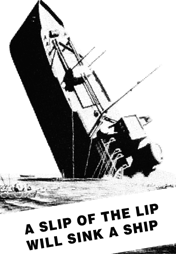
On DC’s beltway, you can easily spot trucks carrying concealed military equipment. All you have to do is to go about your business, and you will pass one or two semi trucks every day, each carrying some big payload wrapped in canvas. While the trucks are generic, the canvas isn’t. You will almost certainly find some logo or initials on it.
If you’re diligent, you can trace that logo back to the company, then find out what contract they were awarded, by whom, and finally, what concealed equipment you might have seen. It’s not hard to do this if you have a somewhat basic knowledge of how government/military contracts work.
I’m not saying this because I want to divulge any government secrets or put anyone at risk. I simply want to point out that most people can’t keep their mouth shut when it comes to bragging about their work, particularly when they’re proud of what they’re doing.
Remember Napster back in its golden days (circa 1997)? You could log on and download music all day long. College students everywhere were doing it. I did it too, for a while, until I realized it was wrong to rob artists of their hard work like that. Later, I even deleted most of the music I’d downloaded, and since then, I’ve been buying my music.
I’m not sure how online music sharing works today, but back then, most hardcore music sharers would mark their files by putting some sort of identifier (such as a nickname) inside the meta data. Some even put site URLs in the meta data. I’m sure that as music labels clamped down on file sharers, these nicknames and site URLs made it easier for them to find the culprits.
These file sharers and the military contractors are just two examples of how one can always count on pride to get at some information. Like most things in this world, this is nothing new, but it’s something to keep in mind if you’re working on something you’d like to keep under wraps.
 Raoul Pop