I thought I’d put together some Christmas abstract photos I’ve taken lately. As mentioned in past posts, I love abstract photos, and I love out of focus photos even more, but only when they’re done right. I’m not saying I own the recipe for making out of focus photos, but I like the way mine come out. 🙂
Not sure if you’ve noticed this with past photos, but if you put your mouse over them, you’ll see the title. It might be nice to see what I have to say…
I have owned the Kodak EasyShare v610 Dual Lens digital camera for the past year and a half, and I’ve meant to write about it for some time. This will be a nostalgic review, since the camera is no longer being made.
Last weekend, I put together an 8-minute video review, and also took some photographs of the camera. I’ll accompany those two offerings with my insights, gathered after a LOT of use in just about any weather and light conditions. At the end of the review, I’ll also post selected photos taken with the camera.
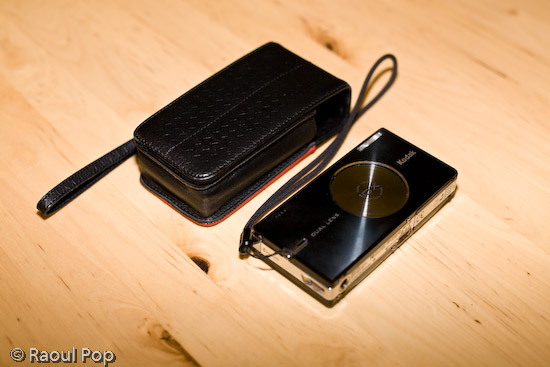
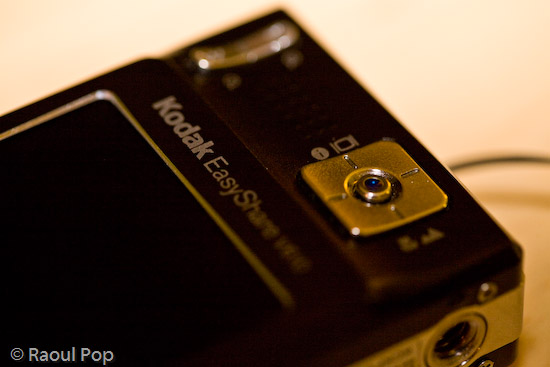
There’s what the camera looks like at first glance. I purchased a matching leather case for it, and I’m not sorry I did it. It protected the LCD screen from scratches, and it helped protect the camera itself when I threw it about from bag to bag. Back when I was in college, in the mid 90s, my parents gave me a first generation Canon Elph. It used APS film, and it was a small, beautiful and elegantly designed little camera for its time. I’m talking about this because I got a leather case for that camera as well, and it helped keep that camera running in good condition for several years. My advice to you if you get a small camera is to get a good case for it as well. Make it sturdy, so it can withstand abuse, and make it stylish, so you won’t be ashamed to be seen with it in public. Leather fits that bill quite nicely, doesn’t it?
Video review
The video I recorded is enclosed below. You can also view it here, or download it if you like. If you’ve seen some of my other video reviews, you’ll have to excuse the lower overall quality of this one. I shot it this past Sunday, informally, during a very hectic weekend. I had a limited amount of time at my disposal, I was rushed, and it shows. But I managed to get my points across, and I’m happy about that, so it is worth watching.
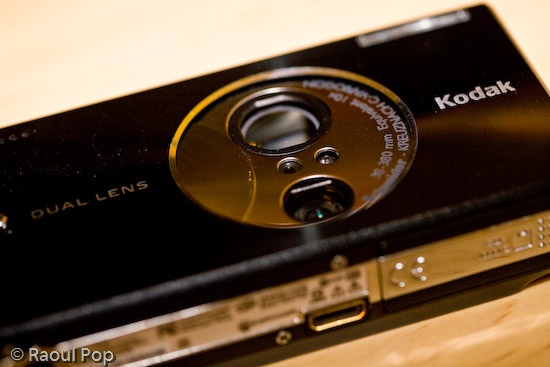
One of the striking features of the camera is its dual lens setup. Back when it came out, a 10x zoom on a camera this compact was virtually unheard of. It’s still fairly uncommon. The only way this could be accomplished, while still keeping things looking great and with no external zoom extending outwards from the camera body, was with two lenses, one for closer distances, and one for what could be called tele. The first lens — the bottom one — is for 1-5x, and the second lens — the top, larger one — is for 5-10x, as you can see below.
The two lenses together have an astounding range of 38-380 equivalent focal millimeters. The first lens goes from 38-114mm, and the second goes from 130-380mm. I have good things to say about the quality of the optics. The images were sharp when in focus, and there was little fringing and chromatic aberration. There were two drawbacks to the lenses.
One, they were fairly slow. What I mean by that is that they didn’t open up quite enough, and that tended to make the camera pretty hard to use in low light situations without a tripod. The smaller lens (1-5x) is rated from f/3.9 to f/4.4, and the large lens (5-10x) is rated to f/4.8.
Two, there was a pause when zooming out past the 5x mark. The camera’s zoom would stop when it reached the end of the focusing range of the first lens, and I would have to press the tele button again to pick up the next lens and focus further than that. Over long periods of use, that tended to be pretty annoying.
But I didn’t let these things bother me too much. After all, I got 10x zoom in a very compact package.
Controls and ease of use
What I liked most about the camera was its ease of use for basic photo taking. That proved to be both good and bad. Anything more advanced (such as long exposures, a change in ISO, or White Balance) required some menu surfing, and any custom settings were erased when the camera was turned off. Even something as simple as delayed exposures (2 or 10 seconds, for example) needed to be set for every single photo where they were needed. One couldn’t just turn on that setting and keep it on. It would reset after every exposure.
Even though I didn’t like this, I can understand the rationale for it very well. After all, this camera is a compact point and shoot meant for people who just want to pull it out and take photos, not for more serious tasks. And let me tell you, if someone that doesn’t know much about cameras picks up a Kodak v610, messes with the settings, and doesn’t know how to get it back to normal, they’ll be VERY much relieved when they find out all they have to do is turn it off, then back on.
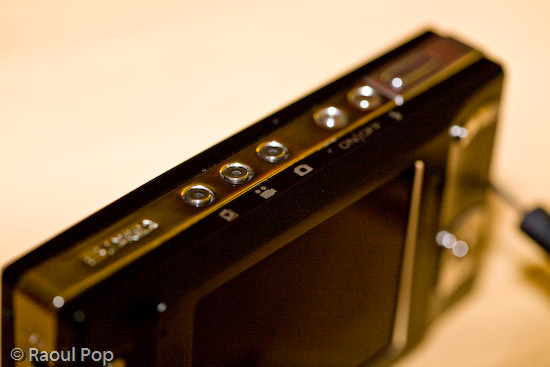
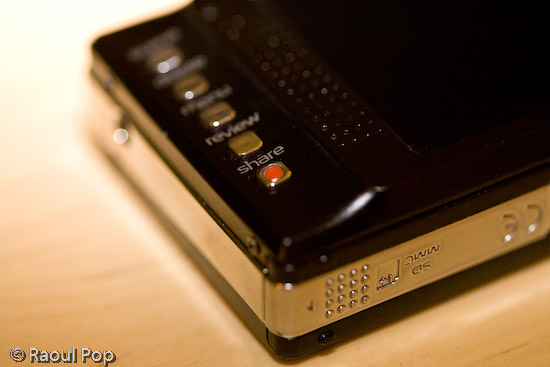
The controls on the camera are wonderfully designed. The buttons are either metal or very hard plastic, and I am not about to scratch them to find out what they’re made of. At any rate, they’re the right shape and texture, and it’s fun to press them.
They’re intuitive, they fit well within the camera’s interface, and there aren’t too many of them, which is the right decision for a compact camera such as this.
I loved the easy way to switch between normal, macro and tele mode. See the big, square button above? Turn the camera on, and you’re in normal mode, where the camera can focus from 2 feet to infinity. Take photos as would normally do. Press the bottom part of the button once, and you’re in macro mode, where the camera can focus from 2 inches to 2.3 feet. Press it again, and you’re in tele mode, where you can take photos of things very far away and not have to worry about focus. The camera focuses to infinity automatically and picks a higher aperture, which means you’ll get a larger depth of field.
The build quality of the camera was evident everywhere. The tripod mount is a great example of this. It was pre-planned and integrated into the silver metal border that lines the camera’s sides. Not only that, but the mount itself is metal, not plastic. Given the camera’s light weight and compact size, one wouldn’t think it’d need a metal tripod mount, but there it is, and I love it!
One point of contention with the camera is the USB connector, which is a custom one. I would have loved to see Kodak put a standard USB mini connector on the camera, but they didn’t. That’s probably because they wanted it to integrate with their camera stands and plug right into their photo printers, but come on, there are volumes to be said about standardization… It’s really important when it comes to good design.
Capabilities
The camera includes a movie mode which records Quicktime movies using MPEG-4 compression at 30fps. I found the quality of the movies (640×480 pixels) to be plenty for my on-the-go needs, and often used it as my primary video camera. I have a confession to make: it was also my only video camera. 🙂 Remember my video review of the Canon Rebel XTi? It was done with the Kodak v610 mounted to a tripod. Came out great, didn’t it?
With a 2GB SD card in the camera, it could record over 1,100 photos or 1 hour of video, which is more than plenty for such a compact camera. The only problem was, the camera’s battery would only last for about 125 photos. I’m not sure how many minutes of video the camera could do on a fully charged battery, so I can’t speak for that. But I did find myself frustrated by the low battery life when taking photos, and ended up purchasing a second battery. With judicious use of the zoom and LCD screen, I found I could extend the battery life to 135-150 photos, but that was still not quite enough for me, and it was pretty frustrating to be out in the city, taking photos, only to have the camera die on me.
Again, I think this is a design issue, and I wouldn’t necessarily call it a flaw. This is a small, stylish camera meant for the person who would pull it out every once in a while and take a few photos, not for someone who wants to take lots of photos. That person should opt for a bigger camera with more battery life.
One other point I wanted to mention was the sensor’s light sensitivity. It was capable of 64-800 ISO on paper. In real life, I found 400 ISO to be barely acceptable, and 800 ISO unusable. 64, 100 and 200 worked out great. If I left it on Auto ISO, it varied it between 64-200 automatically to get the optimal exposure. The camera changed the ISO settings in increments of 10 between 70-200 ISO, and I’d always get a chuckle out of seeing all sorts of ISO speeds show up in my photos’ meta-data.
Overall, I was pretty happy with the camera. I say “was” because I recently gave it to my parents. They had a more complicated digital camera, and they often couldn’t understand the settings and were frustrated because they couldn’t get the photos they wanted. The Kodak v610 will work out much better for them since it’s more compact, it’s fully automatic, and it resets its settings with every “reboot”.
The camera also has a blurry photo indicator that can be turned on. If a photo is good, a little green hand will appear. If the photo is marginally acceptable, the little hand will turn orange. And if the photo’s not good at all, the little hand will turn red. That’s easy enough for anyone to understand. I told them to re-take any photos where the little hand will turn red, and if they can’t get anything orange or green to seek more light or give up. I think they’ll finally be able to get more decent photos now.
Let me show you a few photos I took with the camera to illustrate what it could do. I can’t emphasize enough how useful that 10x zoom proved to be, and you’ll see what I mean as you look at the photos.
Sample photos
This first photo is quite appropriate for this time of the year, as it represents a group of merry carolers on a sled.
This is another macro shot, this time of colorful beads in a public market.
The wide focal range allowed me to get photos of entire valleys from mountain tops. This is a photo of a portion of the Shenandoah Valley, as seen from Skyline Drive. Here you can see the typical bluish tinge caused by UV haze. This gets exacerbated by the CCD sensors of smaller cameras. I’ve seen it on many small cameras. For example, the iPhone’s built-in camera suffers from this defect to what I consider an unacceptable degree.
The camera’s CCD sensor was fairly adept at capturing color.
These very red and vibrant fall foliage was captured last year at our local Audubon Naturalist Society in Bethesda, MD.
During one weekend morning, I decided to set up the camera on a tripod and play around with water drops on petals. I got some really nice photos out of that session. This is one of them.
There’s a WWI memorial in downtown DC, and the crowning piece is this golden statue.
I love great sunrises, and I captured many of them with the Kodak v610. This is one of those photos.
The inside courtyard of the Watergate Hotel in Washington, DC is shown below. The camera always managed to expose photos decently when confronted with situations like this: a wall in shade and the bright sky above. A LOT of cameras have problem with this kind of a setup, including my 5D, which tends to overexpose the sky.
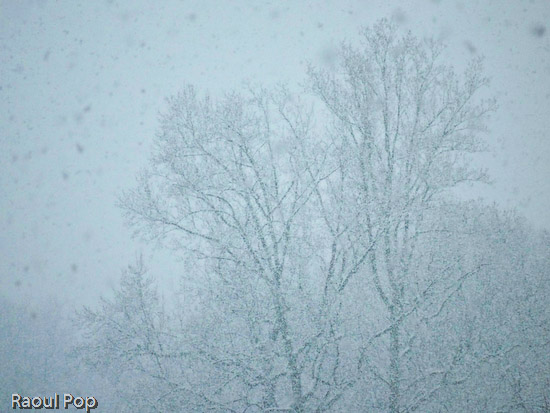
Taken during a fierce snowstorm (we get one of those every year around here). It’s too bad the snow melts away so quickly afterwards.
The next day, snow began to melt, as expected. I rushed to get a few photos before it would all be gone. This photo was post-processed to emphasize the frozen atmosphere — wishful thinking on my part, since the temperature was above 32 degrees Fahrenheit.
We were walking along the C&O Canal this past spring, and spotted a fox walking around in the forest. It stopped to check us out as well. This is where the camera’s 10x zoom was very useful. We were able to get up close even though we were separated by a body of water.
The camera’s compact size made it a breeze to use when an opportune moment was spotted, like with this lone tulip outlined against a green wall.
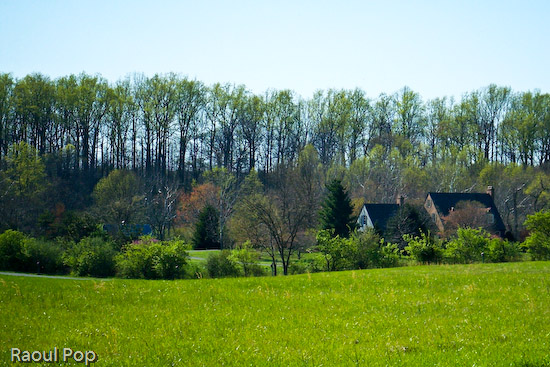
The zoom once again proved useful for getting closer to this lovely country house. In reality it was quite far from the road.
Although there’s some lens flare in this photo, which could have been avoided with a lens hood (but the camera isn’t equipped with one) I love it. This is a portion of the C&O Canal where the water has pooled and is now stationary. Since the canal is no longer maintained, this portion has turned into a swamp. While I wouldn’t wade around in it, it makes for an interesting wildlife habitat, and the afternoon light is superb.
Guess where this photo was taken? It was at the top of the Tyson’s Corner Mall parking lot, looking toward DC. Summer was in full swing, and that’s the reason for the rich, deep green foliage of the trees.
This was taken more recently, right in my community. Those beautiful golden hues can be seen every fall, but I won’t tell you where. I’ll keep it a secret for now. 🙂
I leave you with another beautiful sunrise.
Summary
If you’re interested in a capable little point and shoot with a very powerful zoom for its size, try finding the Kodak v610. I checked and it’s out of stock even at Kodak’s own online store. It seems only Amazon still has a few units left. Though it’s no longer being made, if you can pick up a used one at a reasonable price and provided you understand its limitations, I think you’ll enjoy using it.
➡ Updated 11/3/08: I’ve seen renewed traffic to this post, and wanted to let you know that at this point the drive retails for $99. I think that price point is a little high given that 1TB drives have become affordable, and bare 1TB drives only cost $110-130. This means that if you’re looking for an external 500 GB drive, it should cost you somewhere between $79-89. Keep in mind that the manufacturer has to strike a balance between the cost of the drive and the cost of the enclosure, and while 500GB drives are bargains now, it will soon become impractical to manufacture them at the large scale needed for low price points, because the 1TB drives will become the new commodity hard drive. My message is, get them while you can, or spring for the 1TB external drives. The original review continues below.
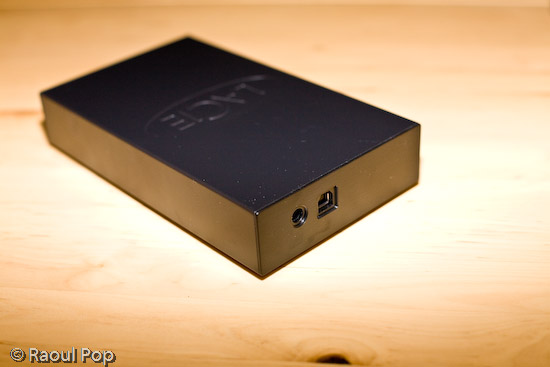
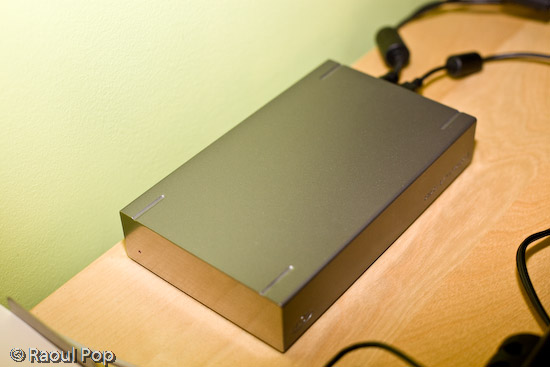
This unassuming little black drive is a great product and a great buy at only $120 for 500 GB. It seems that LaCie has discontinued it. Buy.com, where I purchased two of them, no longer has it in stock. Amazon still has it, thankfully. Read below to see why I like it.
The price is right for all that space. C’mon, 500 GB for $120? Sign me up! On top of all that, it’s whisper quiet! My big complaint with a previous 500 GB LaCie drive that I owned was the noise it made. Boy, was it loud! Not this drive. It’s so quiet, I can’t even hear it, unless it’s being actively accessed, and even then, it’s pretty quiet.
What’s also REALLY nice about it is that it doesn’t have a power brick. You know what I’m talking about, right? It’s that big, heavy annoying power adapter that sits in the middle, between the part you plug in the outlet and the part that plugs into the drive. Not on this drive! I love that! It only has a simple, unassuming cable, and that does wonders when it comes to cable management and keeping the underside of my desk neat. These are all the cables you’ll need with the drive.
Here’s what the back of it looks like. Again, no annoying and loud cooling vents, just the adapter and USB ports.
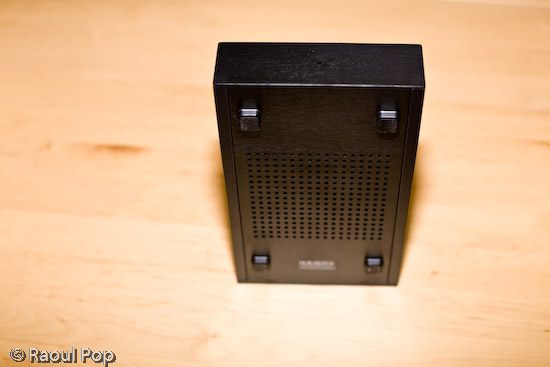
I love the simple, unassuming, but very efficient design. Instead of a cooling fan, the drive cools via a grille built into its bottom.
The only other drive that compares to it in terms of how little noise it makes is the LaCie 250 GB external hard drive, which I also own. But I don’t think this drive can be found on the market any more, and besides, why go for 250 GB when you can get 500 GB for $120?
If you want a great little drive to store your files, jump for the LaCie 500 GB USB drive before it’s gone. It’s hard to get 500 GB drives by themselves at this price point nowadays, much less already packaged up in a neat little enclosure and with cables. I’m not sorry at all I bought two of them, and I might get one more in the very near future — if there’ll be any left on the market after the Christmas season, that is.
I’ve written about the USPS before, and how slow and unreliable it can be. I want to give you an idea of how terrible their service can be with hard, indisputable evidence (see screen shots enclosed below).
A package was mailed to us from a vendor on 11/14/2007. It came from Capitol Heights, Maryland, and shipped to my city, which is North Bethesda, Maryland. [For those unaware of this, North Bethesda is not officially a city (yet); it’s a borough between Bethesda and Rockville. The Post Office treats it as Rockville but anything addressed to North Bethesda will get there just fine.] It arrived on 11/27/2007, approximately 13 days after it left Capitol Heights.
Here’s the kicker: not only are Capitol Heights and North Bethesda in the SAME state, but they’re only 25 miles apart. According to Google Maps, and taking the long way around DC by going on the Beltway (I-495), it’s approximately 25 miles from Capitol Heights to my place.
How in the world could it have taken them 13 days to deliver it? I don’t know how, but there it is. If you want to talk about incompetent service, I think this would be a good example. If they’d have walked the package to my place, it would have been faster. But no, they have fleets of cars, and automated systems, and all sorts of things to speed things up, and somehow they not only manage to miss deadlines for Priority Mail and lose packages on top of that, but they bungle up a 25-mile delivery so badly that it takes them 13 days to get the package to me.
Here’s the proof. The package was supposedly processed on 11/20/07 at their Capitol Heights facility.
It arrived at my place on 11/27/07.
But they received the electronic shipping notice sometime on the 14th, according to the Additional Details page. That means they received the package itself either on that same date, or shortly afterwards. Whether the vendor took their time to get the package to the post office, or whether it sat at the post office between 11/14/07 and 11/20/07 is irrelevant to me. Even if I give the USPS the benefit of the doubt and say they started working on the package on 11/20/07, that’s still 7 days to transport it 25 miles. It’s still unacceptable.
Any way you look at it, the USPS is a mess. If it takes them this long to process and transport what’s essentially a local package, I suppose I should be happy it “only” takes them 7 days to get a letter from me to my parents down in Florida. That could be called an improvement on their local delivery service.
To top it all off, they want to keep increasing the price of first-class postage and other services. I’d like to know what we’re getting in return, other than copious amounts of junk mail.
Friends of ours had a gorgeous bouquet of chrysanthemums at their place, and I couldn’t resist taking a few photos. These were taken handheld, with the wonderful 580 EX speedlite from Canon and the 100mm macro lens.























 Raoul Pop