Several years ago, the common advice was 6-8 cups of water a day. Lately, I’ve been hearing 8-10 cups a day. Thankfully, there’s a easy formula you can use to calculate the amount you need.
½ * bodyweight = x ounces of daily water
I didn’t come up with this on my own. It’s a formula you can find on the Hippocrates Health website. So let’s see, for my 160 lbs. body, I’d need 10 cups of water per day.
½ * 160 = 80 ounces / 8 = 10 cups of daily water
For those of you on the metric system, 1 ounce is about 25.6 ml, and 8 ounces (1 cup) is 237 ml (or a little more than a quarter liter).
For my needs, that would work out to 2.36 liters per day. It’s really not that much, particularly on these hot summer days. The sad thing is I’m not drinking enough, and then I end up with these monster headaches. The lack of water may not be the main reason, since I’ve got plenty of other things going on, but it sure is one of the contributing factors.
A Venetian nobleman on the brink of death discovered a way to stay healthy and alert to the ripe old age of 102. He lived in the 15 century, and his name was Luigi Cornaro (1464-1566).
At that time, Venice was a thriving commercial port — one of the main shipping hubs in Europe — and a life of abundance with little thought for health was the norm for all wealthy people there. What also factors into the equation is the average life expectancy during that time, which was somewhere around 40 years. Yet Luigi Cornaro was a nobleman who chose to live a balanced life, eat a healthy diet, and lived to 102 years. That is truly remarkable.
How did he do it?! It’s really no mystery. At the age of 83, he wrote a treatise on the subject, entitled “Tratatto de la vita sobria”, followed by three more treatises on the same subject, published at the ages of 86, 91 and 95, respectively. In his treatises, he described in detail just how he lived his life and what he ate, hoping that others would follow his advice and reap the same benefits.
He believed in consuming the best quality and most easily digestible foods in small amounts. He reduced his food intake, cutting it down to twelve ounces a day of solid foods, divided into two meals with fourteen ounces of light wine, also divided into two servings. He sometimes ate a little beef, but mostly he would eat one egg yolk, vegetable soup, coarse, unrefined bread, salads, small quantities of locally grown fresh seasonal fruits and vegetables, and he’d drink slightly fermented wine. His stomach didn’t agree with fish or chicken, so he avoided them.
The amazing part is that all his faculties stayed intact and even better, improved with age, right up to the day of his death. He had no memory loss, his eyesight and hearing grew keener with the years, and he was able to stay active, physically and mentally, in his advanced age. In his nineties, he even studied singing and horseback riding.
His writings are now part of the public domain and thus freely available for download. If you want to live a healthy life, do yourself a favor and read through them. Google Books, has an 1833 English translation of his writings, entitled “Discourses on a Sober and Temperate Life“, translated and edited by Sylvester Graham. You can download the entire book as a PDF there, or here on my site (see 1st PDF below). You can also download an abridged version of Cornaro’s writings as a 6-page PDF (see 2nd link below). It was sent to me via email, and am not sure who its translator is, but would be glad to give credit if someone will contact me.
If you’re interested in modern advice on the subject, US News recently published an article entitled “10 Healthy Habits that Will Help You Live to 100“. They didn’t mention Cornaro, but their advice is easy to follow, if you’ve got the willpower.
There’s a Looney Tunes cartoon from 1944, entitled “Brother Brat“. It stars Porky Pig and speaks eloquently about child discipline. In it, Porky becomes the unwitting baby sitter for a Rosie the Riveter type super-woman who’s pulling long shifts at the factory, helping out with the war effort.
When she leaves her brat, Butch, with him, she also hands him a book, which she says always helped her. It happens to be a book on Child Psychology.
Porky takes the offer at face value, and believes the book will really help him. When baby Butch starts acting out, he checks the book for advice.
He soon finds out the book is no good, as he applies the wishy-washy, sound-good nonsense from the book to his real life situation and things go from bad to worse.
By the end of the cartoon, he’s running for his life, with an axe-wielding maniac baby on his tail.
Then Susie the Riveter comes in, notices the mayhem, and asks him if he used the book. Desperate, still running, he screams, “Yes, but it didn’t work!” Then Susie grabs the book and shows Porky how it’s done: “Maybe you didn’t use it right. It always works for me!”
The punchline is obvious, and yet it teaches all of us, to this day, a valuable lesson: sometimes the only thing that works is a spanking. As for child psychology books, I share the opinion of the animators — those books are a bunch of hooey, fit to be printed on toilet paper and used that way. I’m not alone in that sense. Most people shared this opinion when classic cartoons were made. Cartoon studios of all sizes lampooned child psychology books, including Disney.
Spanking has sadly become a tabu practice in this “enlightened” age. If you spank your child now, the state will take it away from you. Surely the state must know what it’s doing, right? Because governments in all developed countries have shown us they manage everything else to a tee, beyond reproach, right? Naturally, we ought to trust what they tell us to do with our children?
I see parents these days, stressed to the breaking point because of children who haven’t been properly disciplined, and they’re afraid to discipline them. They try talking to them, they try to reward them for good behavior, they try timeouts, but seriously, sometimes a child just needs a good spanking. The Bible knows what it’s talking about when it says in Proverbs 13:24: “He who spares the rod hates his son, but he who loves him is careful to discipline him.” It has the benefit of thousands of years of experience on its side when it gives that advice.
If you’re interested, my father wrote a couple of articles several years ago. One is on the duties of children toward their parents, and the other is on the duties of parents toward their children. The articles are a compilation of verses from various books of the Bible on those topics, and they’re not doom and gloom stuff — they’re thoughtful, fascinating stuff. To make things even more interesting, my father is a psychiatrist who is keenly interested in the proper development of one’s character and personality.
On an unrelated note, thank goodness for Google Video, which indexed the cartoon from Dailymotion! I wouldn’t have been able to provide you with screenshots from the cartoon otherwise, because I couldn’t find it in regular web searches. I don’t have it in my collection, and only saw it a few times on TV, including once on Boomerang recently. I encourage you to watch it.
You might think this is a banal topic, but I don’t. I’ve had to take three of my Drobos with me on a recent overseas trip, and I had to make some clear decisions about how I was going to transport each of them.
The first thing I wondered about is whether there’s a carrying case or bag for the Drobo. I’ll talk about this first, then I’ll give you some practical travel advice.
Right, the carrying case — there isn’t any. There’s a grainy pic on TwitPic of some sort of a large plastic case with foam where you could place the Drobo and its hard drives, but that’s too big to take with you most places, particularly when you have lots of other luggage. It won’t work. We need something slim, something that fits right around the Drobo’s rectangular shape, has handles, sort of like a bowling bag, and yet is well-padded to protect the Drobo. Alas, there isn’t any such thing…
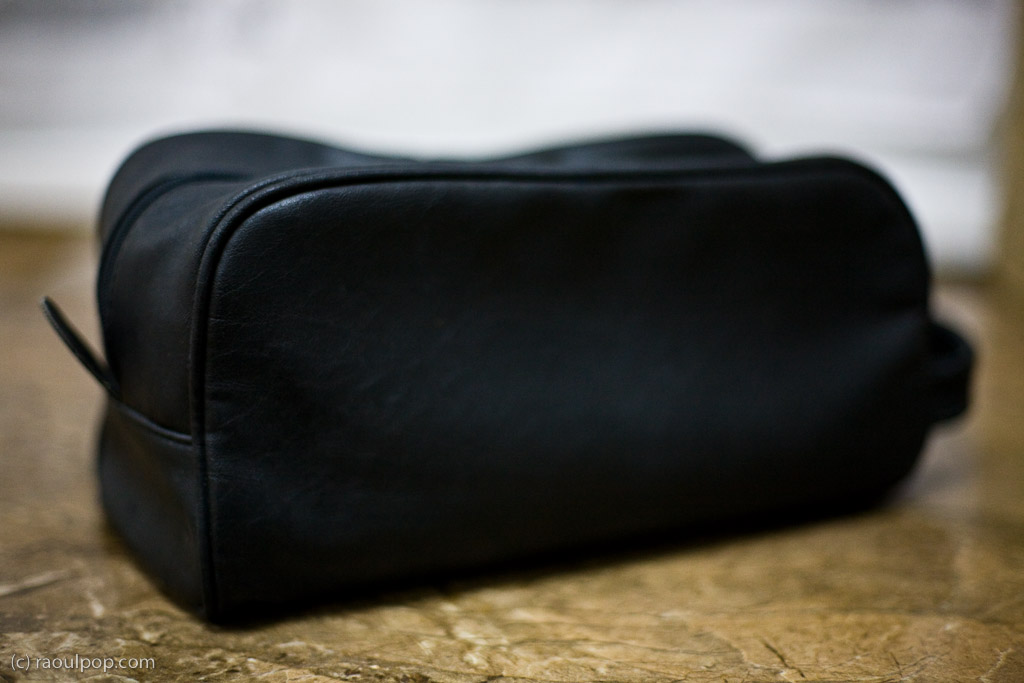
Let me show you a potential design that could work. It’s not something I invented — it’s my travel toiletry bag. Notice its handle is on the front, but I think there ought to be two handles at the top, one on each side, since the Drobo can be fairly heavy with the hard drives inside. The zipper ought to be down the middle of the case, at the top, and the bag ought to have two compartments on each side, or one below, where you can stick the power brick and the USB and Firewire cables.
If Data Robotics or some other company made this sort of a carrying case, we would simply take the Drobo, with its hard drives inside, put it in the bag, and stick the bag in our carry-on luggage. I wouldn’t trust airport personnel enough to check the bag containing the Drobo. Given the way they throw baggage around like it’s bales of hay, they’d likely damage the Drobo and our data.
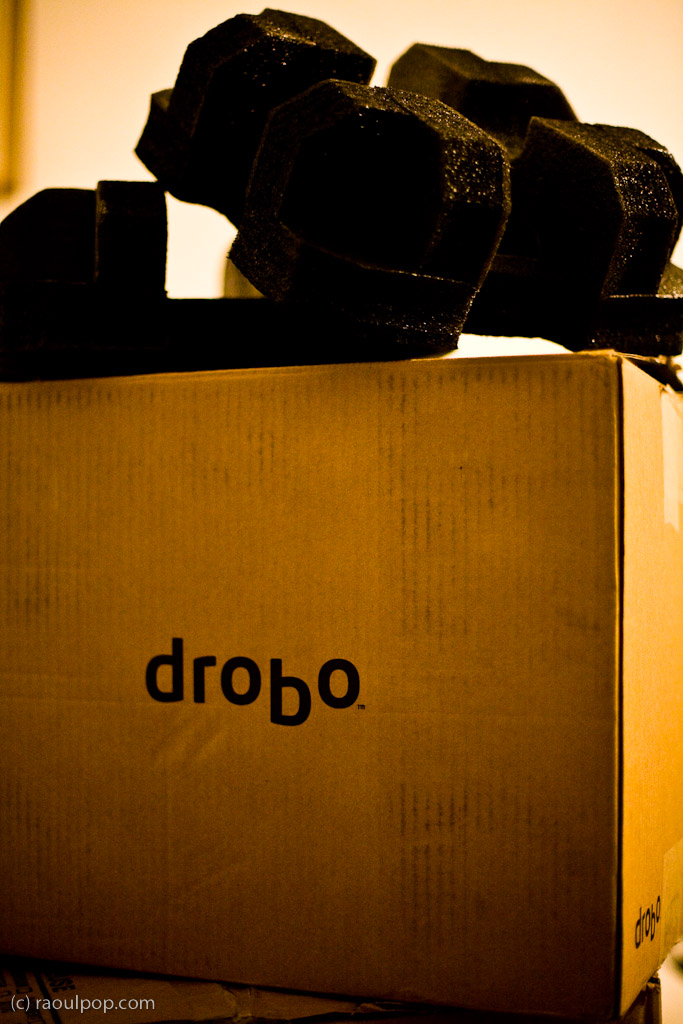
Now let’s get back to reality. There isn’t any carrying case yet. What do we do? What did I do? I was able to send two of my Drobos separately, by ship, and I placed them in their original boxes, which I packed into larger cardboard boxes with other items. They arrived safely, thank goodness. I love those Drobo boxes, they hold up so well! I kept all of them and used them often for storage or transport.
As for my third Drobo, the Firewire Drobo, my current primary storage unit, that had to come with me on the plane. I kept the hard drives inside it, packed it in woolen sweaters and other soft clothes, and put it in one of the carry-on bags. Yes, in case you’re wondering, I had to pull it out of the bag for airport security and show it to them. They kept wondering what it was and what it does, and couldn’t believe it was basically an external hard drive. Expect the same treatment from them, at least until they see more Drobos. As for the Drobo’s original box, I didn’t want to lose that, so I flattened it and placed it in one of the checked pieces of luggage along with the foam holders and the box that contains the wires, power brick and software CD. I’m glad to tell you that it arrived safely with me, and it’s connected to my MacBook Pro as I write this.
One last bit of advice. If you travel by car, and there isn’t yet any Drobo carrying case/bag, make room in your trunk for the Drobo’s original box. Pack it inside, and you’ll know that short of an accident, your Drobo will be well protected.
I can’t take credit for this cure. A life-long nurse told me about it a few years ago, and it’s worked for us ever since. I’m not sure if she’d be comfortable having her name revealed here, so I won’t do it. But I’ll always be grateful to her for the advice.
In a few words, cold sores are cured and even prevented by Lysine. Any brand should do. Just go to your local supermarket or drug store and pick up some Lysine pills. They’re white, round, medium-sized as pills go, and they’ll do a number on your cold sore.
I, for example, have had these things since my childhood. Whenever I got stressed, or ate too much sugared stuff, or happened to be recovering from a cold or some other illness and my immune system was down, I got a cold sore. I used to be terribly embarrassed about them, and I still am, to some degree. Sometimes I’d get them four or five times a year, and each one took about 2-3 weeks to go away completely.
Now, whenever I feel that tingle in my skin and know that one’s on the way, I take a Lysine pill. You can take up to 3-4 pills a day, just don’t take them all at once. It’s not a sure-fire, 100% kind of thing, but I would say the overwhelming majority of the time, the cold sore doesn’t even show up on the skin. It just goes away. And when it does manage to break out, taking Lysine while you have it will make it go away sooner.
I don’t know why other cures don’t work, particularly the useless brand-name cremes that cost upwards of $20 for a tiny little tube (they only make things worse for me) — but inexpensive Lysine does the job just great. For less than $10, you get a huge pill bottle that will likely last you more years than you’ll remember.









 Raoul Pop