Thoughts

What cartoons are your children watching?

This is a question I keep asking myself every time I turn on the TV and look at the Cartoon Network, or The Disney Channel, or Nickelodeon these days. It’s unbelievable how much thoughtless, cheaply made programming they shove into their slots, with little or no thought for substance, style, quality and most of all, for values.

Just like most foods you can buy at the store these days are made up mostly of fillers and devoid of nutrition and natural goodness, most cartoons on TV are nothing but patina, a modicum of presentation pulled over a steaming pile of dung.

The Disney Channel is in the most shameful state of all. They have a legacy to live up to. They have a heritage, which is something no other channel has. Back in the early 90s, when I came to the States, The Disney Channel was way up there on a pedestal in terms of programming quality. It was heaven for a boy with a hunger for good cartoons.

Now, it’s 95% garbage. They’ve got terrible live-action shows geared solely toward filling programming slots and selling merchandise and hurriedly-done computer-animated cartoons.

What happened to shows like Duck Tales, or the Rescue Rangers, or Tale Spin? What happened to the old cartoons with Mickey Mouse, Pluto, Daffy Duck and the rest of the gang? Aren’t there any people who still have good ideas at Disney’s TV subsidiary? There are obviously very talented people at Pixar, where great movies still get made. Can’t Disney recruit some more people like that? They’ve obviously got the money, since they just spent $4 billion on Marvel. Only a small fraction of that money would go a long way toward turning around The Disney Channel.

Overall, the industry is in decline, precisely because they’ve been focusing on quantity, not quality and substance. They’re trying to spend as little money as possible and churn out as much footage as possible, without any foresight or real planning about a show’s direction, character development, plot, dialogue, character animation (movement, drawing style, aesthetic appearance, etc.), progress (generally, if characters are doing something or striving to achieve something, progress or setbacks toward an overarching goal ought to be achieved with each show), and most of all, since these cartoons are shown on children’s channels, they ought to be kid-friendly, they ought to promote good values, and they ought to appeal to one’s artistic sensibilities.

As for those who give these shows the go-ahead, I can only describe their approach as auto-pilot. They’re throwing stuff at a wall in order to see what sticks, and instead of trying to figure out why stuff doesn’t stick, they’re looking for more stuff to throw. They care little about any of the things I mentioned above. They care about filling slots, preferably with stuff made by people they know, and about selling ads during those slots. They’re trying to hock merchandise instead of realizing their jobs involve a much higher responsibility than that of a vendor at the local flea market. They ought to care deeply about what they put on the air, and instead of examining the merchandise they’re selling through the critical lens of someone who is helping shape young children into responsible, caring, sensible adults, they’re looking at these cartoons as a means to an end — the end being solely the channel’s bottom line.

What they don’t realize is their revenues are decreasing not because they need more live action shows on a cartoon channel, or because less people are watching TV because they’re spending more time on the internet, or because they need to spend less money and cut more corners — they’re decreasing as a direct result of the crap they are putting on TV. If only they took their time to find quality cartoons and filled their programming slots with them, they would see revenues and ratings increase, not to mention that we’d have happier, healthier children all around.

You may ask yourselves, how do I find good cartoons when the good offerings are so slim? I outlined a few good rules of thumb in this post. The most important part is that you should use your good judgment to find shows that are worth watching. Don’t give into popular opinion or into what kids may ask for, because at younger ages, they need guidance. They’re not ready to save the world, in spite of what’s portrayed in run-of-the-mill cartoons. Ask your friends, or go online to sample what’s available in stores. Go to YouTube and look for video clips from quality cartoons you can purchase, or if you hear of a good cartoon show that’s not televised, go to their website and see if they show clips. Now, more than ever, there’s real choice, because you’re not limited by what’s on the TV channels, and it’s so easy and affordable to get to the good stuff if you only put a little effort into it.
Standard
Thoughts

Sometimes you need to use a book the right way

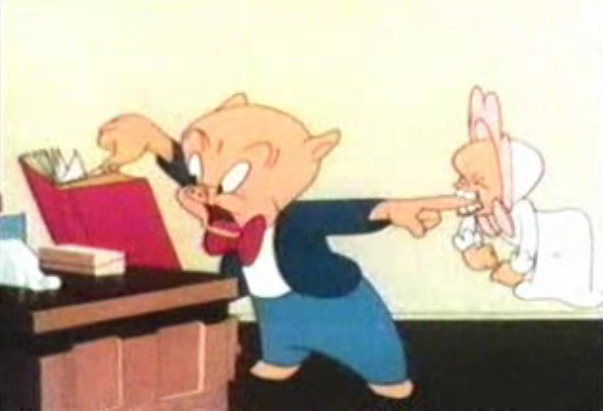
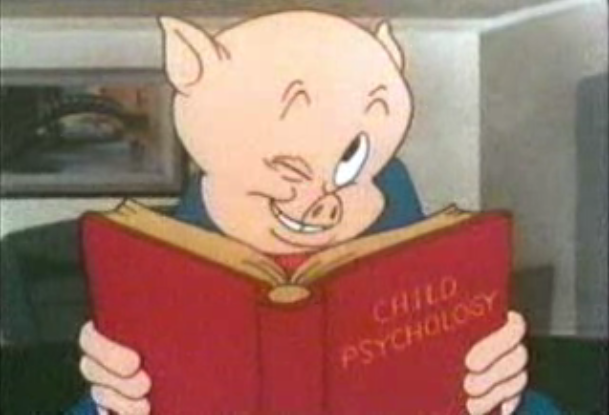
There’s a Looney Tunes cartoon from 1944, entitled “Brother Brat“. It stars Porky Pig and speaks eloquently about child discipline. In it, Porky becomes the unwitting baby sitter for a Rosie the Riveter type super-woman who’s pulling long shifts at the factory, helping out with the war effort.

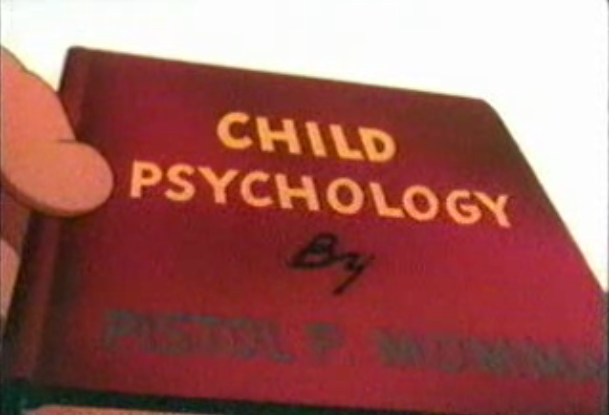
When she leaves her brat, Butch, with him, she also hands him a book, which she says always helped her. It happens to be a book on Child Psychology.

Child Psychology - 1

Porky takes the offer at face value, and believes the book will really help him. When baby Butch starts acting out, he checks the book for advice.

Child Psychology - 2

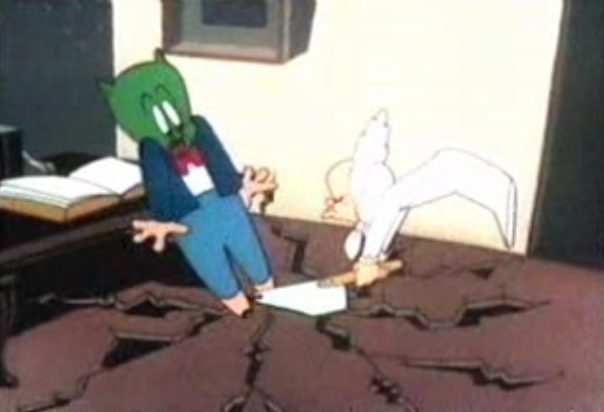
He soon finds out the book is no good, as he applies the wishy-washy, sound-good nonsense from the book to his real life situation and things go from bad to worse.

Child Psychology - 3

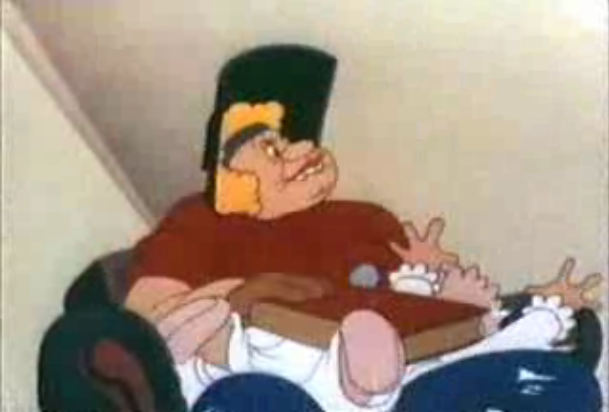
By the end of the cartoon, he’s running for his life, with an axe-wielding maniac baby on his tail.

Child Psychology - 4

Then Susie the Riveter comes in, notices the mayhem, and asks him if he used the book. Desperate, still running, he screams, “Yes, but it didn’t work!” Then Susie grabs the book and shows Porky how it’s done: “Maybe you didn’t use it right. It always works for me!”

Child Psychology - 5

The punchline is obvious, and yet it teaches all of us, to this day, a valuable lesson: sometimes the only thing that works is a spanking. As for child psychology books, I share the opinion of the animators — those books are a bunch of hooey, fit to be printed on toilet paper and used that way. I’m not alone in that sense. Most people shared this opinion when classic cartoons were made. Cartoon studios of all sizes lampooned child psychology books, including Disney.

Spanking has sadly become a tabu practice in this “enlightened” age. If you spank your child now, the state will take it away from you. Surely the state must know what it’s doing, right? Because governments in all developed countries have shown us they manage everything else to a tee, beyond reproach, right? Naturally, we ought to trust what they tell us to do with our children?

I see parents these days, stressed to the breaking point because of children who haven’t been properly disciplined, and they’re afraid to discipline them. They try talking to them, they try to reward them for good behavior, they try timeouts, but seriously, sometimes a child just needs a good spanking. The Bible knows what it’s talking about when it says in Proverbs 13:24: “He who spares the rod hates his son, but he who loves him is careful to discipline him.” It has the benefit of thousands of years of experience on its side when it gives that advice.

If you’re interested, my father wrote a couple of articles several years ago. One is on the duties of children toward their parents, and the other is on the duties of parents toward their children. The articles are a compilation of verses from various books of the Bible on those topics, and they’re not doom and gloom stuff — they’re thoughtful, fascinating stuff. To make things even more interesting, my father is a psychiatrist who is keenly interested in the proper development of one’s character and personality.

On an unrelated note, thank goodness for Google Video, which indexed the cartoon from Dailymotion! I wouldn’t have been able to provide you with screenshots from the cartoon otherwise, because I couldn’t find it in regular web searches. I don’t have it in my collection, and only saw it a few times on TV, including once on Boomerang recently. I encourage you to watch it.

http://www.youtube.com/watch?v=Tzj2GHuH4eo

Standard
Reviews

The Raccoons

I recently re-discovered a show I used to watch and love as a kid: The Raccoons. I can’t remember if I saw it in the US or in Romania as I grew up, but I remember the characters quite well. My wife remembers watching the show as a child, too. Now, thanks to Boomerang, I can watch it once again.

The Raccoons

What I like about it is the stories, which always have a nice lesson in them for children, and the show’s setting — a beautiful evergreen forest somewhere in the mountains. The characters, though odd at first, get to be quite likable as you watch the show regularly.

When I was little, I didn’t really care who created the show — I only wondered why the main characters had to have big, bent noses, and why Bert and Cedric had such whiny voices. Now that I’m older, I still wonder about the noses and the voices, but I also want to know who is responsible for creating this wonderful show and bringing it to market. One name pops up time after time in the show’s credits, as producer, director and writer: Kevin Gillis.

Kevin Gillis

Kevin Gillis - creator, producer, director and head writer for "The Raccoons"

As you can see, he looks like a normal human being. I wondered about that… He doesn’t have a huge, bent nose, so I don’t know why he chose to make the characters that way. And since I haven’t yet heard his voice, I don’t know if it’s whiny, like Bert and Cedric’s. I guess that’ll have to wait. In the meantime, I’m glad I can watch “The Raccoons” once more.

If you have children, please know that I highly recommend this show. If you have Boomerang where you live, or have another channel where it’s being shown, then definitely tune in and enjoy it. If you don’t, the store pickings are unfortunately fairly slim. The DVD production is discontinued for now. At leat YouTube has quite a few video clips from various episodes available.

Images used courtesy of Breakthrough Films & Television. There’s more info about the show on IMDB and Wikipedia.

Standard
Thoughts

Another point of view about ferryboats

Nowadays, people think a ferry is a romantic way to get over a river, but in the 1930s, during the Great Depression, people used to think otherwise.

A ferry ride

A ferry ride

For a great look back in time, watch “Bridge Ahoy“, a Popeye cartoon released on May 1, 1936. In it, Bluto overcharges passengers for rides on his ferry, so Popeye, Olive and Wimpy decide to build a bridge and let people cross the river for free.

You see, when you’re the only way to get across a river, you’ve got a monopoly. You control the market and set your own price. Before monopoly laws, it’s probably what happened with ferryboats, and it didn’t sit well with the cash-strapped folks of the mid-1930s. If we had only ferryboats to get across rivers nowadays, we’d no doubt share the same feelings.

Things worked out in the cartoon and the three delivered a bridge made to order. Everyone was happy except Bluto, the ferryboat owner, which was as expected.

Of course, if we carry this solution over to modern times, it breaks down right away. You see, we get charged to go over bridges nowadays. Kind of makes the point of building a bridge to avoid ferry tolls moot, doesn’t it?

Standard
Lists

Condensed knowledge for 2008-03-21

Standard