Reviews

Camera review: Canon EOS 5D DSLR

With the release of the new EOS 40D and EOS-1Ds Mark III, it’s easy to forget the camera that changed the entire market: the EOS 5D. It was the first affordable full-frame sensor DSLR ever. I bought it in April of this year, and I still don’t regret the purchase. As a matter of fact, I love my 5D!

Updated 2/1/09: I’ve also written about the new 5D Mark II.
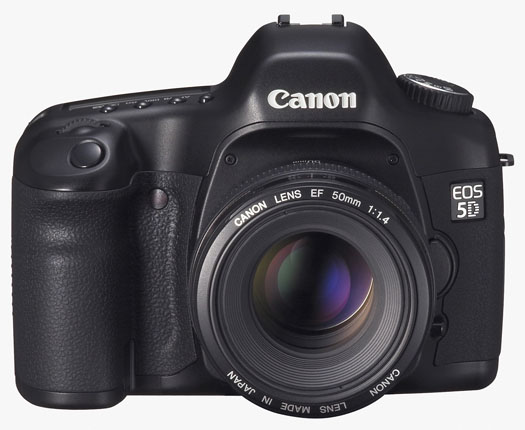
Canon EOS 5D (front)

Yes, the newer models that came out have more resolution and low light sensitivity, in addition to the EOS Integrated Cleaning System, which shakes dust off the sensor. It’s annoying to have to clean my 5D’s sensor with swabs once in a while, and to get out my bulb air blower and make sure there’s nothing inside the sensor chamber, but I don’t mind it that much — except when I have to use the Heal brush to get that dust off my photos. Even then, Adobe Lightroom makes it a breeze with its wonderful Heal/Clone tool.

I went back through Canon’s PR section and dug up the 5D’s original press release. You know how we have a healthy amount of mistrust when we read press releases? Well, read through that one and tell me if anything written there turned out to be untrue.

All these new models make me wonder what Canon will do with the 5D. I don’t think the 5D will go away. It fulfills a very important role in the marketplace and it’s beloved by many photographers. But what will happen come November? Will Canon announce a second-generation 5D? I’d kind of like them to hold off on upgrading the 5D till next spring, and I recognize that I’m entirely biased when I say that.

Whenever they decide to upgrade it, here’s what I think will happen:

  • It will get the EOS Integrated Cleaning system
  • It will get Live View
  • The pixel count will go up, possibly to 16 megapixels, but not much beyond that. If they go up higher, the renowned low light sensitivity of the 5D will suffer. Remember, pixel pitch (the space that each pixel occupies on the sensor) has a lot to do with low light sensitivity. The more pixels you squeeze on that sensor, that harder it is to keep noise in check. The DIGIC III processor should help with this, and putting microlenses over each pixel should also help, but I don’t think the new 5D will get more than 16 megapixels. Keeping all this in mind, I’d really like the new 5D to be able to go up to 3200 ISO natively, and to 6400 ISO with expansion turned on.
  • The battery life will go up slightly
  • The body will get weatherproofing
  • The AF will get upgraded with the new system present on the Mark III cameras
  • Exposure metering will get more zones, possibly as many as the new 1Ds Mark III, or at least as many as the new 40D
  • Shutter durability will be increased to 300,000 cycles from 100,000 cycles
  • The LCD screen will be upgraded to 3 inches
  • The retail price will be around $3,300, just like with the previous model, and the street price will stick pretty close to that for the first few months after the launch

Meanwhile, the existing 5D cameras aren’t outdated by any measurement, and I look forward to using mine for a long time to come. It was a significant investment for me, and I’ll try to get at least 3 years from it before I upgrade.

Buy the Canon EOS 5D

Standard
Reviews

Flickr tightens up image security

Given my concern with image theft, I do not like to hear about Flickr hacks. A while back, a Flickr hack circulated around that allowed people to view an image’s full size even if the photographer didn’t allow it (provided the image was uploaded at high resolution.) The hack was based on Flickr’s standard URL structure for both pages and image file names, and allowed people to get at the original sizes in two ways. It was so easy to use, and the security hole was so big, that I was shocked Flickr didn’t take care of it as soon as the hack started to make the rounds.

It’s been a few months now, and I’m glad to say the hack no longer works. I’m not sure exactly when they fixed it. Since it’s no longer functional, I might as well tell you how it worked, and how they fixed it.

D

First, let’s look at a page’s URL structure. Take this photo of mine (reproduced above). The URL for the Medium size (the same size that gets displayed on the photo page) is:

http://flickr.com/photo_zoom.gne?id=511744735&size=m

Notice the last URL parameter: size=m. The URL for the Original size is the same, except for that last parameter, which changes to size=o. That makes the URL for the original photo size:

http://flickr.com/photo_zoom.gne?id=511744735&size=o

Thankfully, that no longer works. If the photographer disallows the availability of sizes larger than Medium (500px wide), then you get an error that says something like “This page is private…”

Second, they’ve randomized the actual file names. So although that image of mine is number 511744735, and it stands to reason that I would be able to access the file by typing in something like http://farm1.static.flickr.com/231/511744735_o.jpg, that’s just not the case. Each file name is made up of that sequential number, plus a random component made up of letters and numbers, plus the size indicator. So the actual path to the medium size of the image file is:

http://farm1.static.flickr.com/231/511744735_b873d33b12_m.jpg

This may lead you to think that if you can get that random component from the URLs of the smaller sizes, you can then apply the same URL structure to get at the larger size, but this is also not the case. It turns out that Flickr randomizes that middle part again for the original size. So although it stays the same for all sizes up to 1024×768, it’s different for the original. For example, the URL for the original size of that same photo is:

http://farm1.static.flickr.com/231/511744735_d3eb0edf2d_o.jpg

This means that even if you go to the trouble of getting the file name for one of the smaller sizes, you cannot guess the file name of the original photo, and this is great news for photographers worried about image theft.

While I’m writing about this, let me not forget about spaceball.gif, the transparent GIF file that gets placed over an image to discourage downloads. It can be circumvented by going to View >> Source and looking at the code to find the URL for the medium-size image file. It’s painful, but it can be done, and I understand there are some scripts that do it automatically. The cool thing is that after Flickr randomized the file names, it became next to impossible to guess the URL for a file’s original size. The best image size that someone can get is 1024×768, which might be enough for a 4×6 print, and can probably be blown up with special apps to a larger size, but still, it’s not the original.

Perhaps it would be even better to randomize the file name for the large size as well, so that it’s different from the smaller sizes and the original size. That would definitely take care of the problem. Still, this is a big step in the right direction.

Standard
Reviews

The new and improved Google Analytics

I’ve just been playing with the new Google Analytics interface, and wow, that’s a seriously cool improvement over the old one! Google announced this a few days ago, and I waited to see when the change would take place in my account.

I logged in a few minutes ago and was given a choice between using the old interface and the new one, which is still in Beta. Chose the new one, of course, and was blown away by the overhaul! My gosh, it’s clean, crisp, much easier to use, and it lets you dig down as much as you want to, but doesn’t overwhelm you if you just want to get the bird’s eye view.

What I also like is that they’ve buried the AdWords campaign tracking stuff down toward the bottom, and it’s even less visible than before. That’s great for me, since I’m not currently running any AdWords campaigns for ComeAcross, and wasn’t tracking the conversion anyway. My traffic’s pretty much organic, and it’s been steadily growing since I launched my blog last year.

You’ve got to have a look when you get a chance. Log in, and definitely play around with the new interface if you’re given the option. You will not regret it! I criticized Google Analytics for their hard-to-use interface in a previous post, but that was before this gorgeous new overhaul.

Now if they’d only fix their persistent login issue… Just about every other Google property knows I’m logged into my account and lets me right in, but Google Analytics always asks for my password, and that’s a bit annoying.

Standard
Thoughts

Google Reader changes things, slightly

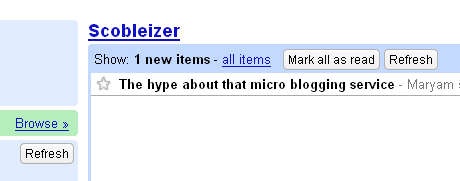
Logged into Google Reader this morning to get my daily fix of feeds, and saw that something changed. Took me a few seconds to realize it, but it looks like they replaced the command links with nice, rounded buttons. Have a look:

The new Google Reader buttons

Those buttons used to be links. Maybe this happened yesterday, maybe it happened overnight, but I just caught it, thought it was cool, and wanted to share the news. Certainly makes for a better look.

It also looks like Robert Scoble‘s spending too much time on Twitter and not enough time on his blog. Just one new post since yesterday afternoon?

Standard
Thoughts

A lot of good things are happening

I’m pretty excited, because Canon confirmed today that they’ll be shipping out an EOS 30D to me for review. It’ll come with an 18-55mm zoom lens, which is actually going to act like a 28-88mm lens because of the 30D’s 1.6x focal length conversion factor which, being an EF-S lens, won’t be affected by the 30D’s 1.6x focal length conversion factor (thanks Erik!). So I’ll have that gorgeous camera for 30 days, and I’ll be sure to take lots of photos with it. Meanwhile, I’m saving up for an EOS 5D, and may be able to purchase one in a few months.

My blog readership is growing as well, and I don’t know yet if it has to do with my use of Twitter. At any rate, my thanks to all of the new subscribers!

Finally, I’ve just finished a review of the Fuji FinePix S9100, and I’ll likely submit it to BlogCritics tomorrow. After that, I’ll publish it here as well. While the review’s good (tooting my own horn, I know), the camera isn’t. Stay tuned for the details.

Standard