Thoughts

This is why I dislike tests

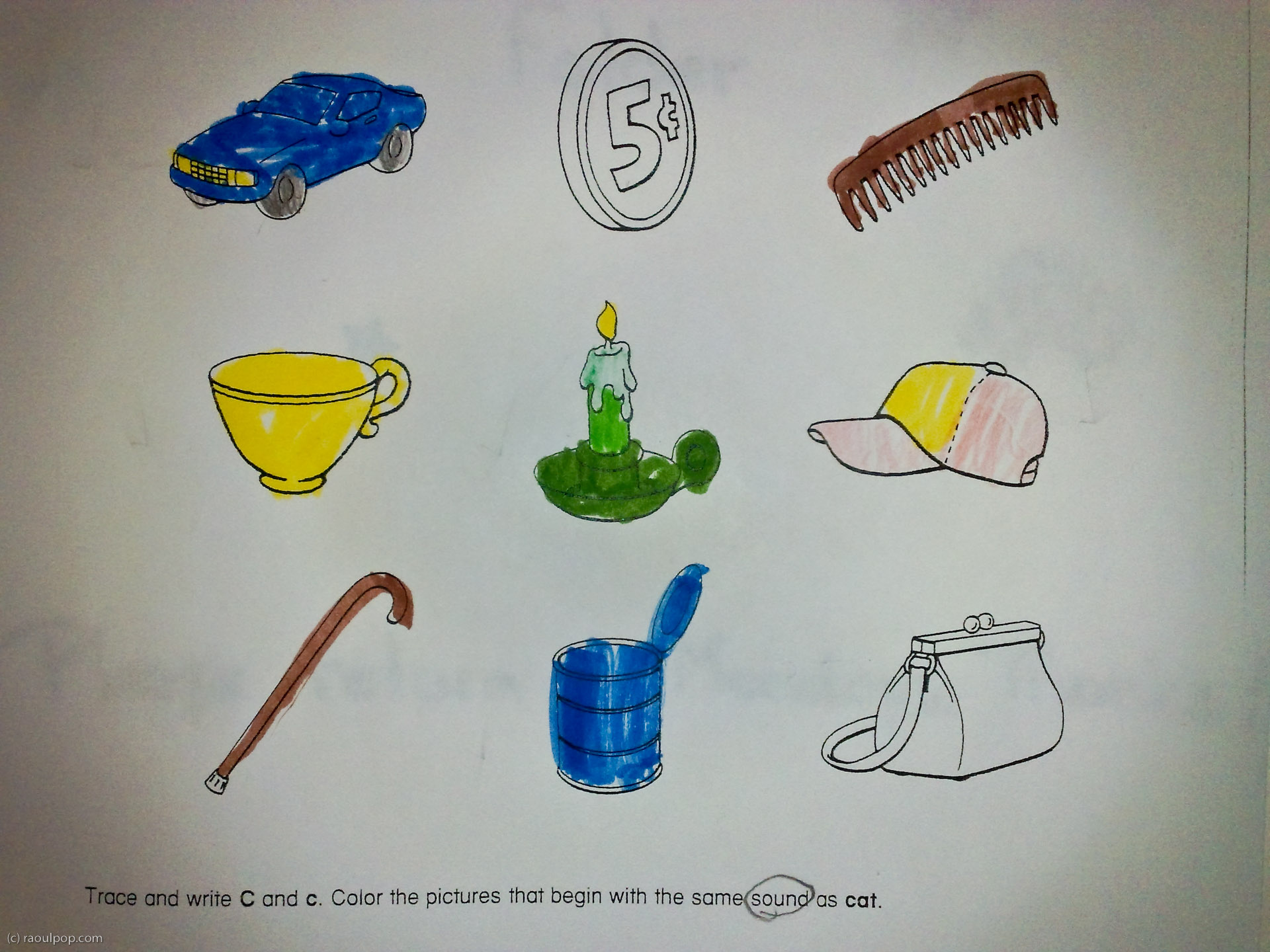
A couple of evenings ago, we were at our friends’ home, and I helped their daughter with her homework. She’s in kindergarten, and they’re teaching them how to read. One of the homework questions helped to re-awaken my dislike for tests. You can see the question below, I took a quick photo of it.

My beef with things like this is that there are usually multiple answers to a question, depending on how it’s interpreted. Unless you phrase it clearly and objectively from the start (which doesn’t happen very often), you’ll always have students that get it wrong, because not everyone thinks the same way. While in college and in graduate school, I’d often find myself at a crossroads when it came to answering many test questions; I’d come up with two or more different answers, all of which would be valid answers depending on how I interpreted the question. I’m fairly certain that some professors still remember my arguments with them on matters like these, and my insistence that my answer was also right, if only the question would be looked at another way.

If we look at this particular question, we see that it asks the child to “color the pictures that begin with the same sound as cat“. Okay, it sounds innocuous enough, until you start thinking about what that means. Do they mean the “c” sound of the word “cat”, or do they mean the “ca-” sound from the word “cat”? I don’t know. No further explanation is given.

Our friends’ daughter told me her teacher wanted her to choose the objects that began with the same “c” sound, and proceeded to do so. You can see what she did above. She told me that’s what her teacher wanted her to do, and those were the choices that her teacher wanted her to pick. But if you judge the objects by the teacher’s own definition, you see that the teacher is wrong. After all, the 5-cent coin starts with the same “c” sound as “cat”, unless you choose to call it a nickel, in which case it doesn’t belong on the list. So does the coin purse in the lower right corner, unless you choose to call it a purse or a bag, in which case it also has no place on this list.

No, I think the correct way to look at it is to interpret the instructions literally, and to pick the objects that begin with the same “sound” as “cat”, which is the “ca-” sound. If we do that, then we can only pick the candle, the cap and the can. The cane is a close call, but I’d say it’s not the same sound as cat. (If we were from Massachussetts, then we’d also be able to pick the car, since we’d pronounce it the same way due to our NE accent.)

Do you see the real problem here? It doesn’t matter what the right thing is or what the facts are. It only matters what the teacher thinks is right, which in this case, and quite possibly in many other cases, is wrong. As long as you learn what the teacher wants you to learn, facts, reality and objectivity be damned, you’ll get good grades and you’ll get ahead in life. As long as you go along with the generally accepted answer, you’re okay. This doesn’t encourage creative thinking, and it doesn’t encourage variety of thought; this is more or less brainwashing. This is why I dislike tests, and why I don’t like questions made up by others, particularly when they’ll only take one answer — theirs.

Standard
Thoughts

Good vs. bad globalization

As I traveled around Europe, I saw globalization in action, and made the following observations.

Being able to drive through various countries without needing to go through customs checks at the borders was wonderful. Unencumbered travel is a great experience.

The preservation of local or national cultures is of the utmost importance as people from various countries mingle more freely. Dominant cultures end up dominating, and that’s not a good thing. If I switched through various radio stations in Austria or Romania, I seldom heard German music, and even less often did I hear local music, like traditional Tirolean songs. Instead, I heard the latest hits from the US and the UK. I really don’t care to hear the same music I hear at home when I travel. I’d rather be immersed in the culture of the country I’m visiting, but that’s become quite rare nowadays.

Related to the point made above, the people who win from globalization preserve their local culture, because it not only enriches them, but it’s also a bankable practice when it comes to tourism. Clean, beautiful cities, where the old building were preserved and renovated, not torn down, and friendly local people are what tourists want to see.

The ability to export and import goods freely is great. It’s good for the local economies to have the potential of greater distribution. By the same token, it’s horribly bad when companies and factories move to areas where it’s cheaper to operate. Local economies, cities and people suffer so much when that happens. Just look at what’s going on in the US. I can see the same thing happening in certain cities in Romania. Just a decade or so ago, people used to have jobs and work in local factories or shops, and now they’ve all been sold or moved, and those same people, tied to those cities through their families and houses, are now scraping the ground to get by. I don’t know how they do it. It must be incredibly tough and frustrating.

Related to the point made above about not companies staying put and not moving, why do you think the US economy is hurting so badly now? It’s because it has become based on services and virtual goods like complicated and unnecessary financial speculation, not hard goods. Other than farming products, we make very little in the US these days. Most of the US products (and most of the world’s products for that matter) get made in China. Is it any surprise to see that China’s economy is booming?

Remember that countries have two ways to exert their influence in the world: (1) soft power, which refers to economic and cultural power, and (2) hard power, which refers to military force. US’ soft power has been waning in recent years, through its own faulty policies, and so the only way left for it to retain its dominance is to increase its hard power. The problem is that exerting hard power makes the soft power diminish even more and it also breeds enemies, which makes it even harder to retain dominance in the long run. Soft power preservation is the best long-term foreign policy a country could have, and the US has failed at it.

EU taxes are a heavy burden to bear. The VAT (Value Added Tax) is around 20%. That’s crazy. Not only does that make everything more expensive, but the markups are also higher. This means you’ll sometimes find that the same product, like a laptop or a camera, is up to 50% more expensive in Europe. That doesn’t make sense to me, particularly when salaries in so many Eastern European countries are unbelievably lower than in Western European countries, yet the prices are just as high.

In globalized economies, there’s greater potential to encourage correct or responsible behavior by standardizing business or agricultural practices. Vice versa, there’s greater potential to mess it all up as well, but let’s try to stay positive here. I liked what I saw in Europe when it came to land care and the preservation of forests. I also liked seeing entire fields filled with wind turbines, which generate electricity with zero pollution. I also liked seeing solar panels on the roofs of many, many houses in the countryside. I like the EU’s anti-corruption efforts, and I like the way they encourage good infrastructure through grants and loans to member countries.

When standards are put in place, there’s the potential to go overboard with rules and regulations. While the intentions are good, if you make it too onerous for an individual or a small business to compete or participate in the marketplace, you are effectively favoring large corporations and driving out the small guys. I see this happening with farming regulations in Europe. People that used to own herds of sheep and cows have now been forced to sell them or become part of large farming cooperatives, because they couldn’t afford to keep up with all the rules. Farmers operate on thin margins and big risks, and when you introduce extra costs, you are in effect killing them.

It would be a horrible shame to drive out all the small guys and let large corporations handle all of the marketplace. For one thing, you are killing the spirit of passionate people that love what they’re doing, and for another, you’re destroying a way of life that has served us well for thousands of years.

I do hope the EU and the US do their part to keep small farmers alive and well, while encouraging the production of food through responsible, renewable and healthy practices, free of genetic manipulation and unnecessary hormonal, pesticide and antibiotic treatments.

Standard
Thoughts

Hot teachers and sex with students

Three more female teachers have been jailed after it was discovered that they had sex with students in Tampa, FL. MSN has a video report on this. Plus, if you do a search on MSN Live, you’ll get plenty of search results summarizing recent news stories about similar events.

What bothers me about these reports is that the boys in question are always categorized as “abused”. It’s a great example of societal hypocrisy. To those that say that, I say this: BS! Seriously, does any male in their right mind think these boys were abused? Young boys practically swoon and fawn over attractive female teachers. It’s been going on for ages. They fantasize, and they do “other things” as well to “cope” with those crushes. So when these boys — in spite of what they might say now to the authorities — had the chance to engage in those sexual encounters, do you think they had doubts for even a second? Not a chance. Seriously, have these adults trying the women’s cases forgotten their own childhoods?

Sure, those boys will deny it now, and agree that they were corrupted, and to some extent, I agree with that characterization, as you’ll see below, but they engaged in the encounters willingly, happily and repeatedly. Given the chance to do it again, they did it and still would do it again. They went back for more, time and time again. In the case of one of the teachers, she had an orgy in a hotel room where more than 10 teens were in “attendance”. That is not abuse. That’s really slutty behavior on both sides.

Look, don’t get me wrong. I agree that the teachers did something unethical. They abused their position of authority as teachers, and they corrupted the normal teacher-pupil bond by engaging and participating in those situations. Furthermore, it was morally wrong to start an adult-level relationship with a child, in spite of their physical maturity. From a religious point of view, what they committed was adultery, and that’s clearly wrong. But we need to look at this objectively, from a civic point of view.

We should look at how much damage was caused to what we call the “victims”. It’s possible that the teachers corrupted the boys, in the sense that they introduced them to sexual situations that boys don’t normally encounter. One’s perspective in life changes once one has had those sorts of experiences. They will look at sex differently. They will look at relationships differently.

Then again, it depends greatly on how those teachers approached the situations, and how the boys viewed the encounters. In the context of “love”, not sex — and suspend for a moment the disbelief that love can exist when the age disparity is so great — it’s quite possible to have a healthier outcome, whatever that means. There are varying degrees of perception, and they depend on each individual. One must ask how ready the boys were, physically and mentally, for such an experience, and how much mutual respect there was in each “relationship”, etc… It’s a gray area, and it needs to be looked at as such. Clearly in the case of the hotel room orgy, there was no respect or “love”, simply animal sex, and that should be looked at as corruption of a minor (or rather, multiple minors).

If one is to look at this as a black and white situation, was there sex with a minor? Yes. Should it have taken place? No. Should the standard punishment apply? NO. This is not typical sexual abuse. The boys weren’t coerced. They enjoyed it, every minute of it. They went back for more. They probably bragged to their friends, etc… These are all attenuating circumstances.

In the grand picture, are these situations going to create more long-term sequelae for the boys than any of the following situations:

  • A young girl who has consensual sex with her boyfriend, but then finds out he is calling her a slut to all his friends, and is bragging about having “bagged” her, etc.
  • A young boy who has consensual sex with his girlfriend, but then finds out she is making fun of his naked body, or the size of his… manhood, or about the sounds or face he made during sex, etc.
  • A young boy or girl who are convinced by their “friends” to experiment with same-sex encounters when they’re not really interested, just questioning themselves.
  • A young girl who is forced into sex by her boyfriend, but is too ashamed to admit it afterwards.
  • A girl who is slipped a mickey or gotten drunk at a party, then gang-raped by classmates or friends while she’s unaware of what’s going on.

What happened to these boys is peanuts, literally. Yet all these “offenders” described in the bullet list above would not be prosecuted under law. Seriously, I think any one of us has either heard of “gray-area” situations like these, or experienced them in person. I can practically guarantee you that the boys and girls who have gone through the situations I described above will have more sequelae and will experience more long-term trauma than the boys who’ve had sex with their teachers in recent news. It’s pretty much a given. Yet which situations are getting more attention? These ones? Why? Because it makes it easy for prosecutors to look good. And it makes for good news. That’s why. And it’s hypocritical.

I could go on and on and talk about situations that are much worse than that, like serious rape cases, or sexual torture, or sexual mutilation. These are much more serious, yet in terms of news coverage and severity of punishment, they’re simply not getting the attention they need. In some cultures, like Africa, female circumcision, a form of sexual mutilation, is condoned and accepted by society.

Right here in the States, I’ve heard of a case where a girl was repeatedly raped by her father from an early age, with her mother’s permission. To this day, the girl cannot bring legal charges against her parents. I’ve also heard of a girl who was loaned out (prostituted) to perverts by her mother from the age of 3, in exchange for drug money. That sort of stuff is is really screwed up. That should be the stuff that gets obsessively prosecuted. Instead, we have rapists that can get away with only a few years’ punishment, then get out and rape again and again, while these teachers in the news right now are put through the works for doing something that was pretty much consensual.

Everyone is now rushing to pronounce the verdict and crowd around the “victims” when there are countless other real victims all around us that are getting no positive attention at all. I say look at each teacher-boy encounter individually, mete punishment in accordance with the gravity of the crime, keeping in mind the attenuating circumstances, and if some of those situations only deserve a slap on the hand for the teacher, let’s be honest enough to admit it, as a society. And let’s also be honest enough to admit when a crime is heinous enough to deserve the death punishment (don’t get me started on that).

Standard
Thoughts

A look at culture and technology through sound effects

I was listening to the radio one morning, and realized the sound effects they were using to advertise a website were the clicks of a keyboard likely made in the 80’s — you know, long key travel, spring-loaded action, hard clicks. But it worked.

More importantly, it is the only sound that can approximate a keyboard well, and transmit that action to an audience. Think about where keyboards are going today though. Apple is putting out keyboards that barely make any sounds — for example, see the new slim iMac keyboard, or the MacBook or MacBook Pro keyboards. Other hardware manufacturers are following suit, each advertising softer keys, more muffled sounds, etc. How do you record that? It can’t translate well over radio as a sound effect.

Remember how they used to advertise accessing the internet just a few short years ago? Through the sounds of modems. Tell me, could anyone afford to advertise internet access like that any more? No, they’d get laughed out of business, because most everyone is using high-speed access now. But is there a sound that can represent an Internet connection now? How do you represent it or record it?

What about the sound effects for phone calls? They were the simple, old-fashioned ring, right? Everyone knew what it was, and there was no confusion. Not any more. Although people still recognize the old phone ring, children growing up nowadays have so many choices when it comes to ringtones, that soon enough, the old phone ring will no longer be a recognizable sound effect for phone calls.

In some of the older movies or radio commercials, beeps, flashing lights and loud sounds were used as sound effects for computers. The starts and stops of tape reels were well known as well. What about the sounds of the punch cards, rolling through the machines and getting processed? Those are all things of the past. The only sounds computer hardware makes nowadays is the drone-like noise of the hard drives and cooling fans. It may be the representation of an efficient computing machine, but it’s pretty boring as a sound effect. Desktops or laptops (the newer ones anyway) make no sounds at all. We prize them based on how little sound they make, and rightly so, but we’ve lost the sound effects.

Remember the sound of switching TV channels? There was the manual, hard click of the round knob on the TV set (not many of you know about those anymore). If you were using a remote on older televisions, there was a sound pop, followed by a short period of static and the sound of the new channel that accompanied each channel switch. On newer televisions, that’s no longer the case. There’s no pop, click or jarring sound transition during channel switches. It’s all handled smoothly, and on some, the sound is gradually brought up to listening volume so as not to disturb you. But how do you represent a channel switch in a radio ad? You can’t, not anymore, not unless you use a decades-old sound effect.

The point of all these examples is to illustrate how technology is outpacing culture. I wanted to look at this through sound effects, but there are many ways in which it can be done. Just think of social networking sites, their invasion of privacy, and the new expectations of online behavior if you want to look at another aspect of this same issue.

One thing’s for sure — our culture has some catching up to do. While I love technology and embrace it (for the most part), we have to recognize that we’re in uncharted territory nowadays, in many, many areas of technology, particularly at its intersection with people and general culture. The rules aren’t even getting written, because no one is sure just how to grasp the situation. We each understand but a little portion of what’s going on — and that’s both scary and exciting, depending on your point of view.

Standard
Thoughts

Humor and societal norms

If I’d taken some sociology classes in college, I might have gotten this point sooner: humor is driven, by and large, by societal norms. Furthermore, it is usually in contrast (marked or absurd) to those same norms. Allow me to illustrate.

Japan: most of us know that public conduct there has been driven by very strict rules, for as long as history holds. For the most part, it still is. Everyone’s supposed to be proper and dignified. The very regimented lifestyle, and lack of personal space, I might add, leads to the desire to escape it all, to do something completely different. Hence, Japanese humor and comedy focuses on the absurd, on the unlikely, on the odd, the weird, etc. If I’d gotten this sooner, I wouldn’t have asked why Japanese ads are so embarrassing a while back. Now I understand, and I can begin to enjoy it.

Take a video like this for example, a “study” of the best way to escape farts. Only the Japanese could have dreamed this up.

http://www.youtube.com/watch?v=P1S9t8XFcOA

Or how about this follow-up to the Human Tetris video I posted before?

http://www.youtube.com/watch?v=84_QL1kEmH4

England: No need to explain much here. In the land of the stiff upper lip, public behavior was excruciatingly dry and complex, at least for a particular class — so much so, that most English humor focuses entirely on it, and the contrast between said behavior and that of the lower classes. A search for Benny Hill, Mr. Bean or Harry Enfield on YouTube suffices to illustrate my point. The behavior of the upper classes is so captivating when skewered, that even bastardized versions of such behavior, the ones that trickled down to the bourgeoisie and the middle class, are fascinating. Keeping Up Appearances was one show that capitalized on this.

http://www.youtube.com/watch?v=OI0e_dy64-E

USA: You might ask why current humor here in the good old US kind of stinks (at least I do). Well, to answer my own question, I think it’s because we’ve been free of restrictive societal norms, at least when it comes to public behavior. In a way, we’ve neutered one of our most potent sources of humor, though it wasn’t done on purpose. We started out with a few civilized cities and mostly wilderness and farms, and it’s still pretty much that way ;-).

Most people are still relaxed in public, and getting even more relaxed. Americans just don’t ascribe to certain norms when out in society, and to a certain extent, this is excusable. In a melting pot like ours, standards differ from family to family, and without huge, focused, national efforts to introduce some standards, things will not improve.

Fortunately, we did have those annoying yuppies in the 80s and early 90s, and we could make fun of them for a while, until that got old. The movie Trading Places (1983, IMDB listing) has some pretty good examples of pseudo-aristocratic behavior just ripe for skewering.

So, here in the States, we’re fresh out of good material unless we tap into history. Or, we could always make fun of how indecently relaxed people have become in public. For example, not a day goes by that I don’t see people wearing unsightly plastic clogs (you know, the “fashionable” kind, the sort that give you athlete’s foot and make your feet smelly) or low-cut jeans that make me wonder what’s more disgusting — the fact that they’re not falling off even though I can plainly see the butt crack, or the plentiful layers of fat that flow over the waistline.

At any rate, the point that I wanted to get across is that I finally get it: humor, by and large, is driven by societal norms, which of course, differ from society to society. I’m beginning to enjoy Japanese humor. I even get why those ads featuring American celebrities are so absurd. They have to be. When you wear a suit and have to act proper all day long, even at home, you long for something completely different.

No matter what culture or nation we talk about, as people, we all share a basic set of needs and wants. One of those is laughter. While the things that make us laugh may differ from region to region, we all want to laugh, and we enjoy ourselves even more when we laugh with others. It’s nice (at least for me) that I can get to understand other cultures through their humor. It’s certainly an interesting way to look at their societies.

Standard