How To

The garden shed

We’ve recently finished putting together a “severe weather” garden shed in our yard, made by a company called Arrow. We wanted a model that could withstand hurricane-force winds, since we live in South Florida, where hurricanes do occur from time to time. The particular model that we purchased was the Homestead 10′ x 8′ (HS108). We filmed our progress along the way (it took 1½ months from beginning to end), and you can see the video below.

The process of selecting and getting the garden shed approved and built highlighted several areas of concern when it comes to the manufacturing, retail and inspection aspects of this particular model. It all turned out to be more involved and more costly than we thought. It certainly was an adventure in do-it-yourself construction.

Watch video on YouTube (parts 1 and 2) | blip.tv

We looked for guidance from our city (Hollywood, FL) when we made the decision about what garden shed to get, but they were not helpful. All they told us was that many of the sheds sold at local building stores may not be approved for use and may not pass the inspections, and that we needed a product approval sheets for the shed.

We went to Home Depot looking for sheds, but we thought the pre-assembled ones they had on display were flimsy and might not withstand strong winds. Then we went to Lowe’s looking for a shed, found one made by a company called Arrow, only to be given the run-around when it came to the product approval sheets. The store clerk thought they were on the Lowe’s website. They weren’t. The management thought the Contractor Services department had them. Perhaps they did, though we couldn’t get them to help us. Then we tried the Arrow website, where they should have been listed alongside the shed specs. They weren’t.

Fortunately (or perhaps unfortunately), we did find a particular model on the Arrow website, called the Homestead, rated for “severe weather” and engineered for the Miami-Dade county building code, which is stricter than what we have in Broward county. That meant it was sure to be approved for use here, and would pass the inspections if assembled correctly. The price was much higher than we thought though (about $1,700) for a pre-fab, un-assembled shed that came in two flat boxes and was only 10 feet by 8 feet (80 sq ft). Still, I remembered seeing a Homestead model at Lowe’s, so we went back to check. To our surprise, it was on sale for a little under $500. We thought ourselves in luck, but the clearance price should have raised a red flag for us. We bought it, knowing we’d at least have no problems getting it approved with the city.

Sure enough, it was approved, and the time for the initial inspection came. The clerks at Lowe’s told us we’d need to pour a six-inch concrete slab. Fine, no problem. Wrong. According to the building inspector, the engineering plans for the shed (put together by Arrow to supposedly comply with the Miami-Dade building code) required a house-sized foundation, which meant digging a trench all around the edge of the foundation that was 1 foot wide by 1 foot deep, with a 45-60 degree slope on the inner lip, using re-bar around its perimeter, not just wire mesh, and naturally filling it all up with concrete. That more than quadrupled our original estimate of the amount of concrete that we needed to purchase. We thought 1 pallet would be enough for a 6-inch slab. We ended up buying over 4 pallets of concrete (almost 5) in the end.

Forget the clearance price! The ridiculous foundation requirements in effect raised the price of the shed to well over its original retail price once again!

I have to lay the blame for this squarely in Arrow’s lap. After all, they were the ones who hired an engineering firm to put together the plans for the shed, and to get them approved with Miami-Dade. I sincerely doubt there’s anything in the Miami-Dade building code that specifies one must have a house-sized foundation for a flimsy pre-fab shed. That makes no sense whatsoever. All other sheds on the market do just fine with a 4-6 inch concrete slab, yet this model, which is shorter and smaller than the rest, somehow needs a house-sized foundation? No way. Someone was careless or fearful when they drew up the plans, and the customers are now paying for it!

I might have been more lenient in my overall view of the shed, had it proven sturdier during the assembly and in the final review. But it’s just as flimsy and cheaply made as the rest of the pre-fab garden sheds on the market, many of which come pre-assembled and cost a third of this shed’s original retail price. There’s nothing to set it apart for me from the rest, other than the presence of extra wall beams at waist height, and the lack of a need to use hurricane anchors to strap it to the ground once it’s assembled. The sheet metal used for its walls and doors is just as cheap and easily bent or dented, the doors open and close just as badly as on other pre-fab sheds, and to top it all off, it’s so darn short I bang my head on the lintel every time I go in and out!

Oh, and lest I forget, let me mention that Arrow forgot to provide the sufficient number of bolts and nuts needed to assemble the shed properly. We were delayed by a day during the assembly process because we needed to make a trip to the store to get some more hardware, which should have been included with the shed to begin with. On the bright side, they did include the Hilti anchors needed to anchor the shed to the concrete foundation, though I expected to need to get those myself.

Yes, the shed is now fully assembled, approved, and we’re using it. But it proved to be much more expensive in the end than it should have been, it took much more time and effort to get the project completed, and in my eyes at least, it wasn’t really worth all that. Imagine how those people who bought this shed at its original retail price felt! They must have felt they were ripped off royally. Thank goodness we at least got it at clearance price.

The City of Hollywood could also have been more helpful when I called them asking for guidance on garden sheds. Instead of dismissing me with some generic advice, they could have said, hey, here’s one of our building inspectors, talk to him and he can recommend sheds that he knows will get approved, cost less, and take less time to put together. While I understand that a government employee can’t recommend specific brands and models, at least I could have gotten helpful advice that could have saved us money, time and effort. Instead, the City of Hollywood was the only city in Broward County to raise property taxes this year, during a big recession, making me wonder exactly what we’re paying for, if they’re not helpful to us, its residents.

All I can say is this shed better hold up when the next hurricane comes, or Arrow will hear from me again.

Standard
Thoughts

Kudos to Apple for a great customer service experience

I’d like to congratulate Apple Customer Service for the way they handled the most recent issue with our iMac G5.

If you’re a regular reader, you may know we’ve had problems with our iMac right from the start. Virtually as soon as we brought it home from the Apple Store, we had issues with it. These things got worse with time, and although we took the iMac in for repairs, repeatedly, the problems persisted. I detailed that first set of issues in this post. Several months later, we took it in for service at our local Apple Store, where we had a terrible experience. A few months after that, we took it in for service again, and then, a month or so before Apple Care ran out in late 2008, we took it in for what we hoped would be its last service call.

Unfortunately, it stopped booting up a month after Apple Care ran out. We were packing for what would turn out to be a long trip abroad, and didn’t have time to take it in for service during the 90-day warranty window offered for that last repair. I kept it boxed up, hoping I’d get to it at some point and who knows, perhaps it would auto-magically boot up. I was soured up with the whole affair, and said as much in this post. In three years of using the iMac, we’d had problem after problem, and I felt as if we never got our money’s worth from that machine. I liked it, Ligia liked it, but it just couldn’t be relied upon, and it was a shame.

By the time I got to have a look at it, it was late 2009, about a year later… I followed the steps outlined in this Support Note from Apple, and according to those instructions, the motherboard was at fault, again. I called Apple Support to explain the situation, hoping someone would be kind enough to understand and sympathize. I was very pleasantly surprised when the tech who answered the call wanted to help. He got a hold of one of the senior support engineers, whose name was Christopher, and he was also willing to help. I mention his name because I hope he’ll get some sort of recognition at work for the nice thing he did for me.

Christopher authorized an out-of-warranty repair for our iMac. We were still abroad, but when we got back to the States, I took it in for service, and the folks at the Genius Bar of the Aventura, FL, Apple Store couldn’t have been nicer, too. They did some testing and discovered, to my surprise, that it was only the power supply, and, even better than that, repaired it within hours. I dropped it at the store at 11 am, and got it back by 7 pm, in working order! I was able to boot up our iMac after more than a year and access our documents, photos, emails and more. It was like reuniting with a long-lost friend.

Now that’s my kind of Apple repair experience! I don’t know if my past repair experiences were flukes, or if something changed at Apple since then, but all I can say is that I’m very pleased to see our iMac working again, and I want to congratulate everyone involved in the resolution of this support ticket for being so understanding and so willing to help us. Great job! Thank you!

Standard
Events

Site migration complete

Last night, I completed what could be called an unusual site migration. I went from a self-hosted WP install to WP.com. That’s right, my full site is now hosted at my WP.com account. People usually migrate from WP.com to WP self-installs after their site gets big and they decide they want more options, like the ability to run all sorts of ads and fiddle with the code, etc. With me, it was the opposite. I wanted to stop worrying about my web server and focus on publishing my content.

As I mentioned here, things got worse after upgrading to WP 2.9. My server kept going down for no reason, and often, too. It’d go down several times a day. I’d have to keep watching it all the time, and that got old real quick, especially when I traveled and had no internet access. I’d often get home to find out my site was down and had been down for several hours, if not more. Since I hadn’t mucked about with my server to make things worse, and had already fiddled with optimized my Apache, MySQL and PHP settings to last me a lifetime, I decided to have WP have a go at hosting my site and let them worry about keeping it going. Judging by the initial results, it looks like they had a bit of trouble with it too (see this, this, this and this), but at least it’s not my headache anymore.

During the migration process, I learned three things:

  1. I hadn’t been getting full XML transcripts of my site in the past, when I used WP’s WXR Export feature. See this for more, and make sure you’re not in the same boat.
  2. The WordPress Import wizard still needs a TON of work to iron out the bugs. You’ll see why below.
  3. WordPress.com Support can be terribly unresponsive. I waited over 20 days for a resolution to my ticket about the site migration, and in the end, I had to work things out myself. When I told them as much — and I tried to be as nice as possible about it — it would have been nice to get a small apology, but I didn’t even get that.

Granted, my site migration does not represent the usual WP user’s migration path, nor was it a typical migration. By current count, I have 1,552 posts, 4,129 comments and 3,090 media files. That’s quite a bit more than your average blogger, and I think that’s what served to point out the bugs in the Import Wizard.

What exactly were the bugs?

  • Failure to import all posts, comments and media files
  • Post and media file duplication
  • Failure to properly change all paths to media files (either image source or image link or both)

Here’s where I need to acknowledge the help I did receive from WP Support. My WXR file was over 20 MB. The WXR upload limit at WP.com is 15 MB. WP Support modified the upload limit to allow me to go through with the WXR upload, and they also adjusted the timeout limit, because the migrations timed out prematurely as well. So I thank them for that help.

The big problem turned out to be the third issue mentioned above. The Import Wizard didn’t change all the paths to the image files. It turned out to be a very hit-or-miss operation. Given the scale of the operation, I might even call it a disaster. Some posts were fine, some weren’t at all, and some were a hodge-podge of images that were okay, and images whose paths were wrong, or whose links were wrong, or both. You might imagine that checking and fixing the image paths for over 3,000 media files can turn out to be a very big job, and it was.

I was also under pressure to finish the job quickly, since the site was live. Imagine how you’d feel as a reader if you visited a website and none of the image files showed up — you’d probably think the site was dead or dying, right? Well, I certainly didn’t want people to think my site was on its last legs, so I had to act quickly.

Thankfully, only (sic) about 40% of my posts had their image files messed up. The rest were fine, but then I also had plenty of posts with no images. If all my posts contained images, I might have had 90% of my posts to worry about… Still, I had to check every post, and as you might know if you’re a regular reader, I post lots of images per post, and where a post was messed up, brother, I had to do a bunch of work to get it fixed up. Just as an example, some posts have anywhere from 20-50 images…

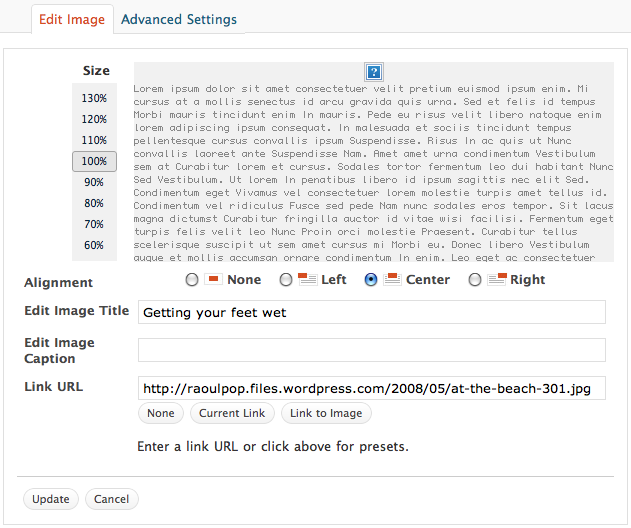
Here are a couple of screenshots that show you how things stood. Here, the image link was okay, which meant I didn’t have to modify it. This was a happy scenario. However, the image path was still wrong, as you’ll see below.

The image source, or path, didn’t change during the import process, which meant I had to change it manually, or browse for the image by title or file name in the media library and re-insert it.

The image size was also lost, which meant that if I changed the image path manually, I had to also enter the width of the image.

What made things more cumbersome was the lack of an image insert button in the Gallery dialog box. That’s one of the differences between a WP self-install and WP.com. This meant that even though I’d uploaded a certain image for a certain post, and it showed on the Gallery tab, I couldn’t go there and re-insert it into a post. I had to go to the Media Library tab, search for it, then re-insert it, which takes precious time and clicks, particularly when you’re dealing with thousands of images.

In spite of all the extra work which I had to do, and which took about 1½ weeks of my time, I got done last night. My site is now fully functional, thank goodness!

As for my experience with WP Support, there are no hard feelings. I like the WordPress platform and it’s done good by me so far. I wasn’t a VIP customer and they didn’t have any financial incentives (besides the small fees for a space upgrade and a domain mapping) to get their hands dirty with my code. They offered minimal support, and to a certain degree, that’s to be expected when most of your customers are non-paying customers, as is the case with the large majority of WP bloggers.

Still, I would encourage them to consider doing the following:

  • Improve their Import Wizard so that it will not terminate until it checks and doublechecks to make sure it has imported all the posts, comments, pages, tags, categories and media files, and all the paths to the media files are correct. They’ve still got one of my WXR files, and they can use it as case study to help improve the accuracy of the import wizard.
  • Include an image insert button on the Gallery tab of the “Add an Image” dialog box, like the one that already exists on WP self-installs.
  • Offer the functionality of the Search & Replace WP plugin for WP.com blogs. This would have been a huge help to me as I fixed the image paths. I could have run a couple of queries on my blog’s content to change most of the image paths, and it would have halved my workload.

If you were one of the folks who kept seeing no images during this transition period, sorry for the inconvenience, and I’m glad you’re still around. If you’re still seeing no images, definitely get in touch with me, I might have missed a few — after all, I’m only human.

Standard
Reviews

United Airlines breaks guitars

In addition to stranding people in foreign cities, lying to them, and making them pay for their own stay, thereby breaking the rules of the Star Alliance, United Airlines now also breaks guitars.

In March 2008, musician Dave Carroll flew with United Airlines through Chicago, where a fellow passenger witnessed his $3,500 Taylor guitar being thrown into the hold of the aircraft by one of the UA employees. Upon arrival, Dave filed a complain with UA, asking them to reimburse him for the repair to his guitar, which came to the hefty sum of $1,500. For over a year, letters and emails and phone calls went back and forth, until UA, true to their lying form, denied responsibility for the damage and refused to pay for the repair. In return, Dave promised to release three music videos, to shame them publicly. The first, entitled “United Breaks Guitars“, is already out.

Kudos to Dave Carroll! I hope tons of people see this video and decide to do their flying with other, more customer-friendly airlines. UA deserves all that’s coming to it for the way it treats people.

[via Gulliver]

Standard
Thoughts

It’s no surprise broadband internet sucks in the US

A recent Akamai survey, which I shared here and here, ranked US in the 33rd spot (globally) when it came to broadband internet connections above 2 Mbps. Sure, it moved up two spots compared to last year, but it’s still lagging behind countries such as Monaco, Slovakia, South Korea, and believe it or not, Romania — which is where I’m living these days.

That’s sad. It’s very sad because a country such as Romania, with fewer resources than the US, and with a LOT more corruption at every level, has managed to provide better Internet services than the US. It just goes to show you how much pork barrel legislation and ridiculous lobbying can slow down an entire country’s Internet access. Why, every time a company tried to improve the way broadband worked in the US, it was eventually bought out or dragged down and kept down for the count.

Remember Telocity? It was one of the first companies to offer DSL service in the US, ahead of Ma Bell. Even though it was paying hefty amounts of money for the right to transport Internet traffic on Ma Bell’s lines, they had enormous problems with the same Ma Bell, due to problems that would somehow just happen to crop up on the same wires or the switching equipment. Then they’d have to pay more money so Ma Bell could fix their own equipment, which they’d say Telocity broke, etc., ad nauseam, and so on and so forth.

That’s just one example. Another was the more recent push to restructure the way cable services are provided (both TV and internet). One of the efforts was the a-la-carte programming initiative, and another was the push for faster and more reliable cable Internet services. You wouldn’t believe the advertising, PR and lobbying blitz the cable industry started and kept up for several months — actually, I’m fairly sure you saw their ads on TVs and buses everywhere, particularly in the Washington, DC area.

Or what about when they got together in late 2007 and 2008 to ask for an Internet tax? Remember the tiers of traffic they wanted to create? They wanted all the big websites to pay them for the traffic, as if they weren’t already getting enough money from the customers for their slow and unreliable services. They also wanted large chunks of money from the federal government in order to upgrade their infrastructure. No matter how much money they make, they’re so greedy they always want more, more, more.

What I’d like to know is how all these other countries, including Romania, can manage to offer faster and more reliable Internet services without asking for money from their countries’ government, without charging big websites for their traffic, and also by charging less per month for better broadband? How is that possible? Could it be that these companies actually know how to run their businesses while their counterparts in the US are filled with lazy, greedy idiots?

I still vividly remember an incident which happened while I was a director of IT at a Florida hospital, several years ago. A BellSouth technician had been called in to check the phone boards, and my network and servers kept going down and coming back up. The Medical Records system kept giving errors when employees wanted to access forms to fill in patient data, not to mention that other network services, like file sharing and printing, kept going on the fritz. I checked every one of the servers and they were fine. I finally walked into the switch room, at my wits’ end, only to find the moronic BellSouth employee with his fat, lazy butt on our UPS, jiggling it back and forth as he chatted with someone back at BellSouth HQ, plugging and unplugging the power supply that fed one of the main network switches. I went ballistic, grabbed him by the collar and threw him out of my switch room. Was he that stupid that he didn’t know where he was sitting? Was he such a pig that he couldn’t feel the plugs underneath him as he sat on them? He didn’t even want to apologize for taking out an entire hospital’s network during daytime hours. That’s BellSouth for you.

I don’t know how the US can get better broadband, unless it’s legislated. An ultimatum must be given by the government, one that can’t be overridden by any lobbyists or CEOs shedding crocodile tears in front of Congress. These companies simply will not get their act together until they, too, are grabbed by their collars and shaken about. They’ve gotten used to the status quo, they like it, and they’re clinging to it with all their might.

Meanwhile, here’s a sample of the Internet plans you can get in Romania right now. For comparison purposes, 1 Euro is worth about $1.4 these days.

Romtelecom (the main phone carrier, provides ADSL services):

  • 2 Mbps, 2084 kbps/512 kbps, 4.88 Euro/month
  • 4 Mbps, 4096 kbps/512 kbps, 7.02 Euro/month
  • 6 Mbps, 6144 kbps/512 kbps, 9.40 Euro/month
  • 8 Mbps, 8192 kbps/768 kbps, 14.16 Euro/month
  • 20 Mbps, 20480 kbps/1024 kbps, 24.87 Euro/month

[source]

Birotec (provides fiber optic services, all plans include phone line with varying amount of minutes based on plan price):

  • 3 Mbps up/down, 10 Euro/month
  • 4 Mbps up/down, 15 Euro/month
  • 6 Mbps up/down, 20 Euro/month
  • 8 Mbps up/down, 29 Euro/month
  • 10 Mbps up/down, 49 Euro/month

[source]

RDS (provides fiber optic, cable, cellular modem and dial-up access — prices not readily available on website):

  • Fiber optic access up to 2.5 Gbps
  • Cable access up to 30 Mbps

[source]

The lowest internet access plan in Romania is 2 Mbps. Cellular modems are advertised at speeds up to 3 Mbps. Meanwhile, in the US, you can still find 512 Kbps plans at prices twice or three times as much as the 2 Mbps plans in Romania. That’s the price of complacency and excessive lobbyism.

Standard