Built between 1887 and 1889 by French engineer Gustave Eiffel, the tower has since become the most recognizable landmark (and the most visited) in the world. For its size, the tower is amazingly light — its mass is less than the mass of the air contained in a cylinder of the same size. For its time, the system for joining the metal girders together was truly innovative, and was inspired by the design ideas of a Romanian engineer named Gheorghe Panculescu.
Eiffel Tower Girders, 1889
The shape of the tower was dictated purely by mathematics, and the primary design goal was wind resistance. Eiffel and the other engineers wanted to make sure it could withstand strong winds, being at the time the tallest building in the world. Being a very tall building, made almost entirely of metal, it’s also a very large lightning rod, which attracts amazing lightning bolts, as you can see in this photo from 1902.
Lightning striking the Eiffel Tower, 1902
Also interesting is the use of the tower as a radio antenna. Over time, antennas were mounted to the tower, or the tower itself was used as a large antenna for radio communications. In 1910, the first cosmic rays were observed with the aid of the tower by Father Theodore Wulf. Nowadays, 9 radio and TV stations broadcast content with the aid of the tower.
This year, the French celebrated the tower’s 120th anniversary on Bastille Day. A concert by Johnny Hallyday was held at night, while fireworks blazed forth from the tower. It was an amazing lightshow, captured fittingly by Alta Media Productions and Toys Prophet, two Vimeo users. You can see their videos below. Taken from different vantage points, one focuses on the Paris nightscape and the tower lightshow, while the other captures the interaction of people with the evening’s events.
I haven’t yet visited the Eiffel Tower, and I look forward to doing it someday. It’s a structure unlike any other. When you think of it in the context of architectural design, it fits into no category. Its design is pure engineering, with no allowances for the niceties of normal architecture. Sure, it’s been adapted for human use over time, and you can even eat there now, but these are all add-ons, insignificant to the initial design goals. It didn’t fit within the times when it was made, in spite of some of the Victorial wrought iron work it faintly resembles, and it still doesn’t fit within any normal design constraints today, even in post-modernist times. And yet it has become a symbol of architectural design, of Paris, and of French culture, odd as it may be. If nothing else, Gustave Eiffel had serious guts to undertake such a work and to withstand all of the criticism leveled at him during and after the construction of the tower. He was right all along.
Eiffel Tower by briandeadly on Flickr
Historic photos of the Eiffel Tower used here are public domain, obtained courtesy of Wikimedia Commons.
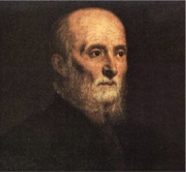
A Venetian nobleman on the brink of death discovered a way to stay healthy and alert to the ripe old age of 102. He lived in the 15 century, and his name was Luigi Cornaro (1464-1566).
At that time, Venice was a thriving commercial port — one of the main shipping hubs in Europe — and a life of abundance with little thought for health was the norm for all wealthy people there. What also factors into the equation is the average life expectancy during that time, which was somewhere around 40 years. Yet Luigi Cornaro was a nobleman who chose to live a balanced life, eat a healthy diet, and lived to 102 years. That is truly remarkable.
How did he do it?! It’s really no mystery. At the age of 83, he wrote a treatise on the subject, entitled “Tratatto de la vita sobria”, followed by three more treatises on the same subject, published at the ages of 86, 91 and 95, respectively. In his treatises, he described in detail just how he lived his life and what he ate, hoping that others would follow his advice and reap the same benefits.
He believed in consuming the best quality and most easily digestible foods in small amounts. He reduced his food intake, cutting it down to twelve ounces a day of solid foods, divided into two meals with fourteen ounces of light wine, also divided into two servings. He sometimes ate a little beef, but mostly he would eat one egg yolk, vegetable soup, coarse, unrefined bread, salads, small quantities of locally grown fresh seasonal fruits and vegetables, and he’d drink slightly fermented wine. His stomach didn’t agree with fish or chicken, so he avoided them.
The amazing part is that all his faculties stayed intact and even better, improved with age, right up to the day of his death. He had no memory loss, his eyesight and hearing grew keener with the years, and he was able to stay active, physically and mentally, in his advanced age. In his nineties, he even studied singing and horseback riding.
His writings are now part of the public domain and thus freely available for download. If you want to live a healthy life, do yourself a favor and read through them. Google Books, has an 1833 English translation of his writings, entitled “Discourses on a Sober and Temperate Life“, translated and edited by Sylvester Graham. You can download the entire book as a PDF there, or here on my site (see 1st PDF below). You can also download an abridged version of Cornaro’s writings as a 6-page PDF (see 2nd link below). It was sent to me via email, and am not sure who its translator is, but would be glad to give credit if someone will contact me.
If you’re interested in modern advice on the subject, US News recently published an article entitled “10 Healthy Habits that Will Help You Live to 100“. They didn’t mention Cornaro, but their advice is easy to follow, if you’ve got the willpower.
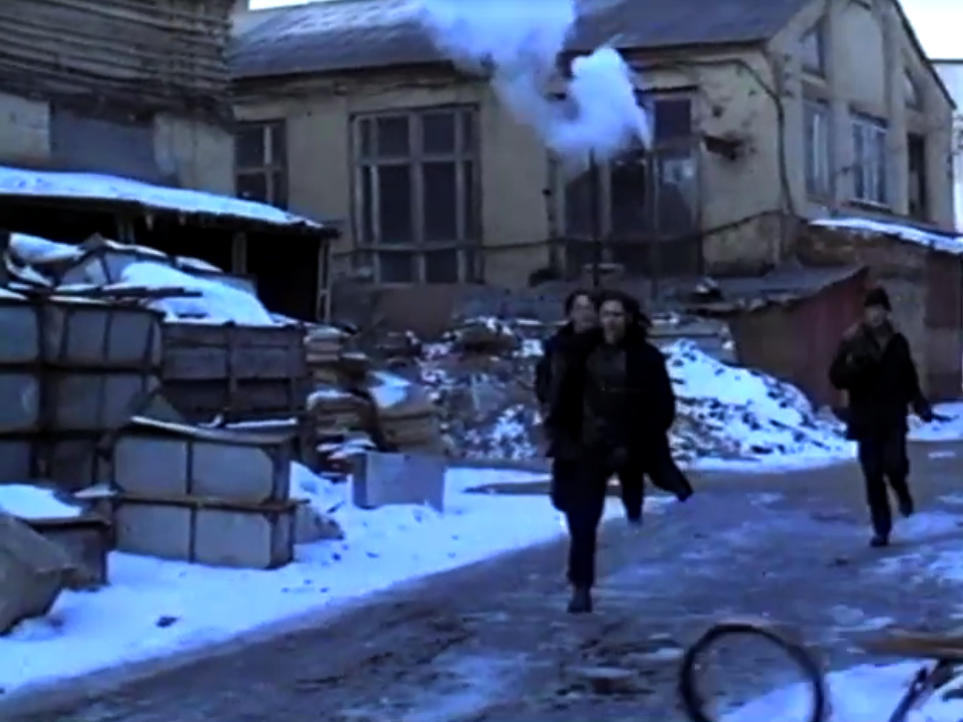
It got panned by the critics. Val Kilmer’s acting was indulgent at times. It was somewhat cliché. What was up with those knee-high socks that Elizabeth Shue’s character wore throughout the movie? Those are some of the things that come to mind when I think of “The Saint” (1997). But it struck a chord with me, from the first time I saw it, and I like it even after all these years.
I think it evokes the feel of that time in Eastern Europe very well. I visited Romania in December 1998, for the first time since I’d left in 1991. The movie and the impressions from my trip match. It was cold, snowy, in many ways dreary, there was poverty all around, but still somehow enchanting, inspiring, in a way that made you feel you could do almost anything, as if the slate had been wiped clean and people were free to start things over.
Simon Templar, the character played by Val Kilmer in the movie, has a long heritage that started in books in 1928. The character itself has been played in movies and on TV by several other actors, Roger Moore being one of the more notable ones. I remember watching Moore in the Saint series as a child growing up in Romania. The films were gripping and I loved seeing a modern-day Robin Hood escape from dangerous situations, just as I enjoyed seeing Kilmer’s character escape from similar situations in this latest installment.
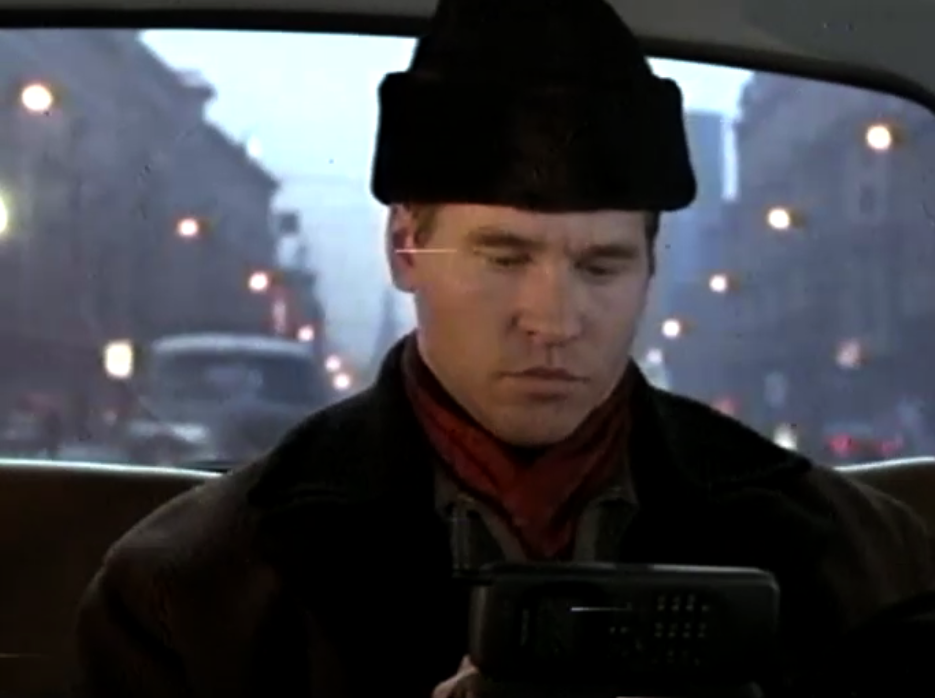
Given the character’s long history, Kilmer had some big shoes to fill in this movie. For example, I thought there were too many close-ups of him. Perhaps the director was trying to establish character, and the close-ups were meant to give us an insight into what S.T. was thinking, but at times, I could see the actor hamming it up behind a thinner-than-usual mask. Still, I always thought Kilmer was charismatic and I don’t begrudge him the less than stellar acting here. Every actor goes through a ham stage in his or her career — most notably of all, the famous John Barrymore, who quite possibly illustrated the very phrase in some of his later film roles.
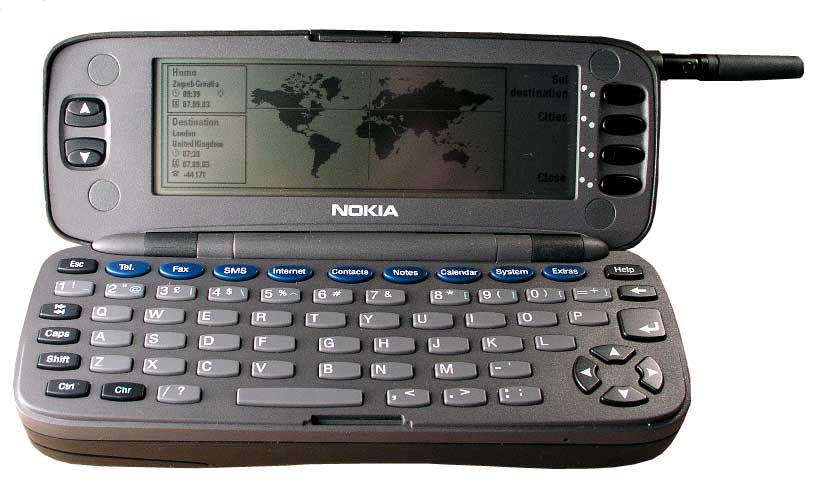
The film’s tech was amazing for its time. Simon Templar’s phone in the movie — that Nokia phone was something else. It blew me away. I think it could do everything modern phones could do — at slower speeds, naturally — except play movies. I learned it was a Nokia 9000 Communicator, thanks to the Saint.org website. And to think, all of that technology was available in 1997! Nokia was very happy about the phone’s appearance in the movie and even issued a press release about it that same year.
All in all, “The Saint” is one of a handful of movies in my library that I’ve watched multiple times, and will probably watch again. I like it.
A video compilation of various Peter Schiff TV appearances (2002-2009) is available on YouTube. The quality isn’t that great, but the message is pure gold. He’s been saying since 2002 that the US economy would collapse, and he gave solid reasons why it would collapse every time. His messages got more pointed with each appearance, they made sense, and yet he was ridiculed over and over for his opinions by so-called pundits on various TV networks. Ben Stein once said to him: “Sub-prime is a tiny, tiny blip.” I bet he’d like to eat his words now…
In 2004, I wrote an article where I said some of the same things Peter Schiff was saying — namely, that an economy financed by debt would not go on forever, and that we might be headed for another Great Depression. Back in 2004, the real estate market hadn’t even hit its peak, so I based my observations on common sense. I have no education in finance, but I can spot a turd no matter what it’s called.
I wrote then that the slowing US economy was being falsely propped up by the war spending in Iraq, but that wouldn’t last. You see, the government operated under a false assumption. The thought that what pulled us out of the Great Depression — the ramped up spending for WWII — would do it again in modern times. They were wrong. As I also wrote then, the WWII spending paid off: the world wanted American products after the war — they were hungry for them, and the manufacturing economy, which had been making weapons, shifted into making lots of things for export, like cars and clothes and other badly needed things in war-torn countries. Back then, we had a manufacturing economy, and there was real demand for our products.
History unfortunately does not repeat itself. In 2004, things were different. The US had no American products to export (unless you count weapons of war). It had moved most of its manufacturing overseas, leaving little to make at home. It was going into massive debt to finance a war that would (among other doubtful goals) stimulate a slowing economy, yet, from the get-go, they were not building American goodwill overseas in order to stimulate demand for American products. Even if they had done that, there were no American products to export, since we did not have a manufacturing economy any more.
A quick aside: some were saying a while back that the US is in the information services business — you know, IT, expertise, analysis, consulting, research, etc. — white collar stuff. I don’t buy it. For one thing, not everyone in the US can hold a white collar job. There are a finite number of people out of the US population (percentage-wise) that can do those jobs, and there are a finite number of such jobs available. To make things worse, information products lose their market value fast in times of economic hardship: when you need money to buy bread, you aren’t going to worry about knowledge; your stomach comes first. Also in the “things get worse” department, India and China are only two of the countries that can steal a large number of our information jobs as more of their people are educated. Don’t forget how many Indians work for Microsoft and other tech companies, and how many Chinese are involved in research. Unfortunately real products that fulfill real, tangible needs are still the king, because they are always in demand if they’re quality goods.
Okay, back to the war. It took people’s minds off the economy until the real estate market ramped up, and when that bubble burst, the whole ugly truth came to life. We had no economy to speak of, it was all propped up by debt, and all that debt was crashing down on us, as some, including myself, predicted. In my article from 2004, I said the following:
… unless we get someone in the White House who is willing to address the problem of debt head-on, I think our country is headed for certain disaster.
Fast forward to 2008. At the end of September of that year, I laid down my thoughts about the impending economic crisis. I was saying pretty much the same things I said now, except I approached the problem from a different angle. You see, we hadn’t yet elected Obama. Later that year, my wife and I, along with many other people, voted for him, because he was better than the alternative, and we hoped he’d do some good.
While the jury is out on that last part, and part of me says I should just sit back and wait to see what he does with his presidency, part of me goes back to the problem of debt and wonders if he’s tackled it head-on, like it needs to be handled. Unfortunately, he’s headed in the very opposite direction. He’s going to put our country into yet more debt in order to keep stimulating the economy. All this stimulating makes me wonder what status quo the government hopes to achieve. Just what state of the economy do we want to return to? Where do we want to go after we’ve spent all of that money? These words from Jim Kunstler say it best:
“… to what state of affairs do we expect to recover? If the answer is a return to an economy based on building ever more suburban sprawl, on credit card over-spending, on routine securitized debt shenanigans in banking, and on consistently lying to ourselves about what reality demands of us, then we are a mortally deluded nation.”
So, we’ve been going into more and more debt, for years and years, propping up a sick economy that has no more manufacturing backbone to stand on its own, and we’ve never taken our medicine. The US economy is like a sick man who’s hyped up on speed and other crap to keep from crashing into a bed and going through a proper recovery from a serious bout of the flu. It can’t go on forever. It has to at some point end. It doesn’t make sense otherwise. Like I said in an article from February of this year, there will be an ugly third act, where the fat lady will sing and the curtains will come down, and believe you me, it’s going to be a doozy.
Will it have to do with the severe de-valuing of the dollar and cause it to be replaced as the world reserve currency? Possibly, since some countries out there, like China and Russia, are already calling for a new global currency. I think there will be more unrest beyond the dollar debacle. And who knows, perhaps behind the scenes, that was the plan all along: bring on a crisis where bargains are to be had for those with the money to get them, and the sort of economic unrest that would make it easier to move certain pieces of the big puzzle into their place.




 Raoul Pop