Places

The C&O Canal

I suppose I should call this “Trip to the C&O Canal – Part Three”, since it’s the third time I write about the C&O Canal (Chesapeake and Ohio Canal) on my site. Here is Part 1 and Part 2. But it’s certainly not our third trip, because we’ve been there numerous times, during various times of the year.

This last time, we did it by bike, starting at Lock 7, which can be accessed from the Southbound Clara Barton Parkway. We traveled past the last gatehouse, which I think was was Lock 12, and past the Carderock Wall, to some section of the canal beyond it.

It’s a lot of fun to bike on the C&O Canal. For one thing, the path that accompanies the canal used to be the old towpath for the mules that pulled the barges, so you know you’re stepping on a piece of history. For another, the canal towpath was built to have no steep grades. Other than little hills that correspond to the drops in altitude at lock gates, the towpath is mostly level, so you won’t get long-winded trying to walk, run or bike up long hills.

As you’ll see in the photos above, some parts of the canal were completely dry. I’m not sure what caused this. Perhaps it was the summer heat, or as you’ll see in a couple of the photos, a sinkhole that opened upstream and possibly swallowed all of the water from those sections of the canal.

The idea for the C&O Canal originated with George Washington, though in another form. Having worked as a land surveyor in his youth, he dreamed of the possibility of making the Potomac River navigable. He thought the only way to do it would be to build skirting canals around its falls. While he was still young, he could not convince the State of Maryland to do this, but after the Revolutionary War, let’s just say it was easier for him to get people to do things.

The Patowmack Company was formed in 1784, and construction began on the skirting canals. Washington himself supervised the construction personally. Beside the canals, channels in the river itself were deepened and boulders were removed. There was a great deal of work to be done, and the work wasn’t finished until 1802, three years after Washington’s death.

Although the canals were useful, the route didn’t generate as much traffic as it should have. For one thing, it was only truly usable up to two months out of the year, due to low water levels. Plus, it was very difficult to get the boats back up the river, because of the current. People ended up dissembling the boats downstream, walking back upstream, and building another boat. This was not efficient nor productive.

George Washington’s idea was interesting, and people kept thinking of a way to capitalize on it. A way to use the Potomac River needed to be found. That’s where the construction of a canal came in. It wasn’t new technology, as that sort of construction was already used in Europe, and even dates back to antiquity.

On November 5, 1823, a convention was held Washington, which led to the chartering of the company that would build the canal on January 27, 1824, and finally, to the start of construction of July 4, 1828.

The construction of the C&O Canal ended in October of 1850 at Cumberland, Maryland. The original plan to extend the canal to the Ohio River had to be modified, because of the extremely hard nature of the work, its slow progression, and financial troubles with the parent company.

Parts of the Canal were opened as they became available, and it worked as a water route until 1924. Frequent flooding closed it for months, and sometimes, for entire seasons, and in 1889, the parent company went bankrupt. It was then taken over by the canal’s rival, the B&O Railroad. In 1902, they even took over the boats. Whereas they had belonged to the people themselves — to the families that toiled night and day to carry goods down the canal — from that year forward, they belonged to the Railroad company…

The B&O Railroad did as little maintenance as possible on the canal, and in 1924, when another flood destroyed parts of it, they closed it down altogether. The canal slowly deteriorated afterwards, until it was taken over by the National Park Service in 1971. They restored the towpath and re-watered parts of the canal.

Here’s an interesting fact [source]:

“Transporting goods and people by canal dates back to antiquity. The lock gates used on the C&O Canal were an adaptation of a design by Leonardo DaVinci in the late 1400’s. Until the advent of the railroad, water travel was far superior to land travel.”

If you’d like more information about the C&O Canal, I recommend the official C&O Canal NPS website. Make sure to use the menu on the left side of the page to navigate through the various sections. It’s a little hard to find your way around at first, but it pays off if you keep digging — there’s a lot of information posted there.
Standard
Places

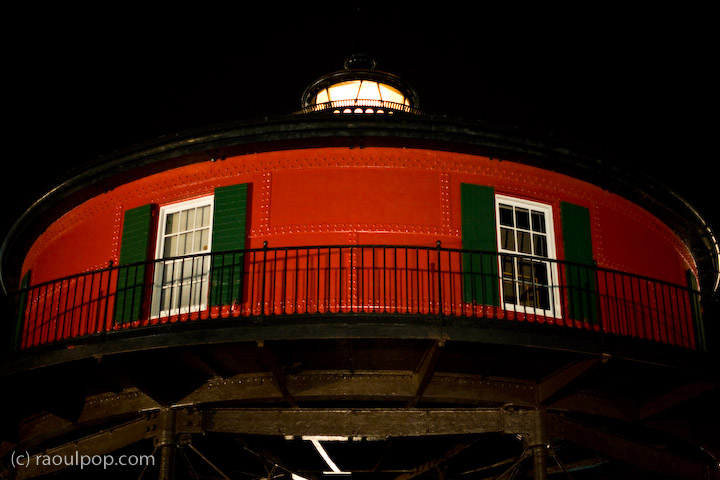
The Seven Foot Knoll Lighthouse

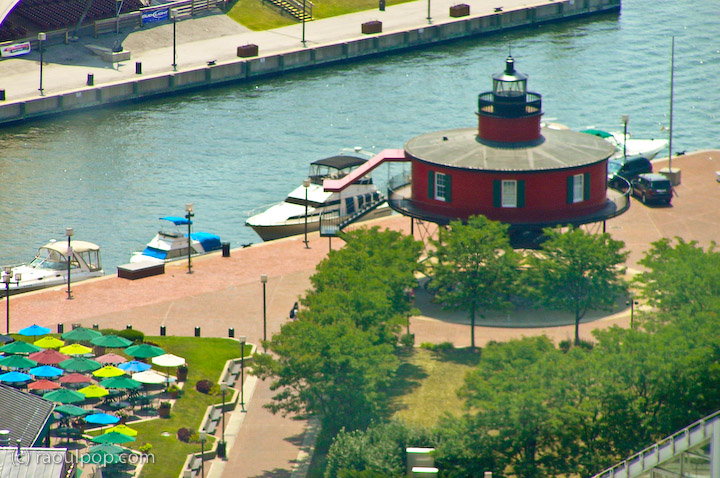
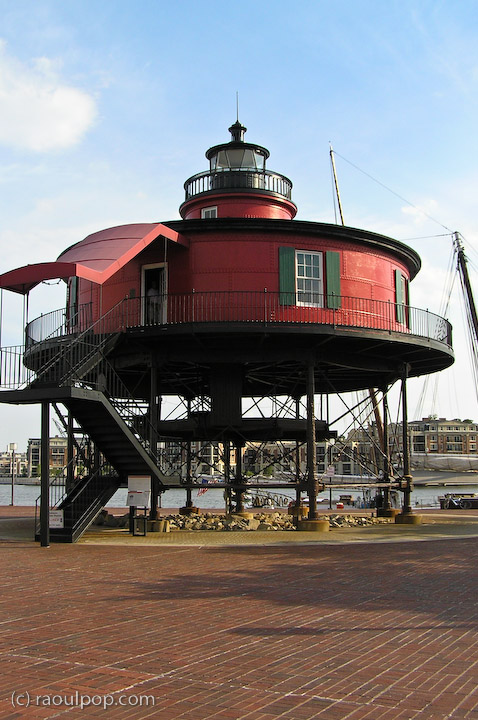
The Seven Foot Knoll Lighthouse is the oldest surviving screw-pile lighthouse on the Chesapeake Bay. It was built in 1856 (before the Civil War), and installed at the mouth of the Patapsco River, where it marked the shoal known as Seven Foot Knoll for 133 years. We visited it during our recent trip to Baltimore.

The lighthouse used an innovative design called the screw-pile, which looks like a large-scale, big-head drill bit. The screw-pile is also described as a “system of cast-iron pilings with corkscrew-like bases”. It eliminated the need for underwater masonry foundations, which were (and still are) hard to build on muddy bottoms. The screw-piles could be screwed into the sea-bottom, and a construction developed on top of them.

The Seven Foot Knoll Lighthouse was the second screw-pile lighthouse on Chesapeake Bay, and was used from 1856 until 1987, although keepers lived in it only until 1949, when it was automated. By the second half of the 1960s, the lighthouse started to show serious signs of aging, and it was thankfully moved to the Inner Harbor in 1988.

From 1856 until 1919, keepers lived in the lighthouse along with their families, but life was very hard in the lighthouse, particularly in the winter, when ice sheets threatened to topple it. Over the years, various pilings and rock barriers were put up to protect the lighthouse from the ice and from ships in distress who might bump into it, but it was the ice that posed the biggest problem, which was never quite solved. Every single winter, families lived in immediate peril there, and even had to be evacuated a few times as the lighthouse bent precariously in the face of advancing ice sheets. From 1919 until 1948, the Coast Guard recognized the hazardous nature of the lighthouse work, and allowed keepers to work in pairs, with each receiving 8 days of shore leave per month.

There’s a courageous event recorded on August 21, 1933, when Keeper Thomas J. Steinhise risked his life to rescue the crew of a sinking tugboat named Point Breeze. There was a terrible storm that night, with fifteen-foot seas and 90-mph winds, and yet Thomas Steinhise fired up his small motor boat and navigated in the direction of distress whistles to save the lives of five crewmen. He was awarded the Silver Lifesaving Medal for his heroic deed.

After the lighthouse was moved to the Inner Harbor in 1988, the Coast Guard donated it to Baltimore City, and in 1990, a lighthouse restoration project, completed with grants and the aid of volunteers, was completed. In 1997, the lighthouse became part of the Baltimore Maritime Museum.

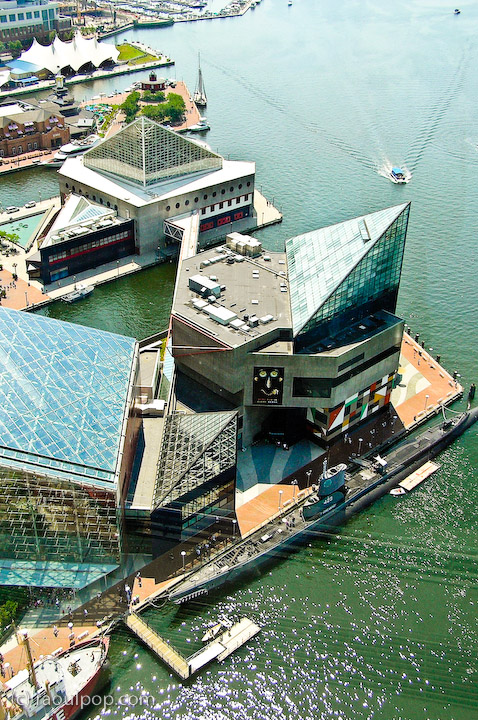
The lighthouse’s current location is more clearly seen in these two photos taken from the top of the World Trade Center in Baltimore. I’m sorry for the poor quality of the photos, but I had to shoot through the thick (and dirty) glass of the visitor center at the top.

Standard
Reviews

The Education of Little Tree (1997)

A little boy loses his parents during the depression, and his grandparents take him to live with them in their mountain cabin. The premise is simple, but the lessons are many. I liked this movie because it taught respect for native Indians.

Let’s face it, the “red skins”, as they used to be called, owned this land. It was theirs long before it was ours. The early American settlers drove them out of their homes and used every possible means to push them aside, to disown them of their inheritance.

That was shameful. And what added insult to injury was the way they tried to “integrate” them into society after they’d been pushed aside for so long. This film tells the story of one such boy. Half-Cherokee, he is forced into an “Indian” school, where he is treated like an animal. The idea is to erase all sense of individuality and family out of him, and to get him to become an “American”.

You might think the subject matter is outdated, but only recently, the Canadian government has had to issue an official apology to Canadian Indians for their treatment of their children.

Quoting from the article: “Between 1870 and 1996, an estimated 150,000 indigenous children were wrenched from their homes and sent to Christian boarding schools, where many were sexually and physically abused.”

The movie offers a solution that I only wish more Indian children had taken. The little child runs away from the school (aided by his grandfather) and spends his teen years hiding from government officials who want to put him back in what they call “schools”. He gets a real education from his uncle, an experienced Cherokee who acts as his surrogate father and prepares him for a solitary, sometimes troubled, but free life in the mountains.

I get raised hackles every time I hear the word “freedom” trumpeted about, yet find clear proof of forced behavior or oppression. For all its talk of freedom, the US has always managed to oppress certain of its population, throughout time. First it was the native Indians, then it was the slaves, then its Japanese and German citizens during WWII, then the presumed Commies during the vile McCarthy trials, then various other groups during the 20th century. Now, this oppression has culminated into the mass reduction of our liberties through the so-called Patriot Act, a filthy lie of a misnomer if I ever heard of one.

The real patriots always stand up for the rights of all, and they always question the system in order to keep it in check. Sometimes, the best statement a free person can make is to stay free, even if it means thumbing your nose at idiotic rules and policies and living in the mountains, outside of society. Because eventually, the government comes around to realize its idiocy, and issues an apology. By the way, the American government is long overdue on just one such apology.

If you want to find out more about the movie or buy/rent it, you can find it at Amazon, Netflix and IMDB.

Standard
Thoughts

How pressure changes a man!

Take a look at these two photographs of President Abraham Lincoln. One was taken in the midst of the Civil War. The other was taken after the Gettysburg Address, and after North had won and managed to keep the country together. Slavery had been abolished, and the goals that had been set out at the start of the war had been achieved.

Can you guess which is which? More to the point, can you believe how much pressure changes a man? In the second photo, Lincoln looks older, more frail, literally spent after the long war effort, but is smiling. Amazing.

Photos are public domain, and were taken by Alexander Gardner. Courtesy of the Library of Congress.

Standard
Places

Photos from Antietam Battlefield

Last weekend, on a fiercely hot Sunday, my wife and I visited the Antietam Battlefield, located near Sharpsburg, MD. It’s quite easy to get to it from DC. You take 270-N to 70-W, then keep going on 70-W until you see the signs for Antietam. Once off the highway, you’ve got another 8 miles or so till you get there. You can’t miss it. There’s a big National Park Service sign by the side of the road. All in all, it’s about a 1 hour and 30 minute drive, give or take 15 minutes, and the history lesson is priceless.

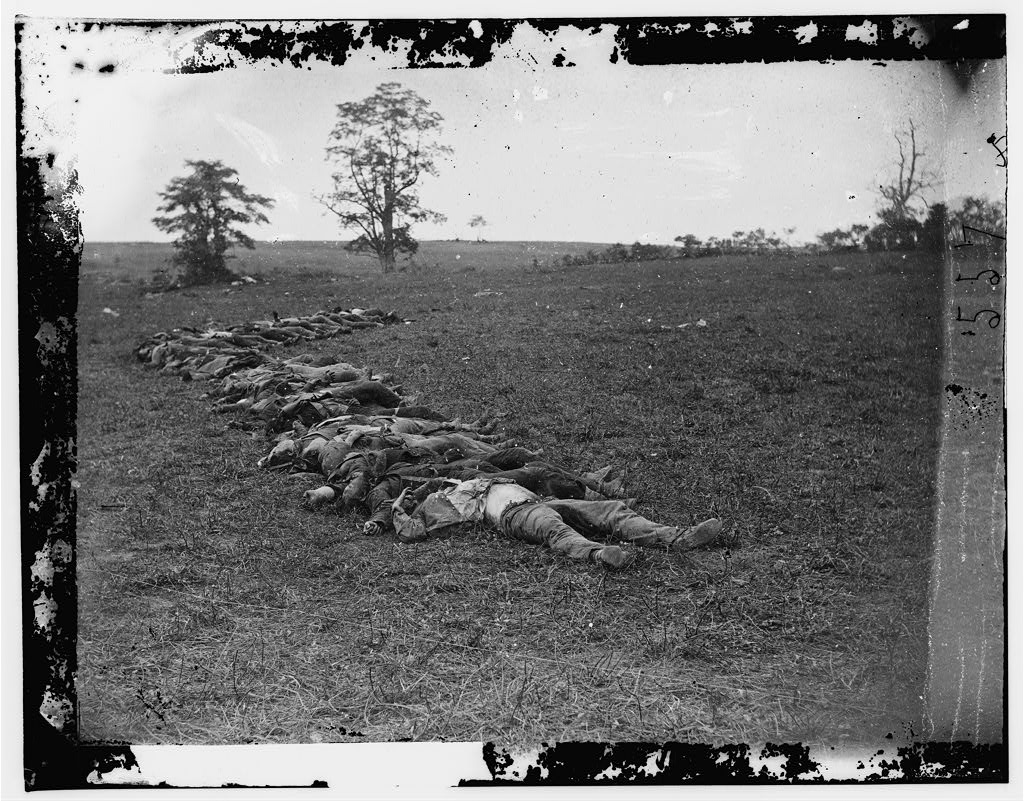
Antietam is “the bloodiest one day battle in American History”, according to the official NPS website. In 12 hours of “savage combat”, over 23,000 soldiers were killed, wounded or missing. Six generals were killed during this battle. The human price of this battle was driven home by a photographer: Alexander Gardner. His haunting photographs of the dead at Antietam were said to have brought them “to our doorsteps” by the New York Times. And it’s true. It’s one thing to sing of battles won and of bravery on the battlefield, and it’s quite another to stare at the dead in front of you and see the horrible price of that thing you call victory.

What always strikes me when I look at war is how senseless it all is. Even when I’m far removed from it, by a century and more, I can’t help shivers from running down my spine when I think the ground I stand on is the same ground where countless men lost their lives.

Why? How many more people need to die horribly until humanity as a whole realizes war is bad? Forget humanity as a whole, how about the United States alone? When will we get it? Ever? At the first sign of trouble somewhere (preferably in the Middle East), we’re more than happy to send our soldiers in there to die for some trumped up cause, and to spend trillions of dollars and bankrupt our economy as well. At least the Civil War had a good reason. The country needed to be kept together, and slavery abolished. Still, in spite of those good reasons, far too many people died during that dark time in American history: around 360,000 lost their lives, and countless more were injured or maimed for life.

I’m going to show you how Antietam looks today. But I want you to have a look at the way it was back then, too, especially through Gardner’s eyes. Never mind the fact that the dead bodies may have been arranged in a photo or two. Death is still death, and it’s still just as grim and nasty regardless of the pose.

First, the Library of Congress has a LOT of scanned negatives from the Civil War — an amazing resource. Here is their collection of Civil War photographs. That’s where I got the few photos shown below (taken by Alexander Gardner). Most of the photos are in the public domain, which means they can be used freely, although it would be nice to give the LoC credit for their work in scanning, archiving and curating the photographs. It’s also worth looking at the October 1862 issue of Harper’s Weekly, which features illustrations and reports by eyewitnesses to the battle.

This is Abraham Lincoln at Antietam, after the battle ended.

Abraham Lincoln with two generals at Antietam

Assorted photos of dead soldiers, in the aftermath of the battle.

Gardner’s notable photographs from the battlefield are listed in an album on the NPS website. Have a look at them, and even download them, should you want to have your own archive.

What does it look like today?

Dunker Church is the spot where truce was called at the end of the battle. If you’re interested, there’s a nice historical summary available.

The church is visible in this photo taken by Gardner as well.

The approximate spot where those soldiers died is now the site for a war monument. I hope you won’t find me irreverent, but I find war monuments woefully inadequate at paying back the men that gave their lives in battle. They’re pretty much useless at teaching people lessons against war as well, since they usually depict some victory symbol, or men charging, or some other idiotic thing like that.

What is that supposed to mean?! Tens of thousands of men died here, and we have an eagle on a column? Whoopee…

You know the expression “war on the doorstep”? Well, the people who had farms at Antietam got to know it full well during that battle.

Just remember, the next time a politician makes the case for war, this is really what he or she means. Those are going to be your sons and daughters.

Historical photographs courtesy of the Library of Congress. Photographer: Alexander Gardner. The recent photographs are naturally, my own.

Standard