Thoughts

Just give me a good zoom lens, thanks

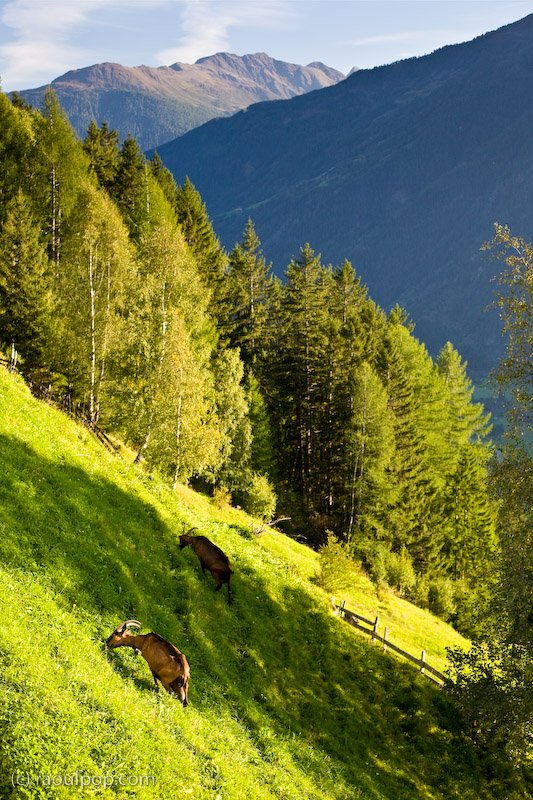
Greetings from Osttirol! My wife and I have been vacationing in Austria for the past week. It’s a gorgeous place to visit and, needless to say, I took tons of photos here. I’ve been carrying my Canon 5D and my lenses with me everywhere, and let me tell you, I’ve been sorely in need of a good zoom lens.

The lens inventory in my camera bag is woefully short at the moment. I started out with three primes: EF 24mm f/1.4L, EF 50mm f/1.4, and EF 100mm f/2.8 Macro. I sold the 24mm prime with the intention of buying the EF 24-105mm f/4L Zoom, but other circumstances intervened, and now I’ve only got the 50mm and 100mm lenses.

There are some who say it’s better to have prime lenses. I disagree. I’d like to see them carry five or six prime lenses in a backpack up and down a mountain in order to get the range that one or two good zoom lenses would give, and then tell me if they still feel the same way. And by the way, try changing lenses in swift mountain breezes, with insects buzzing around you and just dying to get inside the sensor chamber and leave smudge marks (which happened to me). Oh, and don’t forget to throw in a few other accessories such as polarizers and UV filters of various sizes for the different diameters of each lens, plus one or two water bottles and a fleece jacket plus an umbrella in case the weather goes bad, and then we’ll talk…

In a way, I was glad to only have to carry two lenses; I’d have really felt the weight of a third one. But I felt so limited in the photos I could take, because I could only use the 50mm or the 100mm lens to frame my photos. In some instances, I could walk back and forth to get a better view or angle, but in others, there was no way to get a better photo without also being able to fly — which incidentally, would be very nice, but I haven’t figured out how to do it yet. And no, I don’t believe in cropping. I only do it when I absolutely have to. I didn’t pay $2,800 for a full-frame sensor that can take 12.8 megapixel photos so I could crop them and get the same resolution I can get from a $500 camera.

To this day, I slap my head when I think that I could have had the 24-105mm zoom lens as a kit lens with my 5D for a little over half its usual price. I was such a fool not to get it! It’s a light and sharp zoom with more range than the EF 24-70mm f/2.8L, and you can easily walk around with it for hours without getting too tired.

So far on this trip (which ends very soon, unfortunately) I took 1904 photos with the 50mm prime, and 471 photos with the 100mm prime. If I had had (don’t you just love the English language) the 24-105mm zoom on my trip, it’d have stayed on my camera 95% of the time, because that’s the range I use the most, particularly on the wider end of that focal spectrum, which was not available to me, each and every day, how stupid could I be, ugh…

Look, I’m not knocking the 50mm prime, which is a great prime, and very cost effective given its low light capabilities and sharpness. And I’m definitely not knocking the 100mm prime, which is versatile and a fantastic macro lens with gorgeous bokeh. But I really didn’t need f/1.4 or macro capabilities for landscape photography, which is what I did on this trip. I needed a zoom lens!

So, if you’re not sure what lenses to get, don’t do what I did, or you’ll be frustrated to no end as well. First get a good, lightweight zoom lens, one that won’t kill your wrist as you carry your camera around taking photos. Later, as you find that you need more specific capabilities, such as being able to take handheld photos at dusk or dawn, or more bokeh, or macro photos, then spring for those primes that have the features you need.

Standard
Places

Life, as I want to know it

Life, as I want to know it

Early morning just outside a forest near Natural Bridge, VA.

Standard
Places

Shenandoah Valley panoramas

You are about to see several panoramic photos that have taken me well over 35 hours to create — and I’m not counting travel time, setup time, time it took to take the photos, and the time it took to write this post.

This slideshow requires JavaScript.

A couple of weekends ago, Ligia and I got into our MINI and drove up to Shenandoah National Park, for a single purpose: to take a few panoramic photos of the valley from the tops of the Appalachian Mountains. Fortunately, that simply meant driving on beautiful, scenic Skyline Drive and stopping at various points to set up the tripod and take series of shots that would later be stitched together. Unfortunately, the weather wasn’t exactly collaborating, in spite of the cheery weather report. The day was neither sunny nor cloudy. The light was diffuse and had that washed, in-between quality that doesn’t really make it good for anything. But, I was there, and if that’s what I had to work with, so be it.

As it turned out, driving out there and taking the photos was the easiest part of the whole thing. Like I mentioned in the opening paragraph, putting together the panoramas was by far the longest, most excruciatingly slow stretch of processing work I have ever done. I do not recommend it to anyone, for multiple reasons, which I’ll mention below. If you just want to see the photos, skip ahead.

A few thoughts on the whole thing

I will not do panoramas very often in the future, unless I’m commissioned to do specific ones. If and when I do another panorama for myself (not for a client), it will likely only be a 5 to 10 photo image, simply because it takes an enormous amount of time to stitch and process them on the computer if they’re made up of more images than that.

For one thing, you would need a super fast, quad-core or better computer loaded to the gills with RAM to get any sort of decent speed while processing panoramas. A Mac Pro worth about $7,000 or better should do the trick. Seriously, every single simple operation, like cropping or rotating, took at least 10 minutes or more to execute. Sometimes just assembling a single panorama in Photoshop (through the Photomerge feature) took about 45 minutes. I have the latest MacBook Pro laptop (2.5 GHz Intel Core 2 Duo processor, 512 MB video card, 4 GB RAM), and it still took what seemed like forever to get through each panorama.

The resolution of the photos also matters. My individual photos are 12-megapixels each, at 240 dpi, made by a Canon 5D. Just imagine how much processing power is needed to put together 20 or 30 of these photos into a single image!

People don’t appreciate panoramas. I bet you most people will skim this post, unimpressed, and move on. You can’t really appreciate panoramic photos unless they’re printed out in their full size and spread out on a wall, right in front of you. You can’t appreciate their size on your computer monitor, no matter how large it might be. The largest single monitors nowadays are 30″ and have a maximum resolution of 2560×1600. That’s equivalent to about 6 megapixels at 72 dpi. You can’t possibly appreciate a 12 megapixel photo at 1:1 size on a current-day monitor, much less a panorama made up of 20 of those photos.

As an aside, don’t confuse monitor size with resolution. There are LCD HDTVs on the market that are 42″, 46″ or more in size, but they can only display up to 1920×1080 pixels, which is much less resolution than a 30″ monitor.

I can’t show you the full panoramas on my site, because of photo theft. Not that I think my panoramas (these ones in particular) are spectacular and would fetch amazing prices, but I know for a fact that if I post my panoramas at full resolution, there will be people who will steal them and try to profit from them.

How does the new Lightroom 2 Beta handle panoramas?

After I processed the photos in Photoshop CS3, which worked without crashing for the whole bunch, although it ate an amazing amount of space on my hard drive for its scratch disk, I imported them into the new Lightroom 2 Beta, to see how it would handle them.

Most of the photos were over 1 GB in size, uncompressed. Because I saved most as TIFs, using ZIP compression, their file size on disk was significantly lower. Lightroom did amazingly well to start with. It created small previews very quickly, and also created the 1:1 previews much quicker than Photoshop would have been able to render them. I was able to use the spot heal brush to remove sensor dust spots, and also used the new selective retouching brushes, without any problems. Lightroom 2 was able to do these things without significant delays, and would show the effects instantaneously.

LR2 only started hiccuping when I started to add some meta-data to the photos. As I went through and added meta-data, then opened them at 1:1 size once more, it would hang, literally forever. I had to keep force quitting it, and had to do that regularly, for each and every photo that I wanted to look at. Interestingly enough, when I wanted to export the panoramas to use them here on my site, it did it without any problems, and without crashing. It’s certainly odd behavior, but it is in Beta after all.

On to the photos

While I cannot post the panoramas at full resolution here, I did post them at higher sizes than I would normally post, in order to give you a better idea of what they look like. I also created 1:1 previews of regions of each photo, to help you realize how big they really are.

If you click on each panorama (not its 1:1 detail), it will take you to its photo page, where it will tell you how large it is (in megapixels), and how many photos went into making it. If you click on it again (on that page), it will take you to its larger size. Sorry for the double-clicking, but that’s how things work in WordPress these days.

First, a panoramic of Skyline Drive itself. This road is amazing, and I’m so glad the US government decided to build it back in the 1930s. It literally hugs the tops of the Appalachian mountains and lets average John and Jane drive on top of the world (as high as possible in this area of the world, anyway).

We stopped along Skyline Drive, parked our car, and took a hike through the forest on one of the paths marked out there. In the middle of nowhere (literally), we found this cabin, called Range View.

It was a darling little place built out of stone and off the grid (in spite of the fact that wires ran right above it). The fireplace was outside the cabin, by the front door. While the place was locked up and the windows equipped with thick wire and netting, Ligia and I could spot beds and various pieces of old furniture inside. Don’t know what it’s used for nowadays, but it is used, because there was an open bottle of wine standing in plain sight near one of the windows, and it was of recent vintage.

The rest of the photos, including the 1:1 previews, are found in the gallery below. Click on each to get to the photo page, then click again to see it in a larger size. Enjoy!

Standard
Thoughts

The shit days of spring

I am pleased to announce that the shit days of spring are approaching their malodorous end. If you happen to live in non-temperate climates, you may not be accustomed with this rite-of-passage period that takes place every year where I live.

The shit days of spring are that time of the year when pig farmers get to spread the joy of their filthy farm by-products throughout the land, at insanely high prices, under the pretense of fertilizing our grounds. It must put a smile on their faces to know that they’re putting the city slickers through the same shitty time they have year-round, even if it is only for a couple of weeks every year. The regret of not being able to make us smell the offal of their filthy beasts all day, every day, is tempered somewhat by the knowledge that their bank accounts are getting fatter, just like their pigs, with every shovel-full of the nasty stuff they throw our way.

Others are in on the fun as well. Landscaping companies throughout the land rejoice every March. This is their own Christmas time, when they get to sell us pig shit at crazy prices. Just how crazy? Friends of ours who own a house told us they were charged $200 per tree for the privilege of having pig shit dumped around the trunk a couple of springs ago. I can only assume the price has gone up since. That’s right, ladies and gents… The going rate is about $200 for two bags of pig shit mixed with wood chips in the DC area. Ain’t that grand?

So it is with a doubly-chagrined expression that I take walks through our community each spring. For one thing, it smells like shit, and not just like cow shit or horse shit, which would at least smell somewhat decent, but like pig shit, arguably the filthiest, smelliest shit on earth. And for another thing, I can’t believe how much us suckers are paying for the damned pig shit. For shit’s sake, shouldn’t it cost less?

At least the shit days of spring are drawing to a close. Trees and flowers are beginning to blossom, and recent rains have flushed away the nasty stuff. I welcome sweet April, and think of Chaucer as I open my windows and can still get a whiff of March’s filthy stank:

“Whan that April with his showres soote
The droughte of March hath perced to the roote,
And bathed every veine in swich licour,
Of which vertu engendred is the flowr;”

Indeed. Although Chaucer must not have realized that “swich licour” is really just rain water and pig shit. Who knows, perhaps during his time they used cow dung, which would be the civilized thing to do. At any rate, Republican politicians must get a chuckle out of the whole thing too. Who knew that entire armies of Karl Roves blossom out of the turds every spring?

Standard
Thoughts

Photographs for sale

My photographs (a select number of them) are now up for sale through both Alamy and the PhotoShelter Collection. Here are the links:

Alamy presents you with a search page first. To see my photos without doing a search, just click on my name. PhotoShelter presents you with the photos right away.

Of course, you can still purchase any of the photographs I post here by simply contacting me via email and indicating the photo you’d like to purchase. More info on this is available on my Photos for Sale page. But for those of you that prefer a more streamlined look and an instant price quote, Alamy and the PhotoShelter Collection should do nicely.

If you should lose the links to my sites at Alamy and PhotoShelter, don’t worry, I’ve made it easy by listing them in the sidebar. Just look for this section:

Purchase my photographs

Happy shopping and many thanks!

Standard