Thoughts

An announcement about my photos

I’ve been mulling over this decision for some time. As I thought about it, I wanted to balance my desire to let people enjoy my photos with my very real need to retain the ability to sell my photographs, because I do want that to become a larger source of income for me than it has been thus far.

I think I may have reached a happy medium, and I hope I won’t regret what I’ve already begun to do. As of last week, I’ve been publishing my images at a much larger resolution — 1920 pixels on the longest side vs. 800 pixels previously. This means that you, the reader who sees this, will be able to download them and use as desktop backgrounds, without seeing a decrease in the photo quality as it fills up your screen. As a matter of fact, you’ll be able to use my images on monitors up to 24″ or more in size (1920×1200) or on HDTVs of any size, without seeing a decrease in quality. I am also resizing all of them to an aspect ratio of 16:10, so they’ll fit natively on widescreen displays.

Now, what am I not doing? I am not posting them at their native 240 dpi, as my Canon 5D gives them to me. I am posting them at 72 dpi, which is the native dpi spec of computer screens everywhere. I am doing this because I want to discourage the making of large prints from my photos, since I’d like to make money from those prints. This also makes it a little harder for people to blow them up to larger sizes for serious commercial work, which is where I also hope to make money.

I am also not removing my copyright notice from the photos. You’ll see it as a small watermark in the lower left corner that says “(c) raoulpop.com”. I want to keep that there to let people know that while I may be giving my photos away, I am not relinquishing my copyright, nor am I moving to a Creative Commons type of license, which I believe is inadequate for photographs. I also realize that the photos will get edited in various photo editing programs, and any meta-data will unwittingly get wiped from them. The watermark is the only sensible way to tell people down the line that I made a certain photo. I do wish Lightroom would let me format the watermark in some way, but for now, that’s what it gives me, and I’m not going to run all my published photos through Photoshop just to put a watermark on them.

Am I opening myself up for theft? Yes. There’ll be unscrupulous people (I hesitate to call them people) who will likely steal my photos and try to profit from them. For them, I should point out that I do register my images with the US Copyright Office, and I wouldn’t mind getting a six-figure payout.

For you decent folks out there, I’ll be happy to know that you get a little joy from looking at my photos at a resolution where you can actually enjoy them. Go ahead and download them and use them as desktop backgrounds, put them on your HDTV, email them to your friends, use them on your website, whatever. As long as it’s personal, non-commercial use, and you give me credit, it’s okay with me.

If you’re a company or some kind of organization that wants to use my photos in some way, please get in touch with me first to clear that use with me and to pay for the license. I’ll do my best to accommodate your needs.

Okay, so where do you partake of this fantastic offering? There are wo places where you can get it:

  1. My photo catalog.
  2. My Flickr stream. I’ve opened up access to the All Sizes button. Download away.

Remember to play nice. Here’s how to use my photos. Please obey the rules listed there when using my photos for free, and if you’ll end up licensing some, then you’ll make me very happy. Thanks.

Standard
Events

We voted today!

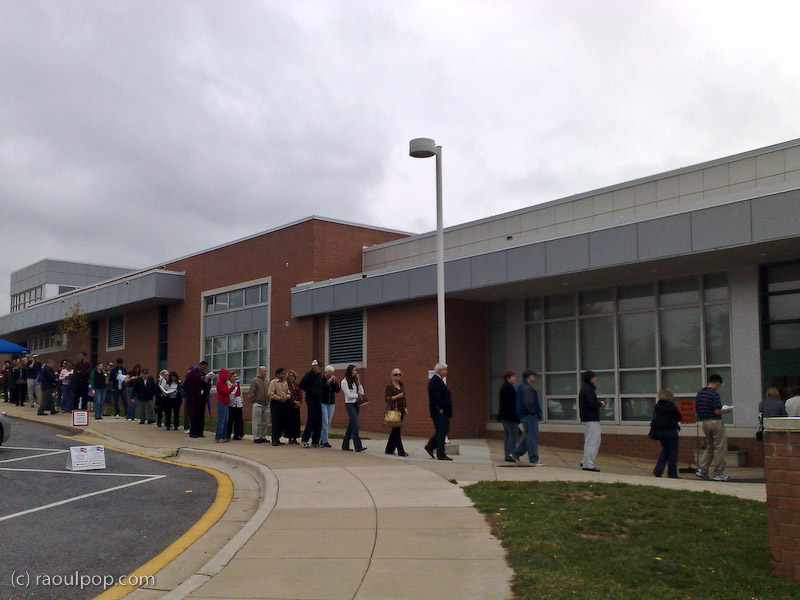
We got back a few minutes ago from voting for Barack Obama. Our polling place was Walter Johnson High School, in North Bethesda, MD. The line wasn’t too long. We waited about 25 minutes in line and it took about 5 minutes to vote.

The voting machines were electronic, and — I’m disappointed to say this — they were Diebold machines. After all of the controversy and research that Diebold has spurred since the last election, I am shocked to see the machines still in use, particularly after Maryland passed a paper ballot initiative a couple of years ago. These machines used a card with an embedded chips, that I inserted in the machine to get the votes written to it. When I got done, I put the card in a collection box and walked out.

Somehow this whole electronic process doesn’t inspire me with confidence. When I read up on it a few years ago, I found out that Diebold tallies the votes on a single computer, in an Access database that is easily hacked. Having designed and built Access database systems, I know how easy it is to bypass any sort of login restrictions and get right at the tables where vote totals can be changed in an instant without any sort of tracking record.

All I can say is that I hope for the best. Let’s hope this transition of power occurs smoothly, correctly, and in a democratic fashion, as George Washington wanted it to be from the get-go.

Standard
Thoughts

A few words on the economic crisis at hand

I’ve just got to say what I’m about to say, because it’s gnawing at me from inside, and I need to have it out. I’m not going to pretend I’m some economic guru, and I’ll use plain words.

My thinking on economics is simple. I understand tangible products. If an economy makes stuff I can touch and see, if it manages to sell that stuff both inside and outside the country, and the unemployment rate is low, then things are well.

I think things started to go sour when our industries decided to shift manufacturing to third-world countries. The thinking was that cheaper labor would result in cheaper products and lower prices. The truth was that it took jobs away from our country and it really only resulted in higher profits for the investors, not lower prices for us. As more companies would announce they were moving factories abroad, I would wince, because I knew our economic power was decreasing with each and every move. When you’re making less stuff in your own country, it’s plain common sense to realize that your economy is weaker.

As our economy started to move away from manufacturing and toward the service sector, I winced again. If you’re not making tangible products, what are you really making? Services? Knowledge? That’s all nice and good, but you can’t base an economy on intangibles. You just can’t. You have to have a good, healthy mix. I suppose I shouldn’t complain about this so much, since I work in IT. Still, at least what I make is tangible. I make websites and web systems. You can see and touch those, or click on them anyway. But not everyone can be a knowledge worker. It takes a certain amount of dedication, interest, perseverance and education, and many people simply don’t have the inclination to do that, or to be knowledge workers. That’s where having a good mix of jobs to offer your people is important. The more manufacturing jobs you move away from the country, the less variety you can offer your people. Plus, what do you do with all the folks you’re laying off as you “restructure” your economy?

When real estate prices started going up like crazy, I knew they’d come down, hard. They were bound to do so. When a pathetic little townhouse with a few tiny rooms, made out of plywood and fake brick cladding, cost over $400,000, that couldn’t be good. As prices kept going up, and people bought up multiple properties using ARMs, banking on the hope that the values of these properties would continue to grow, but no regular person could afford to actually own one of them, that was just plain wrong. When the home prices in most neighborhoods are so high that they’re out of reach for most, that’s asking for trouble.

Then I heard about the gaming that went on behind the scenes, as loans were approved by mortgage companies which seemed to sprout out everywhere. We knew someone who worked at one of these companies, and that person was just shocked at what went on. Executives would push employees to approve more and more loans only so they could get fat bonuses and afford McMansions and Mercedes cars. Meanwhile, the employees got nothing but low pay and long hours.

What’s more, I also heard about investment firms buying up groups of mortgages left and right, and re-selling them, and creating ridiculous layers of investments and speculations on top of these (mostly) insecure loans, in order to squeeze as much profit from them as possible. I’m sure that if you go back and check most loans, you’ll find 5-6 layers of additional financial speculation on top of the original mortgage. That’s insane and it makes me sick when I think about it. Instead of letting someone borrow money and charging them the set interest fee for the life of the loan, banks were selling these loans left and right as soon as the papers were signed, not caring where they ended up, letting others take the fall when and if the loan defaulted, etc ad nauseam. I knew that wasn’t going to end well.

Fast forward a couple of years to where we are today, and is it really any surprise that we’re here? Is it? And what’s being done about it? The government wants to bail out the banks and give them insane sums of money. You can’t do that! If they’ve mismanaged their own money so badly over these past several years, while their executives got filthy rich, let those same “smart” executives figure out how to fix their own problems! But no, what we’ve got now are scare tactics employed across the main stream media, where politicians and bankers are trying to scare us into giving in and allowing the bailout plan to go through. We’ve got bankers lobbying politicians to get the plan passed, and we’ve got them salivating at the thought of getting a piece of the bailout pie. This is ridiculous and irresponsible!

I keep thinking about Bush’s televised speech when he wanted to go into Iraq. And then I think about his speech just a few days ago, where he used the exact same scare tactics and language to try and get us to agree to the bailout plan. Jon Stewart did a great job of contrasting the two speeches on The Daily Show [reference]. Here’s a man that’s derailed our country, our economy, our international standing, and our military over the past 8 years, and we get to see his scare tactics in use once more. He’s clearly beholden to special interests, and they write his agenda. They wrote his agenda when he said we should go into Iraq, and they’re writing his agenda now that he wants to bail out the corrupt bankers. Given his track record, does he really deserve any credibility? I don’t think so.

So what should we do? Ride it out. Let the bankers suffer and cry. Let’s take our proverbial castor oil, let the crap pass through the system, and move on. They said it would be a disaster yesterday, when the stock market tumbled 778 points, and yet it jumped back up by 485 points today as investors gobbled up stocks while the prices were low. I think we all need a serious round of belt-tightening. Many Americans need to learn a hard lesson, namely that life doesn’t work on credit, that you need actual, real money to buy stuff. People and politicians and banks everywhere need to learn real fiscal responsibility. They need to learn that they can’t run up bills on credit cards and loans and credit derivatives and bond issues and not expect them to come due at some point. They need to learn that saving is more important than spending, and that a healthy economy means an economy that keeps its jobs inside the country, and makes most of what it needs inside the country as well.

It is truly unfortunate that none of the candidates running for president is saying this. I support Obama on my website, as you can tell by the Obama button in the sidebar, but that doesn’t mean I agree with him on everything. I think he’s the better choice out of the two, but he’s pretty short on substance when it comes to what needs to be done about our economic crisis. And he actually supports the bailout plan — probably out of fear, because he doesn’t want to be saddled with a big recession should he win office. I honestly wish Ron Paul was still running for president, because he’d get my vote, solely for his common sense approach to this whole mess.

Standard
A Guide To A Good Life

American habits

Slow down. That’s a phrase not often heard in the US. At least not among the people I know. But it’s a notion that’s slowly starting to make more sense.

Americans love to think big and spend big. They want progress on every front, no matter what the cost. In the 20th century, that sort of thinking worked well. It carried us through to the 21st century, where, however reluctantly, I think we’ve got to change the way we operate.

There’s a newspaper article I’ve been saving since June of 2007. It’s about people who overextended themselves in order to keep up with the Joneses, and were paying the price. It’s called “Breaking free of suburbia’s stranglehold“. Even before the real estate bubble burst, sensible people were finding out they couldn’t sustain their lifestyle and stay sane, so they downsized. Each found their own impetus, but they were acting on it. That was smart. I wonder how many people had to downsize the hard way since last year…

How about a more pallatable reference, one for the ADD crowd? There’s a Daft Punk video called “Harder, Better, Faster, Stronger“. The lesson to be drawn from it is found at the end of the video, but to get it, you have to watch it from the start. I’ll summarize it for you here. Don’t be fooled by glitter and glamour. There’s a price to pay for everything.

Paying for it isn’t a new notion. It’s been around for ages. Take “pay the piper“, for example. You look at almost any language, and the idea of everything having a price can be found embodied in certain evocative phrases.

Let’s look at a few more concrete examples:

  • You want a bigger house? There will be a cost for that, as seen above.
  • You want the house of your choice AND the job of your choice? You might have to do some really nasty commuting, and now that gas costs a lot more, you’ll not only pay with your time, but with your wallet as well.
  • You persist in wanting to drive an SUV? There’s a price to pay for that too, and it’s not just in gas.
  • You want a house that looks like a mansion, but you don’t want to think about how things get built? That’s okay, you’ll get a plywood box with fake brick cladding that will look like a mansion and will only last you 20-30 years at most (not to mention that your HVAC bills will go through the roof, literally).
  • You want your meat, particularly your pork? There’s a big cost for that, and it’s measured in incredible amounts of environmental damage and in chronic and deadly health problems for the people who work on the pig farms.
  • You want to keep your computers and lights on all the time at work? You want to keep the temperature at 65 degrees Fahrenheit all the time? Do you want to keep all of your employees on site instead of letting them work from home? As a company, you’ll see increased costs because of your wasteful habits.

These are all hard lessons to learn. It seems the only way to get people and companies to learn to act responsibly is to increase costs. When your actions have a direct and immediate impact on your bottom line, you tend to change your ways in order to stop the bleeding.

It’s a shame it has to be that way, and perhaps at some point in the future, the new way of thinking will be more ingrained in people’s minds, and they’ll think about slowing down, conservation, sustainability and efficiency on a daily basis. Perhaps they’ll realize having a more meaningful life is more important than having a busy life filled with material nothingness.

I’m grateful that at least some are already seeing things the right way. I myself have already started to cut out unnecessary expenses and time commitments, and will continue to do so. I have several more important changes still planned.

If you’d like to do the same, one place to start is a book entitled “Take Back Your Time: Fighting Overwork and Time Poverty in America“. It’ll get you thinking along the right lines, but it’ll be up to you afterwards to make the needed changes in your life.

Standard
Thoughts

Happy Birthday Tataie

It’s my grandfather’s birthday today. He died just a couple of weeks ago after a painful struggle with mesothelioma, a form of cancer caused by asbestos exposure.

He’d been coughing for a few years. It was a persistent cough, but it wasn’t a severe cough. He coughed here and there, and especially after he came into a cooler room after working outside, in his beloved garden. Then things got worse. He kept getting cold-like symptoms and coughing more. When doctors in Romania examined him, they discovered water in one of his lungs. They started drawing it out with syringes regularly, liters at a time. A lesion of sorts developed at the site where they kept inserting the needle. A biopsy of the lesion revealed nothing. Things didn’t improve.

My parents hoped that the Florida weather would do him good, so they brought him to the States. He loved the weather, but didn’t get better. They thought US medical care would be better than Romanian medical care, so they put him in a hospital here. Doctors literally paraded by his bedside by the tens, specialist after specialist, all of them clueless. Oh, let’s try this, let’s try that, blah, blah, blah — that’s how the story usually goes. X-rays and CT scans and urine and lab tests every day, and still they couldn’t figure things out.

Finally they decided to open him up and see what was going on. That’s when they discovered he had mesothelioma, with a few “localized” tumors in his right lung. But they still couldn’t figure out what to do about the water accumulation, so they proposed to insert talcum powder between the lung walls, in the hope of sealing that chamber and stopping the leaks (that’s apparently a standard procedure for this sort of thing).

So they opened him up again and inserted the powder. Water still accumulated, this time more slowly, but it still happened. Then he developed difficulty swallowing. They stuck tubes with cameras down his throat. More CT scans, more X-rays, and still no idea why. Well, let’s enlarge his esophagus and cardiac sphincter (the opening from the esophagus to the stomach.) That might help… Well, it didn’t. He still had trouble swallowing.

They didn’t know what else to do for him, so they released him from the hospital. The bill came to well over $100,000, and my grandfather was no better than before. He was worse, and now he had to contend with pain from the surgery and the other procedures done on him while in the hospital.

My mother had to blend everything into a soupy puree before feeding him, and still he had trouble swallowing. He withered and dried out and lost tens of pounds. He was hardly recognizable, but his spirit was still well, and he hoped he’d get better. That was the hardest part, to see him trying to eat and unable to swallow, then leave the table with a horribly sad look on his face.

We knew he wouldn’t last long like that, so we convinced him to return to Romania, where at least he could die in his own home, if it were to come to that. Once he got there, my aunt, who took care of him, put him on IV fluids. He got a little better. We decided to try seeing some specialists there in Romania, so she took him to the hospitals in Sibiu and Timisoara.

If you don’t know how the healthcare system works in Romania, I’ll tell you. It’s based on heavy bribes. If you don’t bribe the doctors and nurses, no one cares about you. No one even looks at you, and you’re treated like scum. If you have the money to give them, you actually get somewhat decent service, depending on how much you give. You can’t lay the blame entirely on the medical personnel for this practice though. Doctors’ salaries are horribly tiny, smaller than the salaries of some janitors at well-to-do companies. So they need cash infusions from the patients in order to be able to live properly. But the way they go about it is disgusting to me. And there’s no telling when they’ll make up stuff about your condition just so they can get more money out of you. They’ll even do extra procedures (if they’re unethical people) so you’ll pay them more.

Once in the hospital, they slipped a feeding tube through his nose and into his stomach. In Sibiu, they opened him up again and discovered some lesions on his esophagus, and some on his stomach. They said he needed his esophagus replaced, but that they couldn’t do the procedure, and that he needed to be sent to Timisoara. We believe the doctor who operated on him at Sibiu twisted his stomach or intestines around and caused a severe blockage in his GI tract, because his digestion and regularity were never the same after that.

In Timisoara, the specialist who was to replace his esophagus with a silicone stent bragged to high heaven that he was the only one doing the procedure in Romania and in the entire Western Europe. If that sounds phony to you, don’t worry, you’re right. He just wanted to make sure he got enough money for the job. He ended up operating on my grandfather, but replaced less of the esophagus that he’d originally said. We’re not sure why. Things went completely downhill from there.

My grandfather never recovered from that operation. His situation got worse and worse every day. Now he couldn’t digest his food at all, even the soups he was fed through his tube. He coughed up blood and fluids of various colors. He got thinner and more dehydrated every day. My aunt put him back on IV fluids, but they didn’t help. He was in horrible pain, throughout the day and night. He moaned in agony. He couldn’t sleep. When he did manage to sleep, he would writhe and cry out in anguish. He was dying.

Four days before he died, he asked my aunt to make the preparations for his burial. He knew it and he was ready. He asked her to let him go, to stop trying to keep him alive. She couldn’t stop caring for him, but she knew it was going to end anyway. He looked forward to joining my grandmother in the grave next to hers.

And then he died in the evening. I got the call from my mother. She was crying. I couldn’t cry. I knew what he’d been through, and wanted him to get the rest and peace he so badly needed. I was angry with everything that had happened to him, and still am. Why did he have to die in such pain? Why did he have to encounter the utmost morons in his quest for decent medical care? Why did he have to suffer so much?

We don’t know when he got exposed to asbestos. It wasn’t uncommon in communist Romania to get exposed to dangerous conditions or materials. He worked at the same factory all his life, and got promoted to chief technical engineer from a humble line worker. He came up with various inventions and improvements during his career, and was even decorated by Romania’s dictator, Nicolae Ceausescu, for his contributions. I’m not saying this because I care about Ceausescu, who was a horrible man, but I care about my grandfather and about his life’s work, and was glad to see him get recognized.

For me, my grandfather’s suffering serves to underline how little medical science really knows about the human body, and how horribly few things they can do to cure people. In spite of all our technology and advances and drugs, when it comes to treating disease, our options are very limited, and very primitive. We can:

  • Mask the symptoms by treating them with drugs
  • Cut into people and butcher them with plain knives or sear them with electric knives, then sew them up with string
  • Poison them with radiation therapy and chemotherapy

I remember my frustration with this while in medical school, and perhaps it had something to do, subconsciously, with my leaving it to return to IT work. At least in IT you can find out what’s really wrong and can fix it either through code or hardware replacements.

What my grandfather’s death also showed (amply) is how many idiots there are in the healthcare system. My God, we have so many doctors out there that can’t diagnose their way out of a paper bag, and they run test after test and try this and that and still can’t figure out what’s wrong. I’m fortunate enough to know there are good doctors (although they’re few and far between) who know how to diagnose with much less information at their fingertips, because I’ve met some of them.

If all these retards can graduate medical school and can pass the boards, then clearly medical education isn’t doing its part in weeding them out. I had plenty of them in my class in med school, too. They were the ones who got by very nicely by rote memorization. Worked great, until you asked them to analyze something — then they looked at you like a hen looks at a newspaper.

Another one of my beliefs was reinforced: that the overwhelming majority of nurses are lazy asses that don’t care at all about their patients. I’m sorry if that offends you, but that’s the truth. I know this because I saw they way they treated my grandfather, and I saw the way they treated other patients over the years.

All nurses seem to want is more money and more benefits for as little work as humanly possible. Oh sure, they put in a lot of “hours”, but most of those hours are spent socializing at the nursing station, not by the patient’s bedside. What’s unfortunate is that the market is tilted so much in their favor right now (and will continue to be for the next several years) that nothing significant can be done about it. There’s a nursing shortage, and that means we’re going to have mediocre, good-for-nothing nurses in all of our hospitals until supply meets demand, and hospitals can start to weed out the non-performers.

I tell you, the nursing profession will not emerge unscathed from this. The stink caused by these bad nurses will taint the good ones, too. The good ones are out there, I’ve met some of them, and when I say they’re good, I honestly mean it. They’re great, and they care, and they know a lot, but they’re few and far between, and they’re mostly in academia.

Coming back to my grandfather, I think of my grandmother’s death two years ago, also in June. A week or so after her burial, it was my grandfather’s birthday, and I remember him celebrating it with us, his family, but without his beloved wife. The sorrow was evident on his face, even through his smiles, and there was nothing any of us could do for him but to try and cheer him up.

Now, he’s resting in the grave, and it’s his own birthday. There’s no birthday celebration now. Just pain and a feeling of irreplaceable loss.

Rest in peace, tataie. You taught me how to build and fix things and work in the garden, and how to use tools and paint and be the man I am today. You were the first man I looked up to, the first one that made me want to learn how to shave. I saw you do your best, every day, to care for and protect your family. You never spoke much, but you did much. You were loved, and are loved. Rest in peace.

Standard