Reviews

An interview with Robert Kenner about Food, Inc

David Brancacio from PBS’s Now program sat down with Robert Kenner, the director for a documentary about food and the food industry called, appropriately enough, “Food, Inc”, to talk about the making of this very interesting film.

You can watch the interview here, and the trailer for the documentary here. It comes out on DVD and Blu-Ray in a couple of days, on November 3rd, and can be purchased directly from the movie’s official website or from stores like Amazon. I highly encourage you to get it and watch it.

http://www.youtube.com/watch?v=c2sgaO44_1c

Standard
Thoughts

Three psychics exposed as frauds

I’ve always thought and said psychics were fake, along with ghost stories. Sure, it makes life (and books) more interesting if a ghost pops up here and there, but unfortunately, when people die, they’re dead as doornails. They’re gone. Out for good. Goodbye. That’s why life is so precious. Every day must be spent carefully and cherished, because when our days are over, they’re over.

That’s why it’s great to see psychics exposed as the frauds they really are, as one BBC show did, recently. The host made up a fake story about some chocolate factory manager, printed it in a leaflet about the factory, and also put it up on the factory’s website. When the psychics were invited to the factory and asked to channel any ghosts that might be around, they all “somehow” picked up on the fictitious manager’s ghost. When they were told the ghost was fake, each did their best to cover up for their slimy behavior and slinked off camera to lick their wounds. Disgusting.

BBC 3 Bullsh!t detector exposes three mediums [via Boing Boing]

As for questions about what really happens in the afterlife, or if there is one at all, see item #26 on this page. That’s what I believe, and whether it makes sense to you or not, please note the explanation includes no ghost stories.

Standard
Thoughts

Let's recap where we are economically

A video compilation of various Peter Schiff TV appearances (2002-2009) is available on YouTube. The quality isn’t that great, but the message is pure gold. He’s been saying since 2002 that the US economy would collapse, and he gave solid reasons why it would collapse every time. His messages got more pointed with each appearance, they made sense, and yet he was ridiculed over and over for his opinions by so-called pundits on various TV networks. Ben Stein once said to him: “Sub-prime is a tiny, tiny blip.” I bet he’d like to eat his words now…

In 2004, I wrote an article where I said some of the same things Peter Schiff was saying — namely, that an economy financed by debt would not go on forever, and that we might be headed for another Great Depression. Back in 2004, the real estate market hadn’t even hit its peak, so I based my observations on common sense. I have no education in finance, but I can spot a turd no matter what it’s called.

I wrote then that the slowing US economy was being falsely propped up by the war spending in Iraq, but that wouldn’t last. You see, the government operated under a false assumption. The thought that what pulled us out of the Great Depression — the ramped up spending for WWII — would do it again in modern times. They were wrong. As I also wrote then, the WWII spending paid off: the world wanted American products after the war — they were hungry for them, and the manufacturing economy, which had been making weapons, shifted into making lots of things for export, like cars and clothes and other badly needed things in war-torn countries. Back then, we had a manufacturing economy, and there was real demand for our products.

History unfortunately does not repeat itself. In 2004, things were different. The US had no American products to export (unless you count weapons of war). It had moved most of its manufacturing overseas, leaving little to make at home. It was going into massive debt to finance a war that would (among other doubtful goals) stimulate a slowing economy, yet, from the get-go, they were not building American goodwill overseas in order to stimulate demand for American products. Even if they had done that, there were no American products to export, since we did not have a manufacturing economy any more.

A quick aside: some were saying a while back that the US is in the information services business — you know, IT, expertise, analysis, consulting, research, etc. — white collar stuff. I don’t buy it. For one thing, not everyone in the US can hold a white collar job. There are a finite number of people out of the US population (percentage-wise) that can do those jobs, and there are a finite number of such jobs available. To make things worse, information products lose their market value fast in times of economic hardship: when you need money to buy bread, you aren’t going to worry about knowledge; your stomach comes first. Also in the “things get worse” department, India and China are only two of the countries that can steal a large number of our information jobs as more of their people are educated. Don’t forget how many Indians work for Microsoft and other tech companies, and how many Chinese are involved in research. Unfortunately real products that fulfill real, tangible needs are still the king, because they are always in demand if they’re quality goods.

Okay, back to the war. It took people’s minds off the economy until the real estate market ramped up, and when that bubble burst, the whole ugly truth came to life. We had no economy to speak of, it was all propped up by debt, and all that debt was crashing down on us, as some, including myself, predicted. In my article from 2004, I said the following:

… unless we get someone in the White House who is willing to address the problem of debt head-on, I think our country is headed for certain disaster.

Fast forward to 2008. At the end of September of that year, I laid down my thoughts about the impending economic crisis. I was saying pretty much the same things I said now, except I approached the problem from a different angle. You see, we hadn’t yet elected Obama. Later that year, my wife and I, along with many other people, voted for him, because he was better than the alternative, and we hoped he’d do some good.

While the jury is out on that last part, and part of me says I should just sit back and wait to see what he does with his presidency, part of me goes back to the problem of debt and wonders if he’s tackled it head-on, like it needs to be handled. Unfortunately, he’s headed in the very opposite direction. He’s going to put our country into yet more debt in order to keep stimulating the economy. All this stimulating makes me wonder what status quo the government hopes to achieve. Just what state of the economy do we want to return to? Where do we want to go after we’ve spent all of that money? These words from Jim Kunstler say it best:

“… to what state of affairs do we expect to recover? If the answer is a return to an economy based on building ever more suburban sprawl, on credit card over-spending, on routine securitized debt shenanigans in banking, and on consistently lying to ourselves about what reality demands of us, then we are a mortally deluded nation.”

So, we’ve been going into more and more debt, for years and years, propping up a sick economy that has no more manufacturing backbone to stand on its own, and we’ve never taken our medicine. The US economy is like a sick man who’s hyped up on speed and other crap to keep from crashing into a bed and going through a proper recovery from a serious bout of the flu. It can’t go on forever. It has to at some point end. It doesn’t make sense otherwise. Like I said in an article from February of this year, there will be an ugly third act, where the fat lady will sing and the curtains will come down, and believe you me, it’s going to be a doozy.

Will it have to do with the severe de-valuing of the dollar and cause it to be replaced as the world reserve currency? Possibly, since some countries out there, like China and Russia, are already calling for a new global currency. I think there will be more unrest beyond the dollar debacle. And who knows, perhaps behind the scenes, that was the plan all along: bring on a crisis where bargains are to be had for those with the money to get them, and the sort of economic unrest that would make it easier to move certain pieces of the big puzzle into their place.

http://www.youtube.com/watch?v=zdVP_sgCETo

Standard
Reviews

Mozy advertising versus user experience

A few months ago, I was interested in offsite backup, and thought I’d give Mozy a try. Their Home Backup plan intrigued me. It was only $4.95, and was billed as unlimited. Could it actually work as advertised?

Short answer is no, not by a long shot. Sure, it only costs $4.95/month. That much is accurate. The unlimited part is where Mozy starts to stretch the truth. The problem lies with bandwidth, and I’ll give them this much: uplink speeds on US broadband connections, particularly on DSL lines, are horribly inadequate in order to perform any sort of decent backups.

But Mozy also does something I dislike, something that isn’t readily advertised on their site when users sign up: they cap the bandwidth for Home users at 1 Mbps. Even if you should be blessed with faster uplink speeds (like a fiber connection), you won’t be able to take advantage of it with Mozy. You’ll still only upload to the Mozy servers at 1 Mbps or less (usually around 600-800 kbps from my experience).

I had around 150GB of data I wanted to back up on my laptop at the time. It would have taken me several weeks (I think up to 13 weeks) to back up that data from my home DSL connection (860 kbps uplink). I had to reduce that amount to about 96GB, took my laptop into work, where the uplink pipe was much fatter, and still, it would have taken over 12 days to get that data backed up, because they were capping the uplink speed.

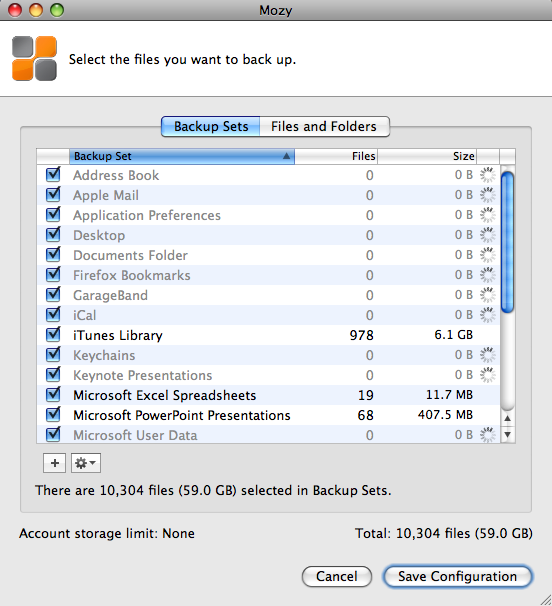
I then reduced my backup set even more, down to 59 GB (see below), hoping this would speed things up. It would have still taken a ridiculous amount of time to back up my data, and I only ended up getting frustrated with Mozy’s software in general, because of its poor design. Every time I wanted to configure the backup set, I needed to wait for the software to finish calculating the aggregate size for all file types, and that could take half an hour or more every time I opened that panel. Couldn’t they have cached this data when the operation was performed the first time?

Isn’t it ironic how they say the “Account storage limit” is “None”, yet you can never really quite test that None unless you leave your computer on and connected to the Internet for a month or more, which is clearly not feasible in the case of a laptop? Let’s not even consider the possibility that your Internet connection might go down, in which case the backup job would fail, and you’d need to start over…

In the end, in order to get any sort of progress with the Mozy backups, I reduced my backup set to 1GB. That’s right, 1GB, which allowed me to back up my Address Book, iCal, and Application Preferences, plus some documents. Then, and only then, did Mozy manage to complete the backup jobs in time.

I’m sorry, but I’m not going to pay $5/month so I can back up my contacts, calendar, and a few docs. That’s not acceptable to me. I canceled the service.

I did write to them to complain about this, and that’s how I found out about the 1 Mbps cap on uplink bandwidth. They also offered to give me a free month, but what good would that have been? I’d have only ended up more frustrated.

Some might say I should have tried the Mozy Business plan, which doesn’t cap uplink speeds and offers more options. For one thing, I don’t care for those extra options. For another, it would have cost me roughly $80/month ($3.95 for the license and $75 for the storage at $0.50 per 150GB). That’s not counting what it’d have cost me to back up my photos offline, which is what I really wanted to do. I have roughly 500 GB of photos, and according to Mozy’s pricing, that would be $250/month in addition to the $80/month I’d already be paying to back up my laptop.

Clearly, at those prices, Mozy is no longer the cheap, easy to use $4.95/month service that they advertise so widely, and instead of paying $330/month to them, I’d rather pay it to buy hard drives, copy my data, and ship them to my parents once every few months. It’d cost me a lot less.

I suppose they’re not entirely to blame. For some reason, $4.95 has become the price point for online home backup plans. Carbonite offers a similar plan for the same amount and other competitors are crowding around the same amount, although with different offerings. The thing is, you can’t really give people unlimited backup for $4.95 a month. Your costs as a business are higher. So what do you do? You fudge. You get truthy. Well, I don’t like it. I’d much rather see them offer a $15/month Home plan where they don’t cap the bandwidth but cap the amount I can back up — say, up to 75GB or something like that. I’ll let them work out the numbers, but the point is, I appreciate honesty a lot more than some cheesy pricing gimmick.

Updated 7/2/09: A reader (M.J. from Denmark) wrote to say the upload bandwidth cap at Mozy has been raised from 1 Mbps to 5 Mbps. It’s an interesting move on Mozy’s part, but I still have questions about their customer service and the ability to properly restore customers’ data, as other people have indicated in the comments below.

Standard
Thoughts

Cabin John cops are the coolest

This past Thursday, I was on my way home from work, in a hurry, because my wife and I wanted to be on time to the Gipsy Kings concert that evening. Traffic on 495 was much nastier than usual, and it was pretty clear to me that I needed to take an alternative route home, and also find another way to get to Wolf Trap. After jumping on 495 from the Georgetown Pike to get over the Legion Bridge, I got off immediately on the Clara Barton Parkway and headed down to the Cabin John exit.

There’s a stop sign there as the exit ramp meets the bridge over the parkway. Usually, no one stops, but I try to, just the same. I think you know by now what I’m getting at. My mind was on the concert, on the projects at work that I’d been working on that day, on the weather, which I hoped would hold up… and I did a lame rolling stop right past the sign.

As I did that, I saw two cop cars on the side of the road ahead. They’d been looking at me, and one of them signaled me to pull over. I knew the instant I saw them that I’d get pulled over, and I knew why they were there, too.

So I pull over, and this towering cop comes up to my window and asks for my license and registration. I start fumbling around. My license was in my wallet, which was in my camera bag on the back seat. I turn around, pull it out, then try to remember where my registration is. Okay, it’s in the glove compartment… somewhere. I pull out the owner’s manual because I think it’s somewhere in there. All of my papers should be neatly placed in a little folding booklet, which I locate and start going through.

The cop is getting a little impatient. What can I do… I don’t get pulled over that often, and now I can’t remember where things are. It’s not like I rehearse what to do when I get pulled over. One doesn’t prepare for it.

Finally, I hand him what I think is my registration, but it turns out to be my insurance. He’s reaches into my booklet himself and fishes out the registration. “Has your license ever been suspended or revoked?” he asks me. I give him a “Huh?!” look as I mumble a “No”. Fine, he goes back to his car to look up my record.

Meanwhile, I start thinking what I’m going to tell him when he asks me why I didn’t stop. I’ve recently seen the “Don’t Talk to the Police” videos [part 1, part 2]. Should I try to put that advice into practice? Will it work? Would it even apply in my situation? After all, they clearly saw me not stopping at the sign. Shouldn’t I be honest and admit I screwed up? Maybe he’ll be lenient, right? Yeah, but what if he’s an ass, like the Virginia trooper that screwed up my driving record to make his ticket quota?

While I’m still thinking, he shows up at my window again, with a stern look on his face. “Do you know why I stopped you?” he asks. All my logic goes out the window and I suddenly become stupid. “Um, ah… no?” I mumble. “There’s a stop sign back there. Did you see it?” What am I going to do now? I got myself into this mess with my fancy double talk, now what? I stick my dumb head out the window and crane my neck, trying to look at the stop sign I know too well. “Um, ah… um, yeeeeeaaaah, that one,” I say, and feel like a certified dolt. He gives me a look that speaks volumes…

I finally decide to fess up and say something lame like, “I’m sorry, I was in a hurry and forgot to stop.” At least that’s true, even if it sounds really lame. He gives me the sort of look that says, “Yeah right, buster,” and goes back to his car. Oh crap, now he’s got me. I’m going to get it for sure: a ticket and some extra points just for kicks. It’s a moving violation, after all.

So I sit there, wondering just how much it’s going to hurt, and it doesn’t take long. He comes right back and sticks a piece of paper in my hand. I can’t look at it, my eyesight’s just gone fuzzy. “That’s a warning!” he says, and a very audible sigh of relief escapes my lips. “Thank you!” I say. I think my whole being effused gratitude that moment, because the corners of his lips started to crack into a smile.

He goes on, intending to give me a stern lesson, “You gotta stop, every time. No rolling stop, no California stop, you have to make a complete stop.” I look up at his face while he’s talking. A father, in his fifties, with mostly white hair with tinges of bronze blond. An honest face, with green eyes that pierce when he talks, and you can see he cares about people and about safety. A good cop. I try to allay his concern by saying, “For what it’s worth, officer, I do stop at the important stop signs,” then realize how stupid I sound, and continue, “but mostly no one stops at that one.”

“I know,” he says, “and that’s why we’re here! Drive safely!” he says as he turns away. I pack up my papers and start on my way, knowing that this would not have turned out the same way in Virginia, where the cops are out to get you no matter what.

Am I saying I deserved to get only a warning? No. I clearly ran that stop sign, the cops saw me, and I expected a ticket. I wasn’t going to argue about it. I dreaded the points though. I hate the points. It seems they get dished out more and more these days, and your insurance goes up, and they make you a liability when other cops stop you and they see you have points — it makes it more likely that you’re going to get another costly ticket. Points beget more points. It’s a vicious circle.

Thankfully, this cop decided he was going to do something really nice. Perhaps he looked at my record and saw that I’m a careful driver, or perhaps he’s just a really nice person. I don’t know why, but he only gave me a warning, and I’m truly grateful for it. Believe me, it had the same effect as a ticket. I’ve obeyed every stop sign since, and will continue to do so, because every time I approach a stop sign, I think about not getting pulled over again. If it happens again, I know I’ll get a ticket.

Thank you, Officer McDonald! You are one cool cop!

Standard