
Steve Irwin, the offbeat Australian [insert own characterization here] died, of a stingray barb through the heart, as he was filming a documentary today. He was apparently swimming on top of the stingray, when it swung its tail up, piercing his chest with the barb. Although crew members tried to save him, there was nothing to be done, and he was pronounced DOA at a nearby Low Isles hospital. Here’s to an individual that managed to amaze and freak me out at the same time. His love for animals was evident, although I’d also say he was obsessed with them, and sometimes got so manic around them that he probably freaked them out, too. In the end, he died doing what he loved.
Build your own web site the right way, using HTML & CSS by Ian Lloyd
 This Sitepoint release, written by Ian Lloyd, proves to be a worthwhile addition to the library of a budding web designer or even that of a complete novice who’d like to build his own site. Ian takes the reader through a complete tour of HTML and CSS, plus a few goodies, and leaves no stone unturned in making sure they can build a good, solid foundation of knowledge.
For those of you not in the know, Ian is a member of the Web Standards Project, and is a self-confessed addict for web standards, accessibility and usability. That means that any reader that picks up this book and follows it will end up with a lot of very useful knowledge on that subject, and that’s good nowadays, when web standards are the norm, not the exception.
As is the case with most computer books, book follows the development of a fictional website, this time for a UK diving group called Bubble Under – and when I say it starts at the bottom, I mean it: the first chapter deals with browsers! But that’s what’s great about it. It’s thorough, from cover to cover! And the emphasis on CSS is very welcome! I remember the HTML books of my day… and of course there was no such thing as CSS back then. Well, this book is modern and up to date, and thankfully so! CSS-based page designs are emphasized, and the reader is taken through a natural transition from pure HTML to CSS integration. Along the way, standards are plugged in, also naturally, and the more advanced elements like images and forms are also nicely presented.
Another indication of the book’s relevance is the chapter on blogs, which talks about the various solutions on the market, and then focuses on how to set up a Blogger account and integrate it into a website’s existing design. Other goodies are stats, search, blogrolls, and discussion forums. The book ends nicely with a good discussion of XHTML, and an XHTML glossary is included to boot.
What more can I say? If you’re in the market for a good book that will help you get started with designing your own site, get this book. It’ll be perfect for you!
Turn your doberman into a poodle
Hey, are you sick of tired of dirty looks from your neighbors, just because you have a doberman? Then you need the Poodle Disguise Kit for Dobermans!
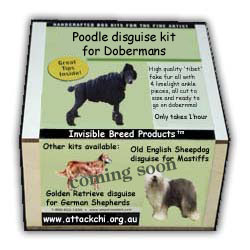
I kid you not. This site called attackchi put it together. It’s tongue-in-cheek, I’m sure, but it’s also in protest at what they say is the unjustified treatment of breeds like the dobermans, mastiffs, rotweillers, etc. – which have acquired a reputation for biting when in truth, all dogs can bite.
So, you want to see the fantastic kit in action? Here it is:

Want to hazard what the poor dog’s thinking? I think it’s: “What the heck have you done to me? You think this is funny?!”
How about this lovely pic?

I think it’s saying: “Mark my word: your day is coming soon!” And people wonder why dobermans turn vicious…
(Pics courtesy of attackchi)
Object-Oriented PHP: Concepts, Techniques, and Code by Peter Lavin
 Can a single book get web designers to start writing better, reusable PHP code? Peter Lavin makes a go of it in Object Oriented PHP, and it comes out pretty darn well.
The gist of the book is this: would you rather write code that does the same sort of stuff over, and over, and over, and over, and… so on and so forth, or would you rather write a piece of code you can plug into any of your pages or sites when you need to do a certain thing? The object-oriented way involves a little more time upfront, but it pays off time and time again. Because let’s face it, none of us enjoys coding the same boring stuff unless we’re gluttons for punishment.
Some may say, “What?! What’s this nonsense about OOP with PHP?”, and I will duly point them to the specs for PHP 5. That’s when OOP techniques were truly made possible. I tell you, even I started reading Peter’s book with skepticism, because heck, PHP is “just” a scripting language, and besides, Dreamweaver can write a lot of the code I need for me. But as I went through the book, I realized an object-oriented approach is a scalable approach. It can be applied to multiple projects. In essence, that’s what Dreamweaver’s doing when I tell it to write a recordset for me, and Macromedia’s not doing too bad as a company… There are obviously benefits to be reaped from OOP in web development.
Peter’s book is great, because it walks you through and explains how OOP in PHP should work. He first explains the basics of OOP, then applies them to PHP, and provides real-world techniques and code to illustrate his points. He touches on AJAX, XML, RSS, thumbnail images, PDO, and other cool things, in an approachable and understandable manner.
It’s funny, but the illustration on the cover of the book says it all. Would you rather code a waffle from scratch, or code the wafflemaker, and make yourself waffles whenever you want them? That’s the difference between just writing code and object-oriented programming. It gives you the power of reproducibility and scalability. So what are you waiting for? Get cooking with OOP!
Suse Linux by Chris Brown
 Have you been itching to try Suse Linux but didn’t know how to get started? Okay, I confess: I know I have. I tried installing Suse once several months ago, then chickened out of using it. (Just FYI, the installation went just fine.) Not sure why, but Suse looks a little more intimidating than Ubuntu, and it isn’t. That’s why Chris Brown’s book is great, because it shows how easy it is to get going and up to speed with Suse.
Suse is one of the most popular Linux distributions available today. Novell claims “over seven thousand installations” of Suse each day, and that’s nothing to sneeze at. ‘Cause if you do, you might just miss one (it works out to one every twelve seconds.)
This book covers it all, and at a hefty 430-some pages, I do mean all. Thankfully, it’s got some great sections, so just jump to the one that interests you. I was particularly interested in section 4 (Using Linux on Your Laptop), especially in configuring wireless networking and Bluetooth devices. Section 7 (Network Services) was also pretty darn good. It covers setting up DNS, NFS, Samba, DHCP, Apache and Mail. Let’s also not forget how to provide a secure remote login with SSH, in section 8. Of course, the section most Suse beginners will definitely use is section 9, because it covers setting up dual-boot systems, and running multiple operating systems.
Let’s face it, we Linux newbies want to try Suse, but are too afraid to let go of Windows or Mac OS X. But that’s okay, this book makes it easy as pie to run both Linux and your other OS. So, what are you waiting for? Jump in, the water’s fine!
 Raoul Pop