Updated 11/02/2018: This video now has over 25,000,000 views. Thank you!
My wife gave me this great little train set as a Christmas present a couple of years ago. I thought it’d be fun to film it in action one day, and when I edited the video, I looked for the right kind of music for some time. The end result was worth it though, and it sets the mood for the upcoming holiday season. Enjoy!
You can watch the video here or on YouTube. The soundtrack for the video is called “Choo Choo Train” by Daffy Dave.
Human trafficking is a practice I condemn deeply, particularly the practice of sex trafficking or sexual slavery, because it could have touched very close to home. My wife went to college in the city of Constanta, Romania, which is one of the main cities in the country where abductions and other crimes of sex trafficking occur. When we met, she still had about two years before graduation. Because we were apart for long periods of time, and she was and is very beautiful, I had this constant fear of her being a target for sex traffickers. Thank goodness nothing happened.
My fear may sound absurd to you, but it was real to me, and it’s real to the parents of girls in that city and in other large Romanian cities. Constanta in particular, being a port city on the Black Sea, invites a lot of unwanted attention from criminals of all varieties. Girls are routinely abducted there and carried off to Middle-Eastern countries, where they’re either made part of some filthy Arab’s harem or forced into prostitution.
Romania is one of the major trafficking source countries for women and children in Europe, among others such as Albania, Moldova, Bulgaria, Russia, Belarus and Ukraine. Just next door to Romania, the Republic of Moldova, Bulgaria and Ukraine also have the dubious distinction of being among the main trafficking sources for the world, along with Thailand, China, Nigeria, Albania, and Belarus. So you see, the entire Eastern Europe region around the Black Sea is a hot spot for human trafficking. I’m not saying this of myself, but many statistics bear this out. Check out the reference links at the bottom of this article and see for yourselves.
Girls and children abducted or manipulated into going abroad may be taken through a transit country like Mexico or Israel, or end up in a destination country, which is usually rich enough for the “customers” to be able to afford the human trafficking “products”. The list of the biggest destination countries is as follows: Thailand (also a major source), Japan, Israel (also a transit country), Belgium, the Netherlands, Germany, Italy, Turkey and the US.
After talking with people in Romania, I found out that a lot of girls from the country end up in Germany and Turkey. Not all are physically coerced into going there. Criminals exploit lack of opportunities, promise good jobs or opportunities for study or marriage, and then force the victims to become prostitutes, or they may abduct them outright. Through agents and brokers who arrange the travel and job placements, women are escorted to their destinations and delivered to the “employers”. Upon reaching their destinations, some women learn that they have been deceived about the nature of the work they will do; most have been lied to about the financial arrangements and conditions of their employment and find themselves in coercive or abusive situations from which escape is both difficult and dangerous. They are psychologically manipulated by skillful, experienced traffickers into the practice of prostitution and are kept in that lifestyle by any means necessary, such as continual psychological or physical abuse or drugs.
Another tactic is for a trafficker to seduce a girl, pose as a couple as they go abroad, then, while the girl is still in love with him, get her to sleep with other men in order to make money while they “start from scratch”. He’ll keep saying he can’t find a job yet, she’ll keep sleeping with other men for money, and before she knows it, she’s a prostitute, and he’ll waste no time calling her one, each and every day, beating her down psychologically till she’s too broken down to resist the sordid lifestyle. When she’s broken, there’s no need for the captor to pretend they’re a couple, so he’ll revert to the job of an outright pimp.
The girls’ families usually know nothing of their girls’ whereabouts and doings. The girls tell them they’re going abroad for jobs, then, when they’re already caught in the web of prostitution, will lie to them and tell them they’re working somewhere, out of shame for what they’re doing. The girls are usually over 18, they’re going willingly, the police can do nothing about it, and once they’re abroad, it’s too late. Some people I talked to were pragmatic, even downright dismissive. “They’re old enough to know what they’re getting into,” they said. “If that’s what they want to do with their lives, it’s their business.”
The vile practice of human trafficking is a profitable one. People in Romania can usually finger the ones who are doing it, and can tell you how quickly they got rich, how many houses and cars they have, and so on. The sad part is that there’s little the police can do, unless abductions are involved. Even then, since the victims are taken to other countries, any moves require close cooperation with police forces in those countries, who may or may not care at all, so authorities are stuck.
Human trafficking is condemned and forbidden by the Protocol to Prevent, Suppress and Punish Trafficking in Persons, especially Women and Children (also referred to as the Trafficking Protocol), which is a protocol to the United Nations Convention against Transnational Organized Crime. The protocol defines human trafficking as “the recruitment, transportation, transfer, harboring or receipt of persons, by means of the threat or use of force or other forms of coercion, of abduction, of fraud, of deception, of the abuse of power or of a position of vulnerability or of the giving or receiving of payments or benefits to achieve the consent of a person having control over another person, for the purpose of exploitation.”
While the UN and many civilized countries condemn the practice, and many celebrities have signed on to the cause of fighting human trafficking, little headway is being made. In part, this is because collaboration between police forces in various countries is difficult, as few protocols with too few teeth are in place for this sort of thing. Also, governmental organizations set up for the purpose of fighting human trafficking are busy bickering among themselves over the definition of human trafficking. Finally, what makes this a difficult fight is that at least where sex trafficking is concerned, the majority of the girls go willingly, because they’re duped into it. Some are even okay with prostitution, though they may not be aware of the real working conditions until it’s too late.
Human trafficking is the fastest-growing criminal industry in the world. The US estimates the market at up to $9 billion, while the EU laughs at that estimate and states it to be around $42.5 billion. No country, rich or poor, civilized or not, is immune from the problem of human trafficking, which can take many forms, but is most often identified with the exploitation of women and children for the purposes of prostitution.Victims of traffickers are usually transported over state borders, though it’s not a pre-requisite, since they can be also coerced and manipulated in their own countries.
Still, good news exists when it comes to catching the criminals involved in this practice. Just a few years ago, while living in the DC area, I heard that a brothel disguised as a massage parlor, staffed by South-Asian women, was closed down, but not before the investigation revealed that prominent politicians and other men of supposed standing in the local community frequented the place, some quite often. In October of 2009, US authorities broke up a child prostitution ring where 52 children were recovered and 60 alleged pimps were arrested, during a three-day operation, tagged Operation Cross Country IV. Law enforcement actions were taken in 36 cities across 30 FBI divisions nationwide. It was part of the FBI’s ongoing Innocence Lost National Initiative, which was created in 2003 with the goal of ending sex trafficking of children in the United States.
The movie “Taken”, released in 2008, starring Liam Neeson, does a good job of showing what an abduction situation for the purposes of sexual trafficking looks like, how one can begin to tackle the situation, and how entangled the whole web of human trafficking really is, with many interested parties holding significant stakes in the matter, including the police, who are often on the take in order to turn a blind eye toward the matter. In the movie, Brian Mills, the main character, manages to track and save his daughter as she is exchanged through the hands of several captors, though in real life, this seldom happens. I’m not knocking the movie — I loved seeing all those sex traffickers get maimed, tortured and killed, because it’s what should happen to all of them — but the people who do this usually prosper while countless women, children and men suffer at their hands.
In the end, I think the problem of human trafficking can be tackled along multiple avenues:
Prostitution and other forms of human trafficking should be made illegal. On one hand, I can understand arguments for making prostitution legal, such as the ability to provide medical care to prostitutes and to check on things a little better. On the other hand, you’d be legalizing a business whose product is the exploitation of women as sex objects. A bad practice shouldn’t be made legal just because some people choose to engage in it.
The burden of the punishment for human trafficking should be on the shoulders of those who are behind the scenes — not the prostitutes or human slaves themselves, who should be helped to reintegrate into society — but those who organize the business of selling them to the public and “recruiting” them. The human traffickers themselves should bear the heaviest legal punishments that can be meted out, probably on par with murderers. The clients themselves should have to pay significant fines if caught trying to solicit prostitutes or purchase human slaves. Heavy fines are a great deterrent for this sort of thing.
So that the bickering can stop over the definition of human trafficking and ways to combat it, separate organizations ought to be set up that deal with each category of offenses that have been grouped under this umbrella. In other words, sex crimes ought to have their own set of laws and organizations that fight them, and other kinds of human trafficking offenses ought to be separated under their own sets of laws and organizations. For example, I think someone that sells women as sex slaves ought to be punished differently and more severely than someone who sells men or women into indentured servitude, and someone who sells children into sexual slavery ought to be punished most severely.
These are just a few of my thoughts on the matter, but if you have anything to contribute, please comment below. For more information on human trafficking, please consult the following resources, on which I drew for facts and figures as I wrote this article:
On October 11, the Youth Choir from the Canto department of the Schaffhausen Music School, Switzerland, gave a concert at Margarethenkirche (Church of St. Margaret) in Medias, the same church where organ concerts were held this summer. Medias is a medieval city in the province of Transilvania, Romania.
The choir sang a wide selection of classical, traditional and modern pieces. Some interpretations even included coreography. Here are some of the titles: “L’amur es üna düra chassa”, “Stets i Truue”, “Mir Senne heis luschtig, “Schau auf die Welt”, “Leise zieht durch mein Gemüt” and more. I have to admit the experience was more entertaining than the organ concerts, and perhaps some of the more lively pieces had something to do with it.
My wife thought the conductor was very good. His name was Hans-Jörg Ganz. The other instructors were Marei Bollinger (Co-Leader), Mirjam Berli (Rehearsals) and Remo Weishaupt (Voice Instruction). Claudia Hold played the piano.
This is a question I keep asking myself every time I turn on the TV and look at the Cartoon Network, or The Disney Channel, or Nickelodeon these days. It’s unbelievable how much thoughtless, cheaply made programming they shove into their slots, with little or no thought for substance, style, quality and most of all, for values.
Just like most foods you can buy at the store these days are made up mostly of fillers and devoid of nutrition and natural goodness, most cartoons on TV are nothing but patina, a modicum of presentation pulled over a steaming pile of dung.
The Disney Channel is in the most shameful state of all. They have a legacy to live up to. They have a heritage, which is something no other channel has. Back in the early 90s, when I came to the States, The Disney Channel was way up there on a pedestal in terms of programming quality. It was heaven for a boy with a hunger for good cartoons.
What happened to shows like Duck Tales, or the Rescue Rangers, or Tale Spin? What happened to the old cartoons with Mickey Mouse, Pluto, Daffy Duck and the rest of the gang? Aren’t there any people who still have good ideas at Disney’s TV subsidiary? There are obviously very talented people at Pixar, where great movies still get made. Can’t Disney recruit some more people like that? They’ve obviously got the money, since they just spent $4 billion on Marvel. Only a small fraction of that money would go a long way toward turning around The Disney Channel.
Overall, the industry is in decline, precisely because they’ve been focusing on quantity, not quality and substance. They’re trying to spend as little money as possible and churn out as much footage as possible, without any foresight or real planning about a show’s direction, character development, plot, dialogue, character animation (movement, drawing style, aesthetic appearance, etc.), progress (generally, if characters are doing something or striving to achieve something, progress or setbacks toward an overarching goal ought to be achieved with each show), and most of all, since these cartoons are shown on children’s channels, they ought to be kid-friendly, they ought to promote good values, and they ought to appeal to one’s artistic sensibilities.
As for those who give these shows the go-ahead, I can only describe their approach as auto-pilot. They’re throwing stuff at a wall in order to see what sticks, and instead of trying to figure out why stuff doesn’t stick, they’re looking for more stuff to throw. They care little about any of the things I mentioned above. They care about filling slots, preferably with stuff made by people they know, and about selling ads during those slots. They’re trying to hock merchandise instead of realizing their jobs involve a much higher responsibility than that of a vendor at the local flea market. They ought to care deeply about what they put on the air, and instead of examining the merchandise they’re selling through the critical lens of someone who is helping shape young children into responsible, caring, sensible adults, they’re looking at these cartoons as a means to an end — the end being solely the channel’s bottom line.
What they don’t realize is their revenues are decreasing not because they need more live action shows on a cartoon channel, or because less people are watching TV because they’re spending more time on the internet, or because they need to spend less money and cut more corners — they’re decreasing as a direct result of the crap they are putting on TV. If only they took their time to find quality cartoons and filled their programming slots with them, they would see revenues and ratings increase, not to mention that we’d have happier, healthier children all around.
You may ask yourselves, how do I find good cartoons when the good offerings are so slim? I outlined a few good rules of thumb in this post. The most important part is that you should use your good judgment to find shows that are worth watching. Don’t give into popular opinion or into what kids may ask for, because at younger ages, they need guidance. They’re not ready to save the world, in spite of what’s portrayed in run-of-the-mill cartoons. Ask your friends, or go online to sample what’s available in stores. Go to YouTube and look for video clips from quality cartoons you can purchase, or if you hear of a good cartoon show that’s not televised, go to their website and see if they show clips. Now, more than ever, there’s real choice, because you’re not limited by what’s on the TV channels, and it’s so easy and affordable to get to the good stuff if you only put a little effort into it.
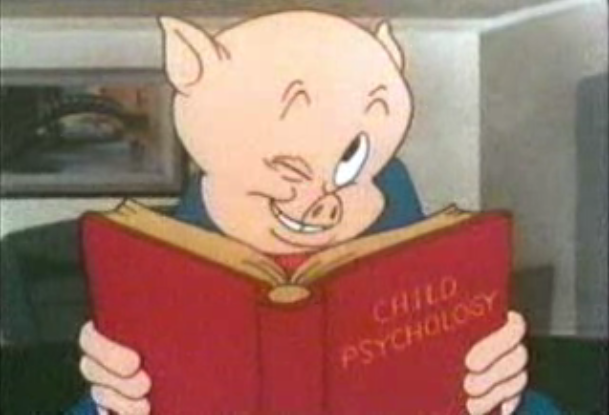
There’s a Looney Tunes cartoon from 1944, entitled “Brother Brat“. It stars Porky Pig and speaks eloquently about child discipline. In it, Porky becomes the unwitting baby sitter for a Rosie the Riveter type super-woman who’s pulling long shifts at the factory, helping out with the war effort.
When she leaves her brat, Butch, with him, she also hands him a book, which she says always helped her. It happens to be a book on Child Psychology.
Porky takes the offer at face value, and believes the book will really help him. When baby Butch starts acting out, he checks the book for advice.
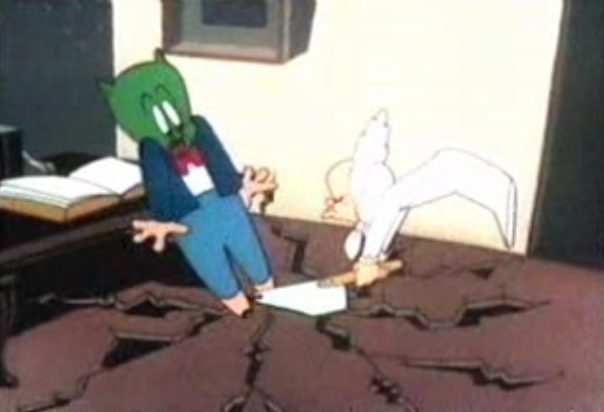
He soon finds out the book is no good, as he applies the wishy-washy, sound-good nonsense from the book to his real life situation and things go from bad to worse.
By the end of the cartoon, he’s running for his life, with an axe-wielding maniac baby on his tail.
Then Susie the Riveter comes in, notices the mayhem, and asks him if he used the book. Desperate, still running, he screams, “Yes, but it didn’t work!” Then Susie grabs the book and shows Porky how it’s done: “Maybe you didn’t use it right. It always works for me!”
The punchline is obvious, and yet it teaches all of us, to this day, a valuable lesson: sometimes the only thing that works is a spanking. As for child psychology books, I share the opinion of the animators — those books are a bunch of hooey, fit to be printed on toilet paper and used that way. I’m not alone in that sense. Most people shared this opinion when classic cartoons were made. Cartoon studios of all sizes lampooned child psychology books, including Disney.
Spanking has sadly become a tabu practice in this “enlightened” age. If you spank your child now, the state will take it away from you. Surely the state must know what it’s doing, right? Because governments in all developed countries have shown us they manage everything else to a tee, beyond reproach, right? Naturally, we ought to trust what they tell us to do with our children?
I see parents these days, stressed to the breaking point because of children who haven’t been properly disciplined, and they’re afraid to discipline them. They try talking to them, they try to reward them for good behavior, they try timeouts, but seriously, sometimes a child just needs a good spanking. The Bible knows what it’s talking about when it says in Proverbs 13:24: “He who spares the rod hates his son, but he who loves him is careful to discipline him.” It has the benefit of thousands of years of experience on its side when it gives that advice.
If you’re interested, my father wrote a couple of articles several years ago. One is on the duties of children toward their parents, and the other is on the duties of parents toward their children. The articles are a compilation of verses from various books of the Bible on those topics, and they’re not doom and gloom stuff — they’re thoughtful, fascinating stuff. To make things even more interesting, my father is a psychiatrist who is keenly interested in the proper development of one’s character and personality.
On an unrelated note, thank goodness for Google Video, which indexed the cartoon from Dailymotion! I wouldn’t have been able to provide you with screenshots from the cartoon otherwise, because I couldn’t find it in regular web searches. I don’t have it in my collection, and only saw it a few times on TV, including once on Boomerang recently. I encourage you to watch it.





 Raoul Pop