Thoughts

My take on the fading car culture

2003 MINI Cooper S

As I read through my feeds, I noticed a headline about the fading car culture. It seems a Nissan executive has noticed how interest in cars is waning due to congestion costs, interest in public transportation, and a desire to spend money elsewhere, like gadgets.

I also noticed something disingenuous in that article. It was his response to the 35 mpg mandate by 2020: “It is not an issue,” he said. Really? Is that why Nissan was one of the car companies that lobbied against it? I don’t want to lay the blame for this on Nissan alone, as most of the major car companies lobbied against fuel regulations in the past and some are still doing it. By the same token, the blame for the fading car culture does fall on most car companies, though there are other factors at play.

For one thing, car designs got horribly bad at some point in the late 60s. While cars are made better and they last longer, car designs have lost their soul. There isn’t that visceral response to a car nowadays that one has when they look at a classic car, one that was built to look good, not just function well. Everything is about streamlining nowadays — the wrong kind of streamlining, that is. There are no bold design decisions made anymore. Every great conceptual design gets neutered before it enters the production floor. I’m talking about curves that serve no purpose other than to make the cars more appealing. I’m talking about bold grilles, wooden or metal accent dashboards, gauges and textures that make you want to touch them. I’m talking about classic design elements. Just look at cars made in the 20s, 30s, 40s and 50s.

The old Mercedes

Fiat

Tears from the headlight

Stout and solid back

I’m not suggesting these photos are the best examples. This is what I have in my photo library, so that’s what I used. I’m sure there are a ton of great examples out there, and those familiar with car history know what I mean. That’s what I’m talking about. And that’s exactly what you won’t see on the market today. The few companies that might still include classic styling elements don’t do it wholeheartedly. We’ve got most people driving around in boxes nowadays. And they’re supposed to like it?

Another reason is an increase in fuel prices. Let’s face it, it’s no fun to drive around in a car that will put a serious dent in your monthly budget. Who’s to blame? Well, besides things that can’t be helped, like a dwindling oil supply, unstable world conditions and an increase in demand, I can think of a certain group I could finger: car companies. After all, they’ve been lobbying against fuel economy regulations for some time, and they’ve also refused to focus on economical models. Well, that same desire to save pennies on the dollar on improvements here and there is now going to cost them dollars — lots of them, and they’re the ones that have helped to dig the hole they’re in.

What’s another problem? Congestion on the roads. It’s no fun to drive bumper to bumper. Yet, increasingly so, that’s what driving has come to mean for those living in urban areas. When driving equals commuting, and when commuting means teeth-gnashing and extra stress you don’t need, do you really think people will want to drive, or that they’ll associate their cars with warm, fuzzy feelings? With the cost of new roads being so prohibitive, we know this isn’t going to change. If anything, we’ll start incurring more tolls in the future.

Congested highway

There are other costs that are driving this trend, such as car insurance and the high cost of traffic tickets, particularly when they’re falsely given out, which happens quite a bit when police departments want to put some money in their coffers. It happened to me, and that false ticket not only cost me about $150 but a day in court as well, and an extra $700 as well because of an increase in my car insurance. You think someone’s not going to consider public transportation options when driving starts costing them that much, particularly when they did nothing wrong? And what do you think they’re going to think about the crooked police officers that put them in that mess? I tell you, every time I remember what that thieving bastard did to me, smoke comes out of my ears. I hope he gets all that’s coming to him for what he did to me and probably to countless others…

More importantly perhaps is this: public companies react in unhealthy ways to market plateaus. That’s because they’re geared toward constant economic growth. Their market share or number of products sold or profits have to continually increase in order to satisfy the hungry appetites of investors and market analysts. Anything less than an increase on last year’s take is considered a failure. An extreme case of this very screwed up way of looking at things is Intel’s current situation. They earned 45% more in 2007 than in 2006, and yet their stock price dropped when they announced that their projected earnings in 2008 would be about the same as those of 2007. Instead of rejoicing over a stellar performance, our faulty economic expectations want more and more out of a market that’s performing very well.

That puts public companies in a very awkward and hard to sustain position. We’ll leave the microprocessor market alone, since I’m talking about cars at the moment. But do they honestly think that they can sustain (no, increase) their growth rate in a plateauing market? Who are they fooling? The demand for cars is going to continue to plateau, and quite possibly decrease. Sure, China and India are starting to develop, but they haven’t got the infrastructure or the economy to sustain a similar car-per-family ratio that we see in the States or Europe. What’s more, petrol supplies have already peaked. They are now going to start decreasing. Even if their infrastructure and economies could support a lot of cars, the Earth couldn’t, thank goodness. Have you driven in China or India lately? Their urban areas are packed chock full with cars of all makes and 2-cycle scooters already. They’re polluted to high heaven. I doubt we’d want more cars in those places. Add to that the upcoming flooding of the car market with cheap cars (enter India’s Tata car), and you’ve got a worldwide car market in serious trouble.

It seems to me there are a few things that could be corrected:

  • Stop the insanity of always expecting more from the market. Economic supply is not unlimited. Economists that made up that cockamamie idea should be taken out and horsewhipped, and recordings of those punishments should be posted to YouTube… Car companies need to realize that demand for their products will plateau. It’s a given. (Do I really expect public companies and their investors to change their perspectives? Yes, but it’s not going to happen. People are inherently greedy.)
  • Boring designs need to be retired for good. Serious inspiration needs to be drawn from the era of automobiles when the term motoring really meant something. Give people a reason to be passionate about their cars. Look at what Apple is doing with computers. Well-designed cars will sell, but they’ve got to look and feel so good people will drool over them.
  • A true focus needs to be placed on fuel efficiency and alternative propulsion methods. Ethanol-enhanced gasoline or even pure ethanol is not going to be the solution. I doubt it, and only one of the reasons is that corn agriculture cannot be sustained at the levels needed to mass-produce ethanol without turning all of the fields into dust bowls. Read up on soil erosion in agriculture if you want more info on this. Hydrogen fuel cells are expensive and still need oil to be produced. Not viable long-term. Now is the time to really look at other ways, such as bacterially-produced fuels, or steam/other water-based fuels. Electricity, if made through solar or wind power, is infinitely sustainable, and electric cars are already viable alternatives.
  • Car companies could focus on producing efficient, well-made public transportation vehicles in addition to personal vehicles. We know they’re going to be needed more and more in urban areas, and yet very few of the major car manufacturers have focused their efforts on fleets. Buses are still horribly inefficient when it comes to fuel usage, and they’re ugly and non-aerodynamic to boot. They usually get 5-8 miles per gallon, they’re loud, slow, unsafe, and they start rattling after only a few months of usage. They could stand a lot of improvement. The market is there and will continue to grow. Did you know, for example, that the Washington, DC metro cars were made in Italy and are very expensive? While it’s nice to know that DC metro goers ride in Italian-made wagons, why couldn’t they be made here in the US?

These are just a few ideas, but they’re meant to get the discussion started. Want to know what Nissan is doing about it? They’re ready to follow in the footsteps of the Tata car, and are readying their own designs for a cheap car. How that’s going to play out in the large scheme of things, no one knows for sure. But what we do know is that we don’t need more pollution and more congestion…

I leave you with a photo of the car that acted as a catalyst for change back when it was introduced. It can be done again, and in all the right ways. We just need a daring and willing company.

The classic MINI

Standard
Reviews

How houses get built in the DC area

I thought that when I lived in Florida, the construction there was shoddy. I was wrong. At least there they used concrete pillars and floors for the houses, and the building code was so strict everything was anchored properly, especially after Hurricane Andrew. When I moved to the DC area, I thought construction would be better here, since it’s a temperate climate and the houses should be built to last and hold up to the weather. I was wrong. Construction here is horribly shoddy.

I have never been so shocked at the cheap and flimsy “workmanship” I see every time I pass some house or building under construction. It never ceases to amaze me what passes code in these parts, and I’ve lived here since 2003. It’s downright thievery, I tell you. I’ll show you some photos below to help you see what I mean. I call it thievery because you’d think housing would be dirt cheap given the materials and level of effort that goes into the construction, but it isn’t. It’s terribly expensive, to the point that people making below what would be called upper middle class in other parts of the country can’t afford to live inside the Beltway, much less outside it. They have to go find housing either in bad neighborhoods, or way out in the boonies, in order to get anything affordable.

It’s not right. It makes my blood boil. Honestly, I can’t believe what goes on. It’s the same construction everywhere, from the (relatively) cheaper townhomes and single family homes right up to the McMansions that have sprung up on River Rd, Georgetown Pike and other richer places. The only thing that changes is the size and price of each monstrosity, but they’re all just as flimsy.

Do you want to see what I mean? Take a look at these photos. They’re from a house currently under construction in my area.

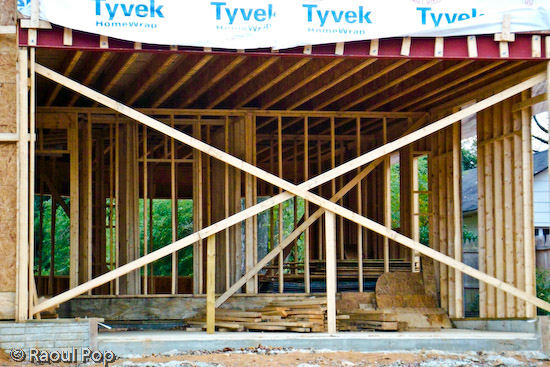
House under construction

Some unwitting soul is going to pay several hundred thousands of dollars for this piece of crap, and he won’t know what a lemon he’s getting. It’s all 2×4 construction. There’s nothing solid and concrete there except the foundation, and I’m not sure how thick that is, either. It’s all either cheap, soft wood or plywood, including the upper floor. Not only that, but the beams aren’t straight, and the joints aren’t secured properly.

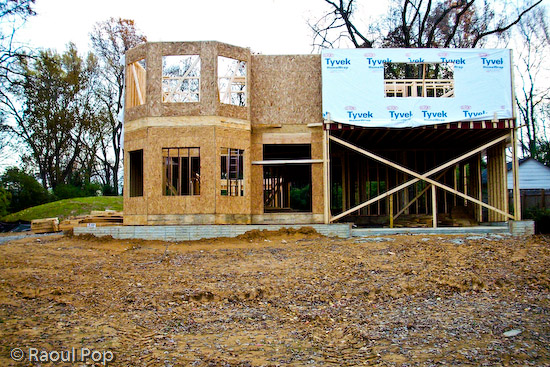
House under construction

It’s basically a big plywood box. I’m not sure what its projected lifetime is, but I can’t imagine it’ll last more than 30 years. It’ll start needing serious repairs even before the mortgage is paid off. Isn’t that terrible?

Do you see that cheap, flimsy Tyvek plastic? That’s the weatherproofing. No, I’m not kidding. That’s it. That’s also the insulation. I doubt they’ll put glass fiber or any other kind of insulation between the drywall and the beams. They might, but I seriously doubt it. I’ve seen the inside of many walls, and they’re usually empty.

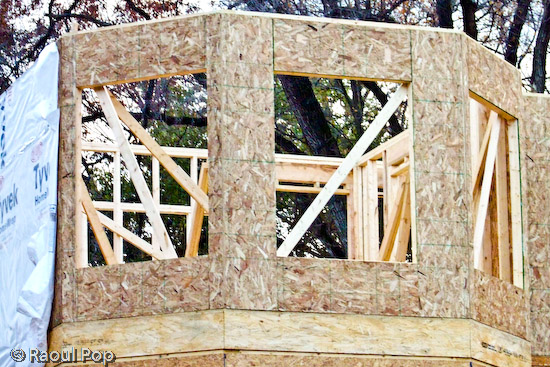
House under construction

Can you say cheap? I can. It’s cheap construction! It’s a travesty. Look at that horrible plywood shell. That’s going to be a tower. It’s going to look so nice, clad in fake brick or plastic siding only 1-2 inches thick… It’s also going to be horribly inefficient when it comes to temperature preservation. And if water should happen to leak in through that cheap brick cladding and through that flimsy Tyvek sheet, the plywood will rot away quietly and the owner won’t even know it… Wonderful, isn’t it? Isn’t this piece of crap worth mortgaging your life away?

Should we be ill-fortunate enough to get a hurricane or some tornado in our area, the roof on this thing will probably get torn off, and the entire house might or might not be standing when nature’s done with it.

Look, don’t get me wrong. I understand that America has a long history of 2×4 construction. It’s how the West was won. It’s cheap, affordable, goes up quickly, etc. But this isn’t the West, and it’s not the 1800s. This is the supposedly refined East. We should know better by now. It’s our nation’s capital. And the prices of these plywood boxes aren’t cheap. No, they’re so high most people can’t afford them.

I also understand the builders have to make a profit and the cost of land in this area is expensive. But this is ridiculous! If you’re going to build something that someone will want to call their home, and will pay dearly for it, sinking most of their productive, working years into paying it off, then God help you if you don’t build something worthwhile, something that’ll last. You’ll get what’s coming to you, don’t you worry about that…

What I wonder about is how the people and companies that put up these things can live with themselves. That’s what I want to know. How can they sleep at night knowing someone’s going to pay a fortune for something that’ll start falling apart after the first several years, for something that’s so horribly inefficient when it comes to energy use that they’ll be paying through the nose to cool it in the summer and to heat it in the winter? Don’t tell me about efficient windows! You can get the most expensive windows out there — if the walls themselves can’t conserve the inside temperature, you’ll still be nowhere. There’s such a thing as global warming to worry about. Have you heard of it? Everyone needs to reduce their carbon footprint, and it starts in the home.

Whatever happened to the good, old masonry work? What happened to quality stone construction? Yes, it’s more expensive, but isn’t it worth it? Why can’t you builders put a little more pride in your work? Why can’t you make a concrete skeleton, and use thicker insulation and better materials for the cladding? Is it so hard to do? So you’ll make a little less money. You might have to mark up the price a little. You might have to educate the consumers that know nothing about quality construction. But isn’t it all worth it in the end? Won’t you feel better knowing the house you built will last a long time? Won’t you feel better knowing the people that will buy your house will thank you for your solid construction later? Isn’t it it worth it to build good will instead of ill will?

Standard
Reviews

Book review: Digital Photography, Expert Techniques (2nd Edition) by Ken Milburn

This book is meant for “photographers who are serious about producing the highest quality photographs in the most efficient and cost-effective way possible.” That would include anyone from advanced amateur photographers to seasoned pros looking for new and more efficient ways of doing things.

Ken Milburn, the author, is a seasoned pro with lots of paid, published experience. He’s also an accomplished writer of technical works like these, in particular ones dealing with digital photography and Photoshop. What’s more, this book is now in its 2nd edition, which ought to tell you that if it was good enough to be reprinted, it’s probably worth your money.

The book is divided into twelve chapters that take you from prepping for a photo shoot to processing the photos and presenting them to the world. A great emphasis is placed on the workflow, and best practices are presented, and I might say, drilled into the reader. O’Reilly has spoiled me, because they always have good TOCs and indexes, and nice intro sections that are good stepping stones to the headier content, and this book is no different. Each chapter is summarized, so the reader knows where to look for things. What’s more, Ken’s writing is approachable and down to earth. You can tell he’s familiar with the subject matter and is also used to explaining these concepts.

Ken teaches the workflow mentioned above using the Adobe Bridge and Photoshop applications. If nothing else, Adobe applications like these have a wide reach, so you’ll be able to replicate what you learn from the book. I like the explanations that Ken offers for shooting in RAW vs. JPEG mode, and for ensuring that you are always ready to take photos, no matter the conditions. Another nice nugget is the method of eliminating noise from your photos by using Photoshop. The book is worth its price for the extensive photo retouching techniques alone. For example, have you ever wanted to know how to eliminate the bags under someone’s eyes, or take out shadows and imperfections? This is covered in the post-processing sections. As a bonus, panoramic and HDR (high dynamic range) photos are also taught. In the last chapter of the book, you’ll learn the methods of editing your photos’ embedded data (EXIF and IPTC), as well as presenting them to clients and to the world at large. This is more and more important these days as photos get posted online and can be so easily copied. Embedding information is one more way you can prove copyright.

There is one error I noticed, and that is in the recommended specs for desktops and laptops in the beginning chapter. Instead of GB, RAM is indicated in MB, as in “plug at least 1 MB of RAM into the motherboard and move up to 2+ MB as quickly as you can afford it.” I had to chuckle when I read this. It’s obvious Ken refers to GB, not MB, and I’m surprised this typo made it past the editors in the 2nd edition.

I highly recommend this book. Being an amateur photographer myself, I looked forward to reading it, and now it’s a worthwhile addition to my reference library. I learned many useful things from it, and I think you will, too.

Standard
Reviews

Hasselblad H2D-39: A 39-megapixel DSLR!

The Hasselblad H2D-39 DSLR Camera

Hold the presses, because I’ve just stumbled onto an amazing DSLR. I used to think 22-megapixels was really something, but this puppy cooks up 39-megapixels! It records in RAW format, and the photos are so big that it comes with an external 80GB hard drive. You can even connect it directly to your Mac or PC and transfer the images as you take them.

Of course, if you yearn for mobility, it also writes to CF cards. I can’t imagine how big they’d need to be or how many you’d need for a typical commercial photo shoot, but hey, it’s your call, right?

It comes with a rechargeable Li-ion battery that will let you take up to 250 photos, or “captures”, as they call them in 4 hours. Needless to say, you won’t be able to put it in your pocket: the camera plus battery and CF card comes in at 2,175 grams, a little over 2 kilos, or 4 pounds.

So how much will all this megapixely goodness cost you? $29,995 seems to be the going price, although I’ve seen it listed on Froogle for as high as $32,973. I can’t say that I’ve got a burning need to get one, but I suppose if my livelihood depended on delivering really high quality pics, it’d be on my shopping list. Read up on it right here.

Standard
How To

How to choose a camcorder

If you’re interested in purchasing a camcorder, this guide will help you decide what to get when you look at the dizzying array of products out there.

At the moment, the industry is “in the 80’s”, caught between 4:3 and 16:9 aspect ratios, and standard and high-definition video. The HDV, 16:9 camcorders are still expensive, while the standard 4:3 camcorders are months to years behind the technology curve. There are some mongrel/hybrid models out there, that offer a mix of standard to high-def recording, on both 4:3 and 16:9 aspects.

To make things more complicated, there are multiple high-def formats: 480p, 780p, 1080p. There are also multiple media: Hi8, DV, miniDV, DVD, miniDVD, and hard drive. Each kind of media has its pros and cons. Finally, there are multiple connections: Firewire, mini-DVI, S-video, RCA, etc. There are caveats with each connection, and the quality of the video output varies with each, even on the same model camcorder.

So, how do you make sense of all this nonsense? Well, my recommendations are:

  • 16:9 aspect ratio (the extra width to the picture truly makes a difference, and allows you to compose your shots a lot better)
  • HDV (780 or 1080p, preferably the latter)
  • Firewire or mini-DVI connector
  • MiniDV or hard drive media

I should mention that some people like the convenience of storing directly on DVD – just realize that if you do that, it’s harder to edit the video. You have to import it to the computer from the DVD or the camcorder, then edit it, which is a slower process overall, plus most DVD media isn’t reusable, etc. Also, if your camcorder will record to mini-DVDs, realize that some DVD players won’t be able to play them, in particular the slot-loading ones that you find on Apple computers or some in-car entertainment systems.

You should also look for a good optical zoom, low-light capabilities, and optical image stabilization. Good, intuitive controls should also be present, and it’d be nice to have good battery life as well.

If you’re more than an amateur/home videographer, then you should look at the capability to use different lenses, and the presence of relevant physical controls directly on the camcorder’s exterior. You probably also want to look at the ability to switch between different frame rates.
Before you go out there and try to find a camera with all these features, realize the market’s in disarray, and you’ll be disappointed if you look for a camera that has it all. A camera that has my list of desired features will cost over $1,000 at the moment, and that’s out of reach for many people.

CNET’s put together a camcorder guide which will help you narrow down your choices, and my advice is to look through that as well. On their site, they also have reviews of many camcorders. Just realize that the editors are people, and the reviews are subjective, in particular the video reviews. I remember viewing one where the editor referred to the LCD panel as very small, literally “the same size as the viewfinder”, when it was clearly 4-5 times larger in terms of surface area.

The best thing to do is to come up with your own wishlist of features for your dream camcorder, using this guide and other guides like the CNET guide, then go to the stores, and see which model most closely fits your wishlist. You’ll have to compromise or give up on some features, but you’ll come out with a great buy in the end, because you’ll have done your homework.

Standard