Thoughts

Romania's orphanages still a bad place for children

The IHT carries an opinions piece from the NYT today on Romania’s orphanages. The gist is that conditions are still deplorable. The problem is that once Communism ended, the big, mega-orphanages were closed down, and the children were distributed to smaller orphanages, who have to battle with pauper’s budgets, which means limited staff and even more limited conditions, all with a growing orphan population.

Meanwhile, Romania’s government is busy putting together task forces and committees. Having grown up in Romania, I am not surprised at the pathetic government response. They can’t be trusted to do much right. There are certain things they’re good for: wasting time talking things to death in Parlament, rampant corruption, and extravagant salaries. Beyond that, it’s anyone’s guess as to whether stuff they put out is good or bad. Sure, certain factors play into it, like the alignment of the rings around Saturn, weather on a particular day, traffic conditions – you know, stuff that matters – but it’s still a crapshoot.

Seems to me the solution is fairly simple: increase community services for disabled children, increase funding for orphanages, and focus on placing children with foster families, not keeping them in orphanages indefinitely.

Of course, I have to smirk when I say that, and believe me, I do it painfully, because the reality is pretty grim – but how many families will really want disabled children? Don’t think I’m cruel when I say it. But in a country where salaries trail woefully behind market prices, and healthy people can barely afford to live, who can take on the added responsibility and cost of caring for a disabled child? Realize that in Romania, most apartment buildings don’t have elevators, and most people live in apartment buildings. How will one get a child in a wheelchair up the stairs? How will one foot the doctors’ bills, the special education, and all of the other things that go along with such a child? Who will want them? My answer will only sadden you. I just don’t know.

Standard
A Guide To A Good Life, How To

An example of cable management

Ligia and I have recently downsized our living room desk. We used to have a big, bulky desk, and now we’ve got a secretary desk. It’s very beautiful, but it also has much less space than the previous desk, and no integrated cable management whatsoever. What to do? With about $8 of stuff from Home Depot (including plastic ties), I’ve modified the desk to allow us to manage our computer cables in a practical way. The end result and the steps are described below, with photos (click on the thumbnails to enlarge). It took about 45 minutes, but it’s worth it!

This is how our desk looks after the modifications. Notice how there are no annoying cables and wires on the floor. We can move the desk if needed, and we can easily vacuum underneath. It’s a joy!

Desk with cable management in place

So, what did I need to be able to do? First, I needed to fit the following pieces of hardware on that desk:

  • iMac G5 plus keyboard/mouse
  • Two stackable backup hard drives
  • Our PVR (we love it!)
  • The mixing board for our podcasts
  • Lamp
  • Various other paperwork and things
  • Printer (I know it sits beside the desk, but I include it since the cables still have to be managed under the desk)

First, I needed to drill a hole for the iMac cable. I debated its location for a while, but decided on the left hand side, for various reasons:

  • There’s a bookshelf behind the computer
  • There are drawers which couldn’t have opened because of the wire
  • If I put it in an easily accessible location, I can use that to route other cables up, like the one for my cellphone charger.

Here is a photo of that cable hole, which I drilled using a readily available drillbit. I stained it at its inside edge so it would match the color of the desk.

Hole drilled for power cable

The next step was to cut a piece of white painted pipe (which I bought for something like $2) to the width of the desk, and mount it to the inner sides with two plastic pieces that cost me about $2 each. I used some wood screws I already had. Then I took some assorted cable ties which I’d bought in bulk, and secured the cables to the bar, as shown in the photo below. You can probably get a package that’ll suffice for a job like this for under $2.

Notice how I mounted the surge protector to the inner side of the desk. Again, I used wood screws that I left half-screwed. The surge protector had holes just for this purpose on its back, and it was a matter of measuring the space between them and putting the screws in the wood at the right length. It hooked right on.

I secured the cables to the pipe with the plastic ties after folding the cables nicely, so they wouldn’t dangle needlessly. Notice I left a bit of slack for those cables I’d need to pull. There are few things more annoying that setting everything up perfectly then discovering you need to move a piece but can’t because the cable’s too tight.

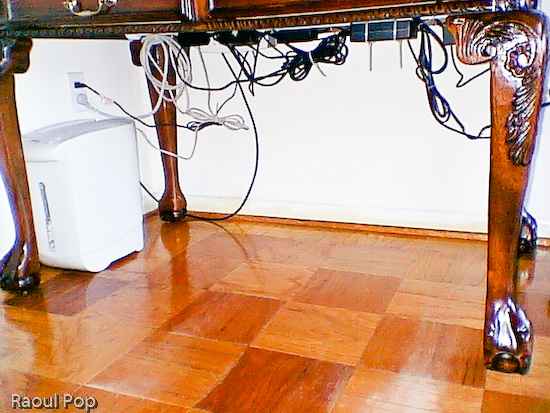
A couple of additional things: I also needed to put a paper shredder underneath the desk. I was able to accommodate it just fine. I also routed the coaxial cable along the wall, and to the PVR with the aid of a little cable tie that I screwed into the wall with a drywall screw.

Here’s the end result. Notice that none of those cables are trailing on the floor. I can’t stress the convenience of such a setup enough. It’s a real pleasure to work at that desk now, and it’s also very easy to keep the floor clean.

Underneath the desk with cable management in place

Standard
Thoughts

From gas guzzler to green extreme

Professor Andrew Frank from the University of California at Davis developed a hybrid SUV that can get about 100 miles per gallon – or so the article says. It does this because it’s a plug-in hybrid. It recharges its batteries from an outlet at night. This is indeed really cool, but what I’d like to know is how much electricity it consumes. I’m not sure that the fuel savings offset the cost in electricity, so if we’re robbing Peter to pay Paul, is it worth it? Here’s the link to the article.

Addition: just stumbled onto this related article, also at CNET News, which talks about the upcoming “100 miles per gallon” cars. Problem is, there’s a cost of $10-12K to convert a hybrid car to a plug-in hybrid, and again, the cost of electricity used to charge it up seems to be sidestepped.

Yet another addition: just came across this video from the Maker Faire, also at CNET News, where the fellow who gets interviewed mentioned you can take an ’04-’06 Prius and convert it for under $3K. One caveat: you’ll need the help of an engineer or electrician who’s comfortable working with high voltages. Cool!

Standard
Thoughts

Are energy vampires in your home?

In the April Issue of the UCS Green Tips, standby or phantom energy loss is detailed. From the issue:

“This wasted energy, known as standby or phantom energy loss, represents a relatively small but growing percentage of an individual home’s electricity use (about five percent), but taken across all U.S. households, adds up to an estimated 65 billion kilowatt-hours of electricity each year. This extra electricity costs consumers more than $5.8 billion annually and sends more than 87 billion pounds of heat-trapping carbon dioxide into the atmosphere each year.

Some of the biggest energy wasters in most homes are the adapters that come with rechargeable battery-powered cordless phones, cell phones, digital cameras and music players, power tools, and other electronic devices. Most draw power whenever they’re plugged into an outlet, regardless of whether the device battery is fully charged or even connected. Other culprits include appliances or electronic equipment with standby capability (such as televisions and computer monitors), a remote control, and/or a digital clock display (such as microwaves, DVD players, and stereo systems).”

Read the issue (it’s only a page long) to find out what to do to prevent phantom energy loss. Here is the link.

Standard
Thoughts

Offset electricity costs through wind turbines

I live in a high-rise condo building, and during one of our building’s board meetings, the discussion arrived at the topic of reducing electricity costs. Immediately I thought about the possibility of placing wind-driven turbines on the top of our building. There is always a good breeze up there, and the electricity produced by the turbines could help offset the energy costs for the building. One of the board members promised to look into the matter, but so far, nothing’s come of it.

Perhaps the costs for the turbines are still prohibitive for many buildings, ours included. But I can see a market for this kind of a product, if the costs are brought down enough so that a cost-benefit analysis of such a solution can show its viability in the long-term.

Standard