Thoughts

Consolidation lurks in the wings for web development industry

I’m struck by the amount of consolidation that’s taking place these days. Companies are gobbling up other companies in order to scale up, expand horizontally or simply eliminate competition. We in the web development industry have so far been spared this fate, simply because of the amount of incredible innovation and changes that always take place in what we do. Let’s face it, a company needs a solid product that can be sold, and so far, it’s really hard to pin down “products” in web development. Plus, the very nature of our work, which can be done anytime, anywhere, rewards individuals, especially those willing to stretch the boundaries of what’s thought possible and come out with something cleaner, something nicer, something slicker, something cooler.

But, even with all of these road bumps in the way of web development consolidation, it’ll still happen. Don’t think I’m enjoying myself as I write this. I don’t want it to happen! You know what’s going to act as the catalyst? The same thing that’s driven manufacturing companies out of the States: price. Look at some of the free products that are out there, that let you create websites with no cost at all: Google Pages, MSN Spaces, Yahoo (whatever it’s called), etc. They’re not full-featured, but they work to get people started. And they’re really easy to use, to the extent that even a “moron in a hurry” (aka the Apple courtroom test) would know how to use them. I’m not implying that most people are morons, but most people don’t need fancy sites that do lots of cool things and manipulate databases, etc.

If you don’t believe me, look at MySpace. It’s there that you’ll see the tastes of most people: that site is full of tasteless decoration, crowded, nasty-looking things that can’t even be called web pages. And that’s only the content. I’m not even talking about the MySpace-imposed page layout and horribly big, screaming ads. The whole site is gross. But, that’s the idea of a “nice” web page to most people. They don’t understand what goes on behind the scenes when it comes to web development. They don’t understand how to design a site. They have no idea about the stress and hard work that goes on when coding/designing a real site. And they shouldn’t be expected to know this. After all, that’s what web designers and developers are paid to do. But the point is, the masses don’t crave and don’t care about good design, they want the free stuff, and most don’t care if that free stuff is ugly.

As free products like the ones I mentioned get more full-featured, and more complicated systems like WordPress or Drupal get even easier to use and customize (not that WordPress isn’t easy to install and use, it is, but you still need to know how to code and design when customizing it) the needs of more and more people will be met. And as that happens, the market for web developers shrinks more and more. And here we get back to my opening comments: solidification of product offerings leads to consolidation. Once a market develops for a clear-cut product, competition will increase, the main differentiating factor will become the price, and the biggest company will be able to offer the lowest price — hence the catalyst for consolidation. Besides, who can beat FREE stuff? How do you beat that? Who can beat offshore web development, where people can live on dollars a day and can afford to develop a complicated site for a few hundred dollars? It’s really, really sad to see web designers and web developers who aren’t able to make a living in the States anymore. I can understand why it happens, but it’s still very troublesome.

What recourse is left to us, as web developers? I would hope we can find some solution that would allow us to keep our independence while also allowing us to make a living without competing purely on price with Ivan in Russia or Mihai in Romania or Jose in Argentina, because living in the States, we’d lose the price battle very quickly.

I realize the outlook as portrayed in this post is a bit depressing, but I plan to write a counter-post to this in the next few days. I do think there’s light at the end of the tunnel, and there’s hope for those of us willing and able to seize certain opportunities.

Standard
Places

The National Seminary at Forest Glen

Just posted photos taken this summer at the National Seminary at Forest Glen, a historic site located in the suburbs of DC.

The history of the place is a pretty interesting read. After being bought in the 1730’s as a much larger property, parts of it were sold off, and finally, what is now known as National Seminary was sold to John and Vesta Cassedy in 1894. They set out to transform it into a girls’ finishing school. In 1916, the school was sold to Dr. James E. Ament after Vesta Cassedy died. John Cassedy then married a recent graduate of the school and lost interest in running it. In 1937, during the Great Depression, with the school’s student population foundering, it was sold to Roy Tasco Davis, who set out to transform it into National Park College, a place where academics and practical skills. He didn’t have much time to do this, because the property caught the eye of an Army general, who invoked the War Powers Act, condemned the property, annexed it to Walter Reed Hospital, and used it as a place where wounded soldiers could recover.

When the Army tired of the property, they let it go to ruin. They wanted to completely tear down the buildings, but local residents objected and managed to get the site designated as a historical landmark in the 1970s. Finally, a deal was made in 2005 to get the entire site redeveloped, the old buildings restored or rebuilt, and luxury condominiums built there. From what I understand, a development company bought the property, under the solemn promise to stick to the historical character and look of the site as they rebuild there. The site is now under construction, and many of the old buildings, too dilapidated to stand up, will be torn down and reconstructed.

Ligia and I visited it this summer (2006) and last summer (2005), and photographed the various buildings. It was also a great place to eat raspberries and mulberries. I still need to post the photos taken last summer, but I’ll do it soon.

(Added 10/19/06: here they are!)

Standard
Reviews

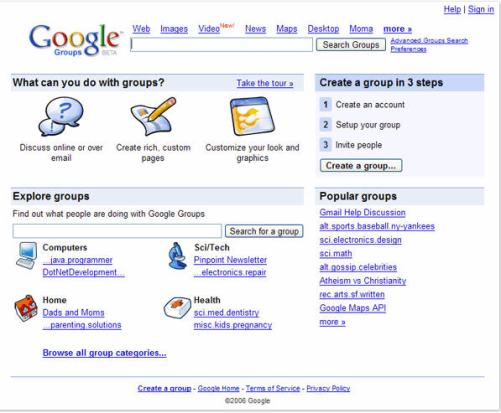
Google Groups gets a makeover

After Google launched the new Reader, I couldn’t help thinking they might just give Groups a re-design as well. My hunch was correct. Brett Lider announced a couple of days ago on the Official Google Blog that a new version of Groups is currently in Beta. It looks a little nicer, but beyond that, no extra functionality was included. Oh yes, there was. There’s now a drop-down menu at the top (Ajaxified) which displays the groups I’m subscribed to without needing to visit a separate page.

The new Google Groups

Beyond that, I think the old version of Groups made better use of the space on the page. When I log into the Groups Beta, my groups get grouped in a right-hand column, and since I’m subscribed to more than 10, the page ends up stretching down with lots of white space in the main column and the groups squished in the right column. It just doesn’t look good.

Overall, I think they’re going in the right direction with the new version of Groups, but it still needs work, particularly in the page layout. I just don’t think enough time was devoted to thinking through the functional areas of the Groups, and how they need to be arranged on the page.

Standard
Reviews

Google Reader changes for the better

I used Google Reader several times yesterday, as I’ve been doing for the past several months, keeping track of the feeds I like to read. Then I read this entry on the Google Blog, telling us that they’ve just launched a new version of the Reader. When did that happen? Wow, that was quick! They launched a brand new version in just a few hours, propagating the change across all their servers.

The new version is much better than the previous one — which worked great, don’t get me wrong — but was not as polished and easy to use. The major changes in this version are obvious: all of the feeds are listed nicely in the left column, and if new items are available, the feed title is bolded and the new items are counted in parentheses. The text formatting for the feed items is also much nicer.

Another cool feature is the Share option, which lets you mark feed items for sharing, and puts them onto a separate page, all your own, with a feed that people can subcribe to. That’s cool! So I don’t have to Star the items that I use, then copy and paste the OPML onto my blog. Now I can just manipulate the feed and display it as I want, wherever I want. But I see that the option to share my starred or tagged items has disappeared. Where did it go? Is it gone for good? (If it has, that’s a bummer, and I’d like it back.)

Finally, I see that the Email feature has been placed next to the Add star and Share options, and the “Blog This!” option has been taken away. If you’re not familiar with it, it would let you blog about a feed item right in your Blogger account. But people didn’t bother to edit the entries, instead choosing the leave the form fields pre-filled with a quote from the post. They’d hit the Publish button, instantly turning their blog into a splog. I can see why Google did away with this.

All in all, a good, solid upgrade. I’m looking forward to using the new Google Reader on a daily basis from now on.

Standard
Reviews

WD Passport Portable Hard Drive: a new kind of sexy

These new Western Digital portable hard drives have me drooling. They’re reasonably priced, and they come in various sizes: 60 GB, 80 GB, 120 GB and 160 GB. They’re powered solely by the USB port, and they’re bundled with encryption software and a bunch of Google software (probably the Google Toolbar and the Google Desktop.) Not that I give a hoot about that — the design is much too cool for me to care about anything else. Wowza!

If you don’t like the prices on the WD site, PC Mall is running a sale on these and other WD drives.

Standard