Exercise

The RPM System just got better!

As I mentioned in some of my recent posts, I recently (5/18) started on the RPM System, a new fitness regimen that you can do with only an exercise ball and an exercise band, and I love it. I recently passed my 6-week progress point, and I plan to post the results from that re-assessment this week.

There have been some changes in the works on the backend of the RPM System website, which have just been completed. As a result of those changes, many of which came about from feedback provided by early users of the system, like me, the RPM System is a lot more affordable and easy to understand now:

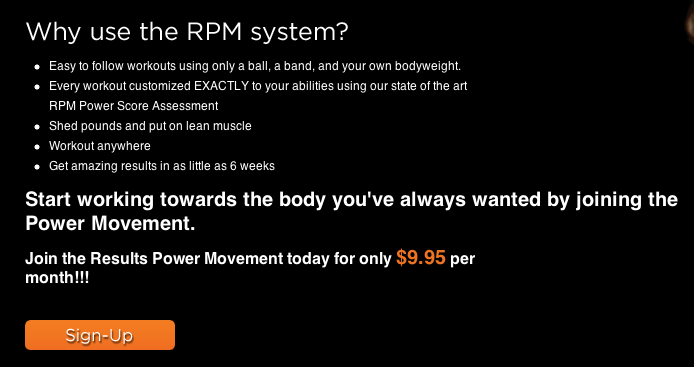
  • The cost has been reduced to $9.95/month, which makes it affordable for just about anybody. It’s now much, much lower than a gym membership, and since you can do it at home, you’ll be saving time and money.
  • Those using the system will have the opportunity to sign up their family members at $7.95/month, with a special code, which will make it easier and even more affordable to stay fit. You’ll be able to work out together and encourage each other.
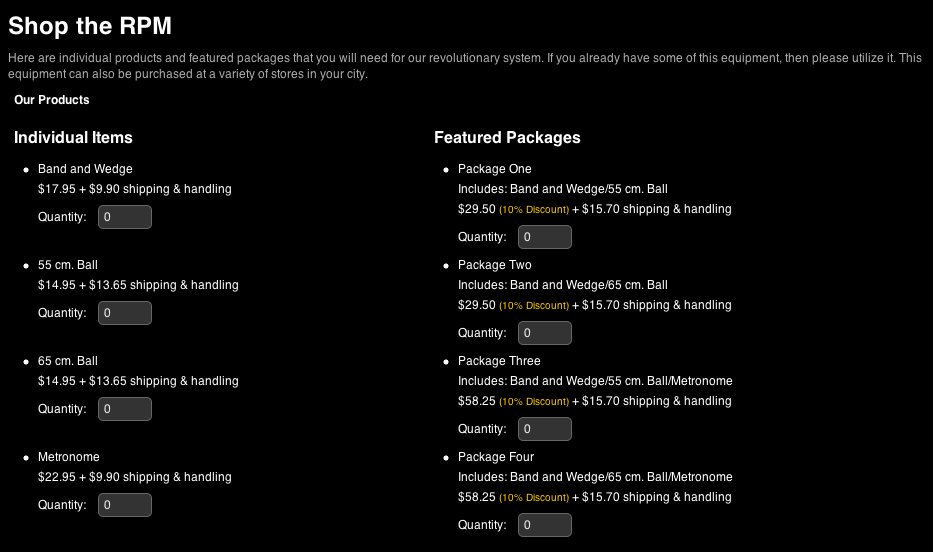
  • It’s much easier now to get the equipment you need for the program. There’s a new Equipment tab on the site menu, where you can purchase the exercise band and the ball, plus the door wedge and the metronome, which are the two additional items I didn’t know about when I started the workouts. Fortunately, you can get all of this as a bundle from the Equipment page, so you’ll be able to get right to the workouts without missing a beat. As a matter of fact, the door wedge is included with every exercise band, right off the bat. And you no longer need to get a metronome, unless you want to. All of the exercises have been changed to the same beat. If you want to try different beats as you advance through the workouts, you can, by using a metronome, but it’s no longer a must-have piece of equipment.

I took a few screenshots of their website, to give you a sense of the changes. Here’s the page where they describe why you should use the program. The new price is clearly posted there.
And here’s the Equipment page. As you can see, things are nicely bundled and the prices are quite affordable.
One of the things I like about this fitness program is the fact they donate to charities. It’s nice when a company decides to do that, especially in these troubled economic times. The founders donate 10% of the corporate profits to the Susan G. Komen Breast Cancer foundation.

If you’d like to try the RPM System, you can get a 2-week free trial through this referral code: 553677456. The normal free trial is 1 week, but this way, you get to really use the system enough to see its true benefits to your body. I have, and I plan to keep using it for a long time.

As I mentioned in my very first post about the RPM System, I am using the system for free. When the founders asked me to review it, that was one of the benefits I got in exchange for putting in the time and effort of using the system enough to be able to speak cogently about it. But I wouldn’t have stuck with it for 6 long weeks if I didn’t love it, and I do. When I say you should give it a try if you’re not already exercising, I really mean it! You will see results!

Standard
Exercise

After a week on the RPM System

I recorded a video last night, after my third workout on the RPM System. I’ve completed a week’s worth of workouts, and I can already feel the program’s effect on my body.

My core muscles have begun to tighten, and my muscle tone is improving. I like the slow burn I get in my muscles after the workouts — not enough to make things painful, but just enough to let me know I’ve done some nice work, and that my body’s getting better.

The interesting thing about the workouts is that they’re easy to under-appreciate, until you begin to do them. You start doing the exercises, and you think it’s a piece of cake, until you get to the second or third run-through (it’s circuit training, remember), and your muscles begin to give up, and you’re drenched in sweat and gasping for air.

I thought I’d post some “before” photos, so I can track my progress accurately. I’ll use these, along with my initial measurements, to see how my body improves as I advance through the workout regimen.

Continue reading

Standard
Exercise, Reviews

The RPM System: first impressions

I had my first workout on the RPM (Results Power Movement) System last night, and I recorded my thoughts in a video clip which you can see below, or on YouTube.

As it turns out, I like the workouts. Of course, I’ve only had one workout so far, but for me, it’s an interesting change to work out without weights. As I mentioned in my previous post, I’ve always worked out with weights. I’ve never really dedicated any significant time, on a regular basis, to working out with just my body weight, doing anything else but crunches, pull-ups and push-ups. So my first workout was a revelation of sorts. I discovered I could get sore and work out all sorts of muscle groups using only my body weight, an exercise ball and an exercise band…

with one caveat: you need a couple more things, without which you can’t do the workouts properly.

You also need a door wedge — something to allow you to anchor the exercise band so you can do band presses and band rows. I didn’t get it, so I had to improvise. Make sure you find one at a sports store, and buy it along with the exercise band. Maybe you’ll get lucky and find it as a set with the exercise band.

Make sure you read through the Equipment PDF, which mentions the door wedge (the general website doesn’t), and also make sure you get an exercise ball that’s the right size for your height. Check the PDF, which has a table listing the various ball sizes for height ranges.

You also need a metronome. If you don’t have one around the house, see if you can pick up an inexpensive one from a music or sports store, or if you have an iPhone or iPod touch, get a metronome app from the App Store. I opted for the second choice, and got an app called Metron, a highly rated metronome app, which costs $1.99. I like it, and it’s got a ton more options than I need for the workouts. The important thing for your metronome is that it needs to be able to go down below 50 BPM, and, just in case you need it, go up to 200 BPM.

The metronome is important, because almost every one of your exercises on the RPM System will have a beat which will dictate how fast or how slow you need to do it. The beat may increase or decrease, depending on the exercise, making it harder to do as you advance. Without a metronome, you won’t be able to keep the proper beat, and you won’t reap the full benefits of your workout regimen.

Another thing I recommend you do before your first workout is to read through the Strength Program Description PDF, which explains how the circuit training works the RPM workouts. It’s really important you do that, or you’ll be looking at your workout schedules like a hen looks at a newspaper, which is how I looked at it the first time…

That’s pretty much it so far. I look forward to the next workout!

If you’d like to try out the RPM System, use this code (553677456) which will get you a free week’s trial.

Standard
Exercise

Started on the RPM System today

I’ve always had an abiding interest in exercise. Perhaps it was brought on by the fact that I was very thin as a child. I was shorter, thinner and looked much younger than my age as I grew up, and I got fed up with being treated like a little boy.

When I got to college, I read about weightlifting voraciously. I educated myself and began lifting weights frequently, advancing from 2-3 times/week to 6-7 times/week. I started weightlifting regularly my sophomore year, and by my senior year, I’d put on about 60 lbs of muscle, without illegal supplements.

After college, even though I was still lifting weights intensely, I lost about 25 lbs. There were a few reasons for that. For one thing, I turned vegan, and I didn’t balance my diet properly. Then I had an operation on my right knee for a torn ACL, and was out of commission for 6-7 months. I became unhappy with going to the gym, for other reasons as well… so I focused my efforts on my job and my personal projects, such as writing for my websites. Over time, that meant more weight loss, until my weight settled around 155-160 lbs. I was still interested in exercise though, and I wrote several articles about the subject when I began to publish online in 2001.

On a side note, if you ever wonder whether you should play rugby or not, keep in mind I broke a rib, then my nose, then tore my ACL playing rugby. It’s not an easy sport on the body. I decided to stick to regular exercise and leave rugby to those with sturdier constitutions and cauliflower ears.

Back to my adventures in exercise… I coasted onward, relying on my previous years of workouts to keep my body in a residual shape, and that worked, for a time, until I noticed that even though my weight stayed the same and my waist stayed the same, I was getting flabbier. The basic shape was still there, but muscle tone was nowhere near what I used to have, and I was accumulating body fat, slowly but surely.

I had several false starts over time, where I tried to go to a gym regularly, but that didn’t work out. So far, my exercise routine has been irregular. I do pull-ups and crunches every now and then, but it’s not enough.

Imagine my surprise, when out of the blue, I was contacted by one of the founders of the RPM System — a low-cost, highly customizable fitness program that tailors itself to each user’s needs after a baseline fitness and diet assessment — and I was asked to review it honestly, without pulling any punches. (RPM stands for Results Power Movement.)

Here was a fitness program I could do at home, with minimal equipment (an exercise band and an exercise ball), using only my body weight. Absolutely, I said, bring it on!

So here I am! I did my initial assessment today, and you can see my results below. My power score is 64, which, on a scale from 1-100, gets me a D (barely). It looks like I need some serious work…

It’s not that I could only do 4 push-ups, and so on… Their website grades each of my numbers on a scale of 1-10, then assigns me a score on a scale of 1-100. Here are my actual numbers for each test:

Continue reading

Standard
Exercise

What do you do all day?

We are defined by what we do with our time. When it comes to our health, that same adage can be re-stated to read: our bodies are the record of what we do with our time.

If you happen to sit in a chair all day, perhaps you wish for a job where you can move around more often. If you have to stand up all day, or run around from place to place, you may wish for the comfort of a cozy chair and a steady desk where you could sit and concentrate on some quiet work. But have you wondered what your job is doing to your body? Just what are the long-term effects of what you do all day, every day?

Desk work isn’t all it’s cracked up to be. Any job that involves an extended amount of sitting, whether it be an office job or a driving job, just isn’t healthy for the body. It makes you sick, slowly, over time, without realizing it. It deforms your posture, it fattens you up, slows down your digestive tract and metabolism, widens your hips, flattens your curves, rounds out your shoulders and hunches your back. Your muscles slowly atrophy from all that inactivity, and they get replaced by fat reserves. Before you know it, you get flabby and fragile. At first you’re angry, then you get complacent, and finally you accept it as a normal part of growing old. But it’s not a normal part of the aging process! It doesn’t have to be that way.

By the same token, any job that involves an extended amount of standing up isn’t good for you either. It introduces posture problems of its own, puts extra stress on the spinal column, the hips and the knees, not to mention your feet, and can lead to varicose veins, among other things. You get home exhausted at the end of the day, with pain in your joints and your back, and crash into your bed, only to put your body through the same punishing process the next day. Again I say, it doesn’t have to be that way.

Over the past several years, I’ve seen many people who had the symptoms I described above, and until recently, I used to think it was due to one’s nature or old age, but I was wrong. Those problems could be traced directly to what these people were doing — or not doing. Because, you see, what you aren’t doing is just as important as what you are doing.

In life, it’s very important to counteract the negative effects of any of our activities with their proper antidotes. If what you do all day is sit on a chair, then you must get outside more often, and jog or run or exercise. At the very least, you should do some crunches or push-ups every day. If you stand all day, then you must mobilize your leg and hip joints. It sounds counterintuitive, but think of it this way: if you kept your arms locked outward all day long, wouldn’t you want to bend them at the end of the day? Wouldn’t your elbows feel horrible? It’s the same thing with our knees and hips, except we’ve gotten so used to standing on them all day long, we’ve forgotten that we need to bend them every once in a while, to put those joints through their full range of motion — so do some squats and lunges, and stretch your hamstrings and quadriceps muscles too.

Our bodies were made for motion. They were not made for sitting or for standing up or for lying down. They need constant, varied movement and effort to keep them in shape. If they don’t get it, they deteriorate. We become wrecks of our former selves — flabby, misshapen bags of skin, fat and bones — a sad memory of what we could have been, and no amount of liposuction and plastic surgery and botox is going to fix that, in spite of what some people may think.

Look, if you want to do things right, then you’ve got to figure out what you want in life. You’ve got to figure out what you do with your time all day, and how you can use it better. If you want to start exercising, then you’ve got to carve out time for it in your daily schedule — you need to find the resolve for exercise, and you need to stick to it. If you don’t, just look around you. The majority of people out there never got their act together on staying fit, and they look it. Do you want to be one of them, or do you want something better?

Standard