Thoughts

Sometimes you need to use a book the right way

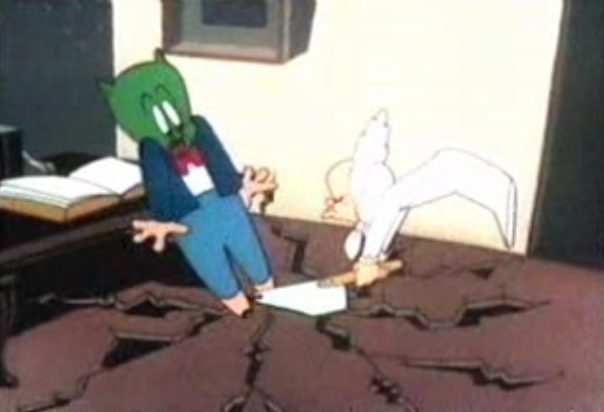
There’s a Looney Tunes cartoon from 1944, entitled “Brother Brat“. It stars Porky Pig and speaks eloquently about child discipline. In it, Porky becomes the unwitting baby sitter for a Rosie the Riveter type super-woman who’s pulling long shifts at the factory, helping out with the war effort.

When she leaves her brat, Butch, with him, she also hands him a book, which she says always helped her. It happens to be a book on Child Psychology.

Child Psychology - 1

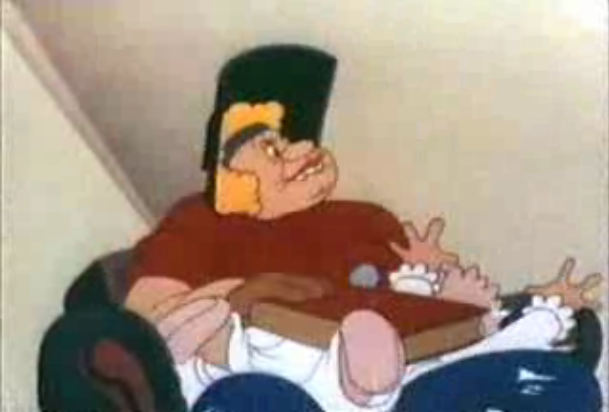
Porky takes the offer at face value, and believes the book will really help him. When baby Butch starts acting out, he checks the book for advice.

Child Psychology - 2

He soon finds out the book is no good, as he applies the wishy-washy, sound-good nonsense from the book to his real life situation and things go from bad to worse.

Child Psychology - 3

By the end of the cartoon, he’s running for his life, with an axe-wielding maniac baby on his tail.

Child Psychology - 4

Then Susie the Riveter comes in, notices the mayhem, and asks him if he used the book. Desperate, still running, he screams, “Yes, but it didn’t work!” Then Susie grabs the book and shows Porky how it’s done: “Maybe you didn’t use it right. It always works for me!”

Child Psychology - 5

The punchline is obvious, and yet it teaches all of us, to this day, a valuable lesson: sometimes the only thing that works is a spanking. As for child psychology books, I share the opinion of the animators — those books are a bunch of hooey, fit to be printed on toilet paper and used that way. I’m not alone in that sense. Most people shared this opinion when classic cartoons were made. Cartoon studios of all sizes lampooned child psychology books, including Disney.

Spanking has sadly become a tabu practice in this “enlightened” age. If you spank your child now, the state will take it away from you. Surely the state must know what it’s doing, right? Because governments in all developed countries have shown us they manage everything else to a tee, beyond reproach, right? Naturally, we ought to trust what they tell us to do with our children?

I see parents these days, stressed to the breaking point because of children who haven’t been properly disciplined, and they’re afraid to discipline them. They try talking to them, they try to reward them for good behavior, they try timeouts, but seriously, sometimes a child just needs a good spanking. The Bible knows what it’s talking about when it says in Proverbs 13:24: “He who spares the rod hates his son, but he who loves him is careful to discipline him.” It has the benefit of thousands of years of experience on its side when it gives that advice.

If you’re interested, my father wrote a couple of articles several years ago. One is on the duties of children toward their parents, and the other is on the duties of parents toward their children. The articles are a compilation of verses from various books of the Bible on those topics, and they’re not doom and gloom stuff — they’re thoughtful, fascinating stuff. To make things even more interesting, my father is a psychiatrist who is keenly interested in the proper development of one’s character and personality.

On an unrelated note, thank goodness for Google Video, which indexed the cartoon from Dailymotion! I wouldn’t have been able to provide you with screenshots from the cartoon otherwise, because I couldn’t find it in regular web searches. I don’t have it in my collection, and only saw it a few times on TV, including once on Boomerang recently. I encourage you to watch it.

Standard
Exercise

What do you do all day?

We are defined by what we do with our time. When it comes to our health, that same adage can be re-stated to read: our bodies are the record of what we do with our time.

If you happen to sit in a chair all day, perhaps you wish for a job where you can move around more often. If you have to stand up all day, or run around from place to place, you may wish for the comfort of a cozy chair and a steady desk where you could sit and concentrate on some quiet work. But have you wondered what your job is doing to your body? Just what are the long-term effects of what you do all day, every day?

Desk work isn’t all it’s cracked up to be. Any job that involves an extended amount of sitting, whether it be an office job or a driving job, just isn’t healthy for the body. It makes you sick, slowly, over time, without realizing it. It deforms your posture, it fattens you up, slows down your digestive tract and metabolism, widens your hips, flattens your curves, rounds out your shoulders and hunches your back. Your muscles slowly atrophy from all that inactivity, and they get replaced by fat reserves. Before you know it, you get flabby and fragile. At first you’re angry, then you get complacent, and finally you accept it as a normal part of growing old. But it’s not a normal part of the aging process! It doesn’t have to be that way.

By the same token, any job that involves an extended amount of standing up isn’t good for you either. It introduces posture problems of its own, puts extra stress on the spinal column, the hips and the knees, not to mention your feet, and can lead to varicose veins, among other things. You get home exhausted at the end of the day, with pain in your joints and your back, and crash into your bed, only to put your body through the same punishing process the next day. Again I say, it doesn’t have to be that way.

Over the past several years, I’ve seen many people who had the symptoms I described above, and until recently, I used to think it was due to one’s nature or old age, but I was wrong. Those problems could be traced directly to what these people were doing — or not doing. Because, you see, what you aren’t doing is just as important as what you are doing.

In life, it’s very important to counteract the negative effects of any of our activities with their proper antidotes. If what you do all day is sit on a chair, then you must get outside more often, and jog or run or exercise. At the very least, you should do some crunches or push-ups every day. If you stand all day, then you must mobilize your leg and hip joints. It sounds counterintuitive, but think of it this way: if you kept your arms locked outward all day long, wouldn’t you want to bend them at the end of the day? Wouldn’t your elbows feel horrible? It’s the same thing with our knees and hips, except we’ve gotten so used to standing on them all day long, we’ve forgotten that we need to bend them every once in a while, to put those joints through their full range of motion — so do some squats and lunges, and stretch your hamstrings and quadriceps muscles too.

Our bodies were made for motion. They were not made for sitting or for standing up or for lying down. They need constant, varied movement and effort to keep them in shape. If they don’t get it, they deteriorate. We become wrecks of our former selves — flabby, misshapen bags of skin, fat and bones — a sad memory of what we could have been, and no amount of liposuction and plastic surgery and botox is going to fix that, in spite of what some people may think.

Look, if you want to do things right, then you’ve got to figure out what you want in life. You’ve got to figure out what you do with your time all day, and how you can use it better. If you want to start exercising, then you’ve got to carve out time for it in your daily schedule — you need to find the resolve for exercise, and you need to stick to it. If you don’t, just look around you. The majority of people out there never got their act together on staying fit, and they look it. Do you want to be one of them, or do you want something better?

Standard
Places

The ancient city of Histria

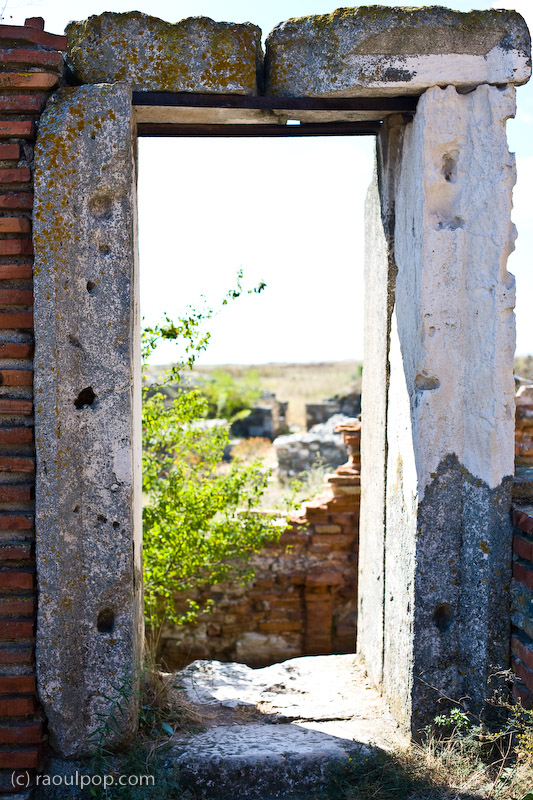
On the shore of Lake Sinoe in Romania, very close to the Black Sea, lie the ruins of the oldest documented city on the territory of modern-day Romania: Histria. (See satellite view below, or go to Google Maps to explore the full map.) We visited it in September of 2008.

It started its life around 630 BC [reference], built by Milesian colonists from Greece, to trade with native Getae tribes (Geti in Romanian). The Getae were Thracian tribes that occupied Dacia, whose territory is matched in smaller proportion by modern-day Romania. They, and the other people who settled in Romania at later times (like the Romans) are the ancestors of modern-day Romanians — my ancestors.

When Histria was built, its port was literally on the shore of the Black Sea. Over its approximately 14 centuries’ existence, silt deposits from the Danube River blocked off its access to the sea and formed what is now Lake Sinoe. This meant that the city’s importance as a port and trading post slowly diminished as the silt deposits grew to become the current land border between the Lake Sinoe and the Black Sea. It must have been painful to try and salvage the city’s livelihood by finding routes through the growing silt, hoping that ships stuck in the increasingly shallow water would somehow want to come back, should they manage to get away. Little did they know that in modern times, a canal would be cut through the silt shore at Periboin, not far from them.

By 100 AD, the city, who had resisted countless attacks and rebuilt its walls time after time after time, could only rely on fishing as a source of income. It managed to survive another 600 years or so, until it was destroyed one last time in the 7th century AD by the Avars and the Slavs. Its inhabitants moved away, and the once bustling and prosperous city, who had forged an important trading link between the Greeks and the Dacians so many centuries ago, began to decay, unoccupied.

Its name forgotten, it didn’t even appear on maps. Its memory swallowed whole by time, its walls covered by the ground itself, it lay in wait until it was re-discovered by a Frenchman, Ernest Desjardins, in 1868. In 1914, Vasile Parvan, a Romanian, began the first excavations of the site. The archeological digs continue to this day, conducted by various multinational teams. This was how we found it a month or so ago.

It was a warm, sunny, late-summer day when we visited. The heat shone down oppresively while we drove through the flat Dobrogea landscape. Yet a soft, cooling breeze from Lake Sinoe met us as soon as we stepped onto the grounds of the city.

There was a peace and quiet at Histria that I can only find when I visit certain ruins. I stood among the remains of the walls, and thought of the people that lived there before I set foot on what used to be their homes. They were born, lived and died there, making a living the best way they knew how, in a famous city by the Black Sea. The breeze must have been stronger then, since the waves of the sea beat against the city’s very shores.

What an adventurous spirit those Greek traders must have had, to get in their boats and travel far off, in hope of establishing a little colony of their own in an unknown land. How did they choose the site? Likely because it sits on top of a slight hill. Just think, the first few families built little homes out of field stone (there are very few trees around), and through hard work applied over time, grew that little settlement into an important port of trade and a fortress, one rich enough to attract the attention of countless attackers.

As I sat there and listened to the lull of the waves, I understood why they rebuilt after each attacks. The peace between each bout of violence was worth the effort, and the surroundings themselves invited (and still invite) company. Had their direct access to the Black Sea not been cut off, I believe Histria would survived to this day, and perhaps the city of Tomis (Constanta) might have had a different fate.

If you walk slowly among the houses or on the streets at Histria, you too will understand why it survived for so long. It’s hard to leave a place like that. It’s so peaceful, so quiet, so welcoming. You want to spend more time there, looking toward the horizon, hoping against hope to spot your ship, which is making its way slowly but surely toward the small port, bearing goods that will replenish your warehouse and provide for your family for another year.

The full set of photos from Histria is available at my online photography catalog. You’re welcome to view them all there. Mircea Angelescu, a Romania researcher, developed a 3D model of Histria which can give you a detailed idea of the city’s layout over time. More info on Histria can be found at Wikipedia.

Standard
A Guide To A Good Life

American habits

Slow down. That’s a phrase not often heard in the US. At least not among the people I know. But it’s a notion that’s slowly starting to make more sense.

Americans love to think big and spend big. They want progress on every front, no matter what the cost. In the 20th century, that sort of thinking worked well. It carried us through to the 21st century, where, however reluctantly, I think we’ve got to change the way we operate.

There’s a newspaper article I’ve been saving since June of 2007. It’s about people who overextended themselves in order to keep up with the Joneses, and were paying the price. It’s called “Breaking free of suburbia’s stranglehold“. Even before the real estate bubble burst, sensible people were finding out they couldn’t sustain their lifestyle and stay sane, so they downsized. Each found their own impetus, but they were acting on it. That was smart. I wonder how many people had to downsize the hard way since last year…

How about a more pallatable reference, one for the ADD crowd? There’s a Daft Punk video called “Harder, Better, Faster, Stronger“. The lesson to be drawn from it is found at the end of the video, but to get it, you have to watch it from the start. I’ll summarize it for you here. Don’t be fooled by glitter and glamour. There’s a price to pay for everything.

Paying for it isn’t a new notion. It’s been around for ages. Take “pay the piper“, for example. You look at almost any language, and the idea of everything having a price can be found embodied in certain evocative phrases.

Let’s look at a few more concrete examples:

  • You want a bigger house? There will be a cost for that, as seen above.
  • You want the house of your choice AND the job of your choice? You might have to do some really nasty commuting, and now that gas costs a lot more, you’ll not only pay with your time, but with your wallet as well.
  • You persist in wanting to drive an SUV? There’s a price to pay for that too, and it’s not just in gas.
  • You want a house that looks like a mansion, but you don’t want to think about how things get built? That’s okay, you’ll get a plywood box with fake brick cladding that will look like a mansion and will only last you 20-30 years at most (not to mention that your HVAC bills will go through the roof, literally).
  • You want your meat, particularly your pork? There’s a big cost for that, and it’s measured in incredible amounts of environmental damage and in chronic and deadly health problems for the people who work on the pig farms.
  • You want to keep your computers and lights on all the time at work? You want to keep the temperature at 65 degrees Fahrenheit all the time? Do you want to keep all of your employees on site instead of letting them work from home? As a company, you’ll see increased costs because of your wasteful habits.

These are all hard lessons to learn. It seems the only way to get people and companies to learn to act responsibly is to increase costs. When your actions have a direct and immediate impact on your bottom line, you tend to change your ways in order to stop the bleeding.

It’s a shame it has to be that way, and perhaps at some point in the future, the new way of thinking will be more ingrained in people’s minds, and they’ll think about slowing down, conservation, sustainability and efficiency on a daily basis. Perhaps they’ll realize having a more meaningful life is more important than having a busy life filled with material nothingness.

I’m grateful that at least some are already seeing things the right way. I myself have already started to cut out unnecessary expenses and time commitments, and will continue to do so. I have several more important changes still planned.

If you’d like to do the same, one place to start is a book entitled “Take Back Your Time: Fighting Overwork and Time Poverty in America“. It’ll get you thinking along the right lines, but it’ll be up to you afterwards to make the needed changes in your life.

Standard
Thoughts

Happy Birthday Tataie

It’s my grandfather’s birthday today. He died just a couple of weeks ago after a painful struggle with mesothelioma, a form of cancer caused by asbestos exposure.

He’d been coughing for a few years. It was a persistent cough, but it wasn’t a severe cough. He coughed here and there, and especially after he came into a cooler room after working outside, in his beloved garden. Then things got worse. He kept getting cold-like symptoms and coughing more. When doctors in Romania examined him, they discovered water in one of his lungs. They started drawing it out with syringes regularly, liters at a time. A lesion of sorts developed at the site where they kept inserting the needle. A biopsy of the lesion revealed nothing. Things didn’t improve.

My parents hoped that the Florida weather would do him good, so they brought him to the States. He loved the weather, but didn’t get better. They thought US medical care would be better than Romanian medical care, so they put him in a hospital here. Doctors literally paraded by his bedside by the tens, specialist after specialist, all of them clueless. Oh, let’s try this, let’s try that, blah, blah, blah — that’s how the story usually goes. X-rays and CT scans and urine and lab tests every day, and still they couldn’t figure things out.

Finally they decided to open him up and see what was going on. That’s when they discovered he had mesothelioma, with a few “localized” tumors in his right lung. But they still couldn’t figure out what to do about the water accumulation, so they proposed to insert talcum powder between the lung walls, in the hope of sealing that chamber and stopping the leaks (that’s apparently a standard procedure for this sort of thing).

So they opened him up again and inserted the powder. Water still accumulated, this time more slowly, but it still happened. Then he developed difficulty swallowing. They stuck tubes with cameras down his throat. More CT scans, more X-rays, and still no idea why. Well, let’s enlarge his esophagus and cardiac sphincter (the opening from the esophagus to the stomach.) That might help… Well, it didn’t. He still had trouble swallowing.

They didn’t know what else to do for him, so they released him from the hospital. The bill came to well over $100,000, and my grandfather was no better than before. He was worse, and now he had to contend with pain from the surgery and the other procedures done on him while in the hospital.

My mother had to blend everything into a soupy puree before feeding him, and still he had trouble swallowing. He withered and dried out and lost tens of pounds. He was hardly recognizable, but his spirit was still well, and he hoped he’d get better. That was the hardest part, to see him trying to eat and unable to swallow, then leave the table with a horribly sad look on his face.

We knew he wouldn’t last long like that, so we convinced him to return to Romania, where at least he could die in his own home, if it were to come to that. Once he got there, my aunt, who took care of him, put him on IV fluids. He got a little better. We decided to try seeing some specialists there in Romania, so she took him to the hospitals in Sibiu and Timisoara.

If you don’t know how the healthcare system works in Romania, I’ll tell you. It’s based on heavy bribes. If you don’t bribe the doctors and nurses, no one cares about you. No one even looks at you, and you’re treated like scum. If you have the money to give them, you actually get somewhat decent service, depending on how much you give. You can’t lay the blame entirely on the medical personnel for this practice though. Doctors’ salaries are horribly tiny, smaller than the salaries of some janitors at well-to-do companies. So they need cash infusions from the patients in order to be able to live properly. But the way they go about it is disgusting to me. And there’s no telling when they’ll make up stuff about your condition just so they can get more money out of you. They’ll even do extra procedures (if they’re unethical people) so you’ll pay them more.

Once in the hospital, they slipped a feeding tube through his nose and into his stomach. In Sibiu, they opened him up again and discovered some lesions on his esophagus, and some on his stomach. They said he needed his esophagus replaced, but that they couldn’t do the procedure, and that he needed to be sent to Timisoara. We believe the doctor who operated on him at Sibiu twisted his stomach or intestines around and caused a severe blockage in his GI tract, because his digestion and regularity were never the same after that.

In Timisoara, the specialist who was to replace his esophagus with a silicone stent bragged to high heaven that he was the only one doing the procedure in Romania and in the entire Western Europe. If that sounds phony to you, don’t worry, you’re right. He just wanted to make sure he got enough money for the job. He ended up operating on my grandfather, but replaced less of the esophagus that he’d originally said. We’re not sure why. Things went completely downhill from there.

My grandfather never recovered from that operation. His situation got worse and worse every day. Now he couldn’t digest his food at all, even the soups he was fed through his tube. He coughed up blood and fluids of various colors. He got thinner and more dehydrated every day. My aunt put him back on IV fluids, but they didn’t help. He was in horrible pain, throughout the day and night. He moaned in agony. He couldn’t sleep. When he did manage to sleep, he would writhe and cry out in anguish. He was dying.

Four days before he died, he asked my aunt to make the preparations for his burial. He knew it and he was ready. He asked her to let him go, to stop trying to keep him alive. She couldn’t stop caring for him, but she knew it was going to end anyway. He looked forward to joining my grandmother in the grave next to hers.

And then he died in the evening. I got the call from my mother. She was crying. I couldn’t cry. I knew what he’d been through, and wanted him to get the rest and peace he so badly needed. I was angry with everything that had happened to him, and still am. Why did he have to die in such pain? Why did he have to encounter the utmost morons in his quest for decent medical care? Why did he have to suffer so much?

We don’t know when he got exposed to asbestos. It wasn’t uncommon in communist Romania to get exposed to dangerous conditions or materials. He worked at the same factory all his life, and got promoted to chief technical engineer from a humble line worker. He came up with various inventions and improvements during his career, and was even decorated by Romania’s dictator, Nicolae Ceausescu, for his contributions. I’m not saying this because I care about Ceausescu, who was a horrible man, but I care about my grandfather and about his life’s work, and was glad to see him get recognized.

For me, my grandfather’s suffering serves to underline how little medical science really knows about the human body, and how horribly few things they can do to cure people. In spite of all our technology and advances and drugs, when it comes to treating disease, our options are very limited, and very primitive. We can:

  • Mask the symptoms by treating them with drugs
  • Cut into people and butcher them with plain knives or sear them with electric knives, then sew them up with string
  • Poison them with radiation therapy and chemotherapy

I remember my frustration with this while in medical school, and perhaps it had something to do, subconsciously, with my leaving it to return to IT work. At least in IT you can find out what’s really wrong and can fix it either through code or hardware replacements.

What my grandfather’s death also showed (amply) is how many idiots there are in the healthcare system. My God, we have so many doctors out there that can’t diagnose their way out of a paper bag, and they run test after test and try this and that and still can’t figure out what’s wrong. I’m fortunate enough to know there are good doctors (although they’re few and far between) who know how to diagnose with much less information at their fingertips, because I’ve met some of them.

If all these retards can graduate medical school and can pass the boards, then clearly medical education isn’t doing its part in weeding them out. I had plenty of them in my class in med school, too. They were the ones who got by very nicely by rote memorization. Worked great, until you asked them to analyze something — then they looked at you like a hen looks at a newspaper.

Another one of my beliefs was reinforced: that the overwhelming majority of nurses are lazy asses that don’t care at all about their patients. I’m sorry if that offends you, but that’s the truth. I know this because I saw they way they treated my grandfather, and I saw the way they treated other patients over the years.

All nurses seem to want is more money and more benefits for as little work as humanly possible. Oh sure, they put in a lot of “hours”, but most of those hours are spent socializing at the nursing station, not by the patient’s bedside. What’s unfortunate is that the market is tilted so much in their favor right now (and will continue to be for the next several years) that nothing significant can be done about it. There’s a nursing shortage, and that means we’re going to have mediocre, good-for-nothing nurses in all of our hospitals until supply meets demand, and hospitals can start to weed out the non-performers.

I tell you, the nursing profession will not emerge unscathed from this. The stink caused by these bad nurses will taint the good ones, too. The good ones are out there, I’ve met some of them, and when I say they’re good, I honestly mean it. They’re great, and they care, and they know a lot, but they’re few and far between, and they’re mostly in academia.

Coming back to my grandfather, I think of my grandmother’s death two years ago, also in June. A week or so after her burial, it was my grandfather’s birthday, and I remember him celebrating it with us, his family, but without his beloved wife. The sorrow was evident on his face, even through his smiles, and there was nothing any of us could do for him but to try and cheer him up.

Now, he’s resting in the grave, and it’s his own birthday. There’s no birthday celebration now. Just pain and a feeling of irreplaceable loss.

Rest in peace, tataie. You taught me how to build and fix things and work in the garden, and how to use tools and paint and be the man I am today. You were the first man I looked up to, the first one that made me want to learn how to shave. I saw you do your best, every day, to care for and protect your family. You never spoke much, but you did much. You were loved, and are loved. Rest in peace.

Standard