Thoughts

Open source software and its use by for-profit companies

Everyone is happy to use free, open source software these days, and for-profit companies are only too happy to join that bandwagon. After all, they’re supporting the open source movement — or are they?

If you’re not sure, there’s an easy litmus test: see how much they contribute to the open source movement.

  • Look at how much they donate to open source. Many companies will make token donations to open source organizations, but let’s face it, that money isn’t going to the developers themselves, it’s going to public relations and ads and the CEOs of those organizations. (Lest we forget, the CEO of Mozilla made $500K/year while the developers made nothing.)
  • Look at how much of their own code (written in-house) they give back to the open source community. If they don’t do much of either, there’s a pretty good chance they’re in it simply to profit off the backs of the many unpaid open source contributors.

After all, companies are more than happy to use free, open source software, since it means they have to do less development themselves, and they don’t have to pay anything at all for that software. But then they charge an arm and a leg for products developed using open-source software. They win, the original developers get screwed, and the customer pays through the nose for something that was free.

I find that sort of a business practice completely hypocritical. Building your business on the backs of malnourished, borderline-healthy geeks, coding their nights away, unpaid is unethical and exploitative. It harks right back to medieval times, when lords would get filthy rich at the expense of poor, overworked serfs. We were supposed to have evolved beyond that, but as it turns out, those sorts of practices haven’t been phased out, they’ve just been sublimated and adapted.

It gets even worse than that. Some companies aren’t content with just using free, open source software to fatten their pockets. They turn around and try to lock the products they’ve built on the free software, and to make it illegal for users of those products to change them. This is quasi-legal and reproachable, because it goes against the original GPL license of that software. You can’t modify open source software by lines of code here and there, and then call that software yours. It’s intellectual theft. This is why I support GPLv3, in spite of the fact that Stallman gives me the willies.

Some developers would argue that they’re writing free software because they want to, and they don’t care if and when they get credit or if they get paid, or even if some ethically questionable company will use their code to make money. They say they’re only interested in writing free code. I say they’re devaluing their work, and when they’ll find themselves without a job, they’ll wish others placed more value on their code.

I don’t need to name specific companies. You just apply this simple litmus test to the big name (or small name) companies out there, and you’ll find them out soon enough.

In the end, a company’s real commitment to the open-source software philosophy can be measured by how much new, internally written code, it contributes back to the open source community.
Standard
Reviews

Pepco fails to fix store's electrical panel after 6 months

Updated 5/27/2008: It has now been a month since I wrote this post, and Pepco still HAS NOT fixed the electrical panel. This makes it 7 months, which is simply unacceptable. I am going to write to Chris Van Hollen, our Congressman, to see if he’d like to get involved in the matter.

Updated 6/09/2008: We received a reply from Congressman Van Hollen on 5/28/2008, just a day after I wrote to him via email, assuring us that he would look into the matter, and putting us in touch with one of his staffers, Miti Figueredo. Today, on 6/09/2008, Pepco showed up with a team of about seven people and got the electricity working again in a matter of hours. I know this wouldn’t have happened without Congressman Van Hollen’s intervention. Congressman, we are deeply grateful and thank you from the bottom of our hearts!

Piano Place, the store where Ligia has her studio, experienced a power outage on November 2, 2007 (over 6 months ago). It was caused by a badly wired electrical panel outside the store, which caught on fire. Pepco, the local (and only) electrical company, has failed to fix that panel ever since, in spite of having the luxury of over 6 months to do it.

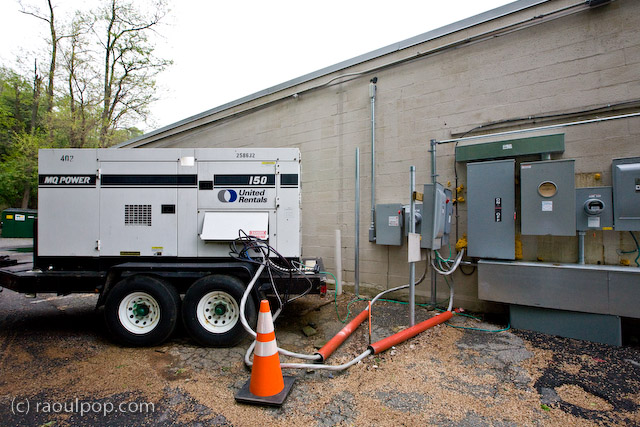
When the panel caught fire, the fire department and the police evacuated all of the stores for a day out of bureaucratic zeal, even though the fire didn’t spread inside the building. Then the store was without power for a few days until a generator was installed outside and connected to the electrical panels.

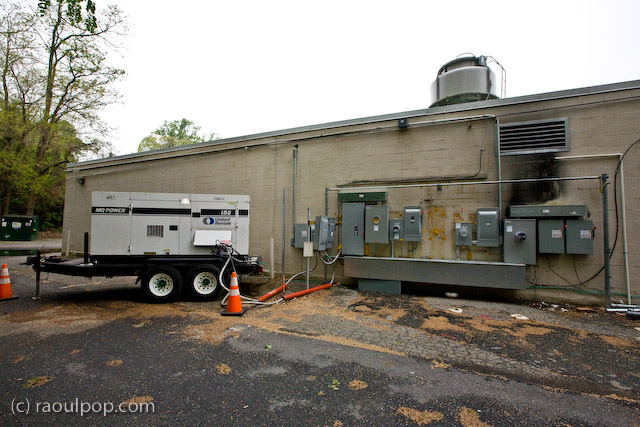
That same generator has sat outside the building since it was installed in November of last year (for over 6 months), waiting for Pepco to get off their lazy bums and fix the electrical panel. You’d think a job like this is of epic proportions, and that’s why it’s taking so long, but as you’ll be able to see from the photos, it’s something that could be done in a day or less with the proper crew.

The smoke on the wall mark the extent of the fire caused by the faulty panels. The wires that carry electricity inside the buildings weren’t damaged, because the generator is connected to them, and the store is able to feed off the generator to get part of its power. Pepco would simply need to fix the panels themselves, but they have offered up excuse after excuse during each of these six months. Appeals to their executives have not helped. The Washington Post has refused to get involved by publishing news of this complete failure in customer service.

Meanwhile, the store is paying $15,000 each month to rent the generator (with fuel charges extra), and still is not up to full power. It has had no air conditioning (only lights) all winter. That means they’ve had to do with space heaters here and there, and Ligia has frozen on many an occasion inside the studio because of Pepco’s utter laziness and unresponsiveness.

Now that summer is approaching and temperatures are climbing into the 80s, the store gets stiflingly hot (understandably so) on those days, because it has no air conditioning. Who’s to blame? Pepco, that’s who!

As if all this is not enough, the store has had the generator stolen once (the entire thing!), and on a separate occasion, it has even had the fuel siphoned off from the generator.

I have to wonder when Pepco will get their act together and fix the damned electrical panel. What will it take to get them to move on this?!

I see this as the strongest possible argument for competition in the marketplace. Pepco has a monopoly on the local power market. There is no other electrical company here, so Pepco can do whatever it pleases and get away with it. There is no one to hold them responsible. The lazy hacks can get away with treating customers like this for months and months, and no one from the local governments seems to care.

I find this outrageous, and I’m fed up with it. So the next time I hear one of Pepco’s hypocritical ads that say “We’re connected to you by more than power lines”, I’ll have to ask what they’re connected with: laziness, lies, inefficiency, procrastination, lack of customer service, monopoly, irresponsibility?

And when I see one of their trucks, I’ll know what sort of people drive them: the sort that would have people freeze in the middle of winter and bake in the summer heat rather than do their jobs.

Standard
Lists

Condensed knowledge for 2008-03-23

Standard
Reviews

The packages return… again

I can’t make this stuff up, seriously. I had another shipment of boxes returned to me by FedEx. I was using pre-printed labels sent to me by Data Robotics themselves. I sent back two Drobos to them a week ago, and the same boxes are now sitting back in my home. One was a replacement unit that didn’t work out, and another was the original Drobo that made questionable fan and chassis noises. See my Drobo review for the details on the Drobos, if you’re interested.

The re-returned FedEx packages

You may remember that one of the RMA Drobos was returned to me already. When I called FedEx this time, I was transferred to a manager who knew how to research the problem, unlike the last time. Still, all he could tell me was that he has no idea what’s going on, and he’s never seen anything like it in the system. Great… What he “thinks” might be going on is that there’s something wrong with the prepaid shipping labels, and apparently, even though the shipper and destination addresses are printed correctly on the label, the barcode isn’t correct, and is causing the packages to be re-routed back to me.

Whatever the case may be, I fed up with yo-yo packages. I want these boxes to go to their destination, and I keep shipping them out, yet they keep coming back to me. I’ve asked Data Robotics to provide me with UPS shipping labels, and will see if UPS can manage to ship them where they belong. I’ve given FedEx two chances already, and I’m not inclined to give them another.

What I’d really like to know is why this stuff keeps happening to me… Sure, it makes for a bit of “entertainment”, but it also frustrates me to no end.

Standard
Reviews

USPS, how slow can you go?

I’ve written about the USPS before, and how slow and unreliable it can be. I want to give you an idea of how terrible their service can be with hard, indisputable evidence (see screen shots enclosed below).

A package was mailed to us from a vendor on 11/14/2007. It came from Capitol Heights, Maryland, and shipped to my city, which is North Bethesda, Maryland. [For those unaware of this, North Bethesda is not officially a city (yet); it’s a borough between Bethesda and Rockville. The Post Office treats it as Rockville but anything addressed to North Bethesda will get there just fine.] It arrived on 11/27/2007, approximately 13 days after it left Capitol Heights.

Here’s the kicker: not only are Capitol Heights and North Bethesda in the SAME state, but they’re only 25 miles apart. According to Google Maps, and taking the long way around DC by going on the Beltway (I-495), it’s approximately 25 miles from Capitol Heights to my place.

How in the world could it have taken them 13 days to deliver it? I don’t know how, but there it is. If you want to talk about incompetent service, I think this would be a good example. If they’d have walked the package to my place, it would have been faster. But no, they have fleets of cars, and automated systems, and all sorts of things to speed things up, and somehow they not only manage to miss deadlines for Priority Mail and lose packages on top of that, but they bungle up a 25-mile delivery so badly that it takes them 13 days to get the package to me.

Here’s the proof. The package was supposedly processed on 11/20/07 at their Capitol Heights facility.


It arrived at my place on 11/27/07.


USPS Track & Confirm (screen 2)

But they received the electronic shipping notice sometime on the 14th, according to the Additional Details page. That means they received the package itself either on that same date, or shortly afterwards. Whether the vendor took their time to get the package to the post office, or whether it sat at the post office between 11/14/07 and 11/20/07 is irrelevant to me. Even if I give the USPS the benefit of the doubt and say they started working on the package on 11/20/07, that’s still 7 days to transport it 25 miles. It’s still unacceptable.


USPS Track & Confirm (screen 3)

Any way you look at it, the USPS is a mess. If it takes them this long to process and transport what’s essentially a local package, I suppose I should be happy it “only” takes them 7 days to get a letter from me to my parents down in Florida. That could be called an improvement on their local delivery service.

To top it all off, they want to keep increasing the price of first-class postage and other services. I’d like to know what we’re getting in return, other than copious amounts of junk mail.

Standard