Thoughts

A look at culture and technology through sound effects

I was listening to the radio one morning, and realized the sound effects they were using to advertise a website were the clicks of a keyboard likely made in the 80’s — you know, long key travel, spring-loaded action, hard clicks. But it worked.

More importantly, it is the only sound that can approximate a keyboard well, and transmit that action to an audience. Think about where keyboards are going today though. Apple is putting out keyboards that barely make any sounds — for example, see the new slim iMac keyboard, or the MacBook or MacBook Pro keyboards. Other hardware manufacturers are following suit, each advertising softer keys, more muffled sounds, etc. How do you record that? It can’t translate well over radio as a sound effect.

Remember how they used to advertise accessing the internet just a few short years ago? Through the sounds of modems. Tell me, could anyone afford to advertise internet access like that any more? No, they’d get laughed out of business, because most everyone is using high-speed access now. But is there a sound that can represent an Internet connection now? How do you represent it or record it?

What about the sound effects for phone calls? They were the simple, old-fashioned ring, right? Everyone knew what it was, and there was no confusion. Not any more. Although people still recognize the old phone ring, children growing up nowadays have so many choices when it comes to ringtones, that soon enough, the old phone ring will no longer be a recognizable sound effect for phone calls.

In some of the older movies or radio commercials, beeps, flashing lights and loud sounds were used as sound effects for computers. The starts and stops of tape reels were well known as well. What about the sounds of the punch cards, rolling through the machines and getting processed? Those are all things of the past. The only sounds computer hardware makes nowadays is the drone-like noise of the hard drives and cooling fans. It may be the representation of an efficient computing machine, but it’s pretty boring as a sound effect. Desktops or laptops (the newer ones anyway) make no sounds at all. We prize them based on how little sound they make, and rightly so, but we’ve lost the sound effects.

Remember the sound of switching TV channels? There was the manual, hard click of the round knob on the TV set (not many of you know about those anymore). If you were using a remote on older televisions, there was a sound pop, followed by a short period of static and the sound of the new channel that accompanied each channel switch. On newer televisions, that’s no longer the case. There’s no pop, click or jarring sound transition during channel switches. It’s all handled smoothly, and on some, the sound is gradually brought up to listening volume so as not to disturb you. But how do you represent a channel switch in a radio ad? You can’t, not anymore, not unless you use a decades-old sound effect.

The point of all these examples is to illustrate how technology is outpacing culture. I wanted to look at this through sound effects, but there are many ways in which it can be done. Just think of social networking sites, their invasion of privacy, and the new expectations of online behavior if you want to look at another aspect of this same issue.

One thing’s for sure — our culture has some catching up to do. While I love technology and embrace it (for the most part), we have to recognize that we’re in uncharted territory nowadays, in many, many areas of technology, particularly at its intersection with people and general culture. The rules aren’t even getting written, because no one is sure just how to grasp the situation. We each understand but a little portion of what’s going on — and that’s both scary and exciting, depending on your point of view.
Standard
A Guide To A Good Life

Fat clothes for fat people

This post is a bit of a rant, but it’s something that’s bothered me for some time. Now that I’m married, I’ve found that Ligia has the same problem as me. We have a really hard time finding clothes that can fit us. It seems that clothing manufacturers out there have geared all of their clothes production toward fat people. I would even go so far as to say that we (and by we I mean thinner people) are being discriminated against. (I’m grinning as I write that…)

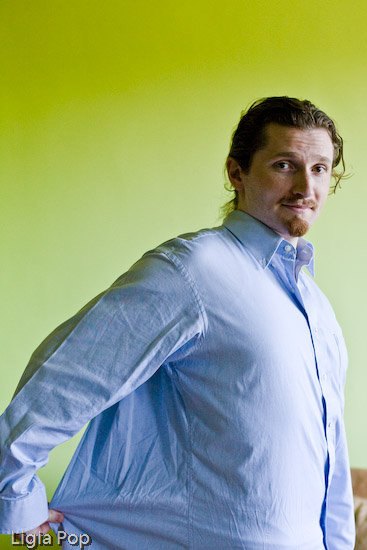
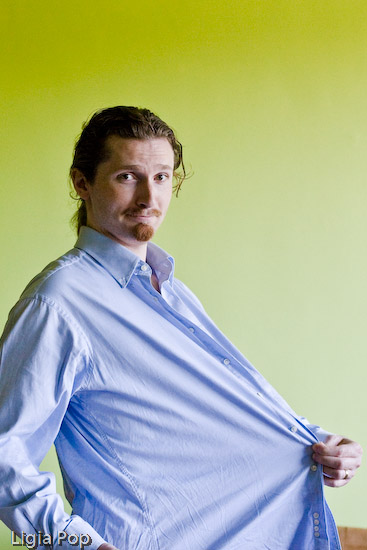
Every time we go to a department store, we can’t find clothes our size. For example, my pant size is 30″ waist x 32″ inseam. There is no such pant size in most places. I kid you not, try finding it. My shirt size is 16-16 1/2″ neck with 34-35″ sleeves. At that size, the shirt’s waist is gigantic. Somehow, they must think only extremely fat people wear those sizes. Have a look below to see how one of those shirts fits me. It’s absolutely ridiculous.

A shirt made for fat people

Ligia took these photos. As you can see, any way you look at it, there’s a ton of extra material around the waist, and on the sleeves. That material doesn’t belong there. I’m trying my best to manage a goofy expression, and yeah, I look pretty goofy…

A shirt made for fat people

I always have to find all sorts of creative ways of tucking my shirts in my pants, and I’m fed up with it. If I want well-fitting shirts and pants, I have to pay more. I shouldn’t have to pay 40-70% more for a piece of clothing simply because clothing manufacturers think everyone’s fat. Not everyone is fat!

Ligia has it even worse. She wears XS or size 2 clothing, but most of the time, those sizes are much too large for her in adult clothes. She has to go hunting around in the children’s department to find clothes that fit her. She’s a full-grown woman, past 25 years of age. She shouldn’t have to do that just so she can dress herself. We’ve honestly tried all sorts of stores. We’ve been to more expensive stores, including specialty petite stores, and still we have a hard time finding clothes in her size at reasonable prices.

I realize the trend these days is to get fat and fatter. We Americans have it too good. We’ve all got our particular excuses, but that doesn’t excuse our nation’s collectively huge waistline, and the lack of clothes in anything but large sizes.

Some people, like us, choose to remain thin, and it seems we’ve been forgotten by mainstream clothing manufacturers. We’re a persona non grata, an unpleasant reminder of what a waistline could look like. We have to shop in children’s departments to find clothes in our sizes and to get decent prices. Is it so hard to make clothes that fit us? It wasn’t so long ago when things were different. Clothing manufacturers, remember, it takes less material to dress us…

Standard
Places

Passing through Cheile Bicazului (part 2)

I realized something after I read through yesterday’s post on Cheile Bicazului a couple of times. I hadn’t included any photos of the actual mountain pass, which made my comments about how it was carved out of the rock seem a bit superfluous. That was an oversight that needed to be corrected.

This time, you’ll get to see what the road looks like. I have to confess I was too much in awe of those abrupt and incredibly tall walls on each side of me to notice the road very much. Maybe I’ll get my head out of the clouds the next time I visit the place. Till then, here’s what I’ve got.

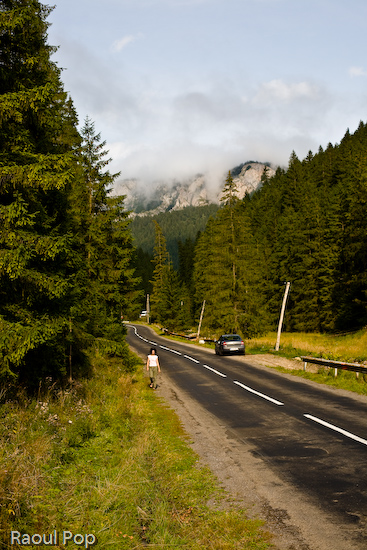
This was taken before going into the pass. You can see the fog and bad weather hovering above the pass a few kilometers ahead. That’s Ligia walking toward me in the photo.

Walk toward me

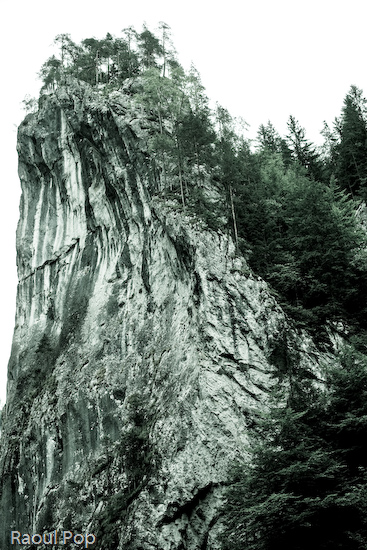
After we entered the pass, my eyes kept wondering upwards toward those impossibly abrupt mountain faces. Not only were they almost vertical, some were even leaning inward. This very next photo reminds me of an impenetrable hold, or fort of medieval times.

Hold

It’s amazing how efficient trees are at finding places to grow! You wouldn’t think it possible, but those evergreens managed to find their ecological niche growing right on sheer rock!

Find a niche

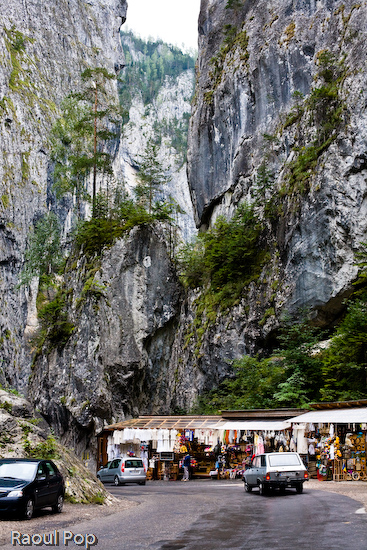
I finally managed to get my eyes on the road for this next photo. It’s narrow all through the pass as it squeezes between the mountain peaks, and there are no lane markers. At strategic points along the road, you’ll find shops that sell various folk items such as earthen vessels, carved ladles and other kitchen utensils, sheepskin vests and coats, and other such things.

Mountain shops

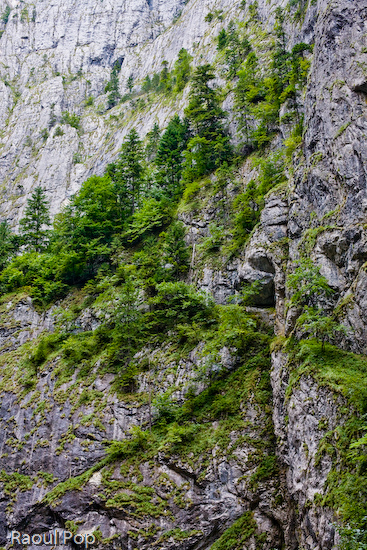
When I think of how they made the road, this photo comes to mind. Notice the deep cuts in the stone? It was by brute force alone they managed to get through that impregnable granite.

Deep cuts

This next photo will get across the sheer size of the stone walls surrounding the visitor. Those are fully grown evergreens sitting on top of that ridge!

Tall and taller

Remember the brook in yesterday’s post? That same happy little mountain brook has grown a little wider by the time I took this photo. It winds along through the pass, accompanying the road.

You’ve grown

I can’t resist showing that impressive wall of granite one more time.

Try climbing that

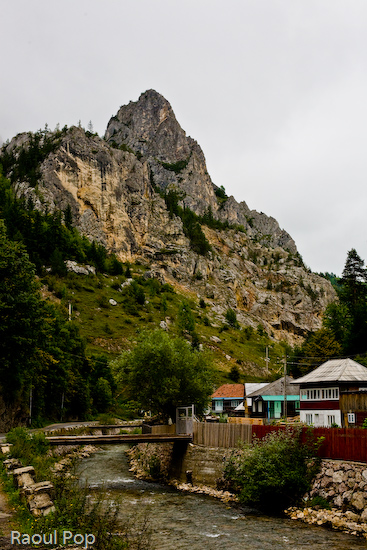
Once we made it through to the other side, the road widened, and we entered a village. Yes, that’s the very same brook shown above. Notice how high the stone walls are on either side? That bridge is also placed high for a good reason. Our happy little brook turns into a furious torrent when the snows melt every spring. The villagers need all the protection they can get to make sure they don’t get swept away with the water. It’s very possible that even that high wall doesn’t protect them enough, and their courtyards flood every once in a while.

On the other side

Cheile Bicazului is such a wonderful and photogenic place! I’ll do my best to return there with Ligia in the near future.

Standard
Thoughts

The winner of the "Object-Oriented PHP" book drawing

Trevor Carpenter… is Trevor Carpenter! I announced the drawing on Tuesday, 9/25, and the deadline was the evening of Friday, 9/24. I’m going to mail the book to Trevor shortly.

Trevor has a few websites, and they’re all worth mentioning. First we have his personal site/blog, then his photoblog, called CamarilloWalk, his professional photography site, called Scribe Photography, and finally, Photowalking, a site dedicated to photowalks. Anyone interested in organizing such events can request an author account on the site and write about them there. The goal is to turn the site into the main place to check for group photowalking events in one’s local area. Pretty cool!

Standard
Thoughts

How I handle contacts at Flickr

When you add me as a contact on Flickr, you may notice that I may not add you back. Please don’t think I’m ignoring you. It’s just that I handle contacts differently at Flickr.

I like to go through all of my contacts’ photographs. I try to view every photo they’re posting. I know that’s a rarity, but I consider it my responsibility. I’m not going to be a false contact that jumps on someone’s photo stream once in a while and comments on a couple of photos, then you don’t hear from them again for 6-12 months, if ever.

Since my time is limited, and I do try to go through every photo that my contacts post, I can only have a limited number of contacts. I’ve found out that I can handle about 100 or so contacts.

I also look for photographs that inspire me. I look for a high concentration of artistic or creative photographs in someone’s photo stream.

I also encourage my contacts to do the same with me. If you’re not inspired by my photos, take me off your contact list. There’s no reason for you to be frustrated with the photos I post. Life’s too short to be frustrated with things you can change.

Does that mean I forget about the people who’ve added me as a contact? No. I go through my Recent Activity regularly, and when I see that people who aren’t on my contact list have taken the time to interact with my photos, I return the favor.

I hope this explains my stance, and I also hope that those of you who’ve added me as a contact don’t feel offended. Feel free to contact me at any time through whatever means I’ve provided to you (phone, email, blog).

If you’d like to get to know me, a good place to start would be this blog, which is where I spend most of my time. Read my work, comment on it, start a dialogue, etc. Life is one big et caetera. It’s not limited to a contact list on one social networking site.

Standard