Thoughts

But what happens if you die?

Blood on the tracks

This is a bit of a rant, but a recent comment on one of my articles reminded of an argument I sometimes hear as a consultant. It goes something like this: “But what happens if you die?” I cringe when I hear it — not because I can’t defend it — because I find it silly.

Actually, it’s not really an argument or a question at all. It’s a symptom. It tells me that the person making it is feeling very insecure about the deal.

Here’s what I told a recent potential client when I was asked that question:

I understand the “drop dead” factor, and it’s something that my long-term clients and I talked about. The thing is, unless I drop dead while the project is in development, you’re fairly safe. Once the project is completed, another knowledgeable designer/developer can come in and pick up where I’ve left off. Even while the project is being developed, if I can’t continue for whatever reason, the work isn’t lost. It isn’t as if I write my code in some language that no one understands. A good coder should be able to understand what I’ve done and build on it.

And that’s the truth. I can’t see how that argument could possibly stand on its own feet. If you’re a good developer, are in communication with the client, you back up your work, and you have certain deliverables and a timeline tied to a project, how can the project just disappear if you should kick the bucket? Makes no sense to me. Even if I should die, my computer will still be there. My wife or my friends will be there. My source code should be there. Besides, if it’s a website, chances are I’m working on a server somewhere as well, not just in my home, so the files can be retrieved even if my computer were to crash or be locked down.

Isn’t it individuals that have driven innovation throughout the ages? It’s people doing the work and driving toward goals, people that could croak at any point, I suppose, not machines. If the same “what if” argument to them, where would we be today? If a company looking to hire someone stops to think, what if he or she dies tomorrow, where will they be? If you find a good product or a good man, do you wait a few years to see whether or not that product will disappear or that person will croak? You have to take some risk if you want to see results, and sometimes the opportunities are there only for short amounts of time.

Standard
Reviews

How houses get built in the DC area

I thought that when I lived in Florida, the construction there was shoddy. I was wrong. At least there they used concrete pillars and floors for the houses, and the building code was so strict everything was anchored properly, especially after Hurricane Andrew. When I moved to the DC area, I thought construction would be better here, since it’s a temperate climate and the houses should be built to last and hold up to the weather. I was wrong. Construction here is horribly shoddy.

I have never been so shocked at the cheap and flimsy “workmanship” I see every time I pass some house or building under construction. It never ceases to amaze me what passes code in these parts, and I’ve lived here since 2003. It’s downright thievery, I tell you. I’ll show you some photos below to help you see what I mean. I call it thievery because you’d think housing would be dirt cheap given the materials and level of effort that goes into the construction, but it isn’t. It’s terribly expensive, to the point that people making below what would be called upper middle class in other parts of the country can’t afford to live inside the Beltway, much less outside it. They have to go find housing either in bad neighborhoods, or way out in the boonies, in order to get anything affordable.

It’s not right. It makes my blood boil. Honestly, I can’t believe what goes on. It’s the same construction everywhere, from the (relatively) cheaper townhomes and single family homes right up to the McMansions that have sprung up on River Rd, Georgetown Pike and other richer places. The only thing that changes is the size and price of each monstrosity, but they’re all just as flimsy.

Do you want to see what I mean? Take a look at these photos. They’re from a house currently under construction in my area.
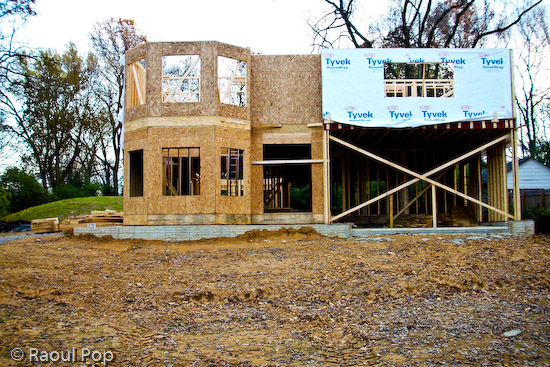
House under construction

Some unwitting soul is going to pay several hundred thousands of dollars for this piece of crap, and he won’t know what a lemon he’s getting. It’s all 2×4 construction. There’s nothing solid and concrete there except the foundation, and I’m not sure how thick that is, either. It’s all either cheap, soft wood or plywood, including the upper floor. Not only that, but the beams aren’t straight, and the joints aren’t secured properly.
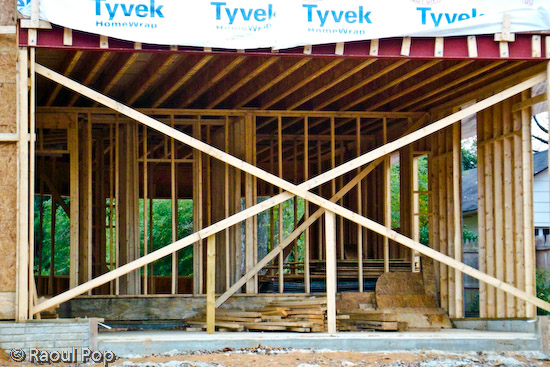
House under construction

It’s basically a big plywood box. I’m not sure what its projected lifetime is, but I can’t imagine it’ll last more than 30 years. It’ll start needing serious repairs even before the mortgage is paid off. Isn’t that terrible?

Do you see that cheap, flimsy Tyvek plastic? That’s the weatherproofing. No, I’m not kidding. That’s it. That’s also the insulation. I doubt they’ll put glass fiber or any other kind of insulation between the drywall and the beams. They might, but I seriously doubt it. I’ve seen the inside of many walls, and they’re usually empty.
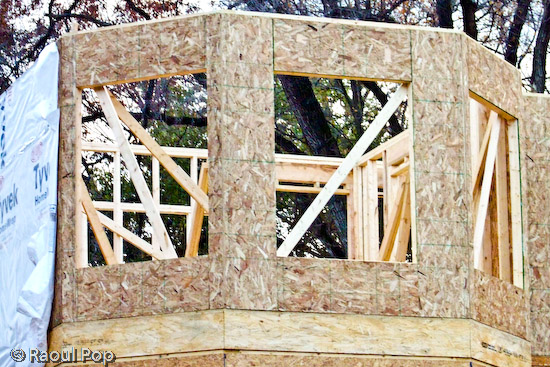
House under construction

Can you say cheap? I can. It’s cheap construction! It’s a travesty. Look at that horrible plywood shell. That’s going to be a tower. It’s going to look so nice, clad in fake brick or plastic siding only 1-2 inches thick… It’s also going to be horribly inefficient when it comes to temperature preservation. And if water should happen to leak in through that cheap brick cladding and through that flimsy Tyvek sheet, the plywood will rot away quietly and the owner won’t even know it… Wonderful, isn’t it? Isn’t this piece of crap worth mortgaging your life away?

Should we be ill-fortunate enough to get a hurricane or some tornado in our area, the roof on this thing will probably get torn off, and the entire house might or might not be standing when nature’s done with it.

Look, don’t get me wrong. I understand that America has a long history of 2×4 construction. It’s how the West was won. It’s cheap, affordable, goes up quickly, etc. But this isn’t the West, and it’s not the 1800s. This is the supposedly refined East. We should know better by now. It’s our nation’s capital. And the prices of these plywood boxes aren’t cheap. No, they’re so high most people can’t afford them.

I also understand the builders have to make a profit and the cost of land in this area is expensive. But this is ridiculous! If you’re going to build something that someone will want to call their home, and will pay dearly for it, sinking most of their productive, working years into paying it off, then God help you if you don’t build something worthwhile, something that’ll last. You’ll get what’s coming to you, don’t you worry about that…

What I wonder about is how the people and companies that put up these things can live with themselves. That’s what I want to know. How can they sleep at night knowing someone’s going to pay a fortune for something that’ll start falling apart after the first several years, for something that’s so horribly inefficient when it comes to energy use that they’ll be paying through the nose to cool it in the summer and to heat it in the winter? Don’t tell me about efficient windows! You can get the most expensive windows out there — if the walls themselves can’t conserve the inside temperature, you’ll still be nowhere. There’s such a thing as global warming to worry about. Have you heard of it? Everyone needs to reduce their carbon footprint, and it starts in the home.

Whatever happened to the good, old masonry work? What happened to quality stone construction? Yes, it’s more expensive, but isn’t it worth it? Why can’t you builders put a little more pride in your work? Why can’t you make a concrete skeleton, and use thicker insulation and better materials for the cladding? Is it so hard to do? So you’ll make a little less money. You might have to mark up the price a little. You might have to educate the consumers that know nothing about quality construction. But isn’t it all worth it in the end? Won’t you feel better knowing the house you built will last a long time? Won’t you feel better knowing the people that will buy your house will thank you for your solid construction later? Isn’t it it worth it to build good will instead of ill will?

Standard
Thoughts

Photography, take two, part three

This is Part 3 of an ongoing series of posts that outlines the work I do behind the scenes to improve my blog’s content. You can read Parts 1 and 2 as well.

I continued my work of replacing photos hosting with third party services with self-hosted ones. Here are the posts I modified:

This last post doesn’t use any photos, but I did re-edit it to make it easier to read:

As a matter of fact, all of the posts included here were either re-edited or re-written. I said it plenty of times in the past, and I’ll say it again: I want to have top notch content on my blog. I only wish I had more time to go through all of my older posts and delete, combine or re-write as needed. When I look back at some of my earlier posts (from early 2006), I cringe. They’re very short, mostly linking to other things or quoting extensively. That’s not the kind of writing that represents me. I’ll do my best to edit them as time goes on.

Standard
Thoughts

Busy, busy, busy

It’s a bit unusual for me that I can’t find the time to write posts, but that’s just what’s happening. I left home shortly after noon on Friday with Ligia to go camping with close friends of ours in the Blue Ridge mountains. Had loads of fun, and we visited Natural Bridge. I’m afraid I wasn’t very good company. My eye was pretty much either glued to the viewfinder of my 5D, or looking for reasons to stay glued to it. Took lots of gorgeous morning, evening and night photos and I can’t wait to post-process them.

Came back early afternoon Sunday and got ready for a photographic gig that same afternoon. Finally arrived home for good around 7:30 pm, exhausted. I’ve been using my spare time since to work on those photos. They get top priority since I got paid for them, which is very nice indeed. In between bouts of work, I also need to spend a little quality time with Ligia.

When you count it all up, it adds up to no spare time whatsoever — short of a trip to “Spare Oom”, where time runs on a different schedule… Perhaps I’ll get a little more time in a couple of days. Till then, I suppose.

Afternoon delight

Standard
Reviews

A tangible argument for working in RAW format

I photograph exclusively in RAW format these days — unless I happen to be using a camera that doesn’t have that capability. This post is a small but tangible example why shooting in RAW is a good thing.

Have a look at the photo below. That’s what happens when you combine dark streets, tall buildings and bright skies. It’s hard to get the exposure correctly, especially if you haven’t got the time to sit there taking lots of photos of the same thing while you adjust the aperture and shutter speed manually. If you expose for the shadows, you get an unpleasantly bright sky, like here. If you expose for the sky, you get really dark buildings, and then you can’t make out the details.

Overexposed sky

Fortunately, I can adjust the exposure of a photo (within limits) after the fact if I shoot in RAW. I can also make tonal adjustments much better than with a JPEG file. Here’s that same photo, post-processed. I only used Lightroom, no Photoshop here. (In case you’re wondering, I also made contrast and color saturation and luminance changes.)

Cafe 123

I was able to recover the highlights and even get a decent amount of detail in the clouds. Yes, you can tell the sky isn’t natural, but hey, it’s a whole lot better than a blown out highlight. And there’s still plenty of shadow detail.

If your camera lets you shoot in RAW, don’t hesitate, take the plunge. Yes, the files will be a little bigger, but you get a ton more creative capability in post-processing. And you don’t have to use Lightroom or Bridge if you can’t afford them. (I know Bridge is free but you need Photoshop or another Adobe app to get it.) Both Picasa and iPhoto will work with RAW files. One caveat about iPhoto: at the time of this post, it does NOT work with DNG files (Adobe’s own RAW file format). It does, however, work with Canon, Nikon and other RAW formats. Your camera may also have come with software that lets you develop and manipulate the RAW files. Get started exploring this new medium — it’s the equivalent of a film negative — and have fun improving your photography!

Standard