Thoughts

Migratory state of being

Every single day, I go around with a little pain in my heart. It’s the sort of pain that only certain people can understand. These people are called immigrants.

Sometime this month, a familiar date will pass, and I’ll know that I’ve been in the States for 17 years. I’ve been a naturalized citizen for a number of those years. Born and raised in Romania, I came here when I was almost 15. I’ve lived the better part of my life in this country, and yet I still do not feel entirely at home. The States feels familiar, but not familial; it feels like I belong, but I don’t entirely fit in; it feels like home, but I don’t feel at home.

I envy Americans born here, I really do. In some ways, they’re better off than me. They feel something, every day, which I cannot feel; they may not realize it, and they may not even appreciate it, but they feel at home. It’s a priceless sort of feeling, and you don’t understand its true value unless you’re away from home.

It’s a painful way to live. I look around me, at those fortunate enough to have been born here, and they haven’t got my problem. They are at home no matter what part of this great big country they happen to live in — especially those that have been born, raised, and now work in the same cities or regions. They benefit from familiarity with customs, habits, lifestyles, places, people, language, traditions — all those things that make home feel like home. If they’ve moved to another part of the country, no matter how different they think it is, it’s still the USA, and it’s still the same country. Some things still apply, and the overall feeling of home is there.

Although I live in the DC area now, and have done so for the last 4 years, I spent most of my years here in the States in Florida. Still, it doesn’t feel like home. Sure, I know the streets and the neighborhoods. I know the cities and the beaches. When I walk or drive down a certain street, memories from my life there evoke certain emotions that make it familiar. The best word to describe that kind of a feeling is comfortable. When I step into my parents’ home down there, I get the closest feeling of home I can get here in the States. It’s relaxing and peaceful, that’s true. But it’s still not home. And I think my parents understand what I mean, since all three of us came to the States as a family back in 1991.

It would be logical to assume that Romania would feel more like home, since it’s where I was born and raised. You’d only be partly correct. Yes, when I go back there, I feel more at home than here. The strings of my heart vibrate at the same frequency as my birthplace. When I’m there, the air is sweeter, the food tastes better, interactions with people are more meaningful, every sensation is accentuated by the vibrancy of my home land. Sleep is more restful, and life takes on a new, familial rhythm. I feel a peace that I cannot feel here. Yet I do not feel at peace.

There’s the awful rub. In the words of Charles Laughton from the movie “It Started With Eve” (1941), “I’ve been tampered with!” I’ve spent so much time in the States that I’ve grown accustomed to the way of living over here. Not the comfort and abundance of products, though that’s part of it, but the way of life, of doing business, of approaching situations. I no longer fit in, in Romania, and I still do not completely fit in over here, after 17 whole years.

I can function just about anywhere, but am at home nowhere. I’ve got a mongrel heart, a split state of being, and it’s a sad, painful way to go through life, at least for me. A piece of me exists in each country, and I’m forever torn between the two.

It must be even worse for Ligia. She’s only been here for 4 years. She spent her entire life in the same region of the country, in a very close-knit family, among friends and relatives, and the only reason she left all of that was to be with me. It’s probably safe to describe the way she feels every day as home sick. At least she’s lived enough in one country to know which one feels more like home. Although the more time she spends here, the more she’ll bond with this country, till she’ll be just like me, a mongrel spirit.

I think of the pilgrims that came to the new continent from Europe, hundreds of years ago. I wonder how they must have felt, knowing that the likelihood of ever going back to their home lands was next to nothing, and having to face the rough conditions that awaited them in untamed territories. Perhaps the tough lives they led, and the blood, sweat and tears they put into eking out an existence bonded them more to their new homes. Or maybe they sat down on quiet evenings and silently bore pangs of sorrow over the distance that separated them from their birthplaces and ancestral homes.

Then I envy their children, who didn’t (and don’t) have to worry about any of those things. And I yearn for the normalcy and peace which I don’t think I’ll ever reach.

Standard
Reviews

Vista SP1 addresses some of my previous frustrations

I’ve had Vista SP1 installed on my machine for a week or so, and I’m pleased (surprised as well) to see that Microsoft addressed some of the issues that have frustrated me in the past. I guess when your expectations are low, any step toward something better is noticeable.

If I sound somewhat bitter, it’s because the SP1 install was problematic. I detailed that ordeal previously (you’re welcome to read it if you’d like). Basically, it had to do with language pack installs, which caused the prep time for the SP1 install to take several days instead of 15-30 minutes.

Once the extra language packs were out of the way, the actual SP1 install itself posed no issues for me. I’ve heard plenty of horror stories, but for me, the experience was normal, if somewhat protracted. Once the computer finished the three install steps (2 pre-reboot, 1 post-reboot), my machine was up and running with SP1.

As I began to use it, the first thing I noticed was the correct calculation of the RAM present in my machine (see screenshot above). That was a nice little surprise. I found it frustrating (pre-SP1) when the BIOS said I had 4 GB of RAM, yet Windows could only see 3,069 MB of RAM. It didn’t make sense. Now that’s fixed, although, as Ben Watt points out in this comment, Vista will still not use all of it due to 32-bit limitations.

Boot-up times also seem to have improved. I haven’t done any stopwatch testing, but I don’t find myself sitting around twiddling my thumbs as much when I need to reboot. That’s nice.

More importantly, I am now able to do something which I couldn’t do pre-SP1, even though it was an advertised feature of Vista: back up my machine (see screenshots above). That’s right, before SP1, a full PC backup was impossible. There was a bug that didn’t allow you to go through with that operation in Vista Ultimate. Now that’s no longer the case, and I’m happy to say I completed my first full PC backup this afternoon.

I also understand that Microsoft is now making Vista SP1 available in more languages, which will help reduce the language uninstall times for those people who were unfortunate enough to install the optional (or in my case, required) language packs.

Furthermore, they’re offering free, unlimited SP1 install and compatibility support, which is laudable — but given the fact that one has to jump through hoops to install SP1 — also needed. In my case, I doubt they could have helped. After all, what I needed to do was to uninstall the language packs, and Microsoft made the uninstall process so freakishly long that all I could do was to either stare at the screen, fuming, or take a walk, then come back to find it still going on…

What I do not approve though, is the way they’re trying to get the word out about Vista and SP1. They’re doing it through an internal (leaked?) video that makes me want to pull my eyes out. It’s as if they’ve learned nothing from the Bank of America video debacle. Worse, it’s as if they took that video and did their best to outdo it. They succeeded all right, in a very sad way.

Standard
Reviews

Hardware review: Logitech Alto Connect Notebook Stand

I bought two Logitech Alto Connect Notebook Stands (with 4-Port USB Hub). One’s a keeper and the other is going back. I love its design and functionality, but there are a couple of things that you need to know if you intend to buy it.

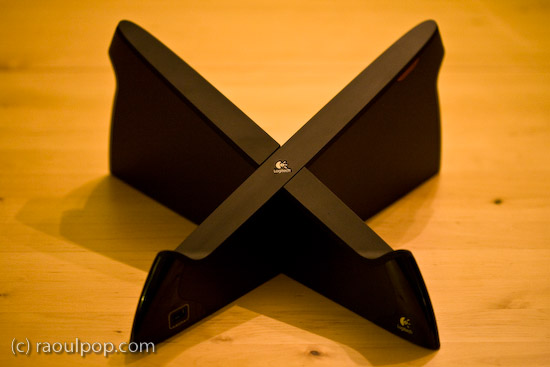
This innovative stand is shaped like an X and wrapped in glossy, black plastic. Does the shape remind you of anything? How about OS X? Or the X-Men? Or the old saying, “X marks the spot”? Not that Logitech is copying anybody, but that shape looks cool, is very different from any other laptop stand on the market, and supports a larger amount of weight, meaning it can work with heavier laptops.

The stand comes unassembled in the box, and you must put the two pieces together (they dovetail precisely). The assembly time is 1-2 minutes or so. It may take you a try or two until you figure out the right way to join the two pieces together (there’s a 50/50 chance you’ll get it right the first time).

An added benefit of this stand is the addition of a built-in USB hub. The hub is self-powered, meaning that you’ll need to plug in a small adapter (included in the box). One port is located on the left front leg of the stand (visible above), and the other three ports are in the back, as you can see below.

As I said, I love this stand, and I think the design is wonderful. I have a lot of respect for Logitech. I’ve used wireless keyboards made by them, Kensington and Microsoft, and Logitech has consistently stood head and shoulders above its competitors when it came to battery life and ease of connectivity. I have a Logitech wireless keyboard and mouse set right now, have been using it for almost two years, and have nothing but good things to say about it. Last, but not least, I like Logitech because they use ColdFusion on their website, and CF is my favorite programming language. 🙂

I bought the first one of these stands for my father’s MacBook, and it works just great with it. The X-shape allows for greater cooling than the flat stands, and it blocks none of the laptop’s ports. My father uses it happily. I noticed an issue with the built-in USB hub though, as soon as I started using it.

I have a Western Digital Passport drive, which I carry pretty much everywhere. That drive has worked with any computer where I’ve used it. I love it. It’s powered directly by the USB port, and that’s where the issue lies when it comes to the Logitech Stand. Right after I plugged it in on my father’s stand, I got a message on-screen (on the laptop) telling me that the USB port where I’d connected the USB hub had experienced a power surge and was shut off. I had to unplug the port from the laptop, and re-connect it without the drive.

Let me clarify. The USB hub built into the stand is self-powered. It has its own power supply. It should be able to power just about any USB device. Why then did it draw power from the laptop when I plugged in the drive? Obviously the design of the hub is defective in some way if every time you plug in port-powered devices like the WD Passport drive, it causes a power surge in the USB circuitry. The only way I could get the drive to connect to the laptop was to plug it directly into the laptop, which I did, and it had no problems there.

The only time when I’ve had issues with port-powered devices was when I plugged them into USB hubs that had no power supplies of their own. On those occasions, the devices would draw power from the hub, which would then draw too much power from the laptop’s USB port, would cause a small surge, and shut off the port. But when you have a self-powered USB hub, this simply shouldn’t happen.

Just so you’re not confused, let me state outright that USB flash drives, which have no moving parts and thus draw much less current, can be used just fine with the built-in USB hub in this stand. And USB drives which have power supplies of their own (the regular 3.5″ drive enclosures of products like Drobo or LaCie) will work just fine with the hub, too.

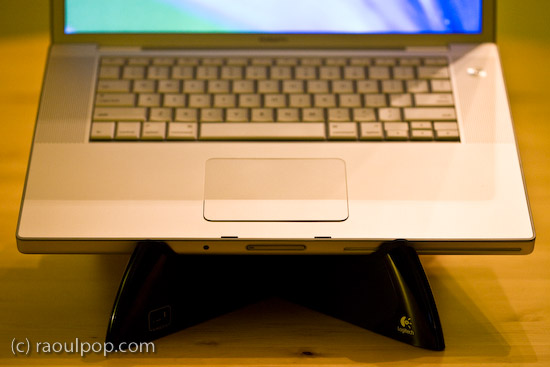
Second, although the stand will work with pretty much any laptop on the market, it will not work with the MacBook Pro line. That’s because it blocks the CD/DVD slot on those laptops. I didn’t realize this until I bought the second stand to use with my 15″ MacBook Pro, which I’d just bought as well. I brought the stand home, sat my laptop on it, and this is what I saw.

Oops… While I appreciate the need for a built-in USB hub (even a half-working one) on a laptop that has only 2 USB ports, I’m going to return this second stand. I’m not going to take my laptop off the stand every time I need to burn a CD or play a DVD. Incidentally, on the Logitech website, this stand is recommended for Windows, not Apple computers, but I bought both stands at the Apple Store, so I doubt Logitech intended it only for the PC market.

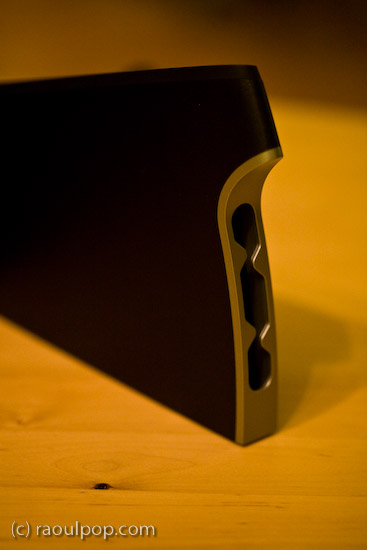
Otherwise, like I said, I really like this stand’s innovative design. It’s beautiful, functional and sturdy. It even has a built-in wire routing slot, which is a nice touch.

And let’s face it, it complements very nicely the design of just about any laptop.

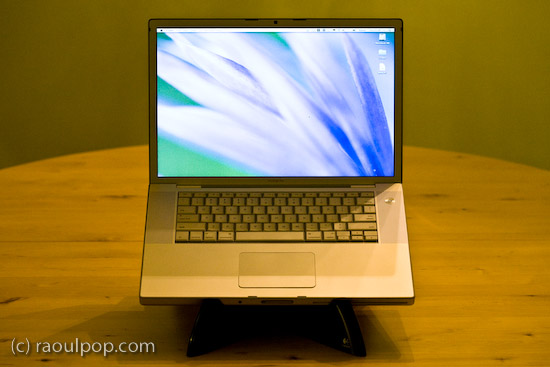
If you don’t have a MacBook Pro, and you don’t mind the USB surge issue with the built-in USB hub, then give this stand a try, you might like it quite a bit. Have a look at the other photos in the gallery below to get a better idea of its looks.

One more thing… The good thing about the way it raises the laptop is that the height of the front lip is low enough to let you type directly on the laptop without discomfort, but the height of the display is high enough for you to maintain proper posture. Of course, you can also use it with a separate keyboard and mouse if you’d like.

Buy the Logitech Alto

Standard
Reviews

Theodora Goes Wild (1936)

Movie poster for Theodora Goes Wild.

One of the many wonderful comedies made during the Great Depression, Theodora Goes Wild explores a young woman’s quest for freedom in a society where tight constraints are the norm. The film’s humorous and entertaining look at some of the hang-ups of the period is a very fun way to spend about 90 minutes. Interestingly enough, we discover that not many things have changed since. Gossip still rules, small town folk are always too interested in each other’s lives, and people still yearn to live their lives the way they see fit.

Theodora Lynn, a respected daughter of the town’s prominent family, has written a book called “The Sinner”. It’s a wildly successful look at the life of an imaginary woman who does things her own way, very much unlike Theodora. She has penned it under the name Caroline Adams, to protect her identity. Meanwhile, the town is in an uproar over the scandalous morals of the book’s main character, all the while unaware that the very same young woman that plays the organ in church every Sunday morning and obeys her aunts to the letter is the author of said scandalous book.

Theodora visits her publisher on an occasion, and while there, meets Michael Grant, played by Melvyn Douglas, a debonair artist who works for the publisher but is very informal. He takes an immediate liking to her, and coaxes his way into having dinner with her and the publisher that evening. During dinner, he gets her to drink (which she never does) and as she unwinds and lets loose, he enjoys his little game more and more. He decides to pursue her back to her town and “free” her, as he puts it. He succeeds, but he has unleashed a force greater than him. She now intends to “free” him.

The film’s gloriously funny twists and turns had us in fits of laughter throughout. And the skewering of the old biddies in that small town was great fun too! The film showcases Irene Dunne’s incredible talent for comedy and sexiness (it’s no wonder she made such a great on-screen pair with Cary Grant), and fits Melvyn Douglas to a tee. He has an endearing quality that shows through his devilish smirks and his on-screen antics. That same quality made him perfect for the role of Leon in Ninotchka (opposite Greta Garbo) three years later. I can safely say that he’s become one of my favorite actors.

Just one year later, Irene Dunne made The Awful Truth (1937) with Cary Grant, one of my all-time favorite movies. It’s so funny to see her honing and refining the same skills she used to great success in that movie while watching this one. The same little trills of laughter, the same thin smiles, the same looks, glances… It’s wonderful to catch great actors doing some of their best work. It’s time well spent to watch them act.

There’s an important lesson to be learned from the movie as well. It’s easy to forget nowadays how stifling society used to be, and how scandalous certain behaviors were considered just a few decades ago. To some extent, that was a good thing, but it must have driven some people mad with frustration. Nowadays, things are much more relaxed, although we still tend to be judgmental. It seems we always want to tell others what to do and what not to do. Sure, it’s important to point out what’s morally and ethically wrong, but that’s the duty of our parents and families, NOT our neighbors and townsfolk. I don’t believe in the saying that “it takes a village to raise a child”. No it does not! That sort of a village would be the quickest way to get me to rebel if I were still a child.

It’s also important to point out that while Theodora rebelled against the gossipy old biddies and against society, she did it all with a purpose, all while not compromising her own morals. She did not demean what she saw as her true worth. She simply put on a show to prove a point, and she certainly proved it. That’s something to keep in mind for the young people of today, who are so ready to step over any rules they might have set to get at what they want. Sometimes there are horrible consequences to that sort of behavior. If you watch the movie, you’ll remember that Theodora kept “both feet on the ground”. Keep that in mind. Have your fun, achieve your dreams, prove your point, but don’t do something you’d later regret.

More information

Standard
Thoughts

Wondering why I write less these days?

I came to the realization that too much work around the clock is not a sustainable lifestyle. When you hold down a full-time job, write on two websites, have a consulting practice and you’re also a photographer, there’s little time to decompress. And I’m determined to carve out more time for relaxation. I have to. It’s not really a choice. My body is telling me so.

It’s nice to see that a few weeks after I started writing less, other, more authoritative sources, have chimed in with their findings, validating my own thoughts. It’s not like this stuff is new. People have been saying for decades that our American lifestyle moves too fast. And I noticed the effects of too much work on my own body back in December of 2006, but failed to take proper action.

Now I’ve done something about it. I’ve rearranged my schedule so that my wife and I spend more time together. I work from 11 to 7 instead of the usual 9 to 5. Just one of the benefits is not having to deal with rush hour traffic during my commute. In return, Ligia and I use some of our free time to exercise, or just spend time at home. I write less, and I publish less photos. And I’ve cut back on my consulting work.

Sure, I miss not being able to say everything I want to say and giving full outlet to my creative side, but my health is more important than a few paragraphs or photos. There are real, tangible benefits to be gained from slowing down. Life gets more manageable, more enjoyable. I realized that in the end, I’m the one that sets the pace, and if I don’t take the initiative, I’ll keep going full tilt till I crash. I don’t want that to happen.

Standard