Exercise

My progress from December 2012 to March 2013

First I’d like to say this: for those of you uninterested in bodybuilding and wondering why I write about the subject on my site, it’s for three reasons:

  1. I began weight training in 1994-95 and am still passionate about it, many years later. My interest in weight training and bodybuilding pre-dates this website by about seven years. 
  2. I am a raw foodist and I want to prove that you can build serious muscle on raw food. For me, raw food means a mix of 20-40% cooked vegan food, with the rest made up of raw vegan food and superfoods. My protein supplementation is about 75% raw vegan and 25% vegan.
  3. I’ll turn 37 this year and I want to prove that one can build muscle at this age and even beyond it.

Last autumn, I started going to the gym regularly once more, with the specific purpose of building muscle. All summer long, I’d been exercising at home, using Arnold’s 1% Workout, getting my body ready for weights. And that’s one thing I’d like to stress right now: if you’ve been off weights for a while, years maybe, like me, you’ll need to get ready for weightlifting with a few months of bodyweight exercises. Don’t just go to the gym and start lifting, you’re asking for unnecessary inflammation, pain and potential injuries.

From September to the end of October, I made great progress. My muscles started remembering their previous size and began to grow again. I was on my way to wonderful results, sooner than expected, until an unexpected injury sidelined me, right at the start of November. This was completely unrelated to bodybuilding. We were doing renovations at home, and the workmen had dug a trench in the garden to lay some new pipes. They forgot to tell me. We came back home at night from an out-of-town trip, I took a walk through the garden in pitch black darkness and fell right in. It was a strange feeling, stepping into a void… When my foot hit bottom, I heard a terrible crunch and then the excruciating pain began… The force of the impact pulled on my ankle ligaments so much that it fractured both the tibula and the fibula at their ends. (The medical term is bimalleolar fracture.) It snapped one of them clean off and the other managed to hang on.  Let’s just say I have a nice zipper-shaped scar on my ankle and a couple of extra titanium screws in there. I’m thankful that the ligaments didn’t tear, because the recovery would have been more painful and would have lasted longer. Here’s the x-ray after surgery.
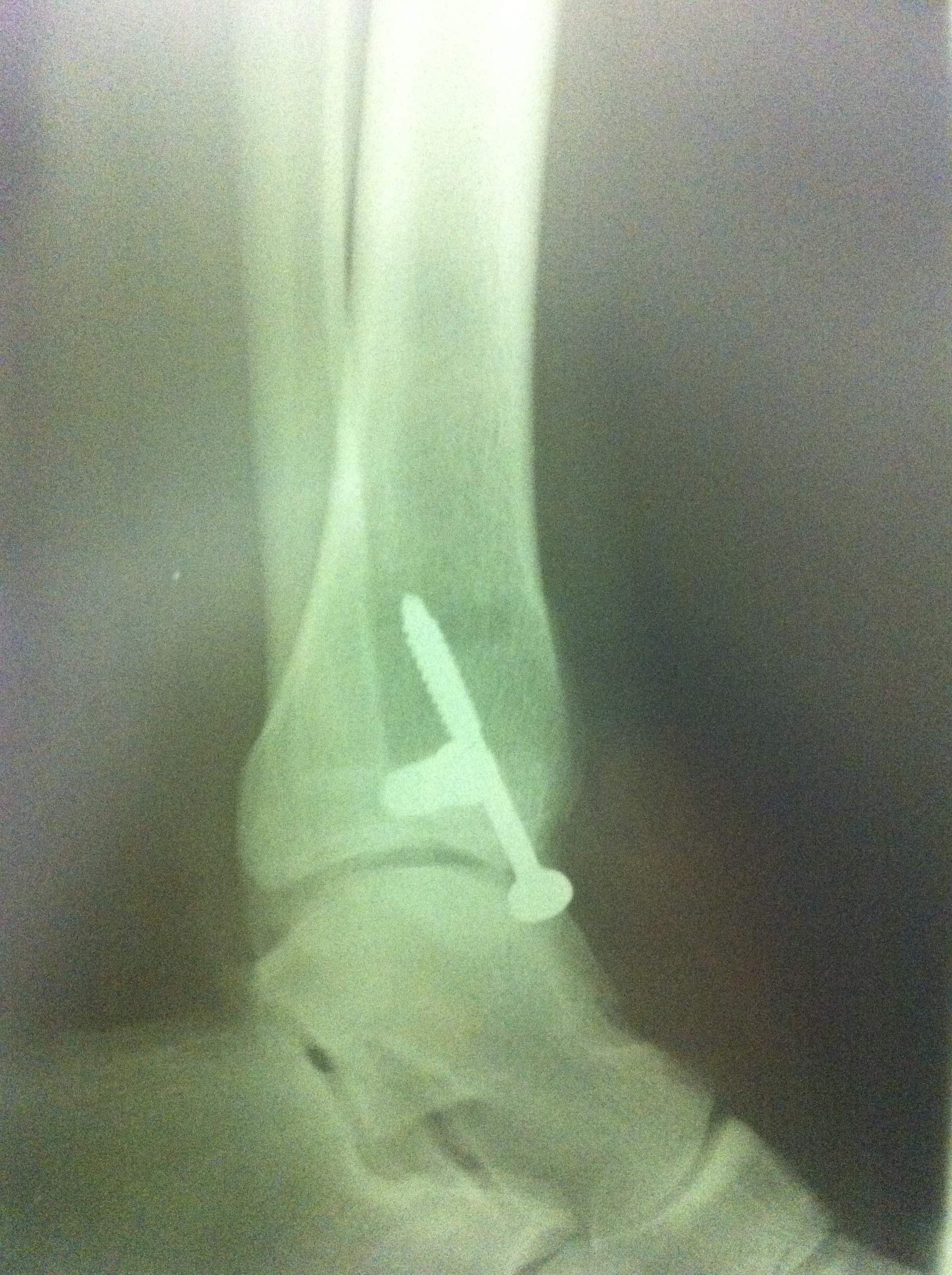
ankle x-ray

I was told to take it easy after the surgery, so two months of what would have been fruitful weight training went down the drain. I finally couldn’t take it any longer after the holidays and went back to the gym on crutches, hopping around on one leg from machine to machine, training what I could train without affecting my ankle.

Things got better soon after that. I also went to physical therapy, did acupuncture and my ankle is almost fully healed now. There’s still some soreness in the mornings, some swelling still has to disappear but I can use it: I can do standing and sitting calf raises, I can walk normally and will soon be able to run and jump as well.

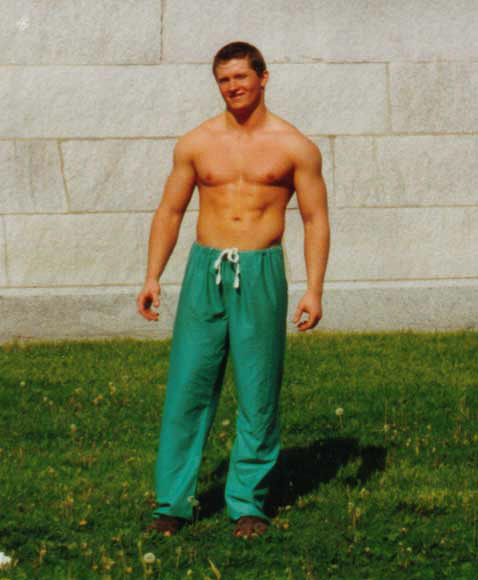
It’s now March and I wanted to show you the progress I’ve made since the start of December. I do wish I’d have taken a photo of my body earlier, at the start of my weight training, but I didn’t. The best I can do is this photo, taken in September on a trip to Lake Vidraru. You can clearly see that I have little muscle mass and my arms are pretty thin.
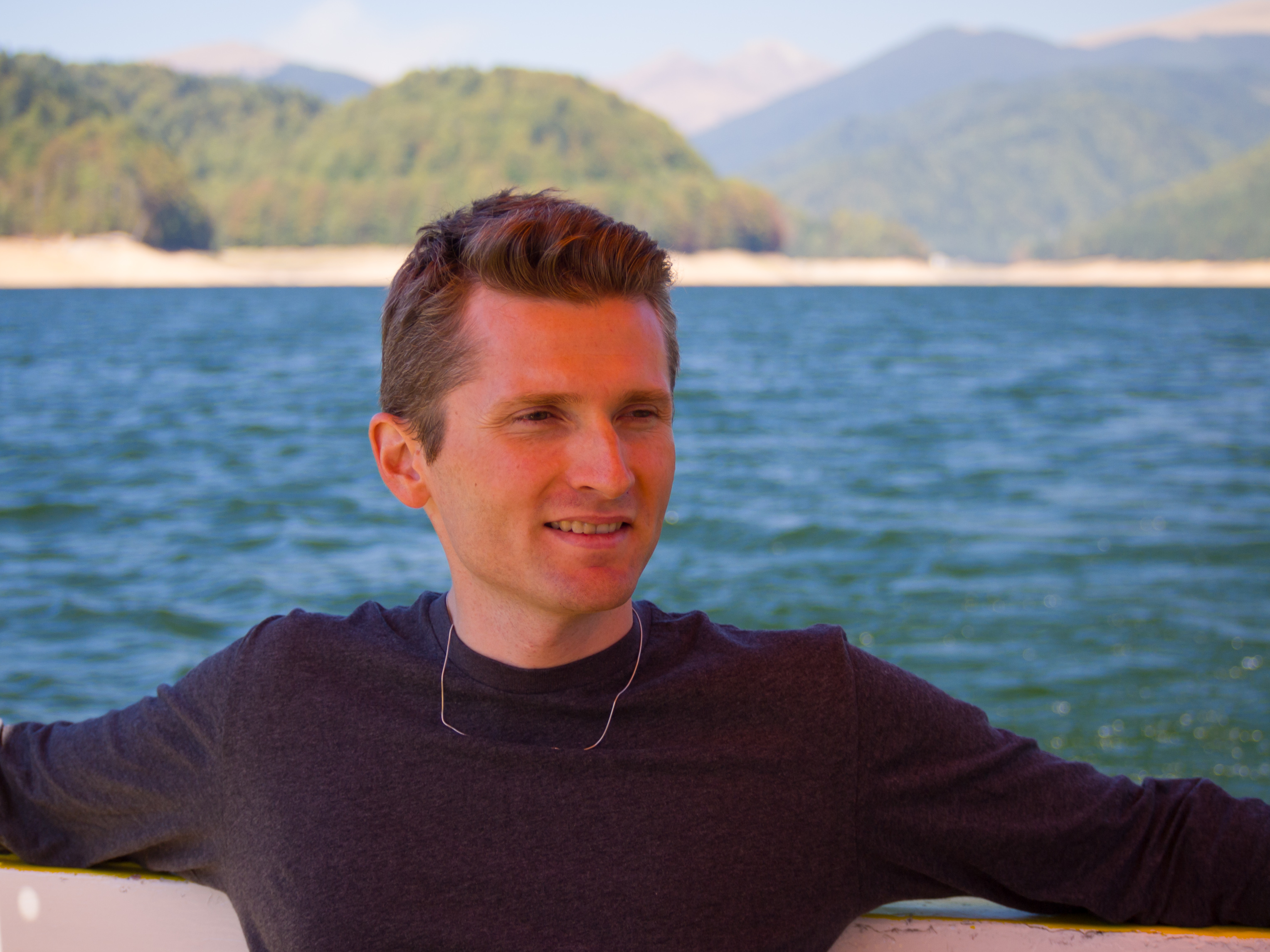
Raoul in September 2009

Now let me show you a much better example of my progress.
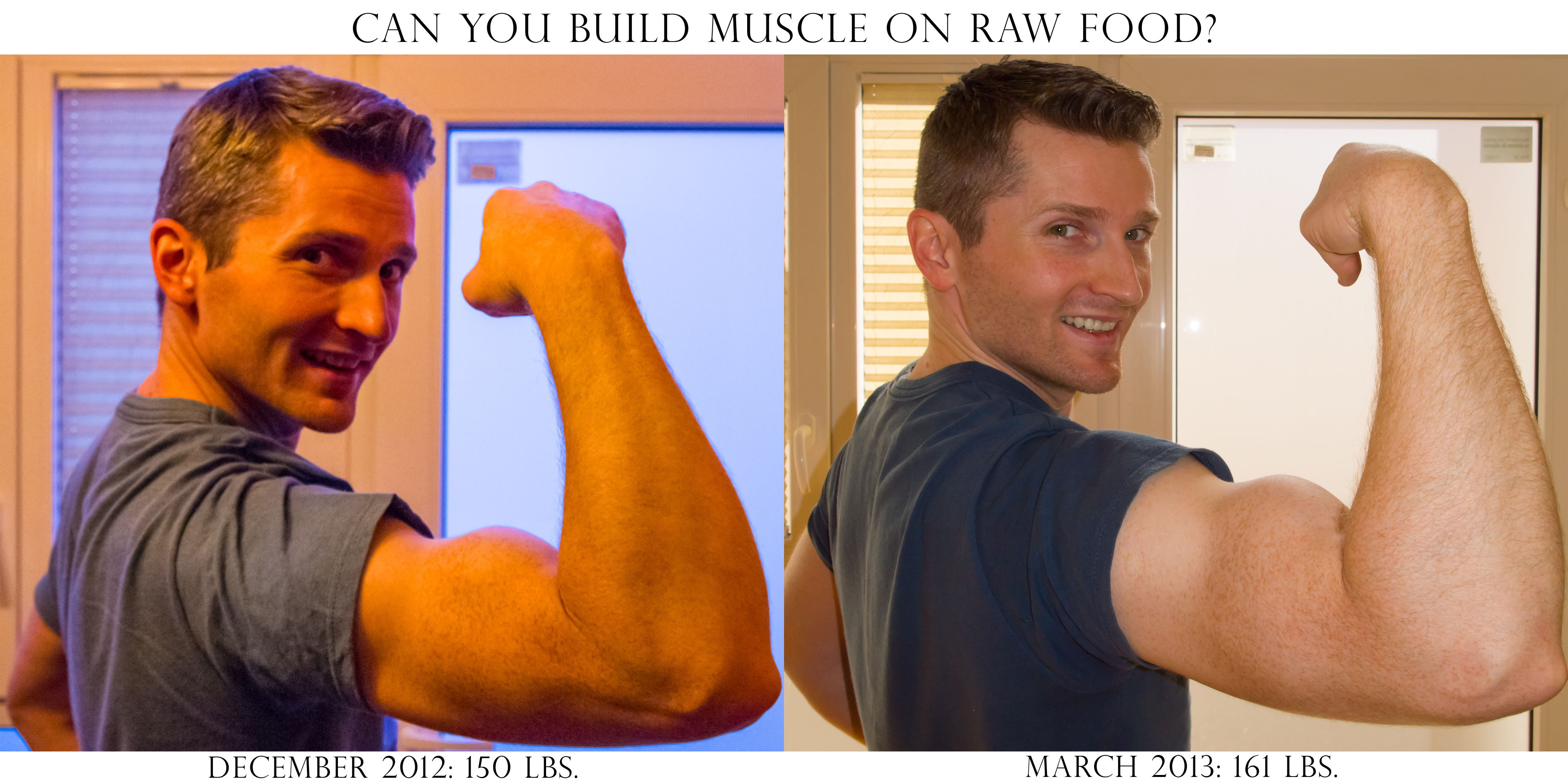
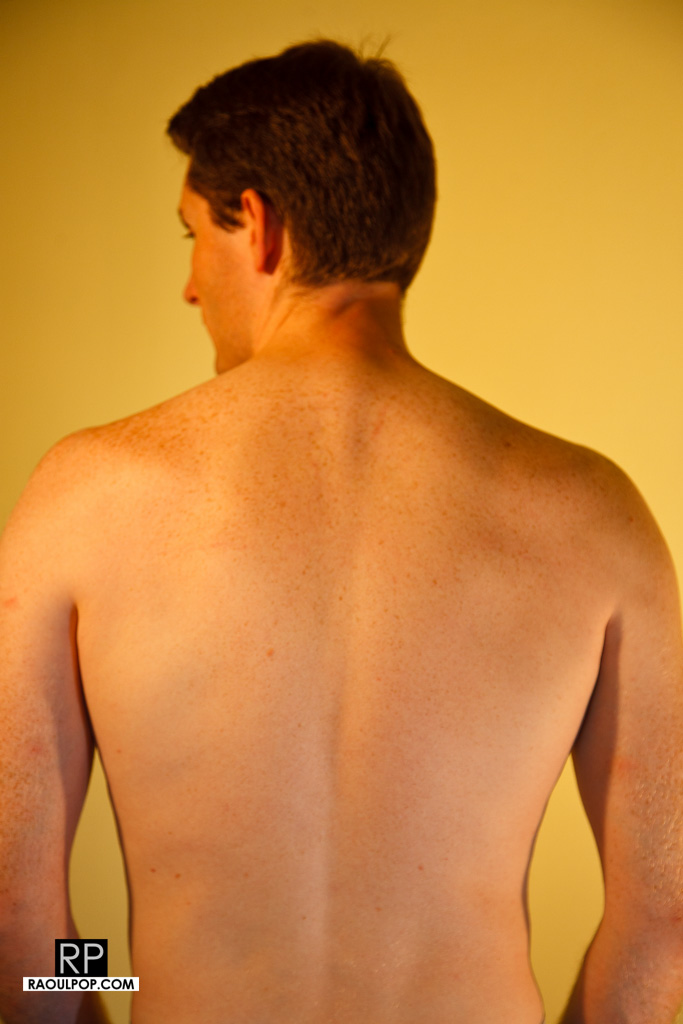
My progress from December 2012 to March 2013

Here you can clearly see that my arms are much thicker and my back is thicker, justifying the ~10 lbs. of weight I put on. And I can assure you that it’s all muscle; if anything, my body fat is lower now.

This is only the beginning. I plan to add muscle mass until I get to 200 lbs. It’s not so far-fetched as you might think. In college, I went from a skinny ectomorph of 135 lbs. in my freshman year to a muscular mesomorph of 195 lbs. in my senior year. Granted, I did it on a traditional diet of meat, dairy, eggs and vegetables, but I know it’s also doable on raw foods. If I got to 195 lbs. once I can do it again and I can go beyond it as well. I can do it on raw foods and more importantly, I can do it without steroids or other illegal substances. My body is perfectly capable of secreting all of the hormones it needs, as it did so in the past and will continue to do so in the future.

Wondering what my diet looks like? Here’s a peek.

I may also do a workout video (or videos) in the future.

Standard
Exercise

My Wonder Smoothie Recipe

Those of you who’ve only followed my website for a few years or less may not know it from the current content, but the very first set of articles I wrote online were about exercise and bodybuilding, back in 2001. Go ahead, browse through my archives to see what I mean.

Given that I’ve started bodybuilding once more in recent months, it’s only fitting I write about it again, this time to share my Wonder Smoothie recipe. It’s what I use to recover from my workouts and build muscle. The best part of this smoothie is that it uses raw food ingredients, so anyone can drink it, whether they’re raw foodists like me, or vegans, vegetarians and meat eaters.

That’s right, you may not think raw food and bodybuilding go together but they do. Since I’ve started bodybuilding again, I’ve been amazed with my progress and ability to put on lean muscle in just a few months, while on a 60-80% raw food diet (and some cooked vegan food). I’m going to share my special list of superfoods and ingredients with you below, and I hope my Wonder Smoothie will benefit you as much as it has benefitted me.

Muscle Building and Workout Recovery Smoothie:

  • Chlorella: 1 tsp
  • Spirulina: 1 tsp
  • Mesquite: 1 tsp
  • Gynostemma: 1/2 tsp
  • Baobab: 1/2 tsp
  • Suma Root: 1/2 tsp
  • Triphala: 1/2 tsp
  • Rose Hip: 1/2 tsp
  • Methylsulfonylmethane: 1/2 tsp
  • Coconut Butter: 1 tsp
  • Hemp Seeds: 1-2 tbsp
  • Sesame Seeds: 2-3 tbsp
  • Alkaline Water: as needed
  • Raw Honey: as needed
  • Raw Protein: 11/2-2 scoops

The instructions are simple: blend the sesame and hemp seeds with water and honey first to get the raw milk. Then add in the rest of the ingredients and blend the whole thing again to a typical smoothie texture.

And here’s what I look like these days…

Standard
Exercise

Let’s change the way we think about Training to Failure

In August of 2001, around the 1-year anniversary of my website, I wrote two articles. The first was titled “How to Keep Your Exercise Goals” and the second, “Finding the Right Resolve for Exercise“.

I wrote the articles after working out seriously and regularly for over 7 years (at the time), so the insights I laid down in them were solid. As good as they were, I was to discover another great insight about exercise, which was to affect me years down the road. It relates to both topics (exercise goals and the resolve to keep them).

It’s about the principle of weightlifting known as “Training to Failure“. You can watch the video or you can read the script (with some slight modifications) below.

I started doing this while in college, as I tried a lot of things in order to grow. I would train to failure on all sets (other than warm-ups) or just the last sets of my workouts, depending on my stamina and my drive on a given day.

Training to failure yielded results, no question about that. Pushing yourself to the limit often helps you discover new limits, beyond what you thought was possible. Coupled with good nutrition, plenty of rest and a proper, serious workout schedule, training to failure will yield results.

In part, it was responsible for my impressive gains in muscle mass and strength. Here’s what I looked like in September of 1994. There’s no way to get around it: I was a pencil-neck. I’d done a lot of swimming in high school and while it’d made me taller, it didn’t add any bulk at all to my body.

In September of 1994, just starting college.

And then here’s what I looked like in May of 1998.

In May of 1998, after a workout.

Big difference, right? That was an increase in weight from 135 lbs. to 195 lbs. and strength gains that went through the roof. I should clarify that I did not take steroids to look like that. I worked out to my limit and beyond, every workout, ate a lot and rested a lot (when I didn’t pull all-nighters to study for exams).

So, training to failure is a good thing, right? Not so fast.

As a practice, it’s a wonderful thing. You’re pushing yourself to the limit. Great! As a name, it’s bad.

Why? Because it’s insidious. The term “Failure Training” or “Exhaustion Training” crawls into your brain and slowly but surely, it begins to affect your attitude toward going to the gym and lifting weights. It takes years, but it’ll happen.

Unless you’re aware of what I’m telling you here, you won’t know why, but workouts and weightlifting will start to become boring to you. You’ll find yourself saying, “What’s the point? I’m lifting these weights up and down, it’s the same movements all the time, I repeat them till I can’t do any more, then I rest for a while and start over again. This is useless, there’s not future in it.”

I’m here to tell you that’s not you talking. You’re doing your part. You’re going to the gym, you’re lifting the weights, you’re eating right, resting, staying informed; you keep at it, but you’re discouraged.

What’s going on is that you’ve got faulty programming in your mind. You’ve gotten so used to the “failure training” that all training has become a failure for you. That’s how your mind now thinks of exercise, and you’re in a terrible situation.

Whoever called it “Training to Failure” made an unfortunate decision. Thankfully, we can fix it, but it’s going to take a bit of effort.

First, let’s start referring to it as “Expansion Training” or “Growth Training“. Make up your own name for it if you want, but it’s got to be something positive, something that encourages you to go on and is a good thing for your mind to recall. It’s got to help you visualize the results you want.

Think about it. Does “Failure Training” help you visualize big muscles or more strength? Not likely. But does “Growth Training” help you see more, bigger muscles? How about “Expansion Training”? Does that help you visualize breaking limits, expanding what you thought was possible?

There’s nothing wrong with the practice of training to exhaustion or to failure. It’s a wonderful thing. We just have to change the way we refer to it, and once we do that, a lot less people who are currently using the technique will get discouraged long-term.

I am currently in the process of trying to change my own thinking on it, after finding out the hard way why I lost the drive to work out years ago. This very thing was one of the reasons.

You may not think simple words can have that sort of power, but when you combine them with effort, pain, visualization and time, those insidious words can have an awful effect. That’s why a positive name change is so important, and it should have been at the top of the list when this technique was invented (or named).

Every time the term “Exhaustion Training” or “Failure Training” comes to your mind, replace it with “Expansion Training” or “Growth Training”. Every time you employ the technique and you push your body to the limit, visualize the positive: your muscles are growing, your body is getting bigger and stronger (or leaner if you want to lose weight). Don’t think about the micro-tears, don’t think about the pain, the exhaustion, and most certainly don’t think about failure. Think about how much you’re improving and how you’re keeping your body in shape, and how good it’s going to look. See yourself leaner, muscular, stronger — all around better.

That’s the way you should approach every “Expansion Training” set and for that matter, every workout, and you’ll be amazed at the results! 

Standard
Exercise

Some things you shouldn’t do after a workout

I learned these things the hard way. Maybe you won’t have to.

  • Don’t shave!
    It may come naturally to you after a morning workout. You take a shower, then you’ll want to shave, since your hair’s been softened by the hot water. Don’t do it! There’s still plenty of blood right under your skin, thanks to the workout, and your hand muscles, having just lifted heavy weights, will inadvertently exert too much pressure on the skin. These two things will translate into cuts, cuts and more cuts… unless your face is tougher than treated leather.
  • Don’t eat right away.
    Allow your body to relax a bit, for at least 30-60 minutes. You may be tempted to drink a shake, or dig into a steak, wanting to get some proteins and carbs into your body, but it’s not a good idea. You’ve just lifted heavy things or done some strenuous cardio, and your body is still racing. It needs time to relax and get back to normal before you can eat and digest food properly.
  • Don’t go outside in cold weather.
    Sure, you may think you’re tough, because you’ve just bested yourself at the deadlift, leg press or bench press, but if you’ve broken out in sweat, and then you go outside in your workout clothes, or right after a shower, thinking you’ll be just fine for a few minutes, you may discover pneumonia couldn’t care less about your fitness level. Dry yourself thoroughly, get dressed properly, and then head outside.
Standard
Exercise

After six weeks on the RPM System

I’m overdue to give my six week re-assessment of the RPM System — two weeks late to be precise, since I started on May 18th. I’ve had good reasons: travel, and some heavy-duty work to get my wife’s raw food recipe book ready for the printers. (I handled the photography, the layout and the design.)

I also haven’t (and I’m ashamed to admit this) worked out for the past two weeks, for the very same reasons. So the photos and measurements you’ll see below really are taken after a two week “break” from the workouts, which involved prolonged sitting at my computer and at the wheel of our car.

In spite of the circumstances that came together to sabotage my workouts, progress was made. I’m happy about that.

Here’s what I look like now. Compare the difference between these photos and the initial ones (taken after a week on the system).

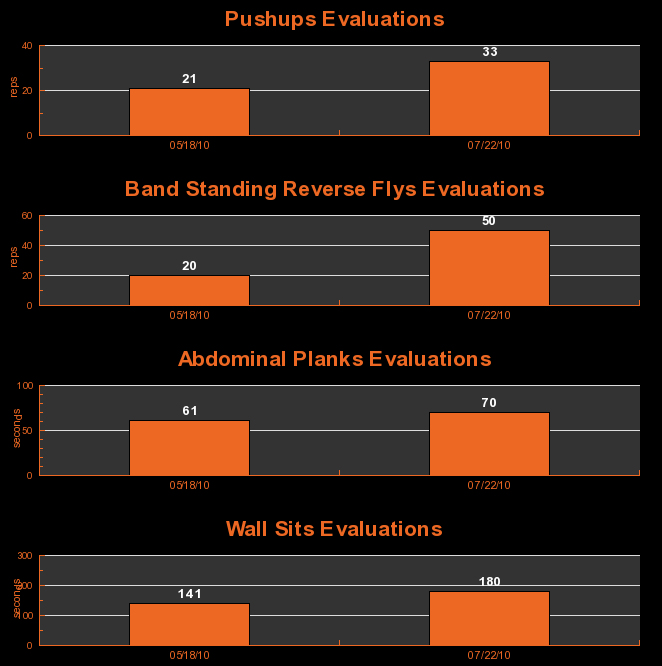
Here are my re-assessment results (power score and measurements). Compare them with the initial ones.

I was pleased to see a marked improvement in my power score, which is now 76, up from the initial 64. My guess is these are beginner gains, and subsequent power score improvements will be harder to achieve. Still, I’m happy and willing to put in the extra work.

The new numbers are:

  • 33 pushups
  • 50 band standing reverse flyes
  • 70 seconds for the modified abdominal plank
  • 180 seconds for the wall sit

There were some surprises when it came to the measurements:

  • Weight: 159.8 lbs, up by about 1½ pounds; my guess is the extra weight is from muscle mass, since I lost fat, as you’ll see below
  • Shoulders: 47.5″, up by ½ inch
  • Chest: 39″, up by 1 inch
  • Arms: 12″, down by 1 inch; this was an unpleasant surprise, but my guess is I had extra fat in the triceps area, which went away.
  • Abdomen: 32″, down by 1 inch
  • Hips: 36.25″, down by 1¾ inches, which was definitely a surprise.
  • Thighs: 19.5″, up by ½ inch

I guess all that sitting on a chair not only atrophied my muscles, but put extra fat on my arms, around my abdomen (which I already knew of) and my hips, which I didn’t know about.

I’ve got another couple of confessions to make:

  • I missed about a week’s worth of workouts during the 6 weeks, again due to travel. I asked the folks at RPM what to do, and they advised me to do one extra workout per week until I caught back up. That’s excellent advice, so if you’re in the same boat, do that, it’s going to be worth it.
  • I haven’t done my aerobic workouts at all. I’ve been too busy. You know how they say you should do three of their workouts per week, and on your off days, do half an hour of your favorite aerobic activity? Well, I skipped out on that entirely. Shame on me.

Still, in spite of cutting all those corners and missing out on plenty of workouts, look at the progress I made! Can you imagine how much more dramatic my progress would have been if I had followed their recipe?

I think this is really good proof of the program’s potential. I missed workouts, played catch-up, took a two week break, and still I made out really nicely.

Don’t take that to mean I fudged on the actual workouts though! Every time I worked out, I did every exercise and every rep indicated. On some exercises, I even did extra reps. The way I see it, if I didn’t give 100% with every workout, I’d have cheated myself.

If you have any doubts about the RPM System and whether it can work for you, I don’t think you need to worry any more. Try it out, you’ve got nothing to lose. It’s only $10/month, and you get two weeks free with this code: 553677456.

I intend to keep going, and will post future updates about my progress.

Standard