
Post-It Love
Gotta love this short film, it’s awesome. It’s about a man and a woman who find love at the office. Their romance blossoms through Post-It note designs they make for each other.
Category Archives: Thoughts
Meet Buttons, the cutest kitteh ever

Sorry for the baited title. This post is really about how web users interact with written content on the Internet, and how people in general interact with the news these days. But read on anyway, you might find this useful, and there’s even another cute kitty photo at the end.
I’ve been sitting on the sidelines lately, looking at the way people interact with items on FriendFeed, and I realized it’s all part of how people in general interact with the world these days. In a word, it’s superficial. On the web, there’s barely any interaction with items that have no thumbnails. If there’s no image to be digested quickly with a news item, then it gets buried, fast. That particular news item might be truly meaningful, it could have real value, it could be worth at least a few minutes of someone’s time, but users just don’t take the time to click through and find out what’s going on if there isn’t an image to go along with it. It’s like they’re little kids and they gotta have pictures in their story books. Whatever happened to being adults?
I’m not talking about my own articles, and I’m not talking about FriendFeed per se. I’m talking about the bigger picture. You can see this on TV as well. In the US nowadays, instead of showing the person who is talking, whether that be a news presenter or a person being interviewed, the stations overlay the audio on top of looping footage of the things the person is talking about, or they run the audio on top of marginally related video, ostensibly to keep a spastic audience glued to the set. In Romania, where I’ve been staying these past few months, they divide the TV screen in half. They show the commentator in one half, and they show video footage in the other. Your eyes keep jumping from one spot on the screen to the other, to make sure they catch all the action. And they also scroll text and stock and weather alerts on the bottom of the screen. It’s nuts. You just don’t get the chance to digest what the person is saying, because your attention is continually grabbed and pulled in many different directions.
If you are reading this on FriendFeed or in a RSS reader that shows media content thumbnails, do you know why you clicked on it? Likely because I had a photo of a cute kitten to draw your attention, not because you wanted to do some actual reading. It would have been much better if I showed some woman in a bikini — many more people would be reading this article right now, or at least skimming it, hoping for more photos.
Isn’t it sad though? For a person who likes to write, and wants to communicate through writing, it’s so disappointing to see the audience drifting from adult food to baby bites, to cute or sexy photos with (preferably) one or two sentence captions, instead of real articles. Whatever happened to sitting down and reading something?
Don’t tell me it’s because you’re busy. I don’t buy it. You’re lying to yourself and you’re lying to me. People have always had lots of work to do. Sure, it wasn’t computer work a few decades ago, but it was chores or factory work, and it took just as much time and much more effort. But they knew how to relax. They could sit down with a magazine or newspaper in hand, tune out everything else, and read something they found interesting.
You still have that ability. Stop being immature and clicking on everything, and pick the stuff you want to spend your time on carefully. There’s only so much time in one day, and you can’t keep up with a thousand RSS subscriptions and still do other things. Thin out the stuff you want to see on the web every day. On a larger scale, thin out the stuff you want to do every day, because you can’t do it all. Decide on what’s important to you, and stick with that. Maybe if more people took this advice, the world would be a saner place for those who write on the web, like me. We wouldn’t have to go nuts trying to get the word out about our content, because people would take the time to find interesting stuff and stick with it.
If you’re a FriendFeed user, let me tell you it’s not cool to subscribe to tons of people just so you can watch news items stream by you in real time and feel good about keeping up with everything that’s going on in the world, because that’s not the case. In the end, you’re just as superficial as the guy who looks at a magazine cover and thinks he knows everything inside it. Instead of wasting your time doing that stuff, pick the people you find interesting, weed out the rest, and really sit down to see what they have to say.
Now, just because you read/skimmed this far, here’s another photo of kittens, this time two of them, playing together. See, I’m not such a bad person.

Goodbye, Duke Nukem
When the Duke Nukem series came out in the late 90s, I was a huge fan. There was a time when I played it every day, and I knew almost every trick on each level. I even bleached my hair once to get the Duke Nukem look. Given that I was also working out regularly back then and had some fairly serious muscle on me, it was a pretty good approximation.
As with all such phases, my obsession with the video game passed on, but I still looked forward to the sequel, called Duke Nukem Forever. I waited, along with countless others, since 1997, only to find out last month that 12 years later, in 2009, work on the game stopped altogether.

It was, by all means, an expected conclusion to what had become a game industry joke and cliché. Still, when I see the trailer for Duke Nukem Forever, released in 2007, I still feel regret for the promises made so many times that never came true. I’d have loved to play the sequel, if only for nostalgic reasons. This should have been awesome. Instead, it ended up in the crapper. What a shame.
[Video from Don MacAskill’s Duke Nukem Forever gallery at SmugMug]
Googling from different countries
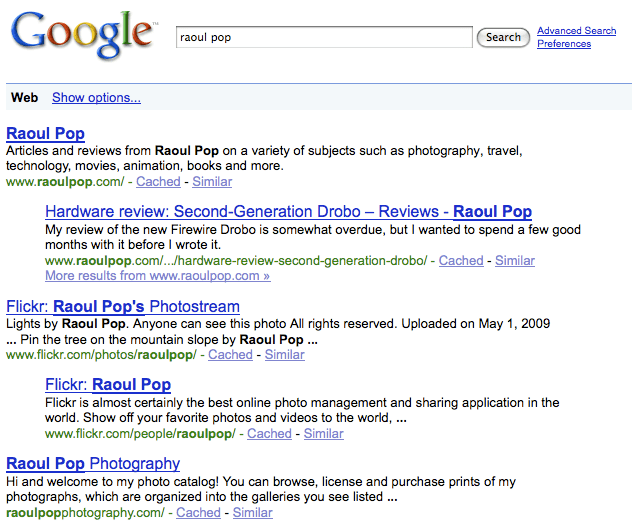
I was watching this video on the Google Webmaster Central Channel, where Matt Cutts answers a question about the impact of server location on Google’s rankings, and he touched on an important point, which I hadn’t noticed until I spent a few months in Romania. In the video, he says that Google will return different search results based on which Google site you visit. For example, if you go to Google.com and type in “bank”, you’ll get different search results than if you go to Google.com.au and type in “bank”.
Back in January, when I arrived in Romania, I noticed the same thing. I Googled myself while in Romania, only to find out I was no longer the first search result that came up for my name at Google.ro or at Google.com. I thought that was odd at the time, because doing the same thing while in the US yielded the expected result. It never occurred to me that Google would yield different search results for each country, although that makes perfect sense now.
Here’s the interesting part though. As I spent more time in Romania, writing and publishing to this site, whose server is in the US, from Romania, the order of the search results for my name at Google.ro and Google.com changed. One day, I googled myself and noticed my name came up first, just like it did in the US. So, Google somehow learned — and I’m not sure how they did it — that I was writing from Romania, or that I was in Romania, and figured out that returning my site as the first search result for my name in Romania was the relevant thing to do. If nothing else, it reveals some of the complexity behind Google’s search algorithms and earns my respect.
Countering the effect of gravity
In 2005, I wrote an article entitled “Gravitational propulsion-levitation vehicle“, where I detailed an idea of mine that I’ve had since 1997 or so, of a vehicle that could harness the gravitation field of the Earth and use it to move on the ground or in the air.
Now, in 2009, I see that my twelve-year old idea was first investigated, albeit in a more limited way, back in 1992, by a Russian scientist named Evgeny Podkletnov. Furthermore, in 2003, an Austrian scientist named Martin Tajmar developed Podkletnov’s research and found a measurable reduction in gravitational pull with the help of a spinning superconductor.
You see, that’s where our ideas are related — in using spinning discs that would generate their own gravitational fields. Back when I started thinking about this stuff, in 1997, I had no idea about Podkletnov or Tajmar. It was just me, a guy who took two college physics classes, trying to figure out how this might work. But I think it’s very interesting that people in different regions of this world, some whose life is physics and some who only have a basic understanding of the subject, are thinking along the same lines when it comes to countering the effect of gravity. It’s the sort of thing that encourages my belief that we’ll get this figured out somehow, that a vehicle powered by gravity isn’t just sci-fi stuff.
I’m not alone in thinking this way. Since I wrote the original article, I’ve gotten contacted by a number of people, some who sounded kooky, and some who sounded like they were serious. I still haven’t written back to any of them, since I’ve had no new spark of inspiration that would make me believe I could contribute anything useful beyond what I already said. But I’m glad to see that we’re possibly on the right track.
My thanks to New Scientist for publishing “Seven things that don’t make sense about gravity” — a very interesting series of mini-articles that brought me up to date with the research done on gravity so far.

