Reviews

Funny comics for sucky times

These “fun” times we’re living in call for some cheering up. I’m subscribed to these following comics (listed in alphabetical order), and they put a smile on my face each and every day:

Basic Instructions by Scott Meyer

Geek and Poke by Oliver Widder

Kawaii Not by Meghan Murphy

What The Duck by Aaron Johnson

Wondermark by David Malki ! (yes, the exclamation sign is required)

xkcd by Randall Munroe

I’ll let you discover what each one is about by visiting their respective sites. Enjoy!

Standard
How To

Get the Nokia N95 for $390

I’ve been amazed by the capabilities of the Nokia N95 smartphone since I first heard about it in 2007. Its price though put it sadly out of reach for me, until a couple of days ago, when I saw it at Micro Center for $389.99. This is a new, unlocked Nokia N95 V3.

If you’ve been watching the price for this phone, like me, then you know that’s at least $60-70 off the lowest price listed anywhere else, if not more. When I search the internet, I still see it listed at some places for over $580.

Of course I bought one. You might want to do the same. If you find it for a lower prices somewhere else, let me know. Keep in mind this isn’t the new N95 8GB model. This is the older N95 that runs the 3rd edition of the S60 software, also known as V3. Btw, the specs say the max size for its MicroSD memory card can only be 2GB, but mine runs fine with a 4GB card.

Standard
How To

How to get T-Mobile Total Internet at 42% off

It’s easy: sign up before 11/1/2008. Why? Because the price will apparently go up to $35/month on or around that date, according to T-Mobile Customer Service.

Updated 10/27/08: Please see this comment below for an up-to-date clarification of the planned price increases. It’s not as bad as I originally thought, but a price increase will still take effect [source].

Updated 11/24/08: It looks like the rate hike will take effect on 12/1, not 11/1. And it also looks like G1 users will have to move to the new, more expensive plans, even if they signed up before the rate hike.

T-Mobile’s current Internet/Data plan for smartphones (it’s called T-Mobile Total Internet) costs $19.99/month, and includes either EDGE or 3G speeds, depending on your area. If you live in the Washington, DC area, like me, you’re currently getting EDGE speeds, but should be upgraded automatically to 3G by the end of this year.

Starting around 11/1/2008, T-Mobile will increase the price for the plan to $35/month, probably because of the G1 smartphone they’re launching, and the extra demand that’s going to place on their networks. I’m guessing they have some infrastructure upgrades to pay for. If you get the Internet plan now (which is what I did) the price for it will stay locked at $19.99/month for as long as you’re with T-Mobile. That’s what I was told by T-Mobile Customer Service yesterday afternoon.

That means you’ll be saving $15 (42%) every single month while others are going to pay $35, and you’ll get the same speeds they’re getting.

Standard
How To

A cure for simple burns

This is something that my wife told me about, and has worked for me numerous times in the last several years. Want to know what will cure your burns quickly, lessen the pain significantly and immediately, eliminate the bubble of interstitial fluid that forms at the burn site, and minimize tissue scarring?

It’s simple. Dab honey on the burn.

As soon as you’ve burned yourself, take honey (in as natural a state as possible — we like Really Raw Honey, but any quality honey should work) and spread it on the burn site. Keep it there for half an hour to an hour if possible. You’ll notice that the pain will go away within minutes, and that the burn site won’t swell up and form that painful bubble that can burst and leave your flesh raw underneath.

What about if you’ve burned your finger (for example) at work and have no honey available? (This happened to me a few months ago.) That’s okay. Put the burned finger in sugared water and hold it in there for 15 minutes or so.

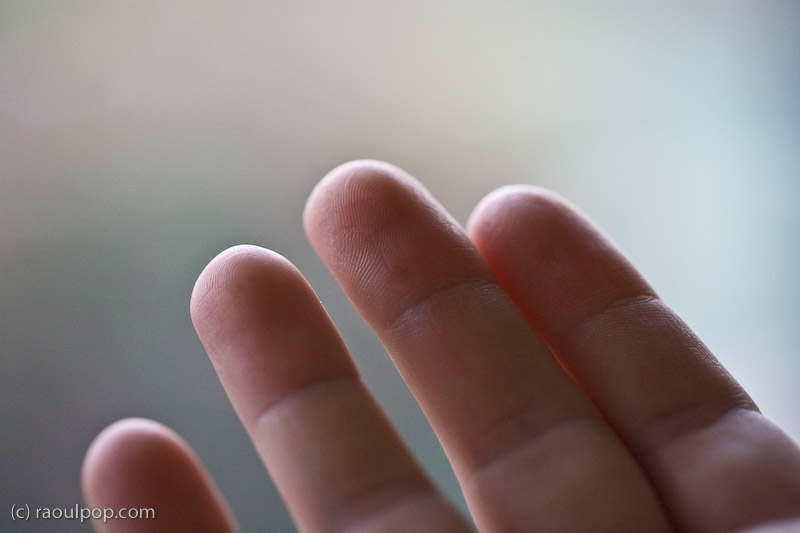
I took some sugar from the coffee station and put about 4-5 teaspoons’ worth in a half a cup of lukewarm water. I mixed it as well as I could so it would dissolve, then I stuck my finger in there. It didn’t work quite as well as the honey, because I the burn pain continued for a couple of hours, though not at the same levels, but in the end, my finger didn’t swell up, and instead, the healing process began from inside, naturally. Look at the middle finger in this photograph. That’s how it looked a few hours after I’d just burned it severely by accidentally grasping a burned piece of Pop-Tart where the sugar was in the process of carbonizing (past the melting point).

You see nothing wrong with the finger, right? Well, that’s the idea! Other than a small numbness at the site, and pain when pressing on it, my finger was fine. After several days, the dead skin peeled off, again with no pain, revealing the fresh new skin underneath.

I know it’s hard to believe this sort of thing, but trust me, honey is a miracle cure for burns. Try it out when you next burn yourself and see what happens.

Standard
Places

The ancient city of Histria

On the shore of Lake Sinoe in Romania, very close to the Black Sea, lie the ruins of the oldest documented city on the territory of modern-day Romania: Histria. (See satellite view below, or go to Google Maps to explore the full map.) We visited it in September of 2008.

It started its life around 630 BC [reference], built by Milesian colonists from Greece, to trade with native Getae tribes (Geti in Romanian). The Getae were Thracian tribes that occupied Dacia, whose territory is matched in smaller proportion by modern-day Romania. They, and the other people who settled in Romania at later times (like the Romans) are the ancestors of modern-day Romanians — my ancestors.
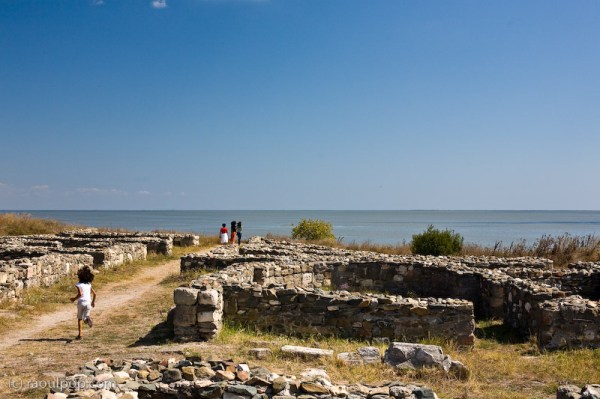
When Histria was built, its port was literally on the shore of the Black Sea. Over its approximately 14 centuries’ existence, silt deposits from the Danube River blocked off its access to the sea and formed what is now Lake Sinoe. This meant that the city’s importance as a port and trading post slowly diminished as the silt deposits grew to become the current land border between the Lake Sinoe and the Black Sea. It must have been painful to try and salvage the city’s livelihood by finding routes through the growing silt, hoping that ships stuck in the increasingly shallow water would somehow want to come back, should they manage to get away. Little did they know that in modern times, a canal would be cut through the silt shore at Periboin, not far from them.

By 100 AD, the city, who had resisted countless attacks and rebuilt its walls time after time after time, could only rely on fishing as a source of income. It managed to survive another 600 years or so, until it was destroyed one last time in the 7th century AD by the Avars and the Slavs. Its inhabitants moved away, and the once bustling and prosperous city, who had forged an important trading link between the Greeks and the Dacians so many centuries ago, began to decay, unoccupied.

Its name forgotten, it didn’t even appear on maps. Its memory swallowed whole by time, its walls covered by the ground itself, it lay in wait until it was re-discovered by a Frenchman, Ernest Desjardins, in 1868. In 1914, Vasile Parvan, a Romanian, began the first excavations of the site. The archeological digs continue to this day, conducted by various multinational teams. This was how we found it a month or so ago.

It was a warm, sunny, late-summer day when we visited. The heat shone down oppresively while we drove through the flat Dobrogea landscape. Yet a soft, cooling breeze from Lake Sinoe met us as soon as we stepped onto the grounds of the city.
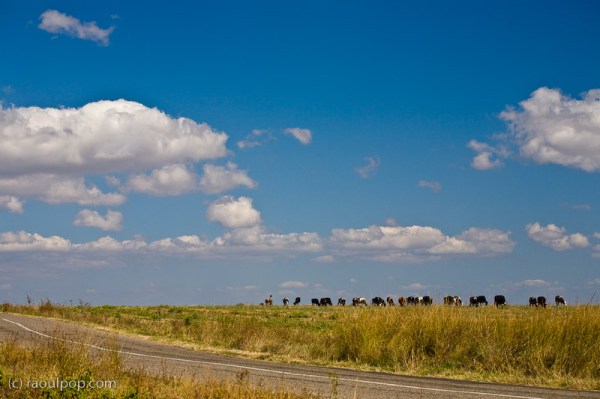
There was a peace and quiet at Histria that I can only find when I visit certain ruins. I stood among the remains of the walls, and thought of the people that lived there before I set foot on what used to be their homes. They were born, lived and died there, making a living the best way they knew how, in a famous city by the Black Sea. The breeze must have been stronger then, since the waves of the sea beat against the city’s very shores.

What an adventurous spirit those Greek traders must have had, to get in their boats and travel far off, in hope of establishing a little colony of their own in an unknown land. How did they choose the site? Likely because it sits on top of a slight hill. Just think, the first few families built little homes out of field stone (there are very few trees around), and through hard work applied over time, grew that little settlement into an important port of trade and a fortress, one rich enough to attract the attention of countless attackers.
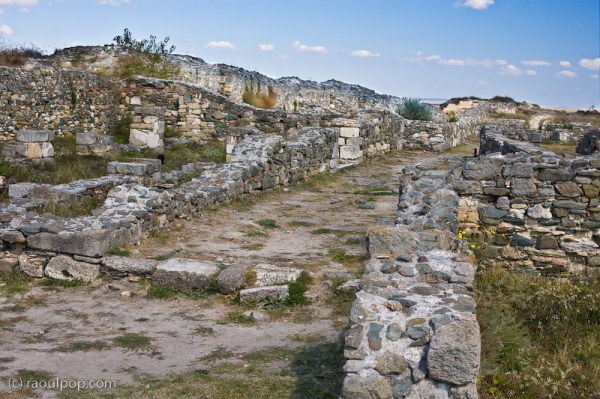
As I sat there and listened to the lull of the waves, I understood why they rebuilt after each attacks. The peace between each bout of violence was worth the effort, and the surroundings themselves invited (and still invite) company. Had their direct access to the Black Sea not been cut off, I believe Histria would survived to this day, and perhaps the city of Tomis (Constanta) might have had a different fate.

If you walk slowly among the houses or on the streets at Histria, you too will understand why it survived for so long. It’s hard to leave a place like that. It’s so peaceful, so quiet, so welcoming. You want to spend more time there, looking toward the horizon, hoping against hope to spot your ship, which is making its way slowly but surely toward the small port, bearing goods that will replenish your warehouse and provide for your family for another year.
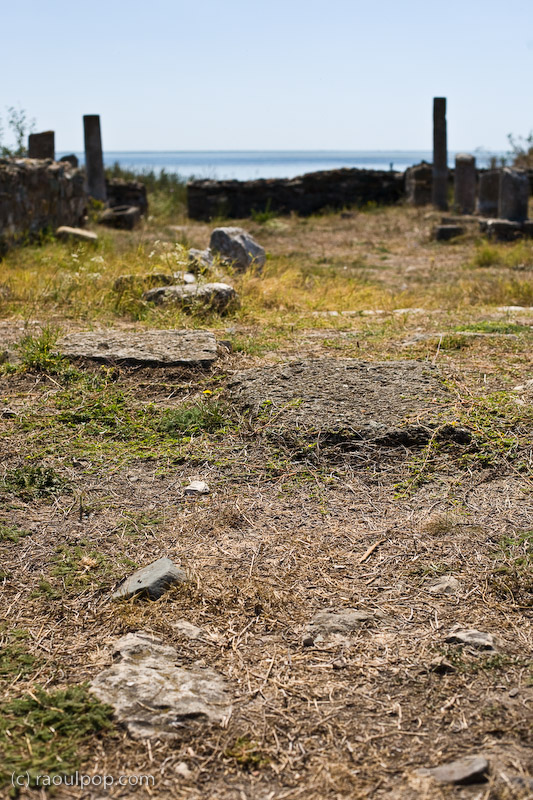
The full set of photos from Histria is available at my online photography catalog. You’re welcome to view them all there. Mircea Angelescu, a Romania researcher, developed a 3D model of Histria which can give you a detailed idea of the city’s layout over time. More info on Histria can be found at Wikipedia.

Standard