Places

The C&O Canal

I suppose I should call this “Trip to the C&O Canal – Part Three”, since it’s the third time I write about the C&O Canal (Chesapeake and Ohio Canal) on my site. Here is Part 1 and Part 2. But it’s certainly not our third trip, because we’ve been there numerous times, during various times of the year.

This last time, we did it by bike, starting at Lock 7, which can be accessed from the Southbound Clara Barton Parkway. We traveled past the last gatehouse, which I think was was Lock 12, and past the Carderock Wall, to some section of the canal beyond it.

It’s a lot of fun to bike on the C&O Canal. For one thing, the path that accompanies the canal used to be the old towpath for the mules that pulled the barges, so you know you’re stepping on a piece of history. For another, the canal towpath was built to have no steep grades. Other than little hills that correspond to the drops in altitude at lock gates, the towpath is mostly level, so you won’t get long-winded trying to walk, run or bike up long hills.

As you’ll see in the photos above, some parts of the canal were completely dry. I’m not sure what caused this. Perhaps it was the summer heat, or as you’ll see in a couple of the photos, a sinkhole that opened upstream and possibly swallowed all of the water from those sections of the canal.

The idea for the C&O Canal originated with George Washington, though in another form. Having worked as a land surveyor in his youth, he dreamed of the possibility of making the Potomac River navigable. He thought the only way to do it would be to build skirting canals around its falls. While he was still young, he could not convince the State of Maryland to do this, but after the Revolutionary War, let’s just say it was easier for him to get people to do things.

The Patowmack Company was formed in 1784, and construction began on the skirting canals. Washington himself supervised the construction personally. Beside the canals, channels in the river itself were deepened and boulders were removed. There was a great deal of work to be done, and the work wasn’t finished until 1802, three years after Washington’s death.

Although the canals were useful, the route didn’t generate as much traffic as it should have. For one thing, it was only truly usable up to two months out of the year, due to low water levels. Plus, it was very difficult to get the boats back up the river, because of the current. People ended up dissembling the boats downstream, walking back upstream, and building another boat. This was not efficient nor productive.

George Washington’s idea was interesting, and people kept thinking of a way to capitalize on it. A way to use the Potomac River needed to be found. That’s where the construction of a canal came in. It wasn’t new technology, as that sort of construction was already used in Europe, and even dates back to antiquity.

On November 5, 1823, a convention was held Washington, which led to the chartering of the company that would build the canal on January 27, 1824, and finally, to the start of construction of July 4, 1828.

The construction of the C&O Canal ended in October of 1850 at Cumberland, Maryland. The original plan to extend the canal to the Ohio River had to be modified, because of the extremely hard nature of the work, its slow progression, and financial troubles with the parent company.

Parts of the Canal were opened as they became available, and it worked as a water route until 1924. Frequent flooding closed it for months, and sometimes, for entire seasons, and in 1889, the parent company went bankrupt. It was then taken over by the canal’s rival, the B&O Railroad. In 1902, they even took over the boats. Whereas they had belonged to the people themselves — to the families that toiled night and day to carry goods down the canal — from that year forward, they belonged to the Railroad company…

The B&O Railroad did as little maintenance as possible on the canal, and in 1924, when another flood destroyed parts of it, they closed it down altogether. The canal slowly deteriorated afterwards, until it was taken over by the National Park Service in 1971. They restored the towpath and re-watered parts of the canal.

Here’s an interesting fact [source]:

“Transporting goods and people by canal dates back to antiquity. The lock gates used on the C&O Canal were an adaptation of a design by Leonardo DaVinci in the late 1400’s. Until the advent of the railroad, water travel was far superior to land travel.”

If you’d like more information about the C&O Canal, I recommend the official C&O Canal NPS website. Make sure to use the menu on the left side of the page to navigate through the various sections. It’s a little hard to find your way around at first, but it pays off if you keep digging — there’s a lot of information posted there.

Standard
Places

National Arboretum

This past May, Ligia and I visited the National Arboretum here in DC. We try to go there at least once a year. The grounds are huge, and they have both outdoors and indoors facilities. Admission is free, and the grounds are open from 8 AM to 5 PM daily, every day of the year except on Christmas.

The National Arboretum was established in 1927 through an Act of Congress. It is administered by the US Department of Agriculture’s Agricultural Research Service. Its mission is to “serve the public need for scientific research, education, and gardens that conserve and showcase plants to enhance the environment”. It sits on 446 acres and has 9.5 miles of roads.

Among its gardens are:

  • Single-genus: azalea, boxwood, daffodil, daylily, dogwood, holly, magnolia, maple, and peony.
  • Major gardens: aquatic plants, the Asian Collections, the Fern Valley Native Plant Collections, the Flowering Tree Collection, the Flowering Tree Walk, the Friendship Garden, the Gotelli Dwarf and Slow-Growing Conifer Collection, the Introduction Garden, the National Bonsai & Penjing Museum, the National Capitol Columns, the National Grove of State Trees, and the National Herb Garden.

If you’re in the area and you haven’t been yet, please visit, it’s worth your time.

Standard
Places

Baltimore Aquarium’s Dolphin Show

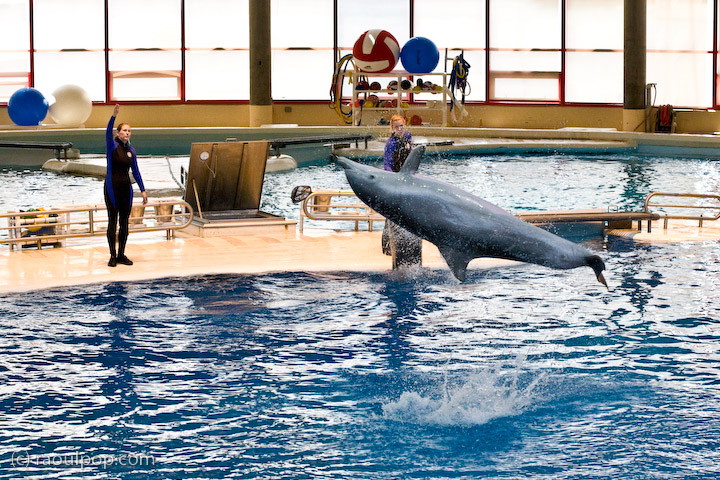
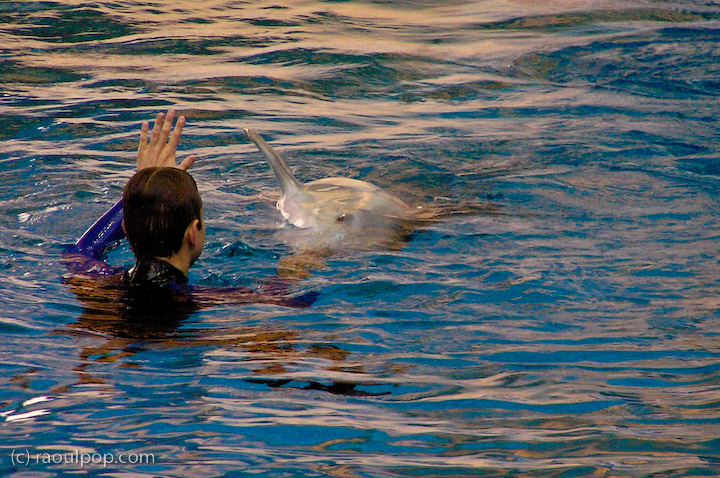
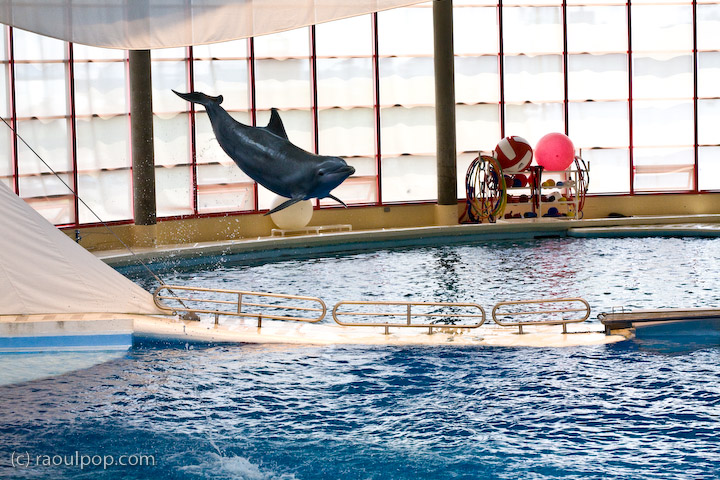
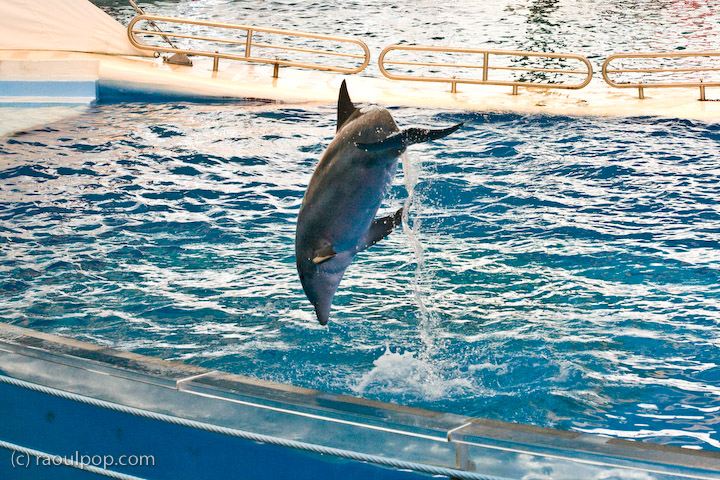
During our last trip to Baltimore, we visited the Baltimore Aquarium and also attended their dolphin show, called “Play!”. It lasts about a half hour or so and it’s geared toward kids — which means quite a bit of talk about dolphins and not so many jumps. If you expect a show packed with acrobatics and non-stop jumps, try the Miami Seaquarium.

I got a bit annoyed with the constant solicitation of applause for the simplest tricks.

Standard
Places

Parking lot goose

This past spring, I took a few photos of the goose you see below. It had been resting in the middle of that parking lot for several days, driving away any other geese that wanted to be there as well. The odd thing for me is that I’d never seen a goose defend a parking lot before. Who in their right mind would stake their food supply on a filthy hot and dry piece of asphalt, good for nothing but global warming?

Parking lot goose

Parking lot goose rests on asphalt

As I approached it while taking photos, it got up and waddled away, unwillingly, knowing it couldn’t really do much to drive me away. It was so sad to see it attached to that useless piece of land when there was a pond surrounded by plentiful trees just 30 feet or so away.

Parking lot goose

Parking lot goose waddles away

In a month or so after I took the photos, I saw the same goose had managed to acquire a mate. How, I don’t know. What can you say to another goose to make the union appealing? “Come join me in ruling my asphalt domain?” Not exactly the best pickup line… Nonetheless, they were both waddling alongside each other through the parking lot, though they stuck a little closer to the pond, so I assume they nested there.

Standard
Places

The Seven Foot Knoll Lighthouse

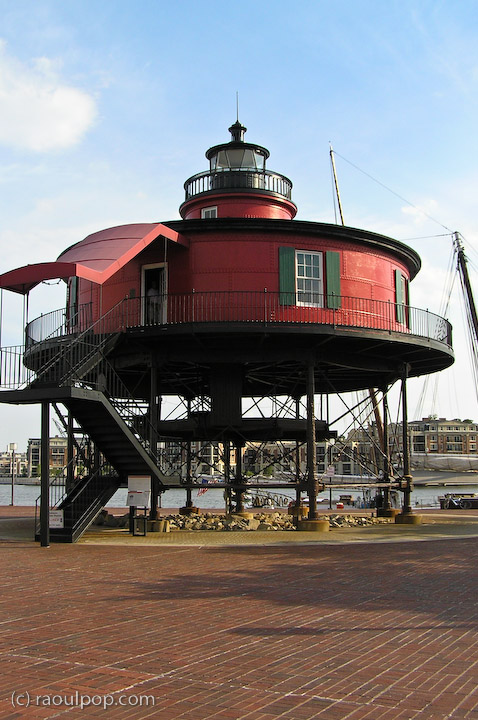
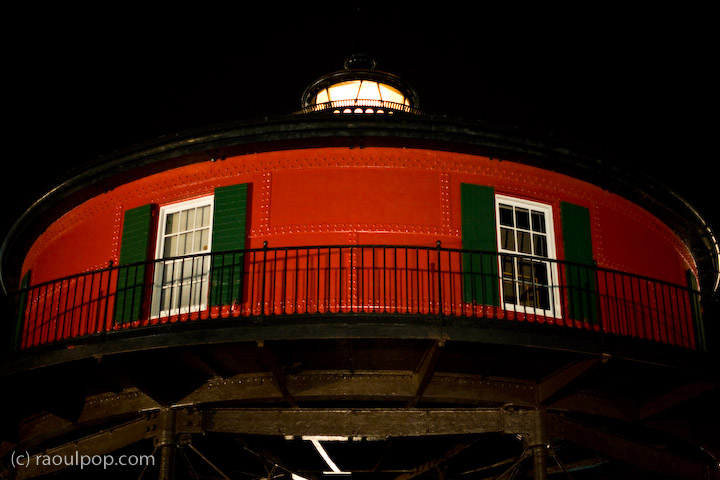
The Seven Foot Knoll Lighthouse is the oldest surviving screw-pile lighthouse on the Chesapeake Bay. It was built in 1856 (before the Civil War), and installed at the mouth of the Patapsco River, where it marked the shoal known as Seven Foot Knoll for 133 years. We visited it during our recent trip to Baltimore.

The lighthouse used an innovative design called the screw-pile, which looks like a large-scale, big-head drill bit. The screw-pile is also described as a “system of cast-iron pilings with corkscrew-like bases”. It eliminated the need for underwater masonry foundations, which were (and still are) hard to build on muddy bottoms. The screw-piles could be screwed into the sea-bottom, and a construction developed on top of them.

The Seven Foot Knoll Lighthouse was the second screw-pile lighthouse on Chesapeake Bay, and was used from 1856 until 1987, although keepers lived in it only until 1949, when it was automated. By the second half of the 1960s, the lighthouse started to show serious signs of aging, and it was thankfully moved to the Inner Harbor in 1988.

From 1856 until 1919, keepers lived in the lighthouse along with their families, but life was very hard in the lighthouse, particularly in the winter, when ice sheets threatened to topple it. Over the years, various pilings and rock barriers were put up to protect the lighthouse from the ice and from ships in distress who might bump into it, but it was the ice that posed the biggest problem, which was never quite solved. Every single winter, families lived in immediate peril there, and even had to be evacuated a few times as the lighthouse bent precariously in the face of advancing ice sheets. From 1919 until 1948, the Coast Guard recognized the hazardous nature of the lighthouse work, and allowed keepers to work in pairs, with each receiving 8 days of shore leave per month.

There’s a courageous event recorded on August 21, 1933, when Keeper Thomas J. Steinhise risked his life to rescue the crew of a sinking tugboat named Point Breeze. There was a terrible storm that night, with fifteen-foot seas and 90-mph winds, and yet Thomas Steinhise fired up his small motor boat and navigated in the direction of distress whistles to save the lives of five crewmen. He was awarded the Silver Lifesaving Medal for his heroic deed.

After the lighthouse was moved to the Inner Harbor in 1988, the Coast Guard donated it to Baltimore City, and in 1990, a lighthouse restoration project, completed with grants and the aid of volunteers, was completed. In 1997, the lighthouse became part of the Baltimore Maritime Museum.

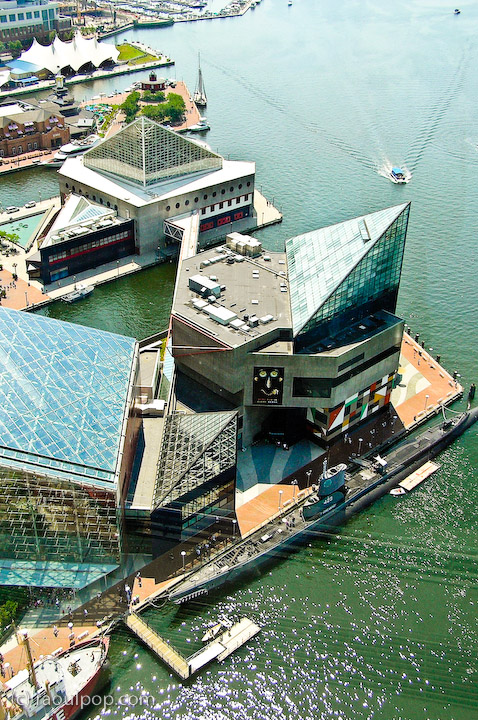
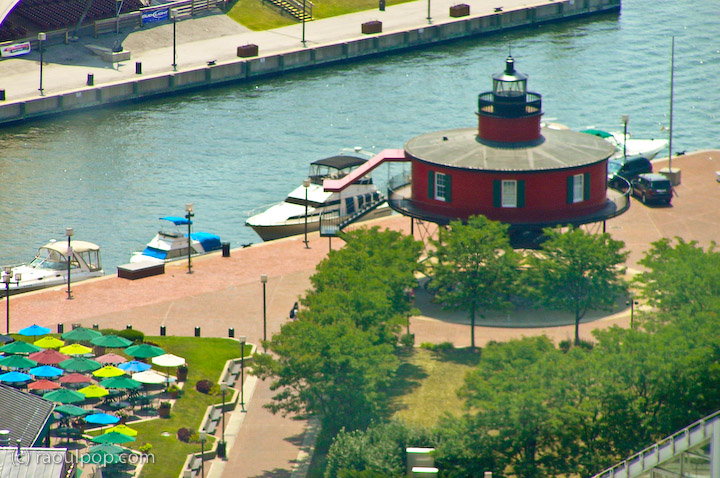
The lighthouse’s current location is more clearly seen in these two photos taken from the top of the World Trade Center in Baltimore. I’m sorry for the poor quality of the photos, but I had to shoot through the thick (and dirty) glass of the visitor center at the top.

Standard