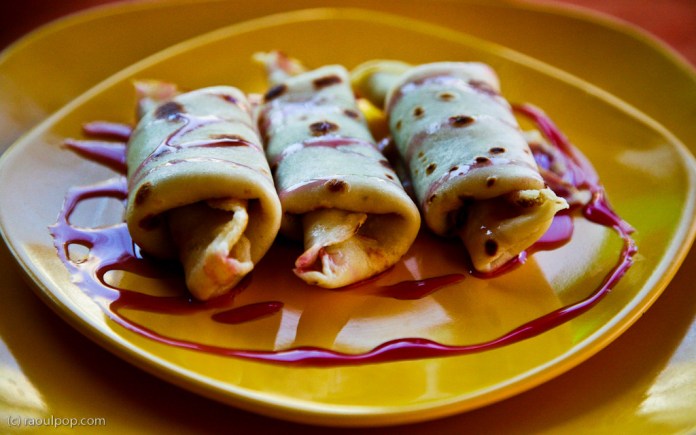
There’s a dessert in Romania called “clatite”. It’s similar to the French crepes, but the dough is prepared somewhat differently, and a clatita is also smaller and usually folded differently than a crepe. Some translate it into English as pancake, but that’s not it either. They’re definitely not as thick, the dough is different, and they’re not left flat, but they’re folded or rolled up. What can I say — they’re a food unto their own. This is how they’re traditionally prepared.
I’ve recently had some of the best clatite ever, at a little restaurant which I believe is called “La Patronul Meu”, in the city of Mangalia, which is a seaside resort in Romania, in the province of Dobrogea. I didn’t jot down the name, forgot to take a photo of the restaurant’s exterior, and didn’t take the receipt with us when we left, but I’m fairly sure the word “Patron” was in the restaurant’s name. It was next to a Pirate-themed restaurant, near the docks.
These clatite were prepared with peach jam and topped with raspberry jam. The dough was just right: not too crisp, not too soft, and they were exquisitely delicious. If you’re ever in Mangalia, stop by this restaurant and order some; you won’t regret it. Here’s what they looked like.
And by all means, order some of the other food on the menu, too. Mmm, mmm, good, and the service was friendly and prompt.
If you want to make some yourself, check out theserecipes.
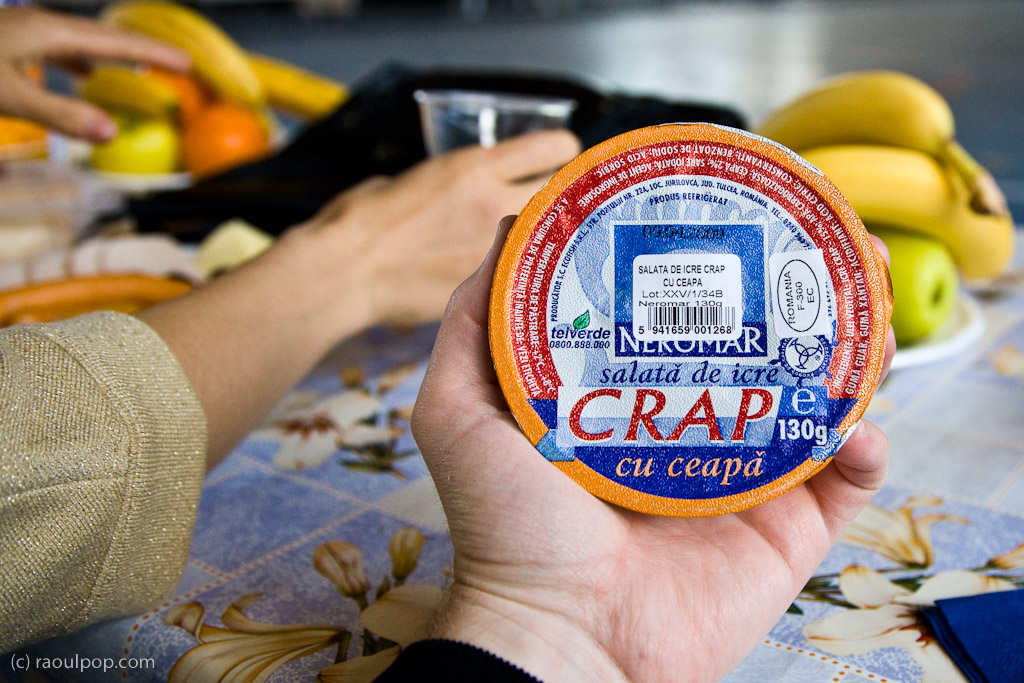
Here is proof positive that crap can be bought. Apparently it comes in 130g packages.
Alright, it’s not really crap. Well, it is — in Romanian — which translates to carp in English. This happens to be carp roe salad, with onions. Quite tasty, if you’re into that sort of thing.
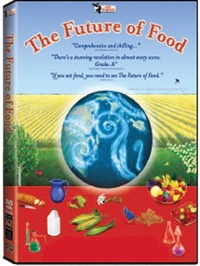
If you have not yet heard of a documentary called “The Future of Food” (2004), or haven’t yet watched it, please take the time to do so. It is vital that you know what’s going into the food that you eat, and it’s vital that you know it now, before it’s too late.
What’s been happening over the past 20 years here in the States is that our food supply has been slowly taken over by biotech companies who are interested only in their bottom line. They have used tactics akin to racketeering practices in order to get farmers to use their seeds and only their seeds. They have placed their executives in key government positions, in order to ensure that their policies go through. They have done and are doing everything in their power to get us to eat their genetically modified foods, without regard for safety, common sense, decency or ethics. I’m not saying this by myself. The documentary itself will prove it to you.
All that is bad enough, but what’s really appalling is that they are patenting genes. They have patented plant genes, and now they want to patent animal genes and even human genes. They are trying to get the market in their tight snare, so they can squeeze profits out of everywhere and ensure they control our food supply completely. They have even patented one of the genes involved in breast cancer, then sued researchers who had been doing working on it, to force them to pay exorbitant licensing fees. Needless to say, research on that gene has been significantly curtailed, directly due to their malefic influence. That’s the sort of “work” they engage in.
When I call them racketeers, I have a great frame of reference in mind. It’s a short crime drama made in 1936, entitled “The Public Pays“, which won an Oscar. It depicted a protection racket that preyed on the local milk distribution in one American city, and the people’s successful fight against them. The biotech goons may not beat up people and physically destroy their milk trucks and containers, but they have legal “procedures” which wield the same sort of power and yield the same horrible results. This time, they’re working hand in hand with specially-placed government officials who make sure the biotech rules get enforced and the little guys get screwed royally — not to mention that the consumers, and the marketplace in general, are manipulated to no end as well.
Don’t believe me? Watch the documentary. And if you can find “The Public Pays”, watch that as well and compare the two to see the striking similarities. What’s more, if someone can assure me that “The Public Pays” is now in the public domain, I’ll gladly post it online, either at Google Video or somewhere else.
As you get to the end of the “Future of Food” documentary, you’ll get heartened by the organic farming efforts, which are great, but keep in mind that Whole Foods now sells mostly non-organic fruits and vegetables, and also imports supposedly organic foods from China, whose food supply is so laden with pesticides it’s not even funny. Yet Whole Foods still dares to hold the same high prices on their stuff, which means they’ve cut costs and are pocketing the difference. Lesson learned: don’t shop at Whole Foods. Go to Trader Joe’s or MOM’s, if you have them in your neighborhoods.
Seek REAL organic foods, and make sure to vote with your wallets. Where you buy your food, and what sort of food you buy, determines our food supply’s future. Write to your congressmen and demand that the proposed law (introduced by Dennis Kucinich) to label genetic foods as such be finally approved.
My wife just chimed in with some great advice. It turns that while we wait for foods to be properly labeled as GM or not, there’s an easy way to tell already. Fruits and vegetables all have little stickers on them, with numeric codes (4 or 5-digit numbers). It seems that if those numbers start with 4, they’re conventionally-grown, but not genetically modified. If they start with 8, they’re GM — stay away from them! And if they start with 9, they’re organically grown and are safe to eat. Not sure if this is officially true, but she says that’s usually been the case, at least for the organic foods that she buys.
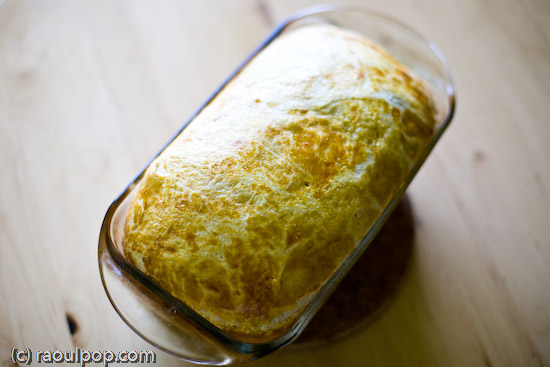
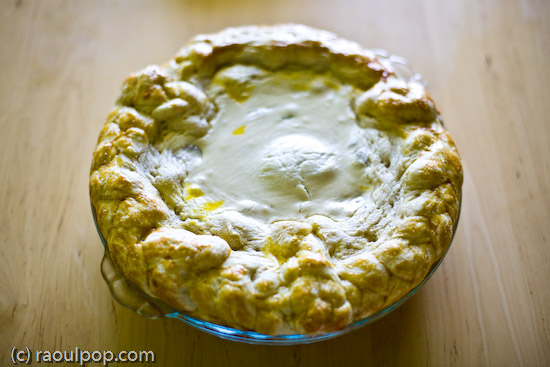
We’re getting ready to have our Easter meal, and Ligia cooked some really delicious pastries. They’re traditional Easter foods in Romania. The first you see below is called Cozonac, and the second is Pasca.
Both are made with pretty much the same ingredients, but their texture and look is quite different, as you can see. The ingredients are: flour, milk, honey, sugar, sweet cheese, rasins and eggs.
Let’s not lose sight of the true meaning of this holiday though! Easter is Easter because Christ is risen!


 Raoul Pop