Professor Andrew Frank from the University of California at Davis developed a hybrid SUV that can get about 100 miles per gallon – or so the article says. It does this because it’s a plug-in hybrid. It recharges its batteries from an outlet at night. This is indeed really cool, but what I’d like to know is how much electricity it consumes. I’m not sure that the fuel savings offset the cost in electricity, so if we’re robbing Peter to pay Paul, is it worth it? Here’s the link to the article.
Addition: just stumbled onto this related article, also at CNET News, which talks about the upcoming “100 miles per gallon” cars. Problem is, there’s a cost of $10-12K to convert a hybrid car to a plug-in hybrid, and again, the cost of electricity used to charge it up seems to be sidestepped.
Yet another addition: just came across this video from the Maker Faire, also at CNET News, where the fellow who gets interviewed mentioned you can take an ’04-’06 Prius and convert it for under $3K. One caveat: you’ll need the help of an engineer or electrician who’s comfortable working with high voltages. Cool!
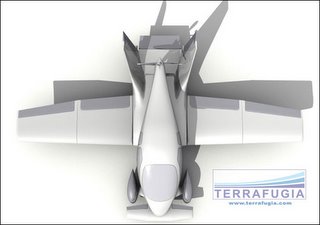
Just caught this article on Discovery News. I’ve seen concepts like this before, but they usually looked just plain awful. This one actually looks cool, and I hope very much that it makes it to market. The fuel economy would be better than my MINI’s, and that’s impressive!
There are two photos available. The first is with the wings folded, ready to park in the garage. The second is with the wings extended, ready for take-off. (Photos courtesy of Terrafugia.)
I’ve had this idea for quite some time – since sometime in 1997 – and I’ve carried it around in my mind, not knowing how to bring it to fruition, and certainly not knowing if I wanted to share it with anyone.
I’ve decided to share this idea with the world because I don’t have the physics knowledge that can allow me to figure it out on my own, and given my current and past schedule, it doesn’t look like I’ll have the time to beef up on physics any time soon. I hope that by sharing it, I can reach someone in whose mind the various pieces I’m going to talk about will click. Maybe this is one person, or a team of people, but that’s the power of the Internet – I can put my idea out there and see what happens!
I have to concede that this is the stuff of science fiction, of Star Trek and Star Wars and the like, but I really do think it can work. I think what makes my idea different from the sci-fi iterations is that it’s grounded – literally and figuratively speaking. I’m talking about gravitation. I have an idea for a vehicle that can move and float by harnessing the gravitational force of the Earth.
Here’s how I think it can work. The gravitational force of the Earth pulls things down to the ground. But it’s a magnetic force. We are attracted by it. If we can somehow deflect the force of attraction, we can move left or right along the surface of the Earth – that’s gravitational propulsion! If we can reverse it, we can rise – that’s gravitational levitation! Okay, so how can one affect a magnetic field or force? Through a magnetic field of opposing polarity. The problem is, I have yet to see a magnet that falls up, not down!
Here’s where it gets interesting. I can offer you the following clues, and I hope that you can put them all together to arrive at a solution:
Create – on a small scale – a gravitational field like the Earth’s, and attract other objects to it – this could be microscopic, it doesn’t have to be on a large scale. Once we can create this, we can apply the technology to see if we can create a gravitational field that the Earth “doesn’t like” and thus rejects – if this works, it means we can float, or levitate.
Look at the following two products currently on the market. The principles upon which they work is very similar to the way my vehicle can work. One involves an oscillating magnetic pendulum whose direction is determined by the repulsion from neighboring magnetic fields. This illustrates my gravitational propulsion idea. The second is an anti-gravity top, which, once tuned correctly, rises and stays in mid-air while it rotates. Please understand I’m not endorsing or advertising the company selling these products or the products themselves. I’m simply using them to illustrate my ideas. I do think the products are really innovative. I first heard about the levitating magnetic top several years ago, and that’s what helped me think about how my gravitational propulsion vehicle could work.
I think the repulsing gravitational field can be generated through the rotation (either parallel or perpendicular, not sure) of a disc or series of discs. It may be that some will have to rotate perpendicularly while others rotate parallel to the Earth. The angle of rotation can be varied to generate propulsion, levitation, or both. I think an important first step would be to generate propulsion alone – 2D movement along the Earth’s surface. That in itself would be a monumentous achievement. Levitation can come later, after the propulsion is perfected.
The vehicle can be perpetually moving. A rechargeable battery can be used to set the rotating mechanism in motion, and once the vehicle is moving and generating its own energy – remember, magnetic fields can be used to generate electricity – the energy from the rotating discs can recharge the battery.
The same mechanism can be applied to power plants, once perfected. We’ll be able to generate electricity directly from gravitational energy – no more nuclear or coal plants! The best part is that gravitational energy is in endless supply!
Just think of the benefits if we can ever get this idea materialized! I can go on and on, but I’ll let you dream about it: driving over fields of flowers without trampling them under wheels, sailing over water without getting anything wet, floating along the Grand Canyon, putting your hand out the window and picking fruits directly from the top of a tree… We won’t need roads anymore. We won’t pollute anymore. We’ll be able to camp out at the top of Mount Everest, or in the middle of the Atlantic Ocean…
Updated 2/27/13: I watched a documentary entitled “Modern Marvels – Car Tech of the Future” tonight, and was glad to see that others are thinking about this very idea: the capability of controlling gravity through what they call a “gravity capacitor”. See the video on YouTube and turn to 1:26:20.
I live in a high-rise condo building, and during one of our building’s board meetings, the discussion arrived at the topic of reducing electricity costs. Immediately I thought about the possibility of placing wind-driven turbines on the top of our building. There is always a good breeze up there, and the electricity produced by the turbines could help offset the energy costs for the building. One of the board members promised to look into the matter, but so far, nothing’s come of it.
Perhaps the costs for the turbines are still prohibitive for many buildings, ours included. But I can see a market for this kind of a product, if the costs are brought down enough so that a cost-benefit analysis of such a solution can show its viability in the long-term.
I can’t take full credit for this idea. A few months ago, I talked with a friend of mine who is a transportation specialist. His name is Chris Bennett, and the idea is really his. I think it’s important enough that others ought to know about it.
As I drove to work this morning and I passed a pothole in the road, what he’d said to me suddenly clicked. The way to solve the congestion problem on our road, and also to get extra revenues that can be used to fix our roads and keep them in top shape, is to institute a tax on using the roads. The perfect place to do it is at the pump, and I’ll explain why.
The most consistent measure of figuring out how much uses the roads is by how much gasoline he/she consumes. Sure, some cars consume more gasoline than others, but that’s fine. A gasoline tax would encourage people to think more carefully about a car’s consumption before they purchase it. A gasoline tax is the only way to properly charge for mileage and for gross vehicle weight.
Everyone knows that in general, heavier cars consume more gas. They also wear out the roads faster, because of their weight. A gasoline tax would automatically separate the people who have lighter cars and consume less gas from those who own heavier cars and consume more fuel. It would not only encourage more responsible driving by making people plan out their trips in advance and considering their vehicles consumption, but it would also generate extra revenues for the upkeep and improvement of our roads.
Sure, you may say, the money will be generated, but how will it be divided among the local, state and federal government? They each are responsible for fixing their roads. Well, this would be done according to road usage studies on each of those types of roads. Roads that get used the most would get the most money to get fixed. All of the roads in a specific metro area would be grouped into light, medium and heavy usage. A percentage of the total revenues would then be divided among the appropriate parties that are responsible for the upkeep of those roads. Incidentally, this is why I think charging people for using the roads (having tollbooths on the roads) is a silly way to generate revenues. Instituting a gasoline tax is the fairest way to distribute the payment responsibility among all the “offenders” out there: us, the drivers.


 Raoul Pop