Reviews

How houses get built in the DC area

I thought that when I lived in Florida, the construction there was shoddy. I was wrong. At least there they used concrete pillars and floors for the houses, and the building code was so strict everything was anchored properly, especially after Hurricane Andrew. When I moved to the DC area, I thought construction would be better here, since it’s a temperate climate and the houses should be built to last and hold up to the weather. I was wrong. Construction here is horribly shoddy.

I have never been so shocked at the cheap and flimsy “workmanship” I see every time I pass some house or building under construction. It never ceases to amaze me what passes code in these parts, and I’ve lived here since 2003. It’s downright thievery, I tell you. I’ll show you some photos below to help you see what I mean. I call it thievery because you’d think housing would be dirt cheap given the materials and level of effort that goes into the construction, but it isn’t. It’s terribly expensive, to the point that people making below what would be called upper middle class in other parts of the country can’t afford to live inside the Beltway, much less outside it. They have to go find housing either in bad neighborhoods, or way out in the boonies, in order to get anything affordable.

It’s not right. It makes my blood boil. Honestly, I can’t believe what goes on. It’s the same construction everywhere, from the (relatively) cheaper townhomes and single family homes right up to the McMansions that have sprung up on River Rd, Georgetown Pike and other richer places. The only thing that changes is the size and price of each monstrosity, but they’re all just as flimsy.

Do you want to see what I mean? Take a look at these photos. They’re from a house currently under construction in my area.
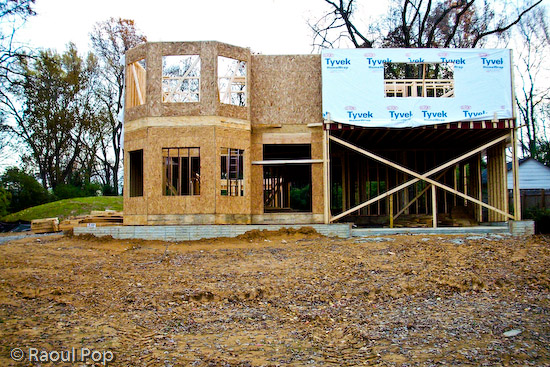
House under construction

Some unwitting soul is going to pay several hundred thousands of dollars for this piece of crap, and he won’t know what a lemon he’s getting. It’s all 2×4 construction. There’s nothing solid and concrete there except the foundation, and I’m not sure how thick that is, either. It’s all either cheap, soft wood or plywood, including the upper floor. Not only that, but the beams aren’t straight, and the joints aren’t secured properly.
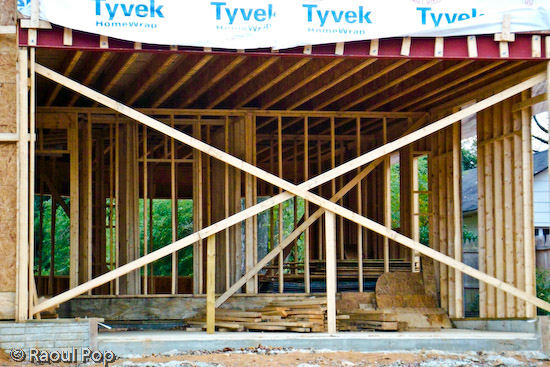
House under construction

It’s basically a big plywood box. I’m not sure what its projected lifetime is, but I can’t imagine it’ll last more than 30 years. It’ll start needing serious repairs even before the mortgage is paid off. Isn’t that terrible?

Do you see that cheap, flimsy Tyvek plastic? That’s the weatherproofing. No, I’m not kidding. That’s it. That’s also the insulation. I doubt they’ll put glass fiber or any other kind of insulation between the drywall and the beams. They might, but I seriously doubt it. I’ve seen the inside of many walls, and they’re usually empty.
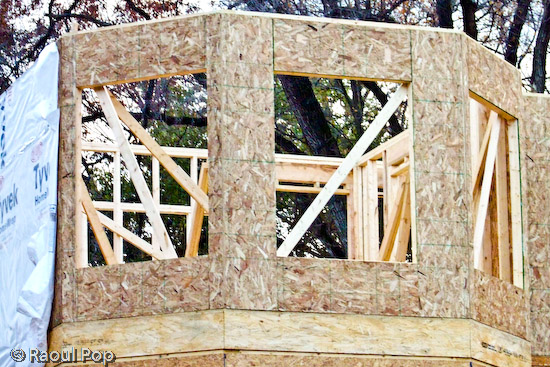
House under construction

Can you say cheap? I can. It’s cheap construction! It’s a travesty. Look at that horrible plywood shell. That’s going to be a tower. It’s going to look so nice, clad in fake brick or plastic siding only 1-2 inches thick… It’s also going to be horribly inefficient when it comes to temperature preservation. And if water should happen to leak in through that cheap brick cladding and through that flimsy Tyvek sheet, the plywood will rot away quietly and the owner won’t even know it… Wonderful, isn’t it? Isn’t this piece of crap worth mortgaging your life away?

Should we be ill-fortunate enough to get a hurricane or some tornado in our area, the roof on this thing will probably get torn off, and the entire house might or might not be standing when nature’s done with it.

Look, don’t get me wrong. I understand that America has a long history of 2×4 construction. It’s how the West was won. It’s cheap, affordable, goes up quickly, etc. But this isn’t the West, and it’s not the 1800s. This is the supposedly refined East. We should know better by now. It’s our nation’s capital. And the prices of these plywood boxes aren’t cheap. No, they’re so high most people can’t afford them.

I also understand the builders have to make a profit and the cost of land in this area is expensive. But this is ridiculous! If you’re going to build something that someone will want to call their home, and will pay dearly for it, sinking most of their productive, working years into paying it off, then God help you if you don’t build something worthwhile, something that’ll last. You’ll get what’s coming to you, don’t you worry about that…

What I wonder about is how the people and companies that put up these things can live with themselves. That’s what I want to know. How can they sleep at night knowing someone’s going to pay a fortune for something that’ll start falling apart after the first several years, for something that’s so horribly inefficient when it comes to energy use that they’ll be paying through the nose to cool it in the summer and to heat it in the winter? Don’t tell me about efficient windows! You can get the most expensive windows out there — if the walls themselves can’t conserve the inside temperature, you’ll still be nowhere. There’s such a thing as global warming to worry about. Have you heard of it? Everyone needs to reduce their carbon footprint, and it starts in the home.

Whatever happened to the good, old masonry work? What happened to quality stone construction? Yes, it’s more expensive, but isn’t it worth it? Why can’t you builders put a little more pride in your work? Why can’t you make a concrete skeleton, and use thicker insulation and better materials for the cladding? Is it so hard to do? So you’ll make a little less money. You might have to mark up the price a little. You might have to educate the consumers that know nothing about quality construction. But isn’t it all worth it in the end? Won’t you feel better knowing the house you built will last a long time? Won’t you feel better knowing the people that will buy your house will thank you for your solid construction later? Isn’t it it worth it to build good will instead of ill will?


Standard
How To

Block anonymous calls with SkypeIn

You may or may not know that Skype offers a service called SkypeIn, which lets you get a local number that people can call to reach you anywhere in the world, provided you’re logged into Skype. I’ve had a SkypeIn number for the past couple of years, and I love it. Want the number? It’s +1 (301) 637-6885.

Do you know why I can give it out so freely? First, because all my calls go right to voicemail. I get that bundled with SkypeIn. I screen all my calls that way and delete all of the annoying telemarketing calls. Second, because of a great feature that I’ve discovered yesterday. It’s hidden away in the Advanced settings for Calls, and it blocks most telemarketing calls automatically.

Here’s how it works. Open Skype and go to Tools >> Options. Then click on the Calls icon, located in the sidebar of the Options dialog box. You’ll get the following screen:

Basic call settings in Skype

Now click on the “Show Advanced Options” button. You’ll get this screen:

Advanced call settings in Skype

Now look for the option that says “Allow SkypeIn calls from…” and select “anyone”, then make sure to check the option called “Block calls when number is hidden”.

Doing this will block most telemarketing calls, since they usually hide their numbers. Isn’t that beautiful?

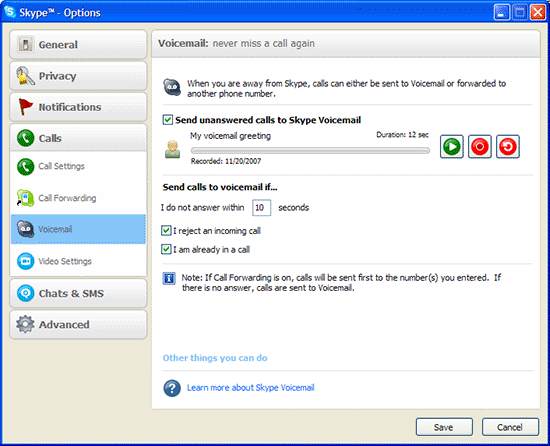
If you want to make sure none of them get through to you, just go to the Voicemail section and look for the “Send calls to voicemail if…” option, then change the number of seconds to 1 or something really small. That way everything that makes it past the initial call filter goes right to voicemail. This allows you to listen to the messages later and hit delete without wasting your time. I have my threshold set to 10 seconds. If I’m logged into Skype, that usually gives me enough time to see who’s calling and decide if I want to take the call or not. If I’m not logged in, then all the calls go directly to voicemail anyway.

Voicemail settings in Skype

Hope this helps!

Standard
Thoughts

When animation trash gets called art

Last year, I stumbled over the blog of one of the directors for the Ren & Stimpy cartoons, by the name of Vincent Waller. I subscribed, curious to see what one of the people who’d worked on that horrible cartoon was doing nowadays. It didn’t take long for me to find out…

A few days later, he blogged about a cartoon made by one of his fans. He lavished so much praise on it that I watched it. It was an utter bunch of filth, filled with suggestive sex, curse words, violence and bestiality. It was done in the style of the Ren & Stimpy cartoons — same sort of animation, similar character movement, similar colors, etc.

I left a comment on his post, telling him that I couldn’t believe he’d posted that garbage to his blog. I honestly thought the guy knew better than that, but I was wrong. He deleted my comment. I left a subsequent comment. He deleted that as well. I contacted him via email. He answered back and seemed somewhat rational. I thought I might have a decent conversation with him, and I asked him out of sheer curiosity why the Ren & Stimpy cartoons ever got made. What was the rationale behind them? I told him I found them depressing altogether, and I found the subject matter crude and filthy. I said that as a child, I wanted to see cartoons on TV, and very often, only Ren & Stimpy were on in the evenings, so I had to watch them if I wanted to watch any cartoons at all.

He told me to go away and not bother him again. He said that there was something wrong with me, that I should have watched something else, and that he and the series creator happened to like them, and that’s why they got made. That was the end of that conversation.

But, it got me thinking about the people behind Ren & Stimpy and the other horrible cartoons that our children can watch on TV nowadays, or were able to watch until not long ago — stuff like Beavis and Butt-head, for example.

These people make this horrible crap that appeals to their sick and twisted minds, filled with all sorts of suggestive behavior and language meant for adults, and they put it on TV, where it gets shoved by the cartload into the minds of our children. Do they take any responsibility for their actions? No, they do not. They blame the viewer for watching their stuff if he or she complains.

What they also do not want to recognize is that stuff that’s on TV carries weight with people (yes, it still does, in spite of widespread cynicism). If it gets shown on the air, people assume it’s been vetted and there’s some merit to it. It’s a false assumption, I know, but most adults don’t know this, much less the children. They don’t know the stuff is crap. If it’s on Nickelodeon or the Cartoon Network, it must be good, right? Wrong.

Generally speaking, crap cartoon shows get made because the creator is friends with a network exec, or he’s worked on a successful series and can now pitch his idea with some leverage. But that doesn’t mean that these shows are any good or that they’ve been vetted responsibly. It only means they got into the channel through the back door, and yes, they smell like it, too. What’s more, series creators and directors often get “artistic freedom” once a show has been approved. Execs don’t dare censor stuff, because that would stifle the series’ “creativity” — and I use that word very loosely in this context. So a bunch of weirdos with no self-control get to put together shows that get shown to children. What’s more, they absolve themselves of any blame whatsoever if children are influenced negatively by their work, and call people who protest “legless, armless lumps” (that’s the term used on me by that director I mentioned in the first paragraph), because they should know better than to watch their stuff.

They do not want to acknowledge, however, that children do not yet have the power to filter things properly. They don’t have a fully developed moral compass, and more often than not, choose to sit in front of the TV and hope that something good is on. Or, these thoughtless, immature “artists” also pull out the parent argument. They say that parents ought to monitor what their kids watch. Well, it’s a bit difficult to do that when you’re at work and your child is at home. Nickelodeon and Cartoon Network are supposed to be fairly safe channels, so you can’t just disallow them altogether. If you can’t even allow them, what can you allow?

But does any of this register with them? No. All they care about is making their crap, expressing themselves “artistically”, and getting paid for making their crap.

The sad thing is that the creator of Ren & Stimpy (whose name is not worth mentioning here) is now enjoying some sort of fame, since he was one of the few people who still adhered to the old animation methods (storyboards, character development, hand drawings, etc.) when he made Ren & Stimpy. He’s getting praised on various animation sites for that, and for contributing heavily to the ASIFA-Hollywood Animation Archive.

I think ALL of that praise is misplaced… You can follow all of the right methods, you can make all the storyboards you want, you can draw painstakingly well, but if your original vision is horrible, the end result will be horrible as well. Ren & Stimpy should have never made it to TV. It should have been released to tape, and I bet if that had happened, we’d have it archived in obscure, seldom-seen videos on YouTube, uploaded and viewed by a few animation geeks, because no one else would have liked it.

In spite of the fact that this man is doing his part to preserve a somewhat lost art in animation, he’s a poor example of putting that art to work. Judging by the stuff he’s created so far, he’s not fit to hold a candle to Preston Blair or any other of the Golden Age animators he is aping. There’s a LOT to be said about censorship in animation, and Disney, in spite of all his shortcomings, had a very, very bright idea when he kept an iron grip on what got made and put out at his company. He made sure it was okay to show to children. The man was a genius.

I’ve done a lot of talking about bad cartoons in this post. What about good cartoons? What cartoons do I think are appropriate for children? Well, it just so happens that I wrote a post on how to find cartoons for children last year. It’s a good read, so have a look at that. I encourage parents out there, and the younger folks as well, if you’re looking for good cartoons, don’t stop looking, and don’t settle for garbage. Go looking for better stuff. If you have to buy DVDs, buy them. You can also rent from Netflix.

Make sure the stuff you watch is good stuff. You’ll know it’s good stuff because it’s the stuff that makes you feel warm, fuzzy and comfortable when you watch it. When you get up after watching it, you feel happier and better. Look for the good stuff, and let the bad stuff go to waste, because that’s where it belongs.

Standard
Thoughts

Living in a mad world

There are two things I want to talk about today. The first took place right here in the US, and the second happened in Italy. Both happened recently.

We’ve got a conductor who has forgotten the US still means freedom. Apparently, a tourist, possibly from Japan, who knew very little English, was taking photos of the scenery (mostly nature) on an Amtrak train between New York City and Boston. The conductor saw him, and asked him to stop in the “interest of national security”. Huh?! For taking photos from a train? For trying to preserve the memories of a trip?

But that wasn’t enough. She screamed at him even though he didn’t understand what she was saying, then called the police in and had him arrested and removed from the train. Yeah, you read that right.

How wrong is that? It’s the sort of thing that makes one’s blood boil. At the very least, that conductor, and the policemen that went along with that sick gag should be censured or suspended, so they can all remember we don’t arrest people willy-nilly in the US, not for taking photos from a moving train open to the public.

The Economist reports that Italy has passed a decree authorizing the expulsion of any Romanian immigrant who is deemed a danger to public safety. This bothers me a lot, since I’m Romanian by birth and upbringing, and I want to clarify the situation.

There was an incident where an Italian woman was killed and possible raped by a Romanian immigrant. There’s a catch to the story though. That was NOT a Romanian immigrant, it was a gypsy from Romania. There’s a BIG difference, so let me explain.

It’s hard for Americans to understand this sort of thing, but ethnicity is a very touch issue in Europe, particularly in Eastern Europe. Just think of the wars in Bosnia and Herzegovina, or go back through the last few hundred years and look at the geography of Europe. All of those governmental and boundary changes created and continue to create ethnic conflicts which may smolder for years, or break out into open war, which is what happened in Bosnia. I’m not saying this to set up my arguments, just to give you some background info. There is no animosity between Romanians and gypsies, just deep-seated and justified frustration with these nomadic people that have chosen to settle in Romania over time.

I was born and grew up in Romania, so I’m a bit more aware of these things than outsiders who decry the situation in the country without really knowing what’s going on. You see, we’ve got a lot of gypsies in Romania. They’re nomadic people, but they’ve chosen to settle there in the last few hundred years. Other countries have them as well, but we seem to have been “blessed” with unusually large numbers of them. There are a few classes of gypsies, and they can be differentiated based on how well they integrated into society, and how clean they are.

First you have the Gabors, which are the most civilized. They’re clean, hard working, responsible people and integrate well into society. I have no issues with them and would be happy to have them as my neighbors. There’s another group whose name escapes me — I don’t know much about them except that while they’re more aloof, they’re also fairly decent in terms of how they interact with other people.

Unfortunately, you then have the gypsies per se, a very mixed class of individuals and families that share these common characteristics: they do not integrate into society, they live mostly in shanty towns, they have little or no hygiene or cleanliness, and they have a very high rate of crime. They call themselves the Roma, which is a title I must protest. It’s much too close to the word Romanian or Roman, and they hail neither from Romania, nor from Rome.

You do not talk about normal living when you talk about these gypsies, the so-called “Roma”. You find them begging on the streets or dealing in God knows what, but mostly, you find quite a large number of them stealing, raping and murdering. This isn’t an exaggeration and has been their historical record. Since they do so poorly in Romanian society and certainly have no interest in obeying the laws of the country, they do not deserve to be called Romanians, and indeed, I would not call them citizens of Romania or bestow on them the rights that go along with that citizenship.

When Romania got accepted into EU, several programs got started whose aim was to integrate these gypsies into society. So far, they have failed. Why? They’re too different and have no interest in life as civilized people know it. Really, they don’t, and if you don’t believe me, you’re welcome to go there and try to integrate them yourself. You will fail miserably.

At any rate, it’s these gypsies that immigrated to other European countries in droves when the borders were opened, along with a number of actual Romanians. When the gypsies arrived in these Western European countries, they started engaging in their usual behavior: living in shanty towns, polluting society in general, participating enthusiastically in crime and other misdemeanors, etc. When they’d get caught by the police, they’d say they were Romanian citizens, which, as I’ve just explained, is not quite true. Ethnically speaking, they most certainly aren’t Romanians, and behaviorally speaking, they’re an entirely different breed.

A few years ago, there was a case where gypsies caught and ate swans from a German lake. There was an uproar, and Romania got the blame for it. As if normal, law-abiding Romanians had something to do with that… Don’t get me wrong, I’m not saying genuine Romanians don’t engage in crime, because every orchard has its rotten apples, but at least the crime rates are very different among Romanians and gypsies.

In the recent case in Italy, we’ve got a gypsy who lived in one of their shanty towns, who accosted, beat up and possibly raped an Italian woman. Who got the blame again? Romania. Why? Because that gypsy was from Romania. Was he a Romanian? Not really. So now we’ve got Italians horribly worked up against Romanians in general, when most of the Romanians that went to Italy did so to find honest work that they couldn’t get in Romania, who’s still having problems with its economy.

It’s just not fair that Romania keeps getting blamed for the actions of gypsies, which, as a group, cannot be controlled or integrated into any society or country where they happen to live. I wanted to set the record straight when it came to this, and do hope that I’ve managed to make my point.

Updated 11/29/07: Came across a great photo-documentary of gypsy life in several countries. Have a look at it. It has photos of gypsies from Romania as well. Try not to romanticize things as you look at the photos. There’s nothing romantic about an utter lack of hygiene or living in a hovel.

Standard
Thoughts

It’s about expectations

Many of us have heard this before, but it bears repeating. Customer or user satisfaction depends, in large part, upon the expectations you set, as a service or product provider. Promise something you can’t or don’t deliver, and satisfaction goes right down the drain, no matter what you did right.

A great friend of mine put this another way: under-promise, and over-deliver. It’s plain, simple, and it should be the golden rule that companies use when they think about their products and services. I don’t mean you should set your sights on mediocrity, or that you should settle for the lowest common denominator. But you should ALWAYS make sure you promise only what you can absolutely deliver, and if you do anything above and beyond the call of duty, it’s icing on the cake, and it makes the customer ecstatic in a viral sort of way.

Have you heard of Micro Center? Neither did I, till a couple of weeks ago. Their website is certainly underwhelming — at least it is at this point in time, but I have a feeling that’ll change. I got a flyer in the mail from them, inviting me to the store for a free gift. I went in and was blown away. Their store has the coolest and best floor layout I’ve ever seen! It’s clean, well-lit, beautiful, stocked to the gills with cool technology, and everyone is friendly! Did they promise any of that in their flyer? No, they just promised the free gift and mentioned the new store. They delivered on the free gift just fine, and their store atmosphere was the icing on the cake that left me ecstatic.

And guess what? They have an in-store pickup option as well. I ordered a few CF cards from their site today, and went to pick them up in the evening. But do you know what they did? They didn’t promise a 20-minute turnaround. They actually put some thought into it. Their staff is new, their store is new, their systems are probably new or re-designed, and they knew they couldn’t deliver on something like that. They said the order would be ready for pickup in a couple of days. Was I disappointed? No. I got the price I wanted on the products I wanted, and as long as they were going to make good on their promise, I didn’t care. But I thought I’d test the waters anyway, and Ligia and I got in our car and drove to the store tonight.

When we got there, the same cheery atmosphere awaited us. The people were courteous and smiled, just like the last time we visited. We went to the customer service counter, where the representative looked up our order and explained that it wasn’t ready yet. No problem, I’d expected that. I asked if I could pick up the items from the store shelves and come back to the counter. She said yes. I browsed through the store, found what I needed, brought the stuff back to the customer service counter, and the representative fulfilled the order. She fiddled a bit with the computer system since it was new, but she was courteous and helpful, and I didn’t mind waiting an extra couple of minutes. In the end, I walked out with my order fulfilled, and the kicker was this: the price was the same as on their website.

It’s about setting the right expectations, plain and simple. Do what works for you, and more importantly, do what you know you can do! Under-promise, over-deliver, and you’ll have happy customers. Even if you go just a bit beyond what you promised, it makes a huge difference!

Standard