Places

The ancient city of Histria

On the shore of Lake Sinoe in Romania, very close to the Black Sea, lie the ruins of the oldest documented city on the territory of modern-day Romania: Histria. (See satellite view below, or go to Google Maps to explore the full map.) We visited it in September of 2008.

It started its life around 630 BC [reference], built by Milesian colonists from Greece, to trade with native Getae tribes (Geti in Romanian). The Getae were Thracian tribes that occupied Dacia, whose territory is matched in smaller proportion by modern-day Romania. They, and the other people who settled in Romania at later times (like the Romans) are the ancestors of modern-day Romanians — my ancestors.

When Histria was built, its port was literally on the shore of the Black Sea. Over its approximately 14 centuries’ existence, silt deposits from the Danube River blocked off its access to the sea and formed what is now Lake Sinoe. This meant that the city’s importance as a port and trading post slowly diminished as the silt deposits grew to become the current land border between the Lake Sinoe and the Black Sea. It must have been painful to try and salvage the city’s livelihood by finding routes through the growing silt, hoping that ships stuck in the increasingly shallow water would somehow want to come back, should they manage to get away. Little did they know that in modern times, a canal would be cut through the silt shore at Periboin, not far from them.

By 100 AD, the city, who had resisted countless attacks and rebuilt its walls time after time after time, could only rely on fishing as a source of income. It managed to survive another 600 years or so, until it was destroyed one last time in the 7th century AD by the Avars and the Slavs. Its inhabitants moved away, and the once bustling and prosperous city, who had forged an important trading link between the Greeks and the Dacians so many centuries ago, began to decay, unoccupied.

Its name forgotten, it didn’t even appear on maps. Its memory swallowed whole by time, its walls covered by the ground itself, it lay in wait until it was re-discovered by a Frenchman, Ernest Desjardins, in 1868. In 1914, Vasile Parvan, a Romanian, began the first excavations of the site. The archeological digs continue to this day, conducted by various multinational teams. This was how we found it a month or so ago.

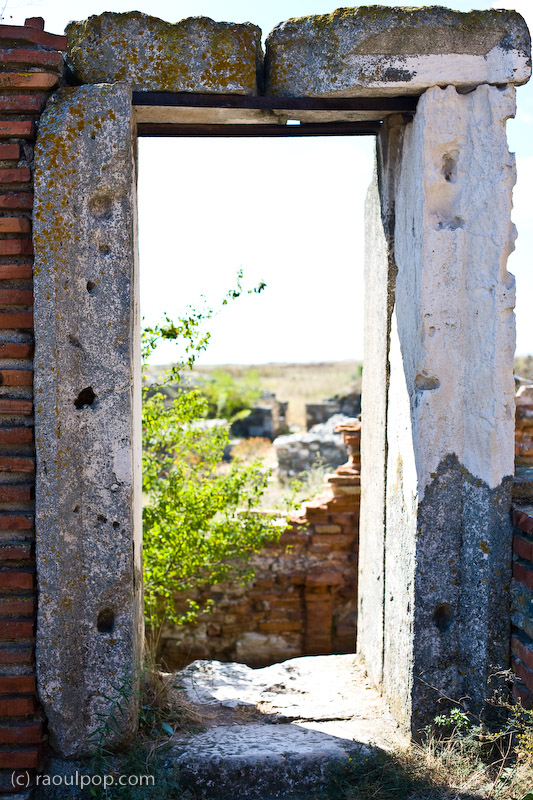
It was a warm, sunny, late-summer day when we visited. The heat shone down oppresively while we drove through the flat Dobrogea landscape. Yet a soft, cooling breeze from Lake Sinoe met us as soon as we stepped onto the grounds of the city.

There was a peace and quiet at Histria that I can only find when I visit certain ruins. I stood among the remains of the walls, and thought of the people that lived there before I set foot on what used to be their homes. They were born, lived and died there, making a living the best way they knew how, in a famous city by the Black Sea. The breeze must have been stronger then, since the waves of the sea beat against the city’s very shores.

What an adventurous spirit those Greek traders must have had, to get in their boats and travel far off, in hope of establishing a little colony of their own in an unknown land. How did they choose the site? Likely because it sits on top of a slight hill. Just think, the first few families built little homes out of field stone (there are very few trees around), and through hard work applied over time, grew that little settlement into an important port of trade and a fortress, one rich enough to attract the attention of countless attackers.

As I sat there and listened to the lull of the waves, I understood why they rebuilt after each attacks. The peace between each bout of violence was worth the effort, and the surroundings themselves invited (and still invite) company. Had their direct access to the Black Sea not been cut off, I believe Histria would survived to this day, and perhaps the city of Tomis (Constanta) might have had a different fate.

If you walk slowly among the houses or on the streets at Histria, you too will understand why it survived for so long. It’s hard to leave a place like that. It’s so peaceful, so quiet, so welcoming. You want to spend more time there, looking toward the horizon, hoping against hope to spot your ship, which is making its way slowly but surely toward the small port, bearing goods that will replenish your warehouse and provide for your family for another year.

The full set of photos from Histria is available at my online photography catalog. You’re welcome to view them all there. Mircea Angelescu, a Romania researcher, developed a 3D model of Histria which can give you a detailed idea of the city’s layout over time. More info on Histria can be found at Wikipedia.

Standard
Thoughts

Happy Birthday Tataie

It’s my grandfather’s birthday today. He died just a couple of weeks ago after a painful struggle with mesothelioma, a form of cancer caused by asbestos exposure.

He’d been coughing for a few years. It was a persistent cough, but it wasn’t a severe cough. He coughed here and there, and especially after he came into a cooler room after working outside, in his beloved garden. Then things got worse. He kept getting cold-like symptoms and coughing more. When doctors in Romania examined him, they discovered water in one of his lungs. They started drawing it out with syringes regularly, liters at a time. A lesion of sorts developed at the site where they kept inserting the needle. A biopsy of the lesion revealed nothing. Things didn’t improve.

My parents hoped that the Florida weather would do him good, so they brought him to the States. He loved the weather, but didn’t get better. They thought US medical care would be better than Romanian medical care, so they put him in a hospital here. Doctors literally paraded by his bedside by the tens, specialist after specialist, all of them clueless. Oh, let’s try this, let’s try that, blah, blah, blah — that’s how the story usually goes. X-rays and CT scans and urine and lab tests every day, and still they couldn’t figure things out.

Finally they decided to open him up and see what was going on. That’s when they discovered he had mesothelioma, with a few “localized” tumors in his right lung. But they still couldn’t figure out what to do about the water accumulation, so they proposed to insert talcum powder between the lung walls, in the hope of sealing that chamber and stopping the leaks (that’s apparently a standard procedure for this sort of thing).

So they opened him up again and inserted the powder. Water still accumulated, this time more slowly, but it still happened. Then he developed difficulty swallowing. They stuck tubes with cameras down his throat. More CT scans, more X-rays, and still no idea why. Well, let’s enlarge his esophagus and cardiac sphincter (the opening from the esophagus to the stomach.) That might help… Well, it didn’t. He still had trouble swallowing.

They didn’t know what else to do for him, so they released him from the hospital. The bill came to well over $100,000, and my grandfather was no better than before. He was worse, and now he had to contend with pain from the surgery and the other procedures done on him while in the hospital.

My mother had to blend everything into a soupy puree before feeding him, and still he had trouble swallowing. He withered and dried out and lost tens of pounds. He was hardly recognizable, but his spirit was still well, and he hoped he’d get better. That was the hardest part, to see him trying to eat and unable to swallow, then leave the table with a horribly sad look on his face.

We knew he wouldn’t last long like that, so we convinced him to return to Romania, where at least he could die in his own home, if it were to come to that. Once he got there, my aunt, who took care of him, put him on IV fluids. He got a little better. We decided to try seeing some specialists there in Romania, so she took him to the hospitals in Sibiu and Timisoara.

If you don’t know how the healthcare system works in Romania, I’ll tell you. It’s based on heavy bribes. If you don’t bribe the doctors and nurses, no one cares about you. No one even looks at you, and you’re treated like scum. If you have the money to give them, you actually get somewhat decent service, depending on how much you give. You can’t lay the blame entirely on the medical personnel for this practice though. Doctors’ salaries are horribly tiny, smaller than the salaries of some janitors at well-to-do companies. So they need cash infusions from the patients in order to be able to live properly. But the way they go about it is disgusting to me. And there’s no telling when they’ll make up stuff about your condition just so they can get more money out of you. They’ll even do extra procedures (if they’re unethical people) so you’ll pay them more.

Once in the hospital, they slipped a feeding tube through his nose and into his stomach. In Sibiu, they opened him up again and discovered some lesions on his esophagus, and some on his stomach. They said he needed his esophagus replaced, but that they couldn’t do the procedure, and that he needed to be sent to Timisoara. We believe the doctor who operated on him at Sibiu twisted his stomach or intestines around and caused a severe blockage in his GI tract, because his digestion and regularity were never the same after that.

In Timisoara, the specialist who was to replace his esophagus with a silicone stent bragged to high heaven that he was the only one doing the procedure in Romania and in the entire Western Europe. If that sounds phony to you, don’t worry, you’re right. He just wanted to make sure he got enough money for the job. He ended up operating on my grandfather, but replaced less of the esophagus that he’d originally said. We’re not sure why. Things went completely downhill from there.

My grandfather never recovered from that operation. His situation got worse and worse every day. Now he couldn’t digest his food at all, even the soups he was fed through his tube. He coughed up blood and fluids of various colors. He got thinner and more dehydrated every day. My aunt put him back on IV fluids, but they didn’t help. He was in horrible pain, throughout the day and night. He moaned in agony. He couldn’t sleep. When he did manage to sleep, he would writhe and cry out in anguish. He was dying.

Four days before he died, he asked my aunt to make the preparations for his burial. He knew it and he was ready. He asked her to let him go, to stop trying to keep him alive. She couldn’t stop caring for him, but she knew it was going to end anyway. He looked forward to joining my grandmother in the grave next to hers.

And then he died in the evening. I got the call from my mother. She was crying. I couldn’t cry. I knew what he’d been through, and wanted him to get the rest and peace he so badly needed. I was angry with everything that had happened to him, and still am. Why did he have to die in such pain? Why did he have to encounter the utmost morons in his quest for decent medical care? Why did he have to suffer so much?

We don’t know when he got exposed to asbestos. It wasn’t uncommon in communist Romania to get exposed to dangerous conditions or materials. He worked at the same factory all his life, and got promoted to chief technical engineer from a humble line worker. He came up with various inventions and improvements during his career, and was even decorated by Romania’s dictator, Nicolae Ceausescu, for his contributions. I’m not saying this because I care about Ceausescu, who was a horrible man, but I care about my grandfather and about his life’s work, and was glad to see him get recognized.

For me, my grandfather’s suffering serves to underline how little medical science really knows about the human body, and how horribly few things they can do to cure people. In spite of all our technology and advances and drugs, when it comes to treating disease, our options are very limited, and very primitive. We can:

  • Mask the symptoms by treating them with drugs
  • Cut into people and butcher them with plain knives or sear them with electric knives, then sew them up with string
  • Poison them with radiation therapy and chemotherapy

I remember my frustration with this while in medical school, and perhaps it had something to do, subconsciously, with my leaving it to return to IT work. At least in IT you can find out what’s really wrong and can fix it either through code or hardware replacements.

What my grandfather’s death also showed (amply) is how many idiots there are in the healthcare system. My God, we have so many doctors out there that can’t diagnose their way out of a paper bag, and they run test after test and try this and that and still can’t figure out what’s wrong. I’m fortunate enough to know there are good doctors (although they’re few and far between) who know how to diagnose with much less information at their fingertips, because I’ve met some of them.

If all these retards can graduate medical school and can pass the boards, then clearly medical education isn’t doing its part in weeding them out. I had plenty of them in my class in med school, too. They were the ones who got by very nicely by rote memorization. Worked great, until you asked them to analyze something — then they looked at you like a hen looks at a newspaper.

Another one of my beliefs was reinforced: that the overwhelming majority of nurses are lazy asses that don’t care at all about their patients. I’m sorry if that offends you, but that’s the truth. I know this because I saw they way they treated my grandfather, and I saw the way they treated other patients over the years.

All nurses seem to want is more money and more benefits for as little work as humanly possible. Oh sure, they put in a lot of “hours”, but most of those hours are spent socializing at the nursing station, not by the patient’s bedside. What’s unfortunate is that the market is tilted so much in their favor right now (and will continue to be for the next several years) that nothing significant can be done about it. There’s a nursing shortage, and that means we’re going to have mediocre, good-for-nothing nurses in all of our hospitals until supply meets demand, and hospitals can start to weed out the non-performers.

I tell you, the nursing profession will not emerge unscathed from this. The stink caused by these bad nurses will taint the good ones, too. The good ones are out there, I’ve met some of them, and when I say they’re good, I honestly mean it. They’re great, and they care, and they know a lot, but they’re few and far between, and they’re mostly in academia.

Coming back to my grandfather, I think of my grandmother’s death two years ago, also in June. A week or so after her burial, it was my grandfather’s birthday, and I remember him celebrating it with us, his family, but without his beloved wife. The sorrow was evident on his face, even through his smiles, and there was nothing any of us could do for him but to try and cheer him up.

Now, he’s resting in the grave, and it’s his own birthday. There’s no birthday celebration now. Just pain and a feeling of irreplaceable loss.

Rest in peace, tataie. You taught me how to build and fix things and work in the garden, and how to use tools and paint and be the man I am today. You were the first man I looked up to, the first one that made me want to learn how to shave. I saw you do your best, every day, to care for and protect your family. You never spoke much, but you did much. You were loved, and are loved. Rest in peace.

Standard
Thoughts

Living in a mad world

There are two things I want to talk about today. The first took place right here in the US, and the second happened in Italy. Both happened recently.

We’ve got a conductor who has forgotten the US still means freedom. Apparently, a tourist, possibly from Japan, who knew very little English, was taking photos of the scenery (mostly nature) on an Amtrak train between New York City and Boston. The conductor saw him, and asked him to stop in the “interest of national security”. Huh?! For taking photos from a train? For trying to preserve the memories of a trip?

But that wasn’t enough. She screamed at him even though he didn’t understand what she was saying, then called the police in and had him arrested and removed from the train. Yeah, you read that right.

How wrong is that? It’s the sort of thing that makes one’s blood boil. At the very least, that conductor, and the policemen that went along with that sick gag should be censured or suspended, so they can all remember we don’t arrest people willy-nilly in the US, not for taking photos from a moving train open to the public.

The Economist reports that Italy has passed a decree authorizing the expulsion of any Romanian immigrant who is deemed a danger to public safety. This bothers me a lot, since I’m Romanian by birth and upbringing, and I want to clarify the situation.

There was an incident where an Italian woman was killed and possible raped by a Romanian immigrant. There’s a catch to the story though. That was NOT a Romanian immigrant, it was a gypsy from Romania. There’s a BIG difference, so let me explain.

It’s hard for Americans to understand this sort of thing, but ethnicity is a very touch issue in Europe, particularly in Eastern Europe. Just think of the wars in Bosnia and Herzegovina, or go back through the last few hundred years and look at the geography of Europe. All of those governmental and boundary changes created and continue to create ethnic conflicts which may smolder for years, or break out into open war, which is what happened in Bosnia. I’m not saying this to set up my arguments, just to give you some background info. There is no animosity between Romanians and gypsies, just deep-seated and justified frustration with these nomadic people that have chosen to settle in Romania over time.

I was born and grew up in Romania, so I’m a bit more aware of these things than outsiders who decry the situation in the country without really knowing what’s going on. You see, we’ve got a lot of gypsies in Romania. They’re nomadic people, but they’ve chosen to settle there in the last few hundred years. Other countries have them as well, but we seem to have been “blessed” with unusually large numbers of them. There are a few classes of gypsies, and they can be differentiated based on how well they integrated into society, and how clean they are.

First you have the Gabors, which are the most civilized. They’re clean, hard working, responsible people and integrate well into society. I have no issues with them and would be happy to have them as my neighbors. There’s another group whose name escapes me — I don’t know much about them except that while they’re more aloof, they’re also fairly decent in terms of how they interact with other people.

Unfortunately, you then have the gypsies per se, a very mixed class of individuals and families that share these common characteristics: they do not integrate into society, they live mostly in shanty towns, they have little or no hygiene or cleanliness, and they have a very high rate of crime. They call themselves the Roma, which is a title I must protest. It’s much too close to the word Romanian or Roman, and they hail neither from Romania, nor from Rome.

You do not talk about normal living when you talk about these gypsies, the so-called “Roma”. You find them begging on the streets or dealing in God knows what, but mostly, you find quite a large number of them stealing, raping and murdering. This isn’t an exaggeration and has been their historical record. Since they do so poorly in Romanian society and certainly have no interest in obeying the laws of the country, they do not deserve to be called Romanians, and indeed, I would not call them citizens of Romania or bestow on them the rights that go along with that citizenship.

When Romania got accepted into EU, several programs got started whose aim was to integrate these gypsies into society. So far, they have failed. Why? They’re too different and have no interest in life as civilized people know it. Really, they don’t, and if you don’t believe me, you’re welcome to go there and try to integrate them yourself. You will fail miserably.

At any rate, it’s these gypsies that immigrated to other European countries in droves when the borders were opened, along with a number of actual Romanians. When the gypsies arrived in these Western European countries, they started engaging in their usual behavior: living in shanty towns, polluting society in general, participating enthusiastically in crime and other misdemeanors, etc. When they’d get caught by the police, they’d say they were Romanian citizens, which, as I’ve just explained, is not quite true. Ethnically speaking, they most certainly aren’t Romanians, and behaviorally speaking, they’re an entirely different breed.

A few years ago, there was a case where gypsies caught and ate swans from a German lake. There was an uproar, and Romania got the blame for it. As if normal, law-abiding Romanians had something to do with that… Don’t get me wrong, I’m not saying genuine Romanians don’t engage in crime, because every orchard has its rotten apples, but at least the crime rates are very different among Romanians and gypsies.

In the recent case in Italy, we’ve got a gypsy who lived in one of their shanty towns, who accosted, beat up and possibly raped an Italian woman. Who got the blame again? Romania. Why? Because that gypsy was from Romania. Was he a Romanian? Not really. So now we’ve got Italians horribly worked up against Romanians in general, when most of the Romanians that went to Italy did so to find honest work that they couldn’t get in Romania, who’s still having problems with its economy.

It’s just not fair that Romania keeps getting blamed for the actions of gypsies, which, as a group, cannot be controlled or integrated into any society or country where they happen to live. I wanted to set the record straight when it came to this, and do hope that I’ve managed to make my point.

Updated 11/29/07: Came across a great photo-documentary of gypsy life in several countries. Have a look at it. It has photos of gypsies from Romania as well. Try not to romanticize things as you look at the photos. There’s nothing romantic about an utter lack of hygiene or living in a hovel.

Standard
Events

The reason behind our trip to Romania

You may recall that I mentioned a recent trip to Romania in a few of my posts. The occasion for our trip was a joyous one, thank goodness: my wife’s sister got married. I would have loved to post a few photos of them, but she and her husband would prefer to stay off the Internet, at least for now. Still, I did the next best thing. I put together a list of my favorite photos from the wedding that are okay to show in public.

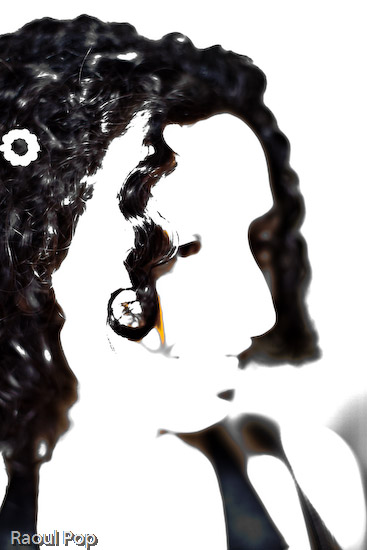
This is an overexposed photo of Ligia, processed in Lightroom. I like the way it came out.

Ligia

My little niece was one of the bridesmaids.

One of the maids of honor

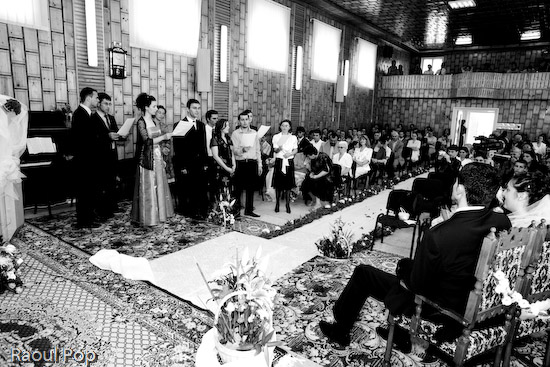
Ligia’s singing in the choir. The bride and bridegroom are in the bottom left corner. I think this photo’s alright to show, since they’re facing away from the camera. 🙂

The bride and bridegroom

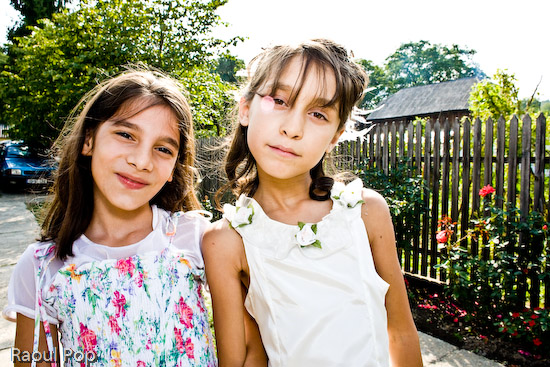
One of my nieces and her friend is giving me the tilted head look. I love how this photo came out, in spite of the lens flare visible near my niece’s right eye. The pose was completely spontaneous, and yet they both managed to tilt their heads and bodies at parallel angles. Lovely!

The tilted look

The bride takes a walk outside the restaurant where the wedding party took place.

The bride

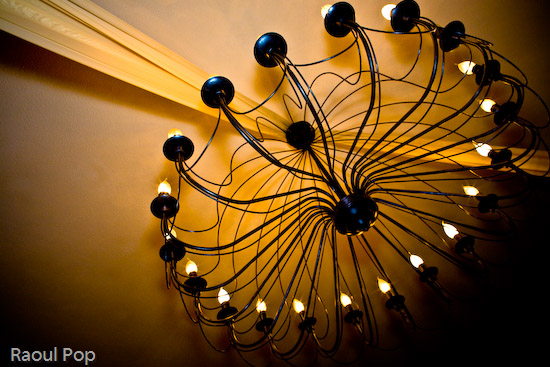
I loved this simple yet dramatic chandelier, and the cloth ribbon draped across the ceiling was a great touch.

Chandelier

The bride and bridegroom cut the wedding cake, hand in hand.

The wedding cake

Here we are. My brother-in-law (not the one getting married) took this photo. It came out really nice, don’t you think?

Ligia and Raoul

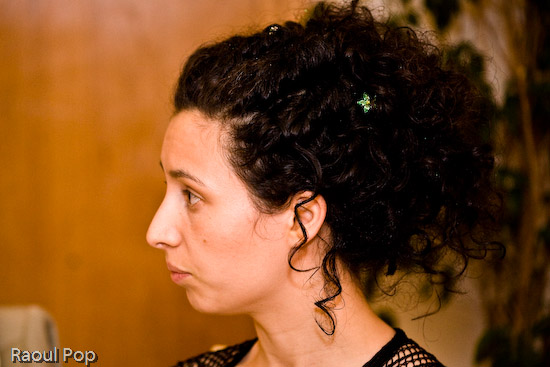
My lovely wife. I never get tired of photographing her.

Ligia

We had a really wonderful time at the wedding, getting to know the groom and making new friends. It all went just as planned, and came out even better!

Standard
Places

Downtown Bacau, Romania

Bacau is one of the bigger cities in Romania. I had a chance to visit its downtown area this September. I’d never been there before, so I stopped to take a few photos. It was early on a Sunday morning, so there weren’t many people on the streets.

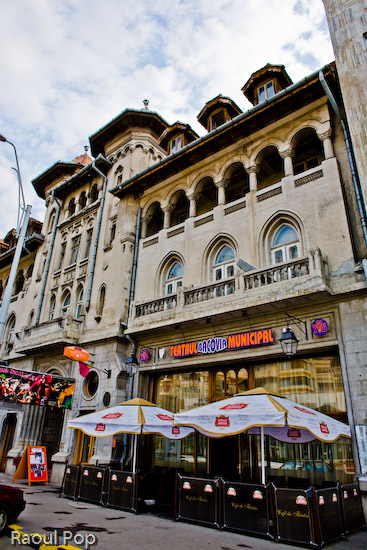
I love the northern Italian architectural elements used in the facade of the Bacau Theatre building, especially the upper floor, with its balcony, arches and mini-towers.

Teatrul Municipal Bacovia

The entrance to the theatre is quite imposing:

Entrance to Bacau Theatre

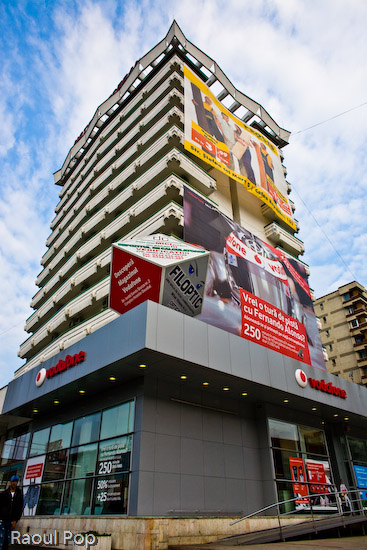
Across the street from the theatre, you can see this large condominium building (at least I assume it’s condominiums, I doubt they’re all offices.) I thought the architectural plan was a good way to make a square shape look interesting. It looked pretty good, but, as one finds in Romania, ads were plastered all over its sides. I wonder what the people living in those apartments now obscured by the posters must think of it all. Are they getting paid? Are they just getting annoyed? Who knows.

Vodafone Bacau

Right next door to the building above, we can see a monster left over from communist times… At least this dying breed of an apartment building is one of the better ones I’ve seen in Romania. One mostly sees nasty, crumbling, weather-stained concrete ruins when it comes to communist architecture. This particular building looks pretty well maintained, too. Of course, its central location might have something to do with that.

Complex Comercial Junior

A little ways down the street, we find the public library, but the building is in sore need of restoration. I’m not sure if it’s still being used, but I’d love to get inside it at some point in the future. It could lead to some interesting photographic opportunities.

Biblioteca Bacau

Here’s another view of the library, from the back:

Almost in ruins

There was a public park in the area, with art on display. I found a modern statue, and some post-modern wooden carved poles, styled after folk themes.

Pensive

Abstract wooden sculpture

Hidden behind the park and public library, I found the Bacau Ateneu. One of our friends plays the violin over there. 🙂

Ateneu Bacau

Further down the street, you’ll see the county government building. This is the main entrance:

Consiliul Judetean Bacau

I liked the clasically-styled architecture, typical of turn-of-the-century construction. Here’s a window detail. Notice the stucco stripes, columns and arches.

Striped and arched

That concludes my sightseeing tour of downtown Bacau. Who knows, maybe I’ll get to visit it again in the future and take more photos. 🙂

Standard