Events

The Olympus E-3 Launch Party

Back on August 15, I wrote about the “new E-1”, the Pro DSLR from Olympus that would replace the existing E-1. I had the wonderful opportunity to attend the launch party for that new DSLR, officially called the E-3, on October 16. The party was held at the Museum of Natural History in NYC, and it started at 5:30 PM EST.

This post is rather long, so I thought I’d summarize it for your benefit:

  • First part: my thoughts on the event and the E-3, with photos of the camera
  • Second part: video from the event
  • Third part: my photos from the event

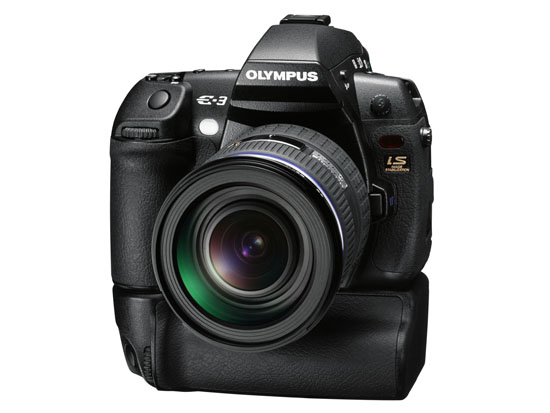
Olympus E-3 DSLR (front view with battery grip)

I was impressed with the quality of the event. Olympus rented an entire wing at the Museum of Natural History, and set up stations where we could talk with specially-chosen pro photographers about the E-3 and try out beta units of the camera. (The firmware isn’t yet finalized, so actual review units weren’t available.) There were food and drink bars (the cheese was fantastic) and all sorts of other goodies were spread all around (like a timeline display of all of the representative Olympus digital cameras, starting with their first model, and ending with the E-3). The event went nicely according to plan, and there was even a drawing where a lucky winner got an E-3 Pro Package (camera, speedlite, lenses, etc.) plus an all-expenses paid trip to India with one of the Olympus pros. I didn’t win it, unfortunately.

The atmosphere wasn’t one of hard sell. I could chat at ease with photographers and relax while looking at slideshows of photos taken by the pros or snacking on food. Ligia and I enjoyed ourselves. The weather was gorgeous. It had been sunny all day, and as evening descended on the city, the sky stayed clear, and a cooler breeze made it feel like a proper autumn night.

The E-3 surprised me in several ways:

  • It didn’t differ much from the concept photos I’d seen earlier, which was interesting. It means Olympus had been working on it for a long time, pretty much had the form factor down, and were simply perfecting it.
  • It was bigger and heavier than I expected. Having worked with the E-500, E-510 and E-410, I expected the body to be lighter and smaller. It wasn’t. The weight of the E-3 is exactly the same as the weight of my Canon 5D: 810 grams. It’s also as big as my 5D – actually, a little taller.
  • It felt very solid. When I gripped it, there was no mistaking it: I held a Pro DSLR in my hand.
  • The ISO sensitivity went all the way to 3200. What’s more, the camera’s Auto ISO function also varied the ISO from 100 to 3200. That’s a rarity. There’s usually an upper limit (something like 800) to Auto ISO on other cameras.
  • The camera uses an 11-point AF system. I complained about the 3-point AF on the E-510, and it looks like that’s not a problem on the E-3. It could focus very fast in lower light conditions, even at f/4.
  • The CMOS resolution is 10.1 megapixels. I honestly expected it to be 12 megapixels, just because everyone is pushing the envelope on resolution these days. I have a feeling this may be a limitation of the sensor’s surface area. The more megapixels one crams onto a sensor, the more chance there is for noise in lower light. It’ll be very interesting to watch and see how Olympus deals with the need for increased resolution in their Four-Thirds system.
  • The LCD screen swivels out, just like on the E-330.

Here are some more photos of the E-3, from various angles. The E-3 was launched with a brand new lens, the 12-60mm f/2.8-4. The effective focal range of this lens is 24-120mm, because of the 2x crop factor of the Four-Thirds system sensors.

I didn’t get a chance to play too much with the controls on the camera. One thing to say here is that Olympus built in a lot of buttons to allow for one-touch access to the camera’s most-used functions. I did find it a bit awkward to change the mode and ISO settings. To change the mode, I had to press the Mode button on the camera’s top left side, then rotate the back dial. To change the ISO, I had to press the ISO button on the top right of the camera, then rotate the front dial (located underneath the ISO button). Both movements felt odd, and I wondered how this would work out in the field.

To be fair, I don’t know if that was the right or only way to change those settings, and I can’t really judge the placement and ergonomics behind the controls after only a few minutes of trying out the E-3. I did like the idea of having two dials, one for the thumb and one for the index finger. I look forward to trying out a review unit for my usual 30 days, and then deciding if the controls work well or not.

I took a few photos at high ISO (1600 and 3200) and was pleasantly surprised by the low noise visible on the camera’s LCD screen, even at f/4. Since I used my own CF card to take the photos, I really looked forward to examining those photos closer when I got home. Unfortunately, one of the Olympus representatives present at the event saw me do it and erased my card. His reasoning was that the camera’s firmware is not yet final, and he didn’t want me to get the wrong impression about the E-3’s capabilities. Sounds logical, and he apologized profusely, but I still couldn’t help feeling it was a pretty stinky thing to do to me, right after I’d talked with an Olympus engineer from Japan who had no problem whatsoever with the photos I’d taken, and who actually encouraged me to go home and have a look at them on my computer. I have to say I was pretty disappointed about that, but I didn’t let it ruin my evening.

Olympus launched three new lenses with the camera. Two were new (12-60mm f/2.8-4 SWD and 14-35mm f/2.0 SWD), and one was re-engineered (50-200mm f/2.8-3.5 SWD). They also launched a re-engineered FL-50 speedlite. I realized once more the big advantage of the Four-Thirds system when I looked at their lens line-up, which was on display at the event. They have a 150mm f/2.0 lens, and a 300mm f/2.8 lens. You may not think that’s much until you realize their crop factor is 2x. That means that they’ve really got a 300mm f/2.0 lens and a 600mm f/2.8 lens. Let that sink in for a bit. That’s pretty spectacular. No one has lenses with that focal reach and at that large aperture on the market. To think that you can get f/2.8 at 600mm effective focal length is mind-boggling to me. Wow.

Overall, the E-3 is truly the new flagship camera from Olympus. It represents the culmination of their efforts in many areas: the Four-Thirds system, AF, durability, ruggedness, optics and image processing. Now that it has arrived, I’m sure many people, including myself, can’t wait to try it out and see what it can do.

I put together a short video (about 4 minutes) of the party. It ends with the lens line-up and a cross-section of the E-3 with the 12-60mm lens mounted on. It’s pretty cool, and it gives you a unique look at the camera from the inside out. You can watch it below or here.

I’ve also got more photos from the event below. They were not taken with the E-3 (for the reason given a few paragraphs above). They were taken with my Canon 5D.

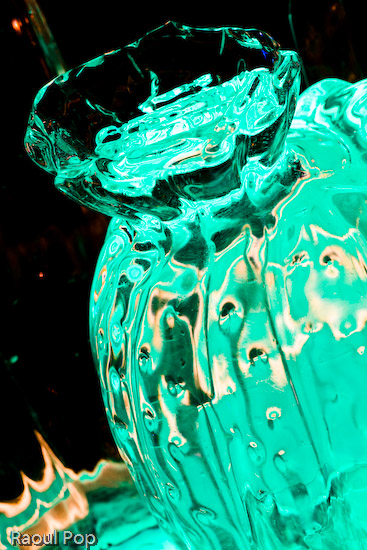
There were some really, really cool ice sculptures on display at the event. There was even a bar made out of ice, with the Olympus logo embedded in it.
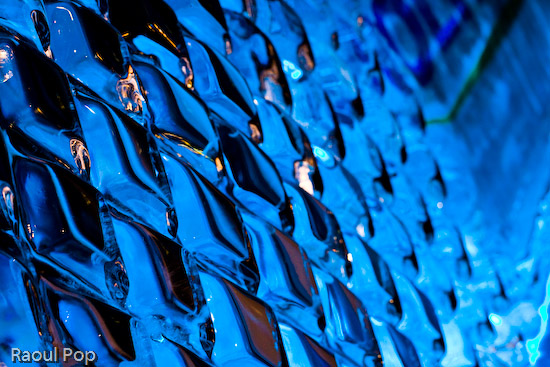
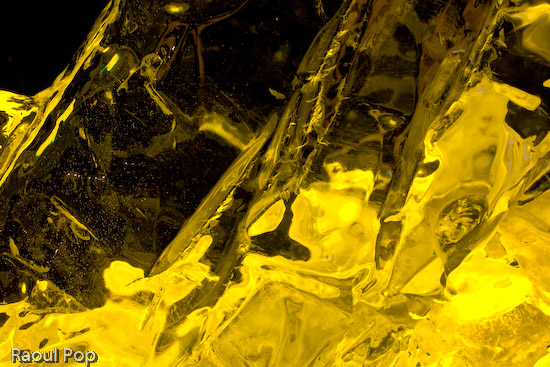
Rhomboid

Mellow yellow

Ice sculpture

The guts of the E-3 were on display.
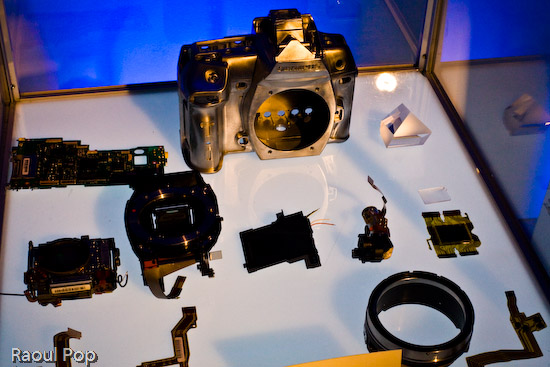
The components of the E-3 DSLR

Gene Hirschel of Internet News was there. I met him at the previous Olympus PR event, which announced the E-510 DSLR.
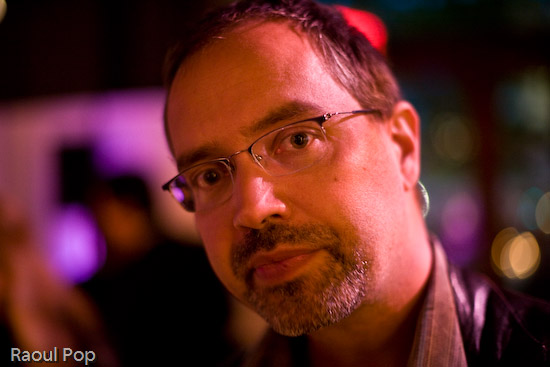
Gene Hirschel

John Isaac is one of the Olympus Pro photographers, and he’s currently specializing in wildlife. He worked at the UN for 30 years as an official photographer.
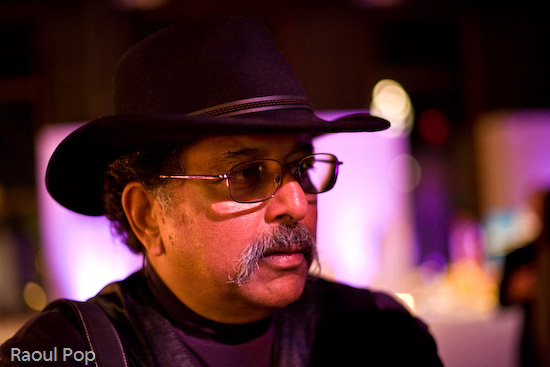
John Isaac

The man below is the sculptor of the many amazing crystal figures on display at the event. I have a photo of one of them below, and they’re also featured in the short video I made. I’m terrible with names and I didn’t catch his.
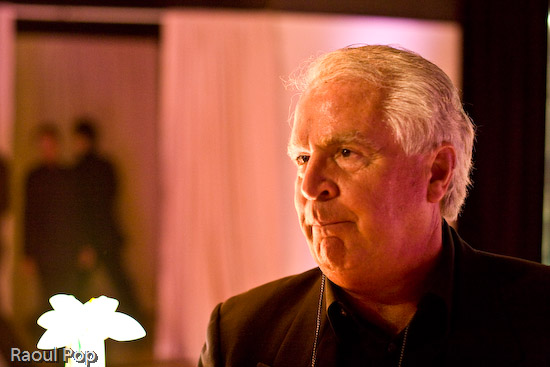
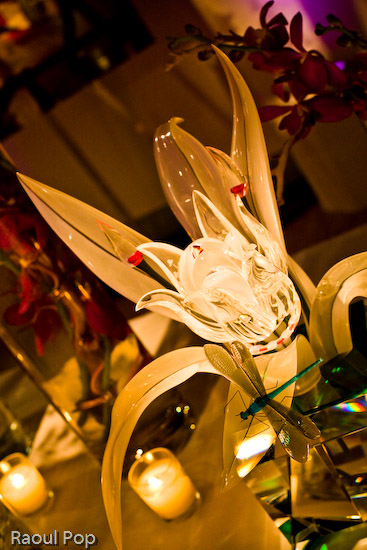
Crystal sculptor

One of the crystal sculptures

Guess who took this photo of us? It was Anne Day, and she used my 5D. I consider it a privilege, especially after I saw some of the other people whose photographs she’s taken. Have a look at her site and see what I mean.
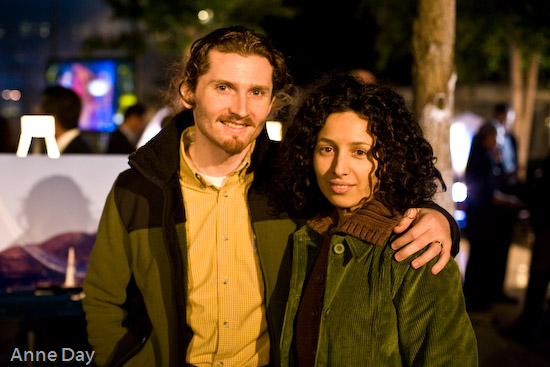
Ligia and Raoul

Here’s Anne Day in person:

Anne Day

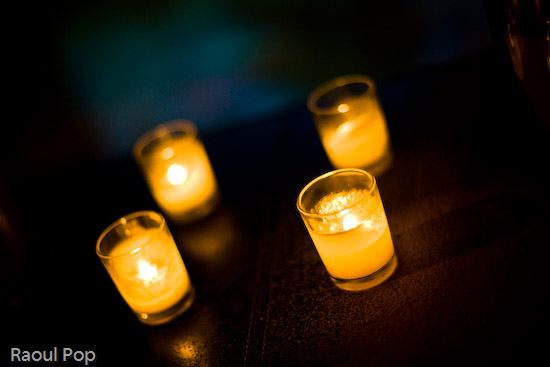
I took this as I rested on a table, watching slideshows of travel photography. The blue light of the LCD projected reflected in my glass of tonic water.
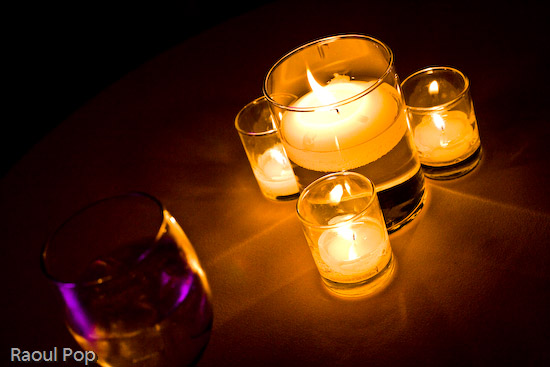
A glass of tonic water by candlelight

I caught Ligia thinking about something when I took this.
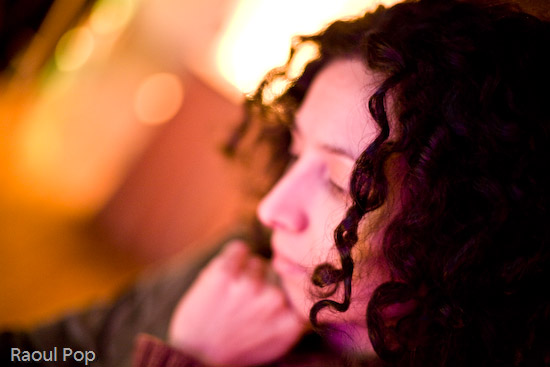
Ligia

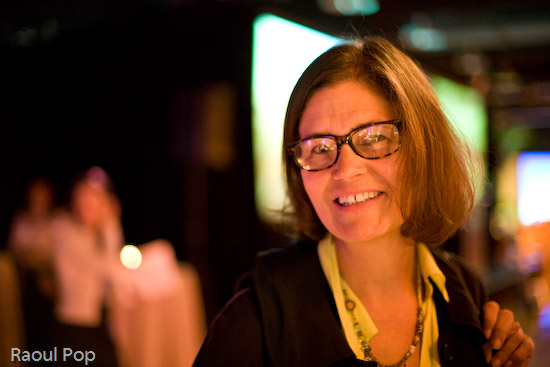
If you thought Ligia’s photo was out of focus, you’re going to get a real surprise out of the next one. The thing is, I LOVE out of focus photographs. There’s a certain sweet spot that varies with lighting, distance and focal length, but if you get it just right, the colors really pop, and the shapes become very interesting. These are people at the launch party. I’m probably going to share more of my out of focus photographs in the near future. I’ve been accumulating a lot of them within the past several months.
People at the launch party

To demonstrate the E-3’s dust proofing, they buried two cameras in sand. They’re supposed to still work without any problems after this happens to them. I didn’t try them out, but it’s very likely that they worked just fine afterwards.
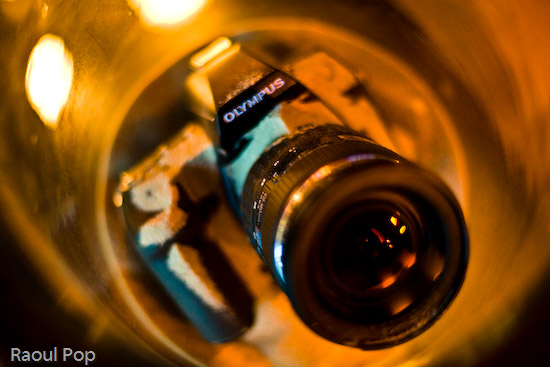
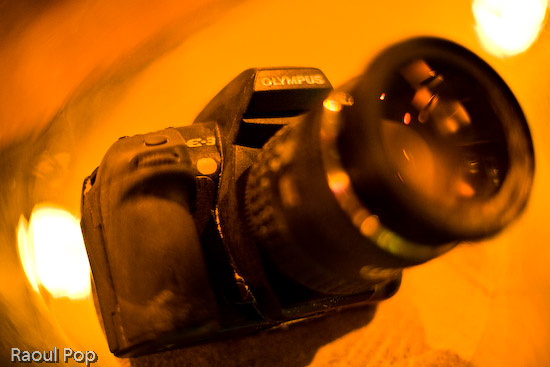
Olympus E-3 buried in sand

Olympus E-3 buried in sand

Gary Kralle (one of the other Olympus Pros), John Isaac and a friend were talking when I took this photo. Gary came up to me afterwards and we chatted a bit about cameras.
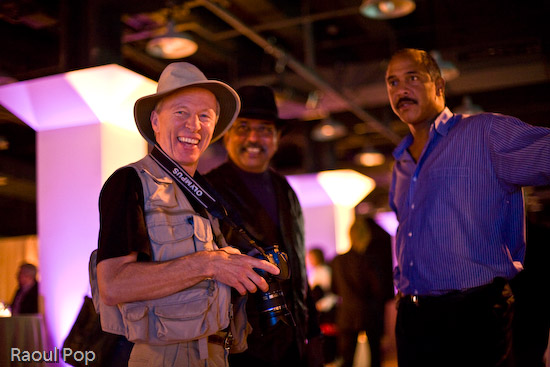
Gary Kralle, John Isaac and friend

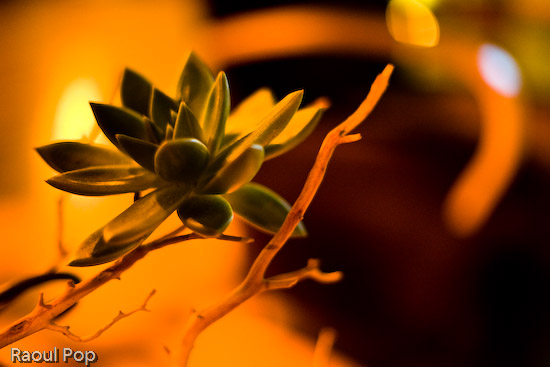
I love abstract shots that emphasize bokeh. Here are a few that I took at that night.
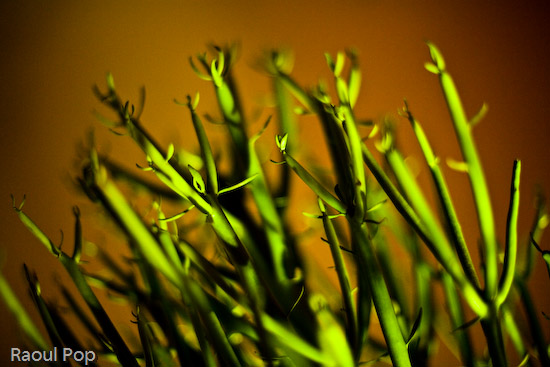
Grow

Cactus

Four lights

When we left, there were swag bags ready for us. Here’s what was inside: a travel document holder, a pen, a paperweight, a coaster, and lots of details on the E-3. All were emblazoned with the Olympus logo. Pretty nice!
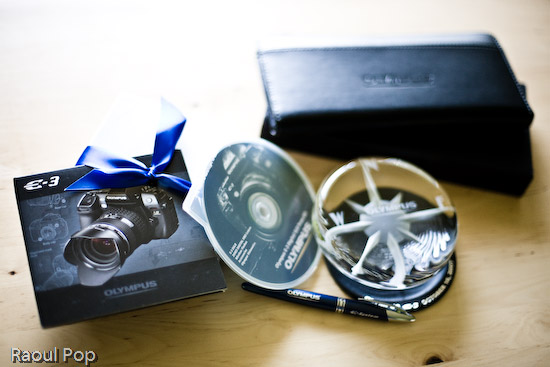
Swag from launch party

Michael Bourne, thank you very much for the invite! I look forward to reviewing the E-3 properly when it becomes available.

More information:
Standard
Places

Downtown Bacau, Romania

Bacau is one of the bigger cities in Romania. I had a chance to visit its downtown area this September. I’d never been there before, so I stopped to take a few photos. It was early on a Sunday morning, so there weren’t many people on the streets.

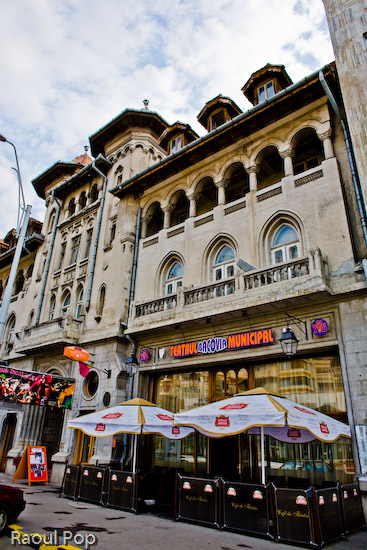
I love the northern Italian architectural elements used in the facade of the Bacau Theatre building, especially the upper floor, with its balcony, arches and mini-towers.

Teatrul Municipal Bacovia

The entrance to the theatre is quite imposing:

Entrance to Bacau Theatre

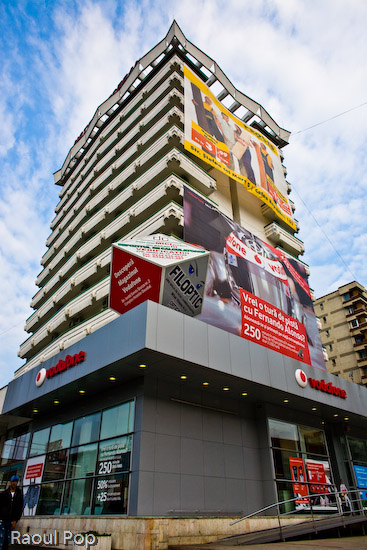
Across the street from the theatre, you can see this large condominium building (at least I assume it’s condominiums, I doubt they’re all offices.) I thought the architectural plan was a good way to make a square shape look interesting. It looked pretty good, but, as one finds in Romania, ads were plastered all over its sides. I wonder what the people living in those apartments now obscured by the posters must think of it all. Are they getting paid? Are they just getting annoyed? Who knows.

Vodafone Bacau

Right next door to the building above, we can see a monster left over from communist times… At least this dying breed of an apartment building is one of the better ones I’ve seen in Romania. One mostly sees nasty, crumbling, weather-stained concrete ruins when it comes to communist architecture. This particular building looks pretty well maintained, too. Of course, its central location might have something to do with that.

Complex Comercial Junior

A little ways down the street, we find the public library, but the building is in sore need of restoration. I’m not sure if it’s still being used, but I’d love to get inside it at some point in the future. It could lead to some interesting photographic opportunities.

Biblioteca Bacau

Here’s another view of the library, from the back:

Almost in ruins

There was a public park in the area, with art on display. I found a modern statue, and some post-modern wooden carved poles, styled after folk themes.

Pensive

Abstract wooden sculpture

Hidden behind the park and public library, I found the Bacau Ateneu. One of our friends plays the violin over there. 🙂

Ateneu Bacau

Further down the street, you’ll see the county government building. This is the main entrance:

Consiliul Judetean Bacau

I liked the clasically-styled architecture, typical of turn-of-the-century construction. Here’s a window detail. Notice the stucco stripes, columns and arches.

Striped and arched

That concludes my sightseeing tour of downtown Bacau. Who knows, maybe I’ll get to visit it again in the future and take more photos. 🙂

Standard
Places

Passing through Cheile Bicazului (part 2)

I realized something after I read through yesterday’s post on Cheile Bicazului a couple of times. I hadn’t included any photos of the actual mountain pass, which made my comments about how it was carved out of the rock seem a bit superfluous. That was an oversight that needed to be corrected.

This time, you’ll get to see what the road looks like. I have to confess I was too much in awe of those abrupt and incredibly tall walls on each side of me to notice the road very much. Maybe I’ll get my head out of the clouds the next time I visit the place. Till then, here’s what I’ve got.

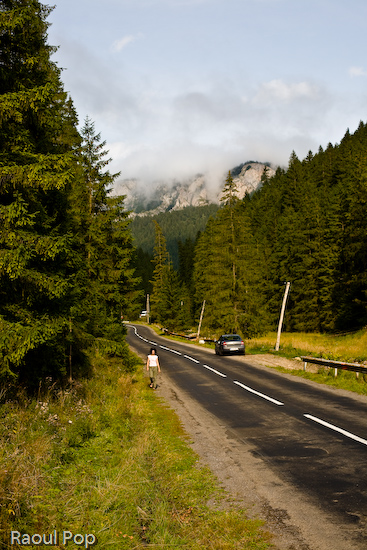
This was taken before going into the pass. You can see the fog and bad weather hovering above the pass a few kilometers ahead. That’s Ligia walking toward me in the photo.

Walk toward me

After we entered the pass, my eyes kept wondering upwards toward those impossibly abrupt mountain faces. Not only were they almost vertical, some were even leaning inward. This very next photo reminds me of an impenetrable hold, or fort of medieval times.

Hold

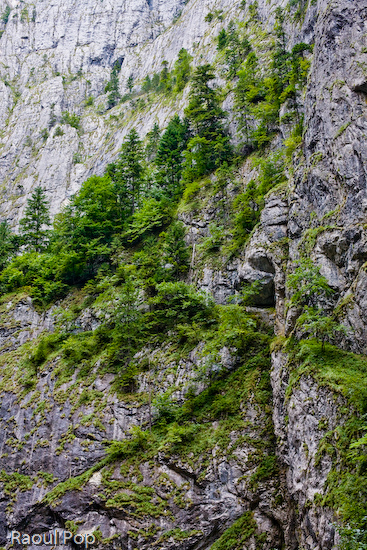
It’s amazing how efficient trees are at finding places to grow! You wouldn’t think it possible, but those evergreens managed to find their ecological niche growing right on sheer rock!

Find a niche

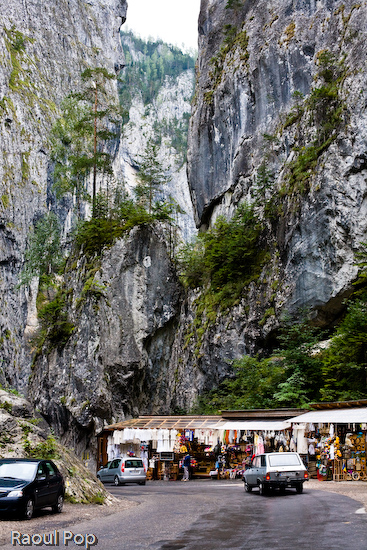
I finally managed to get my eyes on the road for this next photo. It’s narrow all through the pass as it squeezes between the mountain peaks, and there are no lane markers. At strategic points along the road, you’ll find shops that sell various folk items such as earthen vessels, carved ladles and other kitchen utensils, sheepskin vests and coats, and other such things.

Mountain shops

When I think of how they made the road, this photo comes to mind. Notice the deep cuts in the stone? It was by brute force alone they managed to get through that impregnable granite.

Deep cuts

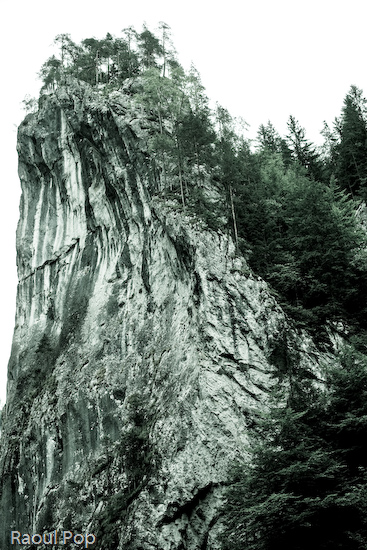
This next photo will get across the sheer size of the stone walls surrounding the visitor. Those are fully grown evergreens sitting on top of that ridge!

Tall and taller

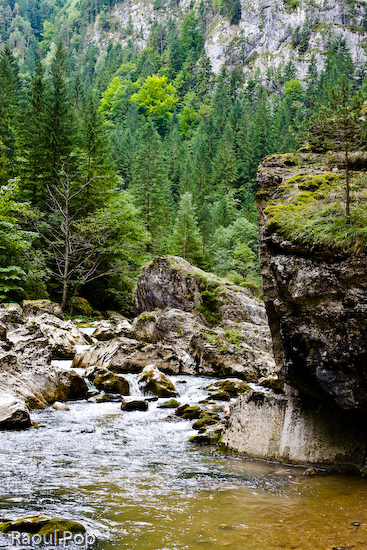
Remember the brook in yesterday’s post? That same happy little mountain brook has grown a little wider by the time I took this photo. It winds along through the pass, accompanying the road.

You’ve grown

I can’t resist showing that impressive wall of granite one more time.

Try climbing that

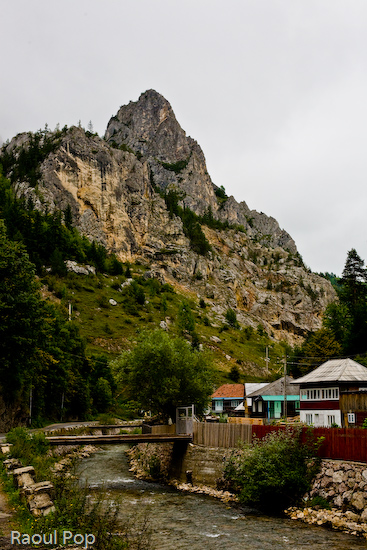
Once we made it through to the other side, the road widened, and we entered a village. Yes, that’s the very same brook shown above. Notice how high the stone walls are on either side? That bridge is also placed high for a good reason. Our happy little brook turns into a furious torrent when the snows melt every spring. The villagers need all the protection they can get to make sure they don’t get swept away with the water. It’s very possible that even that high wall doesn’t protect them enough, and their courtyards flood every once in a while.

On the other side

Cheile Bicazului is such a wonderful and photogenic place! I’ll do my best to return there with Ligia in the near future.

Standard
Places

Passing through Cheile Bicazului

This is Part 1 of a two-part post on Cheile Bicazului. You can read Part Two here.

During our recent trip to Romania, we passed through Cheile Bicazului, a stunning, narrow pass carved through the Carpathian mountains. We started out on the Transylvania side, where the weather was beautiful and sunny, though we could see the clouds hovering over the mountains far into the distance.

Zigzag into the horizon

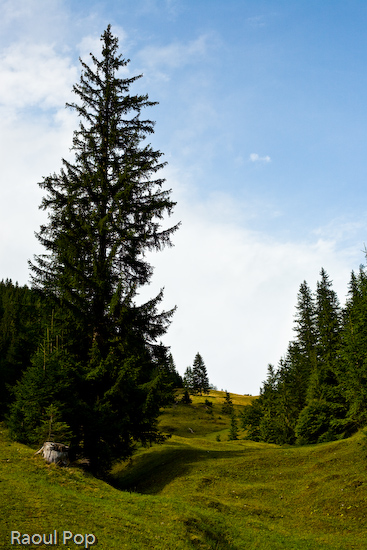
As we got closer, the weather got chillier, and we could see the mountain peaks enshrouded in fog. This mountain meadow was still bright and sunny, though the cold wind made us shiver.

Steep slope

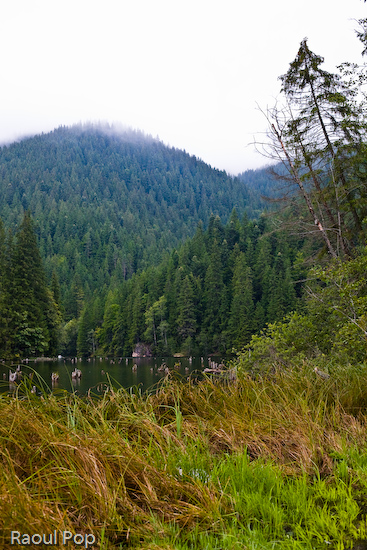
Just a few kilometers away from the meadow pictured above, we stopped at Lacul Rosu, a lake whose origin is uncertain. It seems falling rocks blocked the path of a river, and a lake accumulated in that valley hundreds or thousands of years ago. The trunks of the flooded evergreens can still be seen in the water. Here the weather got even colder and wetter. There was no question about it — we were high up in the mountains.

At the edge of Lacul Rosu

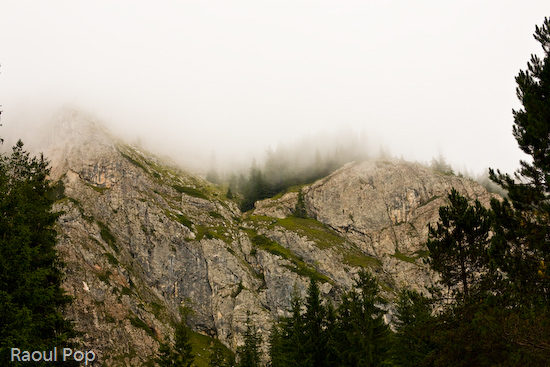
That same punishing weather proved truly beneficial to my photography. Without it, the mountain peaks wouldn’t have looked quite as good. Here are a couple of peaks seen at the start of the pass.

Enshrouded in fog

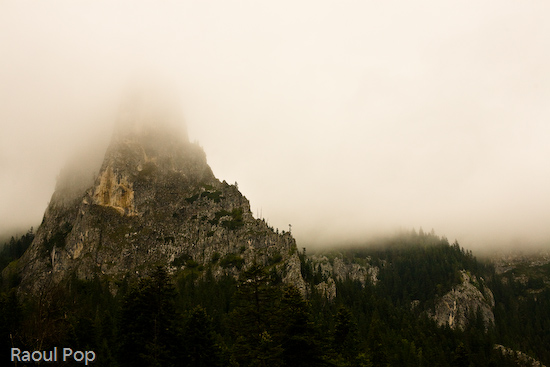
Here’s a truly majestic peak seen from inside the pass. That fog was just perfect!

High above Cheile Bicazului

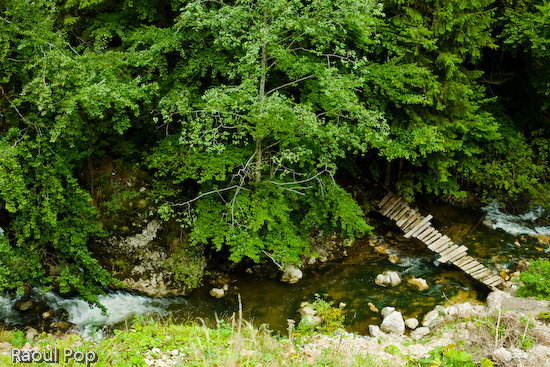
The sharply winding road broke through the peaks onto a meadow set in a small valley. I stopped the car and peered over the edge of the cliff to get this photo of the mountain brook passing below us. I love that little wooden bridge, twisted into a precarious position by spring torrents and autumn storms.

The little bridge down in the valley

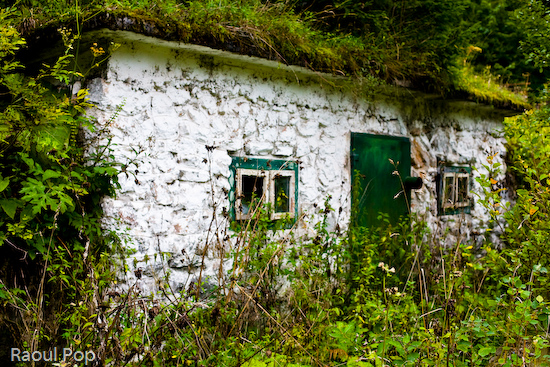
There was a group of cabins in the meadow, and off to the side, I found this deserted hut, built out of stone right into the side of the hill. Grass grew on its roof, and overgrown shrubs surrounded it. I wonder what purpose it once served.

Deserted and overgrown

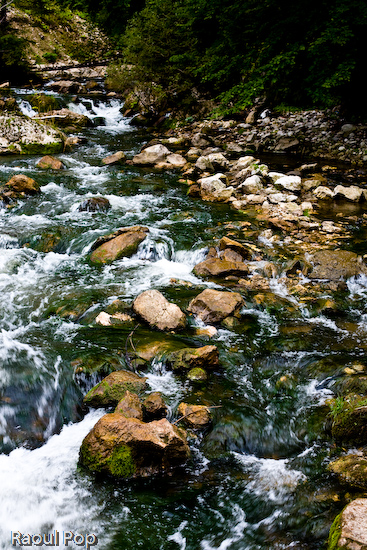
That same mountain brook seen just above can be seen in the photo below. The same bridge can now be spotted in the top left corner. I really like mountain streams. They flow fast, and the water’s clean, cold and invigorating.

A happy mountain brook

We weren’t dressed for the weather, and we ended up with slightly sore throats by the time we made it to the other side, but it sure was worth it! It was my first time through Cheile Bicazului. Ligia used to come there with her parents quite often as a child. We want to go back again and hike through those mountains should we get the chance.

Standard
Places

My grandfather's garden

My grandparents on my mother’s side always had a garden, no matter where they lived. They were city folk, and even when they lived in an apartment, they managed a nice little plot of land in the back of the building, where they grew fruits and vegetables. Later, they moved in a house with a big garden, and my grandfather’s obsession with gardening was finally given free rein. He planted everything in there: grapes, tart cherries, cucumbers, tomatoes, rhubarb, berries, parsley, onions, garlic, salad, potatoes, apples — the list could go on, but I can’t find the English words for some of the things that grew (and still grow) there.

Just a few short weeks ago, I visited my grandfather and got to walk through the garden once more. It was bittersweet this time. My grandmother has passed away, and the place is lonelier and more melancholy. But it’s still beautiful, and it’s full of memories for me, since I practically grew up there.

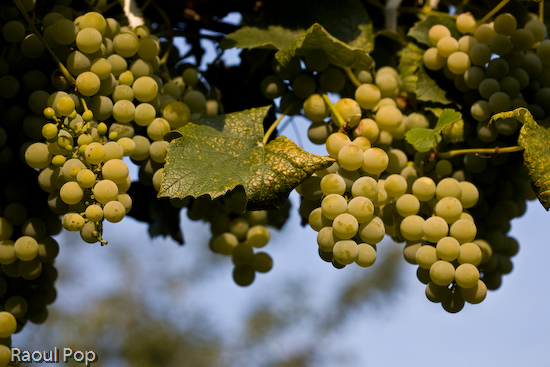
Shortly after taking this photo, I took a pair of scissors, cut down a few bunches and ate them. They were delicious, of course.

Ripe and ready for the picking

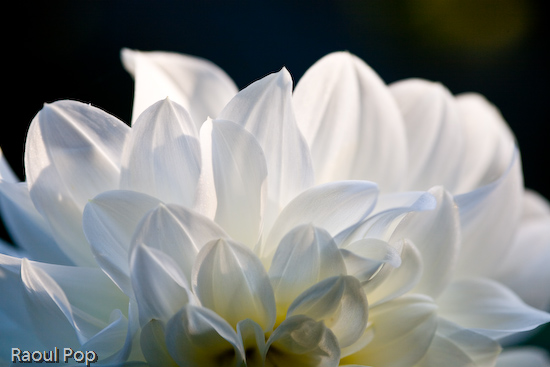
This flower shone so pure and white with the rays of the falling sun passing through its petals, that I just had to photograph it.

Pure white

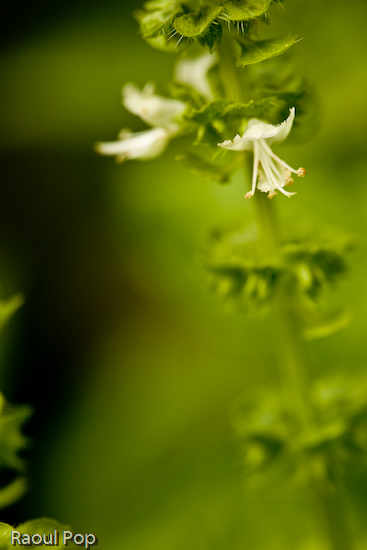
The name of this plant in English escapes me at the moment. In Romanian, it’s “busuioc”. Not so long ago, women in the countryside would take bunches of dried up “busuioc” with them to church. Its fragrance would fill the place.

Busuioc

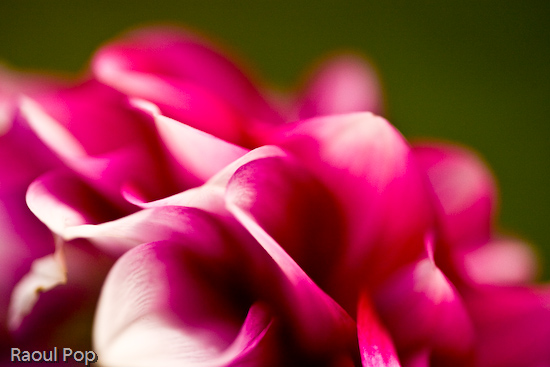
I believe this flower is of the same kind as the white flower pictured above, but its petals are red. I’m terrible with plant names (actually, I’m terrible with names of any kind), so I don’t know what it is. But I really liked the shape and color of the petals. If passion could be photographed, I think it would look like this.

Passionate

I’ve got so many beautiful photographs from Romania — many more from my grandfather’s garden, the various cities and places I visited — but so little time to process them. Oh, how I wish I had a few months to spend curating my photo library…

Standard