Thoughts

Glad to see Nabaztag is still around

It’s coming up on three years since my original review of the Nabaztag. In 2006, it was just getting introduced to the US market. It was a new product from France, and the editors of the “I Want That! Tech Toys” show on HGTV approached me to see if I wanted to review it. I said yes, because the concept intrigued me, and I wasn’t disappointed. I thought it was a pretty cool gadget, in spite of the learning curve involved in setting it up.

nabaztag-1

nabaztag-2

A few months after being taped, the segment featuring the Nabaztag aired on HGTV. The rabbit did just fine, but I was way too serious. Note to self for the next TV interview: lighten up!

In December of that year, Violet (the makers of the Nabaztag) launched the new Nabaztag:tag, which could read RFID tags, had a built-in motion sensor, and could do a bunch more things. Since then, they’ve been busy improving the Nabaztag experience and introducing new things, like the Mir:ror, an inexpensive RFID reader ($50) that works in conjunction with RFID stamps (they call them ztamp:s) to do all kinds of neat things, like tell you the weather, update your Facebook status automatically, read books to your children, etc.

I have to say the new Nabaztag:tag looks a lot better than my original 1st gen Nabaztag. It has a shiny white finish and a better user interface. It’s probably easier to configure, too. I had some issues getting mine to go on the Internet back when I did the original review, which were thankfully sorted out.

All in all, I’m glad to see a product I reviewed and found cool is still around. Kudos to Violet!

Standard
Thoughts

Sometimes you need to use a book the right way

There’s a Looney Tunes cartoon from 1944, entitled “Brother Brat“. It stars Porky Pig and speaks eloquently about child discipline. In it, Porky becomes the unwitting baby sitter for a Rosie the Riveter type super-woman who’s pulling long shifts at the factory, helping out with the war effort.

When she leaves her brat, Butch, with him, she also hands him a book, which she says always helped her. It happens to be a book on Child Psychology.

Child Psychology - 1

Porky takes the offer at face value, and believes the book will really help him. When baby Butch starts acting out, he checks the book for advice.

Child Psychology - 2

He soon finds out the book is no good, as he applies the wishy-washy, sound-good nonsense from the book to his real life situation and things go from bad to worse.

Child Psychology - 3

By the end of the cartoon, he’s running for his life, with an axe-wielding maniac baby on his tail.

Child Psychology - 4

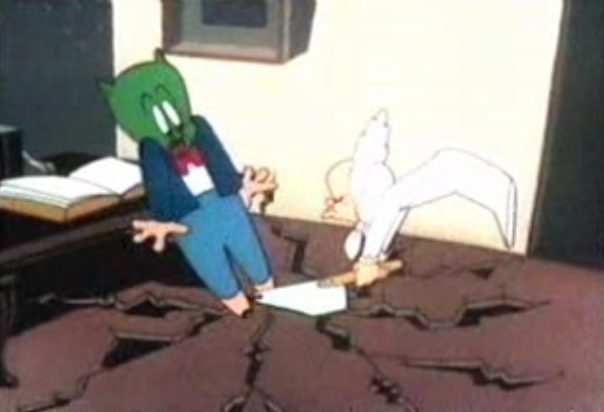
Then Susie the Riveter comes in, notices the mayhem, and asks him if he used the book. Desperate, still running, he screams, “Yes, but it didn’t work!” Then Susie grabs the book and shows Porky how it’s done: “Maybe you didn’t use it right. It always works for me!”

Child Psychology - 5

The punchline is obvious, and yet it teaches all of us, to this day, a valuable lesson: sometimes the only thing that works is a spanking. As for child psychology books, I share the opinion of the animators — those books are a bunch of hooey, fit to be printed on toilet paper and used that way. I’m not alone in that sense. Most people shared this opinion when classic cartoons were made. Cartoon studios of all sizes lampooned child psychology books, including Disney.

Spanking has sadly become a tabu practice in this “enlightened” age. If you spank your child now, the state will take it away from you. Surely the state must know what it’s doing, right? Because governments in all developed countries have shown us they manage everything else to a tee, beyond reproach, right? Naturally, we ought to trust what they tell us to do with our children?

I see parents these days, stressed to the breaking point because of children who haven’t been properly disciplined, and they’re afraid to discipline them. They try talking to them, they try to reward them for good behavior, they try timeouts, but seriously, sometimes a child just needs a good spanking. The Bible knows what it’s talking about when it says in Proverbs 13:24: “He who spares the rod hates his son, but he who loves him is careful to discipline him.” It has the benefit of thousands of years of experience on its side when it gives that advice.

If you’re interested, my father wrote a couple of articles several years ago. One is on the duties of children toward their parents, and the other is on the duties of parents toward their children. The articles are a compilation of verses from various books of the Bible on those topics, and they’re not doom and gloom stuff — they’re thoughtful, fascinating stuff. To make things even more interesting, my father is a psychiatrist who is keenly interested in the proper development of one’s character and personality.

On an unrelated note, thank goodness for Google Video, which indexed the cartoon from Dailymotion! I wouldn’t have been able to provide you with screenshots from the cartoon otherwise, because I couldn’t find it in regular web searches. I don’t have it in my collection, and only saw it a few times on TV, including once on Boomerang recently. I encourage you to watch it.

Standard
Thoughts

Frustrated with European shopping carts

My wife recorded a video clip of me venting my frustration with European shopping carts back in February. Sorry for the rough words in the video, but I tell you, every time I go shopping and have to deal with those idiotic things, I want to get the guy that invented them, pin him to a wall and lob rotten apples at him. What simpleton makes all four wheels pivot, seriously? How can you not realize that loaded shopping carts have inertia, and cannot be steered at all when all four wheels pivot?

American shopping carts should be the standard. Only their front wheels pivot, so they’re easy to steer everywhere, especially around corners. They’re probably cheaper to make for that same reason. As for their European counterparts, they go anywhere except where you want them. It’s absolutely ridiculous, and what makes it worse is they’re everywhere in Europe. It’s like every store got together to figure out how best to frustrate and anger their customers, and decided to get these asinine carts. If that really was their intent, then they succeeded. It truly boggles the mind how they all went for the same moronic design. Didn’t any of their executives put two and two together? Don’t they use shopping carts? Don’t they know there’s something better already available?

See this video on blip.tv, Vimeo or YouTube.

Standard
Thoughts

Micropayments: the only equitable way to reward web publishers

The more time I spend writing and publishing articles on the internet, the more I realize that trying to get paid for my efforts through advertising is not a sustainable way to make a living. I get decent web traffic, but that’s not enough. Have you seen the going CPM rates these days? I’d need to get ridiculous amounts of traffic in order to see any sort of worthwhile profits, and even then, I’m not so sure the costs of running my website wouldn’t trump my revenues or at least take a big bite out of them.

The current system is messed up. Most web publishers don’t get tons of traffic, which also means they don’t make money. They’re lucky if they break even with things like Google AdSense or affiliate programs or other some other ad programs. They, like me, don’t want to load up their websites with ads, left and right, top and bottom, inbetween the lines and everywhere else. They just want to worry about writing and publishing informative articles. They don’t want to spend Âľ of their time (or more) advertising their site and getting their buddies to vote up their posts on Digg or StumbleUpon or who knows where else. They’d much prefer to not have that headache at all, and to only write and publish. But they can’t, because the system is faulty. It only rewards the very few who get the most traffic.

Do you want to know why newspapers aren’t making money these days? Why they’re going under? Sure, blame shoddy journalism, blame whatever else, but the truth is they relied mostly (or solely) on advertising for their revenues, and look where they are now. Subscription fees were kept artificially low, and as circulation numbers started to go down, they couldn’t charge their regular rates for ads, and revenues went down fast, in a vicious spiral that fed itself.

Had a decent micropayment system been in place, the web would be a flourishing, profitable, preferred way to make a living nowadays, instead of the insane, overloaded, “buy, buy, buy, look at me, no look at me, no, I’m better, wait, my titles are more interesting, I get more traffic, I make more money, I know how to increase your traffic, I have more free stuff” nuthouse that it has become. Everyone’s desperate to publish more articles, to make the titles and text more titillating, to grab an extra click from you here and there, to make you vote or like or bookmark their stuff so they can supposedly get more clicks and votes and likes and bookmarks and more and more and more meaningless crap that leads nowhere and contributes to nothing.

Unfortunately for the world and the web, micropayments were talked to death, even in the early days of the internet, and all the fancy initiatives went nowhere. A lot of people were wronged because no one bothered to get things going. Just think, all this time, web publishers of all sizes could have been making an honest living! Fortunately, this nasty situation can still be set right.

Here’s my micropayment initiative. I think it’s workable, and more than that, it would allow a lot of people to make a decent living by doing what they love: writing, not hustling and wasting their time pushing their site on people.

First, we need all the browsers and feed readers to work with the companies or organizations that would process micropayments. Whether the functionality is built in or added through plugins is up to the browser makers and feed reader makers to decide. Users would enter their account information directly in their browser’s or feed reader’s preferences, and their micropayment accounts would be automatically charged every time they access a micropayment-enabled article, on the web or via a feed. There’d be no logging in every time, like with PayPal, which is a hassle when all you want to do is read an article.

Second, search engines and websites would display the price of the article next to its title, just like they’d display the site or the date the article was written. The browser itself would display an extra icon when such a web page is accessed, just like it displays a lock when HTTPS websites are accessed. Perhaps a dollar sign or some other currency sign would show up next to the website’s address. If the user would move their mouse over the button, the price would be displayed, similarly to the behavior of the alt or title tags.

Third, and this would happen behind the scenes, the browser itself would read the price tag of the article the user is reading, and would send that information along to the micropayment service along with the user’s account information. Notice this means the user could use their micropayment service of choice — so there wouldn’t have to be just one — and the browser or the website wouldn’t care. The micropayment service would then transfer the price of the article from the user’s account to the web publisher’s account. The transaction fees would best be charged in bulk, per 50 or 100 transactions or so, and would be deducted from the web publisher’s balance.

That’s it! It’s so simple I just don’t know why it hasn’t yet been implemented.

As for the price of the articles, each web publisher could set their own price. I propose 5 cents per view. When candy and soda costs 75 cents to $1 or more, I think no one would balk at paying 5 cents to read a good article. But let’s have a look at some proposed traffic figures just to give you an idea how 5 cents can add up.

Say you get 5,000 views per month. That’s a modest amount of traffic, but at 5 cents per view, you’d still make $250 at the end of the month. That’s nothing to scoff at. Tell me if you wouldn’t be happy with that money in your bank account!

How about someone who gets 25,000 views per month? That’s a fairly decent amount of traffic. At 5 cents per view, they’d make $1,250 per month. That’s already a line of income. That’s money in the bank you could be using to pay your bills, but you’re not seeing it because micropayments don’t exist yet. Isn’t that infuriating?

How about someone who gets 50,000 views per month? That’s a nice amount of traffic. At 5 cents per view, they’d make $2,500 per month. That’s practically a decent salary right there. If you keep your expenses low, you might even be able to live off that in the US. If you lived in another country where living expenses are less, you could live nicely on that money.

The best part is this: it isn’t free money, and it isn’t money that could be yanked away if your advertisers get pissed off with something you wrote. This is money each and every web publisher has rightfully earned through their work, and yet there is no micropayment system out there to make this possible. This means all the web publishers out there are currently being cheated out of money they could be earning. Isn’t it ridiculous and completely unfair? Think of newspapers, where dedicated journalists work, day in and day out, and who have to close when they could focus their efforts on web publishing and turn a very nice profit with their traffic!

What about developing countries? I suppose the price for reading an article could differ based on your country of origin. The micropayment processor would automatically charge those countries less per article, say 30 to 40 to 70% less, depending on their general economic status.

What about subscriptions? They’re nice but not sufficient. They’re nice because you can predict your income more reliably when you know you’ll have so many subscriptions coming in every month, but not sufficient because users don’t pay per usage. If they end up spending less time on your site, then they’ll feel like they’ve wasted their money on the subscription. Also, just in case you haven’t noticed, subscription numbers are down everywhere these days. When money gets tight, subscriptions are among the first things to go.

What about goodwill, and doing stuff for free? That’s nice, and I already do plenty of stuff for free, but the problem with goodwill is that this world still functions with money. When was the last time you paid your mortgage with goodwill? When you buy your groceries, do you pay with a smile and a hug?

Micropayments are the best way to go forward. I wish people would stop talking about them already and someone would get going with the idea. It goes without saying — but I’ll say it anyway — that I for one would be glad to work with any legitimate company that wants to start processing micropayments.


Standard
Thoughts

Let's recap where we are economically

A video compilation of various Peter Schiff TV appearances (2002-2009) is available on YouTube. The quality isn’t that great, but the message is pure gold. He’s been saying since 2002 that the US economy would collapse, and he gave solid reasons why it would collapse every time. His messages got more pointed with each appearance, they made sense, and yet he was ridiculed over and over for his opinions by so-called pundits on various TV networks. Ben Stein once said to him: “Sub-prime is a tiny, tiny blip.” I bet he’d like to eat his words now…

In 2004, I wrote an article where I said some of the same things Peter Schiff was saying — namely, that an economy financed by debt would not go on forever, and that we might be headed for another Great Depression. Back in 2004, the real estate market hadn’t even hit its peak, so I based my observations on common sense. I have no education in finance, but I can spot a turd no matter what it’s called.

I wrote then that the slowing US economy was being falsely propped up by the war spending in Iraq, but that wouldn’t last. You see, the government operated under a false assumption. The thought that what pulled us out of the Great Depression — the ramped up spending for WWII — would do it again in modern times. They were wrong. As I also wrote then, the WWII spending paid off: the world wanted American products after the war — they were hungry for them, and the manufacturing economy, which had been making weapons, shifted into making lots of things for export, like cars and clothes and other badly needed things in war-torn countries. Back then, we had a manufacturing economy, and there was real demand for our products.

History unfortunately does not repeat itself. In 2004, things were different. The US had no American products to export (unless you count weapons of war). It had moved most of its manufacturing overseas, leaving little to make at home. It was going into massive debt to finance a war that would (among other doubtful goals) stimulate a slowing economy, yet, from the get-go, they were not building American goodwill overseas in order to stimulate demand for American products. Even if they had done that, there were no American products to export, since we did not have a manufacturing economy any more.

A quick aside: some were saying a while back that the US is in the information services business — you know, IT, expertise, analysis, consulting, research, etc. — white collar stuff. I don’t buy it. For one thing, not everyone in the US can hold a white collar job. There are a finite number of people out of the US population (percentage-wise) that can do those jobs, and there are a finite number of such jobs available. To make things worse, information products lose their market value fast in times of economic hardship: when you need money to buy bread, you aren’t going to worry about knowledge; your stomach comes first. Also in the “things get worse” department, India and China are only two of the countries that can steal a large number of our information jobs as more of their people are educated. Don’t forget how many Indians work for Microsoft and other tech companies, and how many Chinese are involved in research. Unfortunately real products that fulfill real, tangible needs are still the king, because they are always in demand if they’re quality goods.

Okay, back to the war. It took people’s minds off the economy until the real estate market ramped up, and when that bubble burst, the whole ugly truth came to life. We had no economy to speak of, it was all propped up by debt, and all that debt was crashing down on us, as some, including myself, predicted. In my article from 2004, I said the following:

… unless we get someone in the White House who is willing to address the problem of debt head-on, I think our country is headed for certain disaster.

Fast forward to 2008. At the end of September of that year, I laid down my thoughts about the impending economic crisis. I was saying pretty much the same things I said now, except I approached the problem from a different angle. You see, we hadn’t yet elected Obama. Later that year, my wife and I, along with many other people, voted for him, because he was better than the alternative, and we hoped he’d do some good.

While the jury is out on that last part, and part of me says I should just sit back and wait to see what he does with his presidency, part of me goes back to the problem of debt and wonders if he’s tackled it head-on, like it needs to be handled. Unfortunately, he’s headed in the very opposite direction. He’s going to put our country into yet more debt in order to keep stimulating the economy. All this stimulating makes me wonder what status quo the government hopes to achieve. Just what state of the economy do we want to return to? Where do we want to go after we’ve spent all of that money? These words from Jim Kunstler say it best:

“… to what state of affairs do we expect to recover? If the answer is a return to an economy based on building ever more suburban sprawl, on credit card over-spending, on routine securitized debt shenanigans in banking, and on consistently lying to ourselves about what reality demands of us, then we are a mortally deluded nation.”

So, we’ve been going into more and more debt, for years and years, propping up a sick economy that has no more manufacturing backbone to stand on its own, and we’ve never taken our medicine. The US economy is like a sick man who’s hyped up on speed and other crap to keep from crashing into a bed and going through a proper recovery from a serious bout of the flu. It can’t go on forever. It has to at some point end. It doesn’t make sense otherwise. Like I said in an article from February of this year, there will be an ugly third act, where the fat lady will sing and the curtains will come down, and believe you me, it’s going to be a doozy.

Will it have to do with the severe de-valuing of the dollar and cause it to be replaced as the world reserve currency? Possibly, since some countries out there, like China and Russia, are already calling for a new global currency. I think there will be more unrest beyond the dollar debacle. And who knows, perhaps behind the scenes, that was the plan all along: bring on a crisis where bargains are to be had for those with the money to get them, and the sort of economic unrest that would make it easier to move certain pieces of the big puzzle into their place.

Standard