
- Cool Mods – Make your own indestructable USB thumb drive http://tinyurl.com/37p2qg #
- Armenia: The Epic Land http://tinyurl.com/2qyxxz #
- Melodyne studio pitch correction now able to break chords down for editing http://tinyurl.com/2qmd6a #
- Electrolux Inspiro intelligent oven – “auto-focus for chefs” http://tinyurl.com/33dbsl #
- Wally announces new ‘floating island’ gigayacht: the WallyIsland http://tinyurl.com/yw4afh #
- Hollywood Hopefuls: 1925 (:-\) http://tinyurl.com/2z2r6o #
- Smart solar-powered road studs http://tinyurl.com/ynkxnc #
- WTD 436 http://tinyurl.com/2fl47u #
- Ron Paul Goes CG http://tinyurl.com/25crs5 #
- It’s Here: Vista Service Pack Debuts http://tinyurl.com/27r2pg #
- Fed, Brokers Send Stocks Skyrocketing http://tinyurl.com/2cmzk5 #
- Court Orders Copies of White House E-mails http://tinyurl.com/yst5tj #
- On the Street…..Early Evening, New Delhi http://tinyurl.com/2uk3g8 #
- A Thought on the Future of Photography http://tinyurl.com/3yzf64 #
- Adobe confirms Flash is coming to the iPhone http://tinyurl.com/327bbd #
- Corn Spaz (Awesome. Get a load of those eyes.) http://tinyurl.com/39epsw #
- How to Live on Less and Love It http://tinyurl.com/32ahlq #
- More Copyright Conundrum http://tinyurl.com/39jwxg #
- I’d like to take all the people that say the economy is collapsing and ship them on a time trip to the 30s for a lesson in reality. #
- Border Security: the Weakest Link http://tinyurl.com/yp6cpa #
- The Toshiba write-down for HD DVD: $1.1 billion http://tinyurl.com/2xfjfs #
- Finding a ‘greener’ concrete http://tinyurl.com/2qdcbf #
- 12 Essential Rules to Live More Like a Zen Monk http://tinyurl.com/39nj6j #
- Apple close to offering subscription music service? http://tinyurl.com/2n8tju #
- The real story: Charlie Rose attacked by Andrea Jung http://tinyurl.com/2lsrje #
- Free File: A Fast, Easy Way to File Your Federal Income Taxes http://tinyurl.com/34jpza #
- What would NVidia want with a CPU company? http://tinyurl.com/2pbnuk #
- Free Copies of Cult of Mac and Cult of iPod on FileSharing Networks http://tinyurl.com/2kj33w #
- Mr. Chomps (Hilarious) http://tinyurl.com/2nd39t #
Tag Archives: companies
Ways in which companies waste money and energy
I want to focus in on a few specific ways in which companies waste money and energy. I see the following things happen daily in the workplace. They’re not specific to any company. Chances are that if you visit any American company, they’re probably doing at least one of these things.
Lights are left on regardless of time or day, and whether or not there are people present in the room
Many people will turn on their lights during the day, even if they have an office window that lets in plenty of light. That makes no sense. Want to know what else doesn’t make sense? Walk around at night in a big city. Look at how many businesses have left their lights on. Now look through the windows (it’s easy to do with skyscrapers) and see if you can see any people in there. Chances are you won’t. Those big offices are empty, and the lights are fully lit. What for? Don’t tell me it’s to discourage theft, because it doesn’t work. Having the lights turned off and making the thief use some sort of light to see his way around is a much better way to discourage theft.
Utility bills are doubled and tripled by leaving lights on at night, and yet that sort of expense is just shrugged off as a given. Well, it shouldn’t be that way. It’s wrong. And no, using CFLs doesn’t really count. They reduce electricity consumption dramatically, yes, but that doesn’t excuse you from turning lights off when you leave the office.
Computers are left on at night and when not being used
This one bothers me a lot. As a past IT director, I know computers consume a lot of electricity, and I also know that most people don’t need to leave their computers on when they leave their office. Short of server rooms, which need to stay on all the time, and selected desktops (used mostly in IT departments) that need to stay on because they’re being accessed remotely, most computers can be safely turned off or put into standby or hibernation at the end of the day. Do people do it? No.
Each desktop system consumes anywhere from 200-500 Watts of power (or more) while turned on, not counting the displays, which vary from 50-200 Watts (or more). IT departments should institute group policies (it’s doable in Windows) that automatically put computers into standby or hibernation if they’re idle and not used. Just think of the energy savings that could be obtained! By the way, Macs come pre-programmed to do just that, so they will give you energy savings right out of the box.
No recycling program in place
Most businesses will have a document shredding services, but they’ll have no recycling containers on site for aluminum, glass or plastic products. They’ll trash them and pollute the landfills, when they could be easily recycled and re-used. What’s more, they miss an important opportunity to set a good example for their employees.
No equipment recycling policies
Related to the overall recycling program, companies usually do not have any arrangements in place to recycle their used computer equipment. When computers and other equipment reach the end of their usable lifespan, they most likely get trashed, not properly recycled through businesses that specialize in this sort of thing. Some companies donate their computers to non-profit organizations that re-use them, which is laudable, but those are few and far between.
Do we really want old circuit boards which contain toxic chemicals polluting landfills everywhere and seeping into our water supply?
Not enough telecommuters
It’s true that a lot of jobs can’t be done via telecommuting. But many of them can be done that way. Programming, web development and design, project management, accounting, etc. are only some of the jobs that can be done from home, if things are planned out correctly. There are many benefits to be reaped by both companies and employees when telecommuting policies are worked out. One of them is cost reductions, for both parties, and another is less pollution on the environment.
Read this article I wrote on telecommuting for the details. Here are just a few of the benefits that can be observed right away:
- Reduced office space
- Reduced utility costs
- Less crowded roads
- Less stress
- Higher job satisfaction
- Less expenses for employees
- More family time
I’m sure there are more items for this list. If you know of any, please let me know in the comments.
Condensed knowledge for 2008-03-07
- 16 Bit Versus 8 Bit Mode http://tinyurl.com/2snass #
- Is Silverlight 2 catching up with Flash? http://tinyurl.com/362kcc #
- BlueArc’s Titan is Flexing Petabytes http://tinyurl.com/3a357r #
- About a company that really knows how to leave a mess http://tinyurl.com/3cxwhn #
- California court threatens homeschoolers http://tinyurl.com/3abrco #
- Ziff Davis Media Files For Bankruptcy Protection http://tinyurl.com/28eocr #
- Where a Dollar Will Get You http://tinyurl.com/2xmh3b #
- Reduce, Reuse, Diffuse: Make Your Own Flash Diffuser from an Old Film Container http://tinyurl.com/2uqvp5 #
- Hit by ID theft, then plagued by Sprint http://tinyurl.com/372go3 #
- LucidTouch – the see-through mobile device http://tinyurl.com/3ban26 #
- Google Pulls Map Images at Pentagon’s Request http://tinyurl.com/32d5ww #
- How to Find Good Ideas for Business and Life http://tinyurl.com/24vqss #
- On the Street….The Silhouette, Milan http://tinyurl.com/2ptd99 #
- Inside the Shady World of Spy Gadgets http://tinyurl.com/2pv9b9 #
- Washday Blues: 1941 http://tinyurl.com/37wwsh #
- The Dangers of a Startup Democracy http://tinyurl.com/3299lb #
- Ask the Readers: How Do You Prepare for Enormous Debt? http://tinyurl.com/37a8xr #
- DoD to stop Google Maps from photographing any more army bases http://tinyurl.com/2gkjcz #
- TSA’s Ideal Laptop Bag http://tinyurl.com/28lhdq #
- The Best Kept Secrets of New York City http://tinyurl.com/3xpkmh #
My take on the fading car culture

As I read through my feeds, I noticed a headline about the fading car culture. It seems a Nissan executive has noticed how interest in cars is waning due to congestion costs, interest in public transportation, and a desire to spend money elsewhere, like gadgets.
I also noticed something disingenuous in that article. It was his response to the 35 mpg mandate by 2020: “It is not an issue,” he said. Really? Is that why Nissan was one of the car companies that lobbied against it? I don’t want to lay the blame for this on Nissan alone, as most of the major car companies lobbied against fuel regulations in the past and some are still doing it. By the same token, the blame for the fading car culture does fall on most car companies, though there are other factors at play.
For one thing, car designs got horribly bad at some point in the late 60s. While cars are made better and they last longer, car designs have lost their soul. There isn’t that visceral response to a car nowadays that one has when they look at a classic car, one that was built to look good, not just function well. Everything is about streamlining nowadays — the wrong kind of streamlining, that is. There are no bold design decisions made anymore. Every great conceptual design gets neutered before it enters the production floor. I’m talking about curves that serve no purpose other than to make the cars more appealing. I’m talking about bold grilles, wooden or metal accent dashboards, gauges and textures that make you want to touch them. I’m talking about classic design elements. Just look at cars made in the 20s, 30s, 40s and 50s.



I’m not suggesting these photos are the best examples. This is what I have in my photo library, so that’s what I used. I’m sure there are a ton of great examples out there, and those familiar with car history know what I mean. That’s what I’m talking about. And that’s exactly what you won’t see on the market today. The few companies that might still include classic styling elements don’t do it wholeheartedly. We’ve got most people driving around in boxes nowadays. And they’re supposed to like it?
Another reason is an increase in fuel prices. Let’s face it, it’s no fun to drive around in a car that will put a serious dent in your monthly budget. Who’s to blame? Well, besides things that can’t be helped, like a dwindling oil supply, unstable world conditions and an increase in demand, I can think of a certain group I could finger: car companies. After all, they’ve been lobbying against fuel economy regulations for some time, and they’ve also refused to focus on economical models. Well, that same desire to save pennies on the dollar on improvements here and there is now going to cost them dollars — lots of them, and they’re the ones that have helped to dig the hole they’re in.
What’s another problem? Congestion on the roads. It’s no fun to drive bumper to bumper. Yet, increasingly so, that’s what driving has come to mean for those living in urban areas. When driving equals commuting, and when commuting means teeth-gnashing and extra stress you don’t need, do you really think people will want to drive, or that they’ll associate their cars with warm, fuzzy feelings? With the cost of new roads being so prohibitive, we know this isn’t going to change. If anything, we’ll start incurring more tolls in the future.

There are other costs that are driving this trend, such as car insurance and the high cost of traffic tickets, particularly when they’re falsely given out, which happens quite a bit when police departments want to put some money in their coffers. It happened to me, and that false ticket not only cost me about $150 but a day in court as well, and an extra $700 as well because of an increase in my car insurance. You think someone’s not going to consider public transportation options when driving starts costing them that much, particularly when they did nothing wrong? And what do you think they’re going to think about the crooked police officers that put them in that mess? I tell you, every time I remember what that thieving bastard did to me, smoke comes out of my ears. I hope he gets all that’s coming to him for what he did to me and probably to countless others…
More importantly perhaps is this: public companies react in unhealthy ways to market plateaus. That’s because they’re geared toward constant economic growth. Their market share or number of products sold or profits have to continually increase in order to satisfy the hungry appetites of investors and market analysts. Anything less than an increase on last year’s take is considered a failure. An extreme case of this very screwed up way of looking at things is Intel’s current situation. They earned 45% more in 2007 than in 2006, and yet their stock price dropped when they announced that their projected earnings in 2008 would be about the same as those of 2007. Instead of rejoicing over a stellar performance, our faulty economic expectations want more and more out of a market that’s performing very well.
That puts public companies in a very awkward and hard to sustain position. We’ll leave the microprocessor market alone, since I’m talking about cars at the moment. But do they honestly think that they can sustain (no, increase) their growth rate in a plateauing market? Who are they fooling? The demand for cars is going to continue to plateau, and quite possibly decrease. Sure, China and India are starting to develop, but they haven’t got the infrastructure or the economy to sustain a similar car-per-family ratio that we see in the States or Europe. What’s more, petrol supplies have already peaked. They are now going to start decreasing. Even if their infrastructure and economies could support a lot of cars, the Earth couldn’t, thank goodness. Have you driven in China or India lately? Their urban areas are packed chock full with cars of all makes and 2-cycle scooters already. They’re polluted to high heaven. I doubt we’d want more cars in those places. Add to that the upcoming flooding of the car market with cheap cars (enter India’s Tata car), and you’ve got a worldwide car market in serious trouble.
It seems to me there are a few things that could be corrected:
- Stop the insanity of always expecting more from the market. Economic supply is not unlimited. Economists that made up that cockamamie idea should be taken out and horsewhipped, and recordings of those punishments should be posted to YouTube… Car companies need to realize that demand for their products will plateau. It’s a given. (Do I really expect public companies and their investors to change their perspectives? Yes, but it’s not going to happen. People are inherently greedy.)
- Boring designs need to be retired for good. Serious inspiration needs to be drawn from the era of automobiles when the term motoring really meant something. Give people a reason to be passionate about their cars. Look at what Apple is doing with computers. Well-designed cars will sell, but they’ve got to look and feel so good people will drool over them.
- A true focus needs to be placed on fuel efficiency and alternative propulsion methods. Ethanol-enhanced gasoline or even pure ethanol is not going to be the solution. I doubt it, and only one of the reasons is that corn agriculture cannot be sustained at the levels needed to mass-produce ethanol without turning all of the fields into dust bowls. Read up on soil erosion in agriculture if you want more info on this. Hydrogen fuel cells are expensive and still need oil to be produced. Not viable long-term. Now is the time to really look at other ways, such as bacterially-produced fuels, or steam/other water-based fuels. Electricity, if made through solar or wind power, is infinitely sustainable, and electric cars are already viable alternatives.
- Car companies could focus on producing efficient, well-made public transportation vehicles in addition to personal vehicles. We know they’re going to be needed more and more in urban areas, and yet very few of the major car manufacturers have focused their efforts on fleets. Buses are still horribly inefficient when it comes to fuel usage, and they’re ugly and non-aerodynamic to boot. They usually get 5-8 miles per gallon, they’re loud, slow, unsafe, and they start rattling after only a few months of usage. They could stand a lot of improvement. The market is there and will continue to grow. Did you know, for example, that the Washington, DC metro cars were made in Italy and are very expensive? While it’s nice to know that DC metro goers ride in Italian-made wagons, why couldn’t they be made here in the US?
These are just a few ideas, but they’re meant to get the discussion started. Want to know what Nissan is doing about it? They’re ready to follow in the footsteps of the Tata car, and are readying their own designs for a cheap car. How that’s going to play out in the large scheme of things, no one knows for sure. But what we do know is that we don’t need more pollution and more congestion…
I leave you with a photo of the car that acted as a catalyst for change back when it was introduced. It can be done again, and in all the right ways. We just need a daring and willing company.

How houses get built in the DC area
I thought that when I lived in Florida, the construction there was shoddy. I was wrong. At least there they used concrete pillars and floors for the houses, and the building code was so strict everything was anchored properly, especially after Hurricane Andrew. When I moved to the DC area, I thought construction would be better here, since it’s a temperate climate and the houses should be built to last and hold up to the weather. I was wrong. Construction here is horribly shoddy.
I have never been so shocked at the cheap and flimsy “workmanship” I see every time I pass some house or building under construction. It never ceases to amaze me what passes code in these parts, and I’ve lived here since 2003. It’s downright thievery, I tell you. I’ll show you some photos below to help you see what I mean. I call it thievery because you’d think housing would be dirt cheap given the materials and level of effort that goes into the construction, but it isn’t. It’s terribly expensive, to the point that people making below what would be called upper middle class in other parts of the country can’t afford to live inside the Beltway, much less outside it. They have to go find housing either in bad neighborhoods, or way out in the boonies, in order to get anything affordable.
It’s not right. It makes my blood boil. Honestly, I can’t believe what goes on. It’s the same construction everywhere, from the (relatively) cheaper townhomes and single family homes right up to the McMansions that have sprung up on River Rd, Georgetown Pike and other richer places. The only thing that changes is the size and price of each monstrosity, but they’re all just as flimsy.
Do you want to see what I mean? Take a look at these photos. They’re from a house currently under construction in my area.
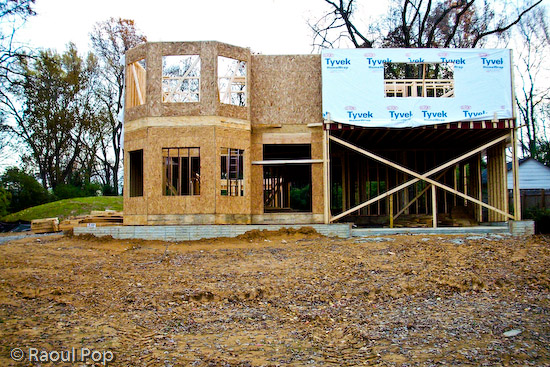
Some unwitting soul is going to pay several hundred thousands of dollars for this piece of crap, and he won’t know what a lemon he’s getting. It’s all 2×4 construction. There’s nothing solid and concrete there except the foundation, and I’m not sure how thick that is, either. It’s all either cheap, soft wood or plywood, including the upper floor. Not only that, but the beams aren’t straight, and the joints aren’t secured properly.
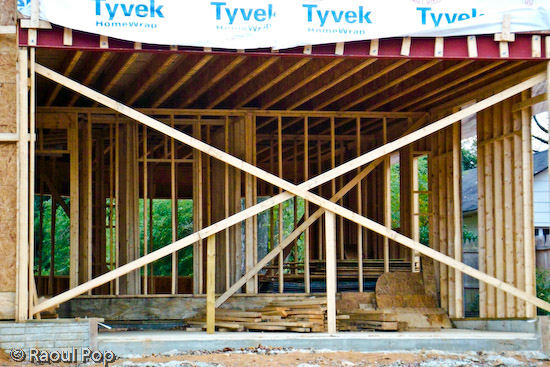
It’s basically a big plywood box. I’m not sure what its projected lifetime is, but I can’t imagine it’ll last more than 30 years. It’ll start needing serious repairs even before the mortgage is paid off. Isn’t that terrible?
Do you see that cheap, flimsy Tyvek plastic? That’s the weatherproofing. No, I’m not kidding. That’s it. That’s also the insulation. I doubt they’ll put glass fiber or any other kind of insulation between the drywall and the beams. They might, but I seriously doubt it. I’ve seen the inside of many walls, and they’re usually empty.
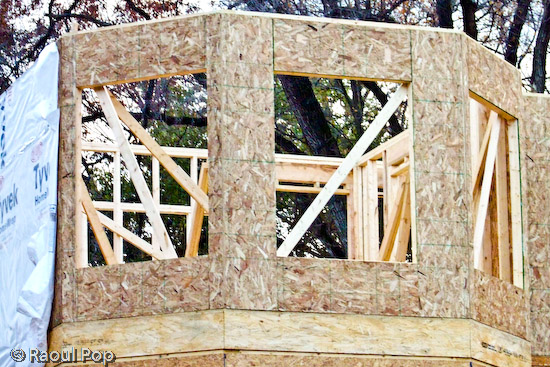
Can you say cheap? I can. It’s cheap construction! It’s a travesty. Look at that horrible plywood shell. That’s going to be a tower. It’s going to look so nice, clad in fake brick or plastic siding only 1-2 inches thick… It’s also going to be horribly inefficient when it comes to temperature preservation. And if water should happen to leak in through that cheap brick cladding and through that flimsy Tyvek sheet, the plywood will rot away quietly and the owner won’t even know it… Wonderful, isn’t it? Isn’t this piece of crap worth mortgaging your life away?
Should we be ill-fortunate enough to get a hurricane or some tornado in our area, the roof on this thing will probably get torn off, and the entire house might or might not be standing when nature’s done with it.
Look, don’t get me wrong. I understand that America has a long history of 2×4 construction. It’s how the West was won. It’s cheap, affordable, goes up quickly, etc. But this isn’t the West, and it’s not the 1800s. This is the supposedly refined East. We should know better by now. It’s our nation’s capital. And the prices of these plywood boxes aren’t cheap. No, they’re so high most people can’t afford them.
I also understand the builders have to make a profit and the cost of land in this area is expensive. But this is ridiculous! If you’re going to build something that someone will want to call their home, and will pay dearly for it, sinking most of their productive, working years into paying it off, then God help you if you don’t build something worthwhile, something that’ll last. You’ll get what’s coming to you, don’t you worry about that…
What I wonder about is how the people and companies that put up these things can live with themselves. That’s what I want to know. How can they sleep at night knowing someone’s going to pay a fortune for something that’ll start falling apart after the first several years, for something that’s so horribly inefficient when it comes to energy use that they’ll be paying through the nose to cool it in the summer and to heat it in the winter? Don’t tell me about efficient windows! You can get the most expensive windows out there — if the walls themselves can’t conserve the inside temperature, you’ll still be nowhere. There’s such a thing as global warming to worry about. Have you heard of it? Everyone needs to reduce their carbon footprint, and it starts in the home.
Whatever happened to the good, old masonry work? What happened to quality stone construction? Yes, it’s more expensive, but isn’t it worth it? Why can’t you builders put a little more pride in your work? Why can’t you make a concrete skeleton, and use thicker insulation and better materials for the cladding? Is it so hard to do? So you’ll make a little less money. You might have to mark up the price a little. You might have to educate the consumers that know nothing about quality construction. But isn’t it all worth it in the end? Won’t you feel better knowing the house you built will last a long time? Won’t you feel better knowing the people that will buy your house will thank you for your solid construction later? Isn’t it it worth it to build good will instead of ill will?
 Raoul Pop